

The way most interns run a 28‑hour call is broken—and it is hurting your brain, your sleep, and your patients.
You are not going to fix your program. You are not going to fix the ACGME. But you can absolutely reshape how you run a 28‑hour call so you are less fried at 4 a.m. and less unsafe at 9 a.m. the next day.
This is not a “drink more water and be resilient” piece. This is a set of concrete, reusable templates you can plug into almost any 28‑hour call:
- Time blocking templates for the full call.
- Communication templates for seniors, nurses, and co‑interns.
- Admit workflow templates to cut mental load when you are exhausted.
- A realistic “protected sleep” protocol that actually has a chance of happening.
You are an intern. Your control is limited. But it is not zero. Use it.
The Core Problem With 28‑Hour Call
I have watched the same pattern play out over and over:
- Intern shows up for call “ready for anything.”
- Zero plan for the night except “survive.”
- Pages hit hard between 7 p.m. and 2 a.m.
- Admits stack up.
- No clear break structure.
- By 4–5 a.m. they are doing admits with half a brain and writing garbage notes.
- Post‑call they feel guilty and assume they are weak.
What actually failed? The system they used to run the call. Because “no system” is still a system. It just happens to be a bad one.
You need to treat a 28‑hour call like a small project:
- Fixed duration
- Predictable phases
- Limited cognitive resources
- High risk if unmanaged
So we will build you a default template you can adjust for your hospital and specialty.
Big Picture: A 28‑Hour Call Template
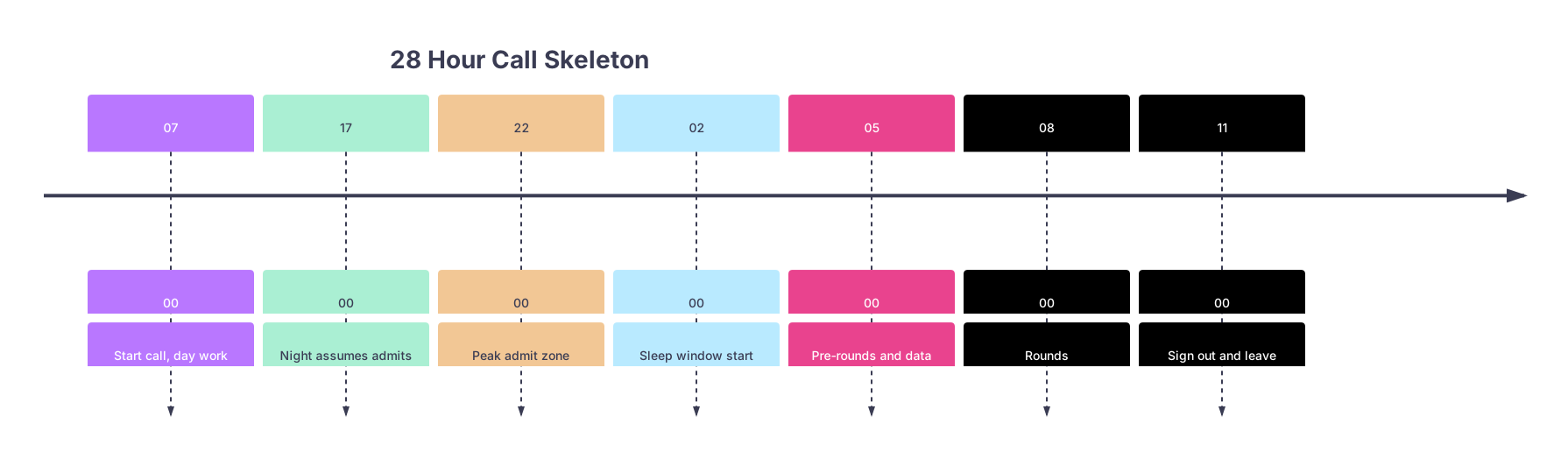
Let us define a generic 28‑hour call starting at 7 a.m. Day 1 and ending at 11 a.m. Day 2.
We will break it into 5 phases:
- 07:00–17:00 – Day work and pre‑call positioning
- 17:00–22:00 – Early admits and stabilization
- 22:00–02:00 – Admit heavy zone
- 02:00–05:00 – Protected sleep / “brain reserve” window
- 05:00–11:00 – Pre‑rounds, rounds, handoff, escape
Here is a simple visual to keep in your head.
| Period | Event |
|---|---|
| 07 | 00 |
| 17 | 00 |
| 22 | 00 |
| 02 | 00 |
| 05 | 00 |
| 08 | 00 |
| 11 | 00 |
Obviously your actual hours may shift (e.g., 6 a.m. to 10 a.m., or night float variations). The structure still applies: front‑load organization, cluster work, deliberately carve out a sleep window, and script the last few hours when your brain is jelly.
Phase 1: 07:00–17:00 – Pre‑Call Positioning
The daytime part of a 28‑hour call is underrated. If you blow this, your night is doomed before it starts.
Goal of this phase
- Clean list
- Clear plan for every patient
- Minimal loose ends after 5 p.m.
Template: Pre‑Call Checklist (Use This By 14:00)
Run this exact checklist at 2 p.m. (set a repeating reminder on your phone):
1. List hygiene
- Mark:
- Discharge candidates
- “Likely discharge tomorrow”
- “Borderline/unstable”
- Remove resolved labs/studies from your brain (not necessarily the note—your brain).
2. Preempt orders
For each “borderline” or “likely to decompensate” patient, pre‑order sensible safety nets so night‑you does not have to reinvent the wheel at 3 a.m.:
- Standing PRNs (antipyretics, nausea control, pain control within limits).
- Clear parameters: “Call if SBP < 90 or > 180,” “Call if RR > 24,” etc.
- Repeat labs that will predictably be needed overnight or early a.m. (e.g., 2 a.m. BMP for DKA, early AM CBC for GI bleeds).
3. Clarify goals of care
The stupidest 3 a.m. page is “family at bedside asking about code status” on a frail 90‑year‑old you have been following for 3 days.
- Check for missing code status or unclear goals.
- Ask attending: “Is tonight a risk night for this patient? Anything you’d want us NOT to do or definitely do?”
- Put one line in your note: “Discussed with team. If acute decompensation overnight, plan is ______.”
4. Eat and hydrate intentionally
Not “remember to hydrate.” Specific:
- Full meal around 16:00–17:00.
- 1 bottle of water you actually drink before 19:00.
- Caffeine cut‑off. If you want any chance of sleeping between 2–5 a.m., no giant energy drinks after ~20:00.
Template: Pre‑Call Script With Senior
You: “I am on for 28 hours. Here is my plan and what I need from you to protect some sleep.”
Use this structure around 3–4 p.m.:
“For tonight, can we agree on a rough structure?
I thought:
– I will front‑load admits between 5 p.m. and midnight, and try to have all new‑patient H&Ps done by 2 a.m.
– Can we block 2–4 a.m. as a soft sleep window unless something is crashing or truly time‑sensitive?
– If admits are still coming heavy after midnight, I will prioritize safe stabilization over perfect notes and finish documentation in the early morning block. Does that work for you?”
You are not “asking for a nap.” You are proposing an operational plan. Seniors and attendings respond much better to that.
Phase 2: 17:00–22:00 – Early Admits and Stabilization
This is when most places have:
- Heavy ED flow
- Cross‑cover pages starting
- Families still awake and calling
Your job is to set the tone.
Template: Admit Workflow (Repeatable For Every Patient)
At 7 p.m. after your third admit, your brain will want to improvise. Do not let it. Use a rigid 5‑step pattern:
Skim → Decide If Sick
- 30–60 second chart skim.
- Ask ED: “What are you most worried about in the next 2 hours?”
- Classify in your head: “Sick,” “Borderline,” “Stable.”
Bedside Focused Exam With Script
At bedside, say variations of the same phrases. Saves time and patient anxiety.
“I am your admitting doctor tonight. I know you have told this story a few times. I am going to focus on what changes what we do next.”
Hit:
- 2–3 key history clarifiers
- Focused exam
- Clear statement: “My immediate plan is X. Then we will Y.”
Stabilize First, Then Document
Do not start typing the note while the ED nurse is waiting on your orders.
Stabilization mini‑checklist:
- Vitals thresholds addressed (BP, O2, HR, pain).
- Initial diagnostics ordered (labs, imaging, EKG).
- Time‑sensitive treatments started (antibiotics, anticoagulation, insulin, etc).
- Nursing communication: “If X happens, page me immediately.”
Note Template (Fast, Structured)
Build a smartphrase or template for admits. Something like:
- HPI: 4–6 sentences, not a novel.
- Pertinent PMH/meds.
- Focused ROS.
- A/P with numbered problems, each with 1–3 interventions max.
Flag Follow‑Ups
In your note or a separate to‑do list, tag:
- “Must re‑eval by 23:00”
- “Need to check labs at 02:00”
- “Update family by phone before 22:00 if possible”
This way, admits do not dissolve into a mush of half‑finished tasks in your head.
Phase 3: 22:00–02:00 – Admit Heavy Zone
This is the danger period. Your circadian rhythm is dropping, but work is still high.
You protect your brain by:
- Aggressive batching
- Aggressive saying “No” to low‑value interruptions
- Clear coordination with nurses and co‑interns
Template: Hourly Micro‑Plan
At the top of each hour (set a quiet reminder if you must), take 60 seconds and write:
- “22:00–23:00: Finish two H&Ps (#3 and #4), quick re‑check on bed 18, address lab pages.”
- “23:00–00:00: New admit from ED bed 24, check 2 a.m. labs orders, send 1 family call.”
You are forcing yourself to work in 60‑minute sprints, not in an endless blur.
Template: “Triage Your Page” Script With Nurses
You are allowed to define what truly needs to wake you up or pull you away.
When you first meet the night nurse team (ideally ~19:00), say something like:
“It really helps me take better care of your patients if I can cluster non‑urgent things. If something is: – Emergent (airway, breathing, pressure tanking, chest pain, new neuro change) – page me any time, top priority.
– Urgent but not crashing (moderate pain uncontrolled, new fever, etc.) – please page, but if it can wait 10–15 minutes while I finish with a sick patient, that helps.
– Routine (sleep meds, constipation, home med reconciliation that is not critical) – if you can batch those and send together, I will knock them out in one go.”
You are not blowing them off. You are framing it as “help me protect bandwidth so my decisions for your patients are safer.”
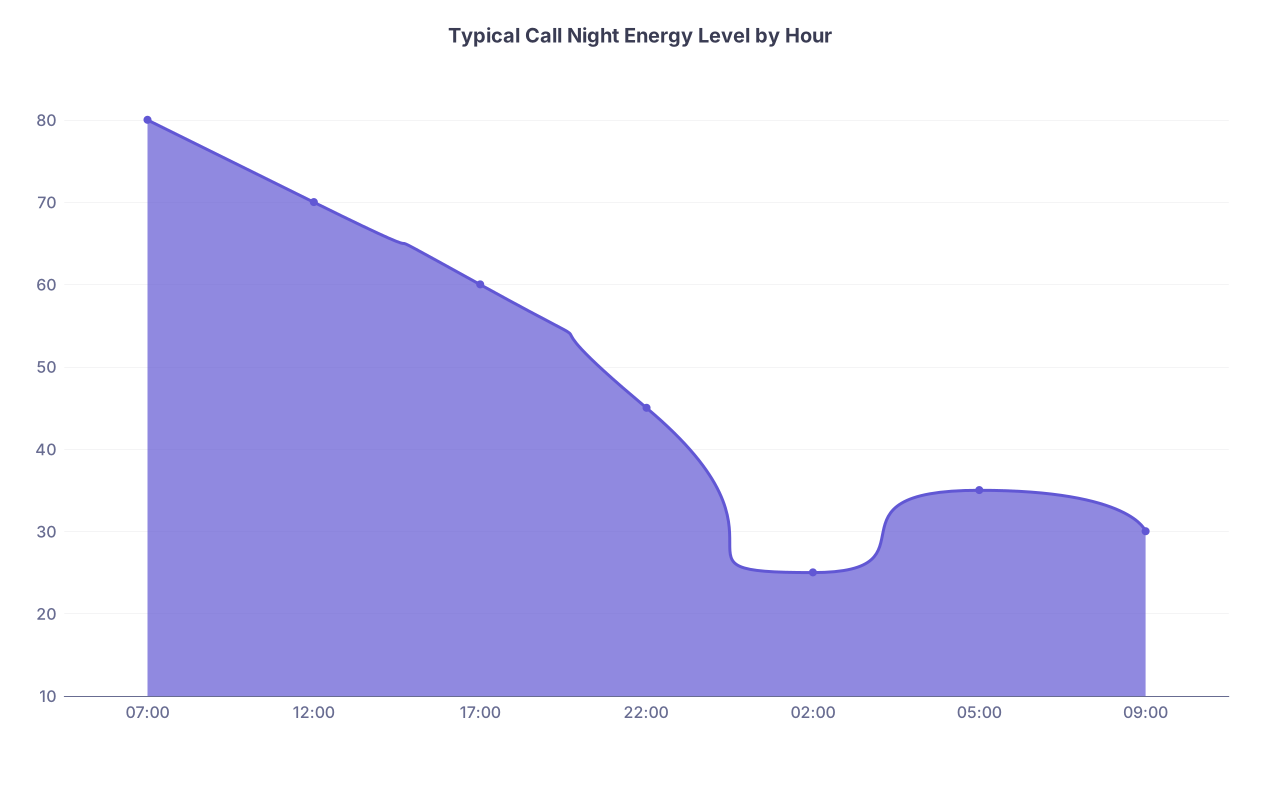
Phase 4: 02:00–05:00 – Protected Sleep / Brain Reserve
This is where almost every intern loses the battle. They tell themselves, “I’ll sleep if it slows down.” That is guaranteed failure.
You need a sleep protocol.
| Category | Value |
|---|---|
| 07:00 | 80 |
| 12:00 | 70 |
| 17:00 | 60 |
| 22:00 | 45 |
| 02:00 | 25 |
| 05:00 | 35 |
| 09:00 | 30 |
Your goal is not luxurious sleep. It is a targeted 60–120 minutes of partial brain reset.
Step 1: Negotiate the Window Early
During your afternoon conversation with the senior, be explicit:
“I would like to target a 2–4 a.m. sleep block if admits and acuity allow. I will aim to have all acute tasks and today’s admits stabilized by 2 a.m. If we get slammed, I will flex, but I want that as our default.”
If there is a co‑intern or night float:
“Can we stagger so one of us is primary from 2–3:30 a.m. while the other lies down, then swap if more work comes in?”
You are aiming for protected potential, not guaranteed sleep.
Step 2: Create a “Sleep‑Ready” Status by 01:30
By ~1:30 a.m., run this quick list:
- All new admits seen, orders in, major time‑sensitive stuff started.
- Any genuinely unstable patient re‑checked.
- Labs that will result between 2–4 a.m. anticipated, with “if X then Y” orders when possible.
- Nurses know:
- Which patients you are most worried about.
- Specific criteria to wake you versus wait 20–30 minutes.
Template: Sleep‑Time Script With Nurses
Before you lie down, make a tiny circuit on the unit or call the charge nurse:
“I am going to lie down in call room 3 for about 90 minutes. For safety, I want to be woken up immediately for: – Any major vital sign change or concern you have, – Any new admit, – Any patient you think looks wrong.
If it is routine stuff like sleep meds or mild pain in stable patients, and it feels safe, it is fine to batch those for when I am up at 4 a.m. But if your gut says wake me, please wake me.”
You are delegating judgment where it belongs: to the nurse at the bedside. You are not asking to be protected at all costs.
Step 3: Make 90 Minutes Count
You will not feel like you are sleeping well. That is fine. The goal is:
- Lying horizontal
- Eyes closed
- No screens
- No charting in bed “just to finish that note”
A few tactical details:
- Eye mask and earplugs in your bag, always.
- Light snack before resting (hungry sleep is trash sleep; huge meal right before is also bad).
- Keep caffeine away for at least 4–5 hours before this block.
Even 45 minutes of light sleep or dozing can improve your executive function between 5–11 a.m. dramatically. I have seen interns go from dangerous to merely miserable with this change alone.
Phase 5: 05:00–11:00 – Surviving Pre‑Rounds, Rounds, and Handoff
From 5 a.m. onward, you are being judged again. Attending, nurses, day team. This is when interns make sloppy mistakes:
- Forgetting key labs
- Missing overnight events
- Botching handoff because they are mentally gone
You fight this with templates, not “trying harder.”
05:00–07:00 – Data and Safety Sweep
You wake up. You feel like death. Fine. Work the checklist.
Template: Post‑Call Safety Sweep (15–20 Minutes)
Before deep‑diving into any one patient:
- Run a list of all active patients.
- For each:
- Quick vitals trend (any big change?).
- Overnight nursing notes for major events.
- New labs/imaging flagged red.
Mark 2 groups:
- “Round lead” patients – acute changes that must be highlighted.
- “Quiet but fragile” – older, comorbid, maybe stable but one lab away from badness.
This way, when your attending asks, “Anything bad overnight?” your answer is not “Uhh… I think 3B had some soft pressures… maybe?”
07:00–09:00 – Rounds With a Tired Brain
You will not think fast. So front‑load the thinking onto paper.
Template: One‑Line Round Update
For each patient, write a literal one‑liner before rounds:
- “Mr. X – CHF, diuresed net –1.5 L, still SOB walking to bathroom, creatinine from 1.0 to 1.3; plan gentle diuresis and repeat BMP at 14:00.”
- “Ms. Y – new admit for DKA, gap closed, transitioning to subQ insulin, eating breakfast.”
If you do nothing else, this keeps you from rambling or forgetting a key lab trend.
09:00–11:00 – Handoff and Escape
Your goal: Safe sign‑out, then out the door. Not extra hero work.
Template: Post‑Call Sign‑Out Structure
For each patient you are handing off, use this 3‑point structure:
- Status – “Stable / Improving / Worrying trend.”
- Today’s goal – “Likely discharge,” “watch creatinine,” “advance diet,” “needs PT eval.”
- The no‑surprises clause – “If ___ happens, do ___.”
Examples:
- “Mr. A – stable COPD exacerbation, breathing better on 2L. Today’s goal is wean O2 and see if he can walk with PT. If he spikes a new fever or needs more than 4L, please call the attending; he may need imaging.”
- “Ms. B – upper GI bleed, Hgb held at 8.3 overnight, hemodynamically stable. Today’s goal is check 12:00 Hgb and start diet if still stable. If she has any melena with dizziness or SBP < 90, call GI and attending.”
You are handing off a plan, not just a body in a bed.
Then you leave.
And yes, there will be guilt the first few times. Someone will say, “Can you just…” as you are walking out. Unless it is clearly your direct patient and time‑critical, your answer is, “I am post‑call and at my limit; the day team is signed in and can handle that.”
Fatigued you is not a bonus resource. Fatigued you is a risk.
Templates You Can Steal and Customize
Here is a consolidated set you can literally copy into your notes app and tweak for your hospital.
| Template | When To Use |
|---|---|
| Pre-call checklist | 14:00–16:00 on call day |
| Senior script | 15:00–17:00 to set expectations |
| Admit workflow steps | Every new admit, especially 17:00–02:00 |
| Nurse triage script | Beginning of night shift, and before sleep |
| Sleep block plan | 2–4 a.m. (or your local low-volume window) |
1. Pre‑Call Checklist (Short Version)
- List hygiene: discharge vs borderline vs sick.
- Preempt orders for likely issues (labs, PRNs, parameters).
- Clarify goals of care/code status.
- Eat a real meal before 17:00.
2. Senior / Team Script
“I would like to structure tonight so I can work aggressively up front and then have a 2–4 a.m. protected window if acuity allows. That means I will: – Prioritize getting all acute care and admits stabilized by 2 a.m.
– Batch low acuity tasks.
– Use 2–4 a.m. for rest unless we are slammed.
Does that sound reasonable for you?”
3. Admit Workflow Keywords
- Skim – Sick / Borderline / Stable.
- Bedside – focused history, focused exam, immediate plan.
- Stabilize – orders, nursing instructions, immediate reversibles.
- Document – short H&P with numbered A/P.
- Flag – must‑recheck, must‑call, important labs.
4. Sleep Protocol Mini‑Script (Nurses)
“I am going to try to rest between 2 and 4 a.m. Please wake me immediately for any real concern, vitals changes, or new admits. For routine things that feel safe to wait a bit, it is helpful to batch them. But if your gut says I should see something, definitely wake me.”
5. One‑Line Rounds and Handoff
- Pre‑round one‑liner: “Diagnosis, overnight change, today’s target.”
- Handoff line: “Status / Today’s goal / If ___ then ___.”
Common Obstacles and How to Counter Them
You will hit resistance. Here is how to handle the predictable nonsense.

Obstacle 1: “We Do Not Really Sleep Here”
Some programs have a macho culture: “We just grind.” Fine. You are not changing the culture. But you can still:
- Use micro‑naps: 20–30 minutes with eyes closed between pages.
- Protect your mental sleep window by avoiding cognitively expensive busywork (rewriting problem lists at 3 a.m. for vanity).
- Batch routine pages even if you cannot lie down.
You might not get a 90‑minute block. You can still refuse to wander the ward at 3:30 a.m. looking for charting to do “because I am up anyway.”
Obstacle 2: A Chaotic Senior
I have seen this a lot: senior who thrives on chaos, changes plans constantly, pulls interns in five directions.
What helps:
- Force micro‑plans: “For the next hour, can I focus on finishing these two H&Ps while you handle cross‑cover? Then I will re‑sync.”
- Pin them down early on admits distribution and cross‑cover responsibilities.
- Politely but firmly say, “I am at capacity with these three sick patients; can you take the next admit?”
You are not refusing work. You are advocating for safe workload distribution.
Obstacle 3: Guilt Around Saying “No” Post‑Call
You will be tempted to be “nice” and stay late. It backfires long‑term.
Call it accurately in your head: after 28 hours, you are a potential liability. If something truly critical comes up as you are leaving, you help transition, yes. But routine things? No.
Script:
“I am actually post‑call and already signed out; the day team is in a much better place to handle that safely.”
Say it calmly. Then go.
How This Actually Protects Sleep and Sanity
Here is what changes when you use these templates consistently:
- You stop reinventing your approach every call. Less decision fatigue.
- Nurses see you as structured and predictable, which buys you more trust and flexibility.
- Seniors know what you are aiming for and are more likely to respect your rest window.
- Your 4 a.m. brain is not trying to hold the entire hospital state in RAM. It is just running pre‑written scripts.
- Post‑call you have fewer “I might have hurt someone” spirals and more “I ran a reasonable plan in a bad system.”
And no, this will not make 28‑hour call pleasant. It will make it survivable. And sometimes, that is the win.

Quick Implementation Plan for Your Next Call
If you are reading this with a call coming up, here is your 3‑step implementation:
Pick just 3 things to try on the next call:
- Pre‑call checklist at 14:00
- Admit workflow steps
- 2–4 a.m. sleep script with your senior and nurses
Write them out in one note on your phone named “CALL NIGHT PLAYBOOK.”
Debrief yourself post‑call (2–3 minutes):
- What worked?
- Where did the plan break?
- What is one tweak for next time?
Iterate. By your fifth call using a system like this, you will feel a very real difference.

FAQ (Exactly 3 Questions)
1. What if my senior refuses any formal “sleep window” and expects constant availability?
You still apply the framework. You may not get a full 2–4 a.m. block, but you can:
- Avoid starting any big, non‑urgent project in that window (like rewriting all H&Ps).
- Take 10–20 minute micro‑rests between pages.
- Use the “triage your page” script with nurses so at least routine things are clustered.
You are shrinking the damage even if you cannot fully protect the time.
2. How do I use these templates if I am on a non‑medicine service (surgery, OB, etc.)?
Adjust the timing and clinical details, keep the skeleton:
- Pre‑call positioning: anticipate who will decompensate or need the OR / L&D.
- Admit or consult workflow: same 5 steps, just different content.
- Targeted rest window: on surgery it may be 1–3 a.m., on OB maybe 3–5 a.m.
- Structured handoff: status, today’s goal, and “if X then Y.”
The principles cross specialties; the orders and specifics change.
3. My hospital is small and nights are unpredictable. Is a rigid template still useful?
Yes, and in some ways more. A template is not a prison; it is a default. Slow night? You flex and do extra learning or catch more sleep. Chaos night? The structure keeps you from total cognitive collapse. You keep returning to the same anchors: batch work, stabilize before documenting, protect a potential rest window, and hand off with a clear “if X then Y.” Over time, this becomes second nature and is exactly how experienced residents avoid burning out.
Key points to remember:
- A 28‑hour call should be run like a project with phases, not a random endurance test.
- Scripts and checklists are not crutches—they are how tired humans stay safe.
- You will not fix the system, but you can absolutely reshape how you move through a 28‑hour call and protect at least some of your sleep and sanity.


