

The most dangerous advice about international medical schools and the MCAT is this: “You can skip the MCAT if you go abroad.”
That half-truth has wrecked more careers than a low GPA ever did.
You’re not really asking, “Do I need the MCAT?”
You’re asking, “Can I still become a practicing doctor in the United States if I skip the MCAT and go to an international medical school?”
Here’s the blunt answer:
- Some international medical schools will admit you without the MCAT.
- But if your goal is U.S. residency and practice, treating the MCAT as optional is usually a bad strategic move.
- In the U.S. system, skipping the MCAT often means you start behind and spend years trying to catch up.
Let’s break it down properly.
The Core Question: MCAT vs. U.S. Practice
If you want to practice in the U.S., your real “gatekeepers” are:
- U.S. residency programs
- State medical boards
- U.S. licensing exams (USMLE, now Step 1/2 CK-based)
They do not care whether your medical school required the MCAT.
They care about:
- Your USMLE Step 1 and Step 2 CK scores
- Your clinical performance and letters
- The reputation of your medical school
- Your visa/citizenship status
- Your research, if you are going into competitive specialties
So where does the MCAT fit?
The MCAT is:
- A filter for getting into many international schools that target U.S. practice
- A proxy indicator: can you handle U.S.-style exam content and test-taking?
- An early rehearsal for USMLE-style thinking and discipline
If you skip the MCAT, you remove an obstacle in the short term. But you also lose an early, controlled “stress test” of your readiness for the much higher-stakes exams ahead.
Which International Schools Require the MCAT (and Which Do Not)?
Different international medical schools take very different approaches.
| School Type / Example | MCAT Required? |
|---|---|
| [Big 4 Caribbean](https://residencyadvisor.com/resources/international-med-schools/do-only-top-ranked-caribbean-schools-match-in-the-us-nuanced-truths) (SGU, Ross, AUC, Saba) | Often required or strongly recommended |
| Other Caribbean schools | Rarely required |
| Irish / UK programs for North Americans | Sometimes accept MCAT or other tests |
| Israeli programs for U.S. students | Commonly require MCAT |
| Eastern European / other EU schools | Typically no MCAT; use local entrance exams |
Caribbean “Big 4” and MCAT
The major Caribbean schools that consistently place grads into U.S. residencies—St. George’s (SGU), Ross, American University of the Caribbean (AUC), and Saba—are not casual about U.S. outcomes. Their business model depends on students matching back to the U.S.
Most of these:
- Either require the MCAT for U.S. citizens/permanent residents
- Or “strongly recommend” it and quietly favor applicants with solid scores
Do they admit some students without MCATs? Yes, especially non-U.S. citizens.
But if you’re a U.S. applicant and they’re not asking for any standardized test… that should worry you more than it should reassure you.
Europe, Asia, and Latin America
Many international programs outside the Caribbean:
- Don’t require the MCAT
- Use local university entrance exams, basic science tests, or just transcripts
- Are not designed primarily around U.S. residency or USMLE outcomes
You can sometimes go this route and still return to the U.S. But now you’re:
- Likely on your own for USMLE prep
- Competing against Caribbean and U.S. grads whose entire curriculum is focused around U.S. residency outcomes
- At the mercy of your own discipline and planning
Skipping the MCAT here doesn’t save you from standardized tests. It just pushes the pain forward to higher-stakes exams with less structure and support.
When You Actually Do NOT “Need” the MCAT
Let me be specific. You might not need the MCAT if:
- You are not a U.S. citizen or permanent resident AND
- You are open to practicing outside the U.S. (e.g., in your home country or region) AND
- You choose a school whose primary pathway and success stories are local, not U.S.-focused
In that scenario, the MCAT is a U.S.-centric exam. It may add little value.
Another legitimate case:
- You already took the MCAT, scored very poorly, and cannot realistically improve
- You still understand that USMLE will be harder, but you have a concrete plan to fix your test-taking and knowledge gaps
- You choose a school with strong USMLE support, excellent outcomes, and are ready for extreme discipline
Even here, I’d still want you to re-attack the MCAT if there’s time. Because a 495 MCAT followed by a 250 Step 1 is rare. Not impossible. But rare.
Why “No MCAT Required” Can Be a Red Flag
That phrase looks attractive on a website.
It also coincides very neatly with schools that have:
- Weak U.S. match rates
- Poor support structures
- A financial incentive to admit almost anyone who can pay
I’ve talked with students who picked a “no MCAT needed” Caribbean or Eastern European school because they were burned out from studying. They wanted an escape hatch.
Here’s what I’ve seen too many times:
- They get in easily. Feels great.
- The basic sciences hit hard. They were never that solid in chem/phys/biochem to begin with.
- They reach USMLE prep and realize: this is MCAT x3, with more detail, more pressure, and bigger consequences.
- Now they’re trying to build MCAT-level foundational knowledge and USMLE-level depth at the same time. Under time pressure. With limited support.
Some grind through it and succeed. Many don’t.
“Easier to get in” does not equal “easier to become a doctor in the U.S.”
Strategic Framework: Should YOU Take the MCAT If You’re Aiming International?
Forget what’s technically required. Think in terms of strategy.
Here’s the simple decision flow:

| Step | Description |
|---|---|
| Step 1 | Want to practice in the U.S.? |
| Step 2 | MCAT optional; focus on local pathways |
| Step 3 | Can you realistically prep for MCAT in 6-12 months? |
| Step 4 | High risk: reconsider timeline or career path |
| Step 5 | Take MCAT and target strong US-focused schools |
| Step 6 | Use MCAT prep as foundation for USMLE |
If your answer to “Do I want U.S. practice?” is yes, then:
- You should treat the MCAT as expected, even if not every school strictly requires it.
- You gain:
- An early check of your science foundation
- Practice with U.S.-style standardized exams
- A stronger application to the better international schools
- A psychological advantage when it’s time for USMLE
The only time I would endorse skipping the MCAT, while still targeting U.S. practice, is if:
- You already have very strong undergrad science grades
- You’ve done extensive independent Step-style question practice and are performing well
- You’re applying to a proven program with excellent USMLE pass rates and U.S. match data
- There’s a personal or timing constraint that makes MCAT prep truly unrealistic
Even then, it’s not Plan A. It’s a narrow exception.
How Different International Pathways Use (or Replace) the MCAT
Let’s compare quickly.
| Pathway | Role of MCAT for U.S.-Bound Students |
|---|---|
| Big 4 Caribbean | Often required; strong positive if solid |
| Mid-/Low-tier Caribbean | Usually not required; skipping is risky |
| Irish / UK programs for North Americans | Often accept MCAT; strong differentiator |
| Israeli programs (e.g., Sackler) | Commonly require MCAT |
| Eastern Europe / other EU | Not required; replaced by local exams |
If a school:
- Boasts heavily about U.S. residency placement
- Publishes detailed match lists by specialty and institution
- Is known among U.S. residency program directors
Then having the MCAT in your file makes you look more like the U.S.-bound cohort they’re actually trying to build their stats on.
If a school:
- Cannot or will not provide honest U.S. match numbers
- Admits most applicants with no standardized testing
- Is vague about USMLE support
Then “no MCAT required” is not a benefit. It’s a symptom.
What If Your Stats Are Too Low for U.S. Schools?
Here’s the real scenario many people are in:
- GPA is mediocre
- MCAT score is low or nonexistent
- You’ve either bombed the MCAT or are terrified of it
- U.S. MD and DO schools feel out of reach
So the thought process becomes: “I’ll just go abroad where they don’t need the MCAT.”
I understand the impulse. But you need to be honest about what you’re solving—and what you’re not.
Going abroad does not fix:
- Weak test-taking skills
- Poor study habits
- Gaps in basic sciences
It just delays the reckoning until USMLE. And USMLE is harder, higher stakes, and more tightly linked to whether you ever practice medicine in the U.S.
If you cannot get yourself to a passing or at least competitive MCAT level after a serious 6–12 month effort, that is meaningful data. It doesn’t mean “no medical career ever,” but it should make you rethink:
- Specialty expectations
- Geographic expectations
- Or even whether a different healthcare path (PA, NP, pharmacy, etc.) would be a better fit
The worst outcome isn’t not getting in. The worst outcome is starting a very expensive, very long process and failing at the licensing stage.
MCAT as Training for USMLE: Why It Actually Helps
Let me spell out how MCAT prep directly feeds your later success, especially if you end up at an international school:
- You build serious endurance for long, dense exams
- You internalize biochem, physics, and general chemistry that many international programs rush or gloss over
- You learn to think in the “why” and “because” patterns that USMLE questions hammer on
- You identify weaknesses years before they become career-threatening
Is the content identical? No.
Is the discipline and style of thinking similar? Absolutely.
Treating the MCAT as “just a hoop for U.S. schools” is the wrong mental model. Treat it as phase one of surviving USMLE.
Practical Recommendation by Profile
Let’s get even more concrete.
U.S. citizen / permanent resident, wants U.S. residency, considering Caribbean or another international option
You should take the MCAT. Aim for at least around 500+ to be in the safer zone for stronger international schools.Non-U.S. citizen, wants U.S. residency eventually, targeting known U.S.-oriented schools (Big 4 Caribbean, Irish, Israeli programs)
Strongly consider the MCAT. It makes you more competitive and proves you’re serious about U.S. standards.Non-U.S. citizen, planning to practice in your home country or region, at a school with minimal U.S. focus
MCAT is optional. Focus on whatever exams your country and school prioritize.Applicant with very weak academic history using “no MCAT required” schools as a backdoor to U.S. practice
High risk. You’re not avoiding the MCAT; you’re postponing the same underlying problem to a deadlier exam.
Quick Reality Check on Outcomes
One last thing. Look at data, not marketing blurbs.
Many schools will brag about:
- “Hundreds of our graduates practice in the U.S.”
- “Global opportunities”
- “U.S.-style curriculum”
What you care about is:
- How many students start each year vs. how many actually match into U.S. residency
- USMLE Step 1 and Step 2 CK pass rates
- The percentage of grads who end up in primary care vs competitive specialties
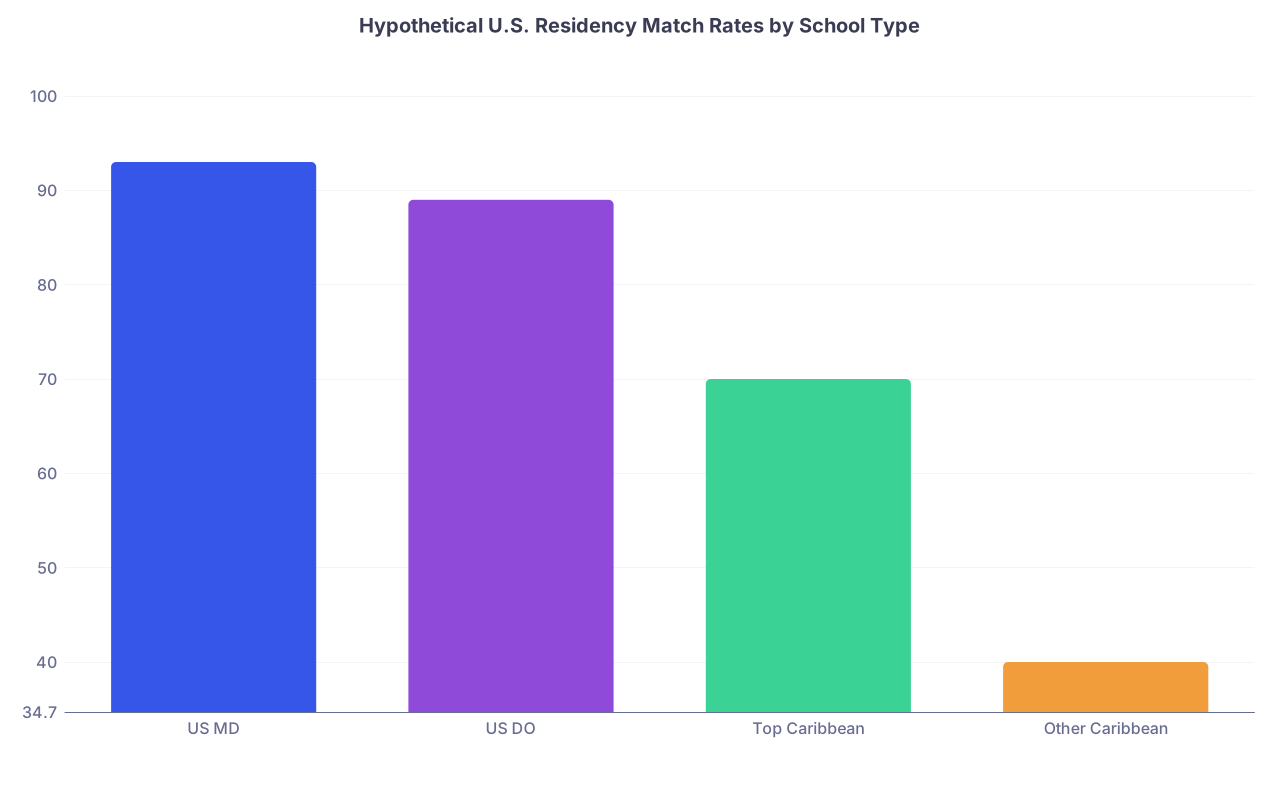
| Category | Value |
|---|---|
| US MD | 93 |
| US DO | 89 |
| Top Caribbean | 70 |
| Other Caribbean | 40 |
These are illustrative numbers, but the pattern is real: the further you move from the U.S. system, the more crucial it is that your preparation and discipline exceed the minimum.
And the MCAT is one of the earliest honest tests of whether that’s happening.
Bottom Line: Do You Need the MCAT for International Schools Aiming at U.S. Practice?
Here’s the straight answer:
- Technically: No, you do not always need the MCAT to attend an international medical school and still aim for U.S. practice. Many schools will take you without it.
- Strategically: If you’re serious about U.S. residency, you should behave as if the MCAT is required. It strengthens your application, prepares you for USMLE, and filters out paths that are setting you up to fail.
Treat “no MCAT required” as a warning label, not a perk.
You’re not trying to win the easiest-admission contest. You’re trying to become a doctor who actually practices in the United States. Those are not the same game.

Key points to walk away with:
- If U.S. practice is the goal, plan to take the MCAT, even for international schools.
- “No MCAT required” usually signals lower selectivity, not a smarter pathway.
- Use the MCAT as early training for USMLE and as a reality check on your readiness, not just as an admissions hurdle.


