

The real reason some IMGs get fast-tracked while others get quietly ignored has almost nothing to do with “hard work” or “passion for medicine.” Everyone says that. Program directors don’t care.
They care about three things: who is vouching for you, how much risk you represent, and whether you make their life easier or harder. Everything else is noise.
Let me walk you through how this actually plays out behind closed doors.
How IMGs Really Get Sorted Before Anyone Reads Your Personal Statement
Here’s the part most advisors never tell you: at many programs, IMGs are filtered before anyone with real power reads your file.
I’ve watched this happen. A coordinator or chief resident opens ERAS, applies a filter: “US MD/DO first.” Then, for IMGs, they narrow again: only certain schools, only certain visa types, only those with Step 2 above a threshold. Then they run through a short list of “known” names.
And there’s the critical word: known.
If your name, school, or letter writer is not already recognized and trusted, you start the race fifty meters behind. Not impossible. But very different from what the brochures imply.
At many mid-tier internal medicine programs, for example, IMGs fall into three buckets in the first 5–10 minutes:
| Bucket | How They’re Seen | Typical Outcome |
|---|---|---|
| [Known quantity](https://residencyadvisor.com/resources/international-med-schools/the-unspoken-img-tiers-how-your-international-school-is-really-labeled) | Trusted school or trusted letter writer | Fast-tracked, often auto-invited |
| Probably safe | Decent scores, neutral school, no red flags | Maybe-interview pile, depends on volume |
| High risk | [Unknown school](https://residencyadvisor.com/resources/international-med-schools/what-pds-actually-check-when-they-see-a-foreign-medical-school-name), weak letters, visa concerns | Quietly screened out |
That “known quantity” bucket is where the fast-tracked IMGs live. And getting there starts years before ERAS.
The Hidden Currency: Who Will Actually Go to Bat for You
Letters of recommendation are not equal. Not even close.
On paper, you see “strong letter,” “excellent student,” “highly recommend.” What you do not see is how that letter writer’s name lands in the program director’s brain.
Here’s the quiet truth: many PDs keep a mental (or literal) list of whose letters they trust, whose letters they totally ignore, and whose letters they treat as red flags.
I’ve watched a PD skim an IMG’s application, stop at a letter, and say: “Oh, this is from Dr. X at Y program. If he says the student is good, that’s real. Move them up.”
That’s fast-tracking. And it had nothing to do with the student’s narrative about empathy or adversity. It had everything to do with the credibility of the person vouching for them.
You want to know why two IMGs with similar scores can have totally different outcomes? This is it.
How this starts before you even graduate
If you’re still premed or early in med school, here’s what matters more than obsessing over every extracurricular box:
You must deliberately place yourself where powerful people can see you work over time and be confident sticking their name next to yours.
That means:
- Clinical electives or observerships in places where faculty actually write influential letters. Not just “any US clinical experience.”
- Attending physicians who are connected to residency leadership, not just nice to work with.
- Faculty who know how to write a US-style comparative letter that says, “top 5% of all students I’ve worked with in 10 years,” not a polite two-paragraph summary of your CV.
The mistake most IMGs make? They collect letters from whoever will say yes. They think three letters from three random people is as good as two powerful letters and one neutral one. That’s wrong.
Program directors look for patterns. If an IMG’s letter is from a chair or associate program director at a respected US hospital, and that person has sent them solid residents before, the PD reads that letter differently. Suddenly that IMG is no longer just “some student from an unknown school.” They’re “Dr. Z’s student.”
Your real job during med school is to become “someone’s student” in that sense.
Why Certain Schools Get Fast-Tracked and Others Get Ignored
Here’s something you won’t hear in official statements: programs absolutely have unofficial tiers of IMG schools in their heads.
The logic is simple. PDs are busy and conservative. They’ve been burned before. So they trust what has worked.
Let me spell out the unspoken categories.
1. The “We Know These People” Schools
These are the Caribbean or international schools that have consistently sent solid residents who didn’t implode on the wards. The PD remembers that. The chiefs remember that. So every year, those schools get a softer landing.
Maybe it’s AUA at one program. Maybe it’s SGU at another. Maybe it’s a particular Indian or Pakistani university that a faculty member attended and champions.
I’ve heard variations of this line dozens of times in ranking meetings:
“We’ve had three grads from that school. All solid. If everything else is reasonable, I’m fine interviewing.”
That sentence is the difference between fast-tracked and ignored.
2. The “Neutral But Unknown” Schools
You’re not blacklisted, but you’re not trusted. No past residents. No faculty connections. No stories—good or bad.
For these applicants, every part of the file carries more burden. Step scores matter more. US clinical letters matter more. Visa type matters more. Any small flaw gets magnified.
Very few people will openly say, “We don’t know this school, skip them,” but you see it in how quickly those charts get closed when there are 3,000 applicants in the list.
3. The “We Got Burned” Schools
This is the category you’ll never see in writing, but it absolutely exists.
A school gets a reputation when:
- Graduates show up unprepared for basic clinical work.
- Residents from that school fail Step 3 or in-training exams repeatedly.
- There are professionalism issues—chronic lateness, arguing about schedules, dishonesty.
No one announces “We no longer accept from School X.” That would look ugly. They just… quietly stop interviewing people from there unless someone very trusted intervenes.
If your school is in that third category and no one tells you, you will think the system is random and unfair. But inside the room, your application was dead before it was opened.
The Risk Equation: Why Some IMGs Feel “Too Expensive” to Interview
You want cynical truth? Program directors are running a risk–benefit calculation on you.
They’re thinking:
“How likely is this person to match here, be competent, pass their exams, not cause drama, and not leave us scrambling for coverage?”
Certain things make you look higher risk before you ever open your mouth.
Visa status: the quiet dealbreaker
No one wants to say this bluntly in public, but I’ve heard it in private meetings for years.
A typical discussion:
“We’ve already got three J-1s this year. GME is on us about the visa budget. Can we afford another?”
Or: “We had that H-1B denial two years ago that left us short on interns. Let’s only go for J-1 this year.”
Is this fair? No. But it’s real.
If you need a visa, you’re not just a candidate. You’re a logistical project. Programs that have been burned by unpredictable consulates or institutional restrictions will quietly reduce their IMG visa intake.
What that means for you: if you need sponsorship, you must compensate with something that dramatically shifts the risk equation—outstanding scores, known letter writers, or prior meaningful work in the US system.
Step scores: not about intelligence, about risk
Nobody cares if you’re naturally brilliant. They care if you’re likely to pass your boards on schedule.
Fellowships, accreditation, funding, hospital reputation—they all track board pass rates. A PD is not going to gamble on an IMG with marginal Step 2 scores when they can grab a safer candidate.
You see this especially in places that had ACGME warnings or poor internal medicine board pass rates in prior years. After that, everything tightens.
So yes, you can still match with “okay” scores. But you will not be fast-tracked. You’ll be the person they debate, not the one they auto-invite.
Communication and accent: what people really say after you leave
This one is sensitive, but pretending it doesn’t matter is lying to you.
After interviews, I’ve heard this:
“Bright, seems capable, but I had trouble understanding them. Our ED and nurses will struggle.”
That candidate drops several spots down the list or disappears entirely.
The bar is not “sound like a native speaker.” The bar is: “Can I safely picture this person calling a code, giving phone orders, talking to an angry family at 2 a.m. without misunderstandings turning into patient safety issues?”
The IMGs who get fast-tracked usually have at least one faculty member saying, “Great communicator, patients loved them, worked well with the team.” That line matters more than you think.
Why Your “US Clinical Experience” Might Be Useless
Many IMGs treat “USCE” like a checkbox. Any observership, any hospital, any practice. Then they’re shocked when it doesn’t move the needle.
The truth: US clinical experience is only powerful if it builds a bridge to someone with influence.
Four meaningless observerships where you shadow at the back of the room and never write a note? That’s not USCE. That’s tourism.
Compare that to:
- One strong sub-internship at a community program where you actually carry patients, present on rounds, and get a letter from a core faculty member who knows the local PD.
- Or a month at a big academic hospital where you attach yourself to a single attending known for training IMGs, you show up early, anticipate tasks, and that attending writes you a three-page, detailed letter sent directly to programs.
Those people? They get fast-tracked.
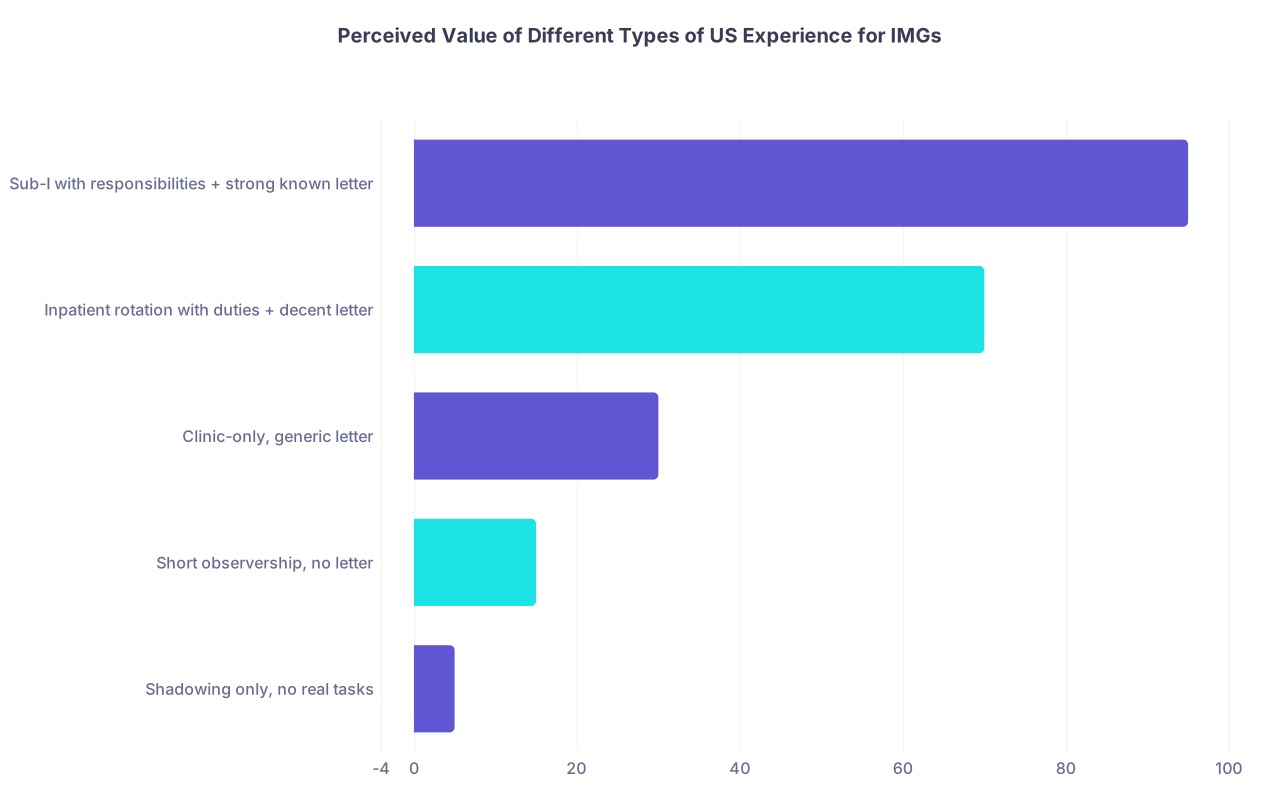
| Category | Value |
|---|---|
| Shadowing only, no real tasks | 5 |
| Short observership, no letter | 15 |
| Clinic-only, generic letter | 30 |
| Inpatient rotation with duties + decent letter | 70 |
| Sub-I with responsibilities + strong known letter | 95 |
Notice the gap. Programs are not impressed by “exposure.” They want evidence that someone in the US system has already stress-tested you.
If you’re still in the planning stage, your question should not be “How many US experiences can I accumulate?” It should be, “Where can I work closely enough with an attending that they’d be comfortable staking their reputation on me?”
Research: When It Helps and When It’s Pointless
Research is another area where IMGs waste time because no one is honest with them.
Here’s the unfiltered version:
For categorical IM in a community or lower-academic program, five poster presentations from random conferences do almost nothing. Nobody cares.
What matters is either:
- You did sustained research with someone known in that field who then writes you a letter that says, “This person is the best student researcher I’ve mentored in the last five years,” or
- You’re aiming for a decent academic program or a future fellowship, and your research proves you can think, finish projects, and present.
The IMGs who get fast-tracked for academic programs usually fall into one of two buckets:
- They’ve done serious work (1–2 years) in a US lab with a PI whose name a PD recognizes.
- They have a tight, consistent story: research in their chosen field, publications with decent co-authors, and letters emphasizing initiative, intellect, and reliability.
But “one month of research during vacation, one poster at a student conference, no real letter”? That’s not leverage. That’s fluff.
How Program Directors Talk About IMGs When You’re Not in the Room
You want to understand fast-tracking? You need to hear the language.
Here are the phrases that move an IMG up the list:
- “We’ve had good experiences with grads from that school.”
- “They rotated here; everyone said they worked like a PGY-1.”
- “Letter from Dr. ___—we can trust that.”
- “Really strong language skills. Patients connected with them.”
- “Already in the US, green card holder, no visa issues.”
Here are the phrases that make an IMG vanish from serious consideration:
- “Unknown school, we’ve never taken anyone from there.”
- “Shadowed only, no responsibility in US rotations.”
- “Letters are all generic and short—no one really knows this person.”
- “Needs H-1B and scores are average. Too risky.”
- “We struggled to understand them on Zoom. Clinic will be rough.”
None of this is about your worth as a person. It’s about a group of overworked faculty members trying to reduce risk and avoid headaches.
If you understand that, you can stop playing the wrong game.
If You’re Still Premed or Early in Med School: What You Should Actually Be Building
Let me be blunt: if you’re planning to attend an international medical school or are already in one, and you want to match in the US, your strategy has to start much earlier and be much more targeted than most of your peers.
Here’s how to think about it.
1. Choose your school with brutal realism
Not all international schools are equal in the eyes of US programs.
Patterns I’ve seen:
- Schools with structured US affiliations (actual clerkships with responsibilities, not just “affiliated via a random contract”) give you a real advantage.
- Schools with strong alumni in US residencies, especially those who actively mentor and place their juniors, are gold.
- Schools that flood the market with poorly prepared grads eventually get informally blacklisted in certain regions.
Before enrolling, you should be asking:
- Where are your graduates matching? Names, specialties, programs.
- Do you have structured US rotations with evaluation forms that look like US med schools use?
- Which faculty consistently place students into US residencies—and how early can I work with them?
If the school dodges those questions or gives vague answers, be careful.
2. Design your rotations for letters, not sightseeing
Every major clinical year decision should be filtered through one question: “Will this put me in front of someone whose opinion US programs will actually trust?”
One strong US inpatient month with a serious faculty member is worth more than six scattered observerships where you’re invisible.
You want:
- Fewer sites, longer blocks.
- Settings where you can present, write notes (even if they’re unofficial), and follow up on your own patients.
- One or two attendings who see you at your best, every single day, long enough to write a detailed, comparative letter.
3. Work on your communication as if it were Step 3
If your English is even slightly shaky in rapid clinical conversation, fix it. Not later. Now.
Not because you’re not smart. Because you will be competing with people who sound immediately “easy” to work with in American clinical settings.
I’ve seen smart IMGs torpedoed by this one variable alone. They improved later, but the interview window was gone.
Invest in:
- Speaking-heavy practice, not just reading and listening.
- Real-world scenarios: presenting patients out loud, explaining labs, giving bad news (practice, role-play).
- Getting blunt feedback: “Rate how clearly you understood me from 1–10.” Then fix the 7s and 8s until they’re 9s.
That work doesn’t show up on ERAS. But it shows up the second you open your mouth on Zoom.
The Ugly Truth: Why Some IMGs Get “Saved” Late in the Game
Let me reveal one last inside detail.
Every year, after interview season, there’s a quiet phase when programs look at their rank list and panic.
“Do we have enough candidates who will actually come here?”
“Do we have enough IMGs/alumni/locals/community ties who won’t all vanish to bigger names?”
“Do we have any backup if our top 60 don’t match with us?”
This is where connections suddenly matter again. It’s also where the “ignored” IMGs sometimes get pulled off the bench.
A faculty member emails the PD: “I know this applicant. Strong worker. If we need to add someone late, consider them.”
An alumni resident says, “My cousin’s in that list somewhere. I’d vouch for them.”
That email can jump an IMG 50 places. No exaggeration.
If you’ve done none of the relationship-building work, no one sends that email for you. You just sit wherever the algorithm placed you. Often too low to matter.
But the IMGs who built real relationships with US faculty—even at modest community hospitals—get these last-minute boosts. That’s why you occasionally hear stories like, “I had only three interviews and still matched.” There’s almost always a human behind the scenes who pulled for them.
With all of this in mind, your job isn’t to become some mythical “perfect candidate.” Your job is to become a lower-risk, known quantity in the eyes of real decision-makers.
That means targeting your school, rotations, relationships, and communication skills years before ERAS. The IMGs who do that don’t just get noticed; they get fast-tracked. The rest get filtered out by people who barely read past their school name.
You now know how the game is actually played. What you do next—who you choose to work with, where you rotate, and how early you start planning—will decide which group you end up in.
You’re still in the preparation phase. The interview trail, the post-interview whispers, the final rank meetings—that’s coming. And that’s a whole different set of secrets for another day.


