

Can I Still Build Wealth If I Chose a Lower‑Paying Specialty I Love?
What if you already picked the “wrong” specialty for money… and it’s too late to go back?
You’re sitting there, maybe on peds call or after a long outpatient psych day, looking at your salary line on Medscape and then looking at ortho/derm/GI and thinking:
“Did I just lock myself into being the ‘poor doctor’ forever?”
Let me just say the quiet part out loud: a lot of us in primary care, peds, psych, family med, hospitalist land have that sinking feeling. You see co-residents matching into ortho at $600k+ potential and you’re like, “Cool, I’ll just… counsel vaccine hesitancy for 250k before taxes and hope I can retire before 75.”
So. Is wealth still on the table if you chose the lower-paying specialty you actually like?
Yes. But only if you stop thinking like “I’m doomed” and start thinking like “I’m running a business with constraints.” Because that’s what you are now. A business with a revenue cap.
Let’s walk through the fear you’re probably having and then what actually changes the outcome.
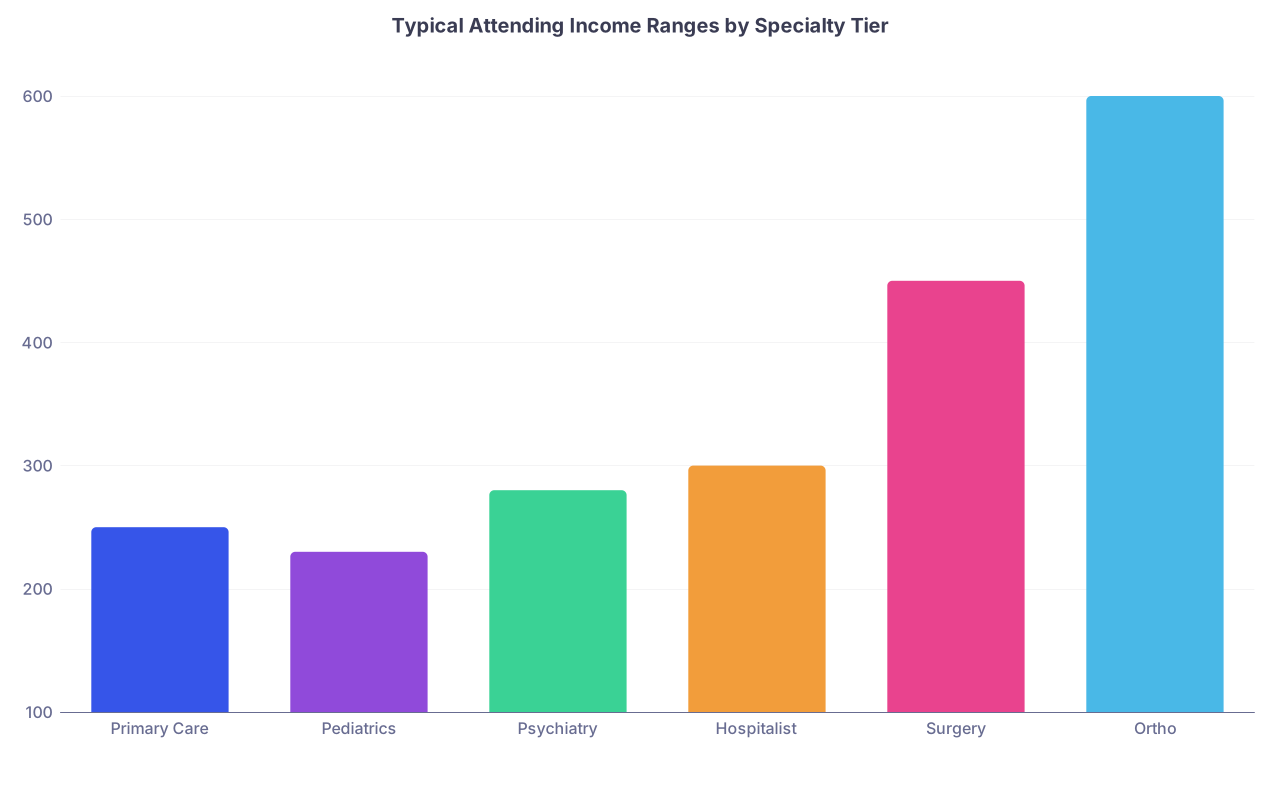
| Category | Value |
|---|---|
| Primary Care | 250 |
| Pediatrics | 230 |
| Psychiatry | 280 |
| Hospitalist | 300 |
| Surgery | 450 |
| Ortho | 600 |
The Fear: “Low‑Paying Specialty = No Real Wealth”
Here’s the nightmare loop that plays in your head at 2 a.m.:
- You picked family med / peds / psych / IM outpatient because you genuinely like it.
- Your total med school + undergrad loans are in the $250k–$500k range.
- You’re looking at a starting attending salary around $200–$280k.
- Cost of living where you want to live is not cheap.
- Everyone keeps saying “just invest early” but you’re like, “With what money?”
And then the worst thought: “Did I sacrifice financial freedom for job satisfaction…and still may end up burned out anyway?”
I’ve seen this up close. The peds attending who said to me in the clinic workroom, “If I’d known the pay gap was this big, I might’ve chosen anesthesia.” That sentence haunts you a little, right?
Here’s the uncomfortably honest part: picking a lower‑paying specialty absolutely makes the margin for error way smaller. You don’t get as many “oops I bought too much house/car” do-overs as an ortho bro pulling $800k.
But smaller margin for error is not the same as “no chance at wealth.” It just means the game is tight, not impossible.

What “Wealth” Actually Looks Like for a Lower‑Paying Doc
Before you assume you’re locked into lifelong financial anxiety, define what you actually mean by “build wealth.”
Most of us secretly imagine “derm money” even if we won’t say it. Seven figures in investments by 40. Paid-off house. Early retirement if we want. Travel without price-filtering everything from lowest to highest.
Here’s the thing: you can get surprisingly close to that on a psych / peds / FM salary. Just on a different curve.
Let’s make this painfully concrete.
Say you’re:
- 32-year-old new attending
- Salary: $240k (peds, FM, academic IM… pick your poison)
- Student loans: $350k at blended 5–7% (refinanced or not)
- Retirement goal: $3–4M invested by your 60s (enough for comfortable but not baller life)
If you invest $40k/year consistently from age 32 to 62 and average ~7% market returns, you’re looking at roughly:
- ~$4.0M at 7%
- That’s not “Malibu dermatologist” rich, but it’s solid-wealth rich. Comfortable-house, kids-college-funded, work-because-you-want-to rich.
Will it feel tight some years? Yes.
Does anyone on a $240k salary feel “rich” when they’re buried under daycare + loans + taxes? No.
But the math works. Even on “sad doctor money” compared to ortho, the raw earning power is high enough that, if you don’t torch it all on lifestyle, you can absolutely build seven-figure net worth.
The problem isn’t the salary. It’s:
- lifestyle creep
- disorganized debt decisions
- and no real investment plan.
You can’t afford to just “wing it” like a 700k surgeon and bail yourself out later.
| Scenario | Savings Rate | Result After 10 Years* |
|---|---|---|
| Dr. A (No Plan) | 5% | ~\$200k invested |
| Dr. B (Intentional) | 20% | ~\$800k invested |
| Dr. C (Aggressive) | 30% | ~\$1.2M invested |
*Assumes $240k income and ~7% average return, simplified.
You and the ortho attending are playing with different difficulty settings. But you’re playing the same game.
The Big Three Levers You Still Control
You don’t control your chosen specialty now. Fine. Here’s what you do still control that actually moves the needle.
1. Savings Rate > Income Flex
Income envy ruins more lower‑paying docs than the actual numbers.
You cannot match the gross income of ortho. You can absolutely surpass their net worth if they live like a baller and you don’t.
If you’re in a $220k–$280k specialty, your life basically comes down to this question:
“How do I structure my life so I can reliably invest 15–30% of my gross income without hating my existence?”
Not in some mythical future. Now. As early as PGY-3/PGY-4 if you can.
Translation into numbers for a $240k income:
- 15% = $36k/year (~$3k/month)
- 20% = $48k/year (~$4k/month)
- 30% = $72k/year (~$6k/month)
Those numbers feel huge right now, I know. But if you let housing, cars, and random stuff expand to fill every new attending dollar, there’s nothing left to invest.
The attending who rents modestly, drives paid-off Corolla, maxes Roth IRA + 401(k) and throws extra at a taxable account? That person quietly becomes the wealthy “poor specialty” doc people whisper about.
The attending who buys a $1.2M house on day one because “I’ve been suffering for years”? That person stays paycheck-to-paycheck with an MD.
2. Time in the Market, Not Timing the Market
You don’t have ortho money, but you do have this advantage: time. Especially if you start now, not “after my loans” or “after I feel settled.”
Every year you delay real investing you’re handing future wealth back to your debt and to inflation.
Stop waiting for:
- the perfect market entry
- the magical raise
- the “I’ll invest once my loans are smaller” threshold
I’ve watched people hit 40 and say, “I’ll start investing once PSLF hits,” and then life happens (kids, divorce, illness, burnout) and boom — no margin, no room, no plan.
Even $500/month in residency, or $1k/month as a new attending, into a simple low-cost index fund portfolio, is better than waiting for the fantasy version of your future self.
You don’t need to become day-trader finance bro. You need boring, automatic, repeatable.
3. Lifestyle and Location Arbitrage
This is where lower‑paying specialties can secretly win.
The psych attending in a mid-cost city working 4 days/week, living in a $450k house, investing aggressively, can easily outrun the private practice plastic surgeon in LA with a $3M mortgage and two G-wagons.
You don’t have to move to rural nowhere, but if you combine:
- reasonable cost of living
- smart housing choice (not maxing what the bank approves)
- and low fixed expenses
… you buy yourself options. The option to reduce FTE later, to take a sabbatical, to tell your group “no” when they try to bury you in RVUs. That’s wealth too.
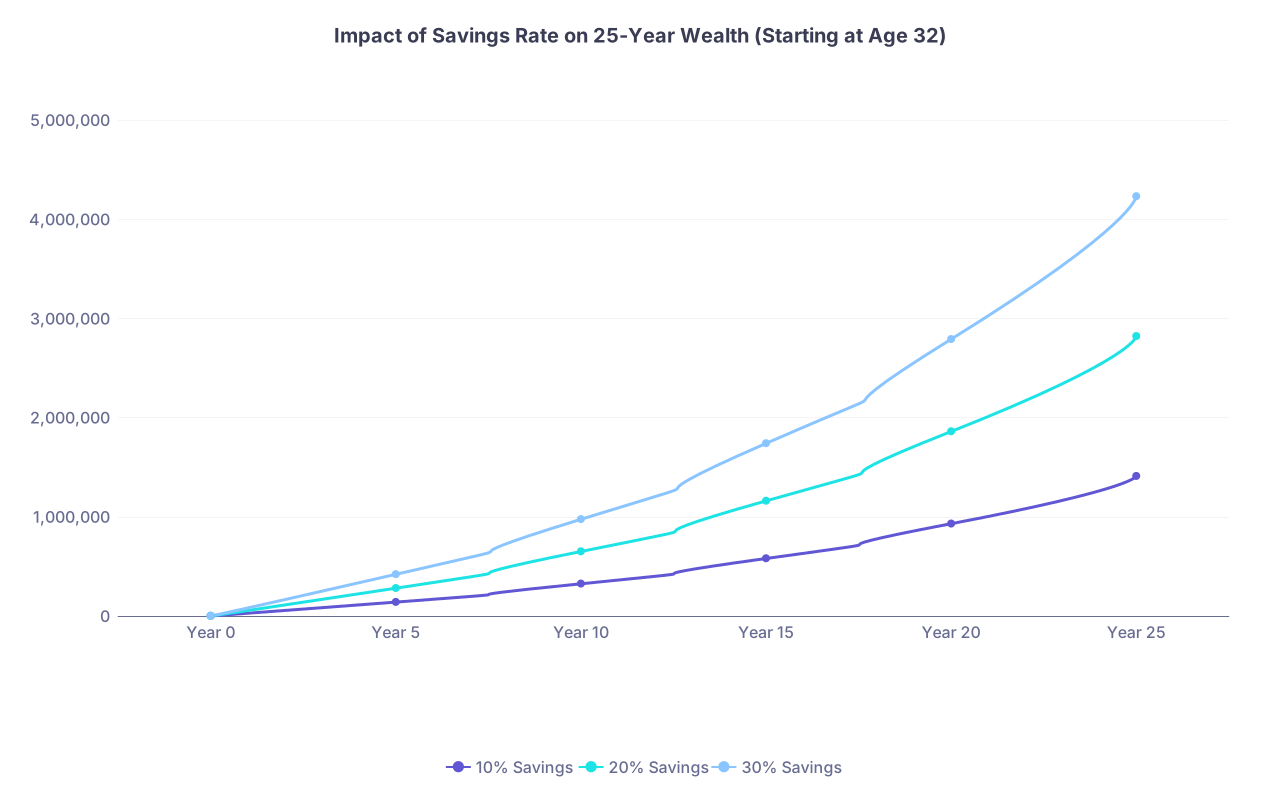
| Category | 10% Savings | 20% Savings | 30% Savings |
|---|---|---|---|
| Year 0 | 0 | 0 | 0 |
| Year 5 | 140000 | 280000 | 420000 |
| Year 10 | 325000 | 650000 | 975000 |
| Year 15 | 580000 | 1160000 | 1740000 |
| Year 20 | 930000 | 1860000 | 2790000 |
| Year 25 | 1410000 | 2820000 | 4230000 |
But What About Loans, PSLF, and All the Other Things Crushing Me?
This is where it gets messy and scary, because the decisions feel permanent and high-stakes.
If you’re in a lower-paying specialty, your student loan strategy matters more. You can’t just throw 12k/month at loans like an anesthesiologist.
Very bluntly, you have two main paths:
- Aggressive payoff: If your debt is moderate relative to income (say, <1x–1.5x your attending salary) and you’re not going for PSLF, you refinance strategically and attack it over 5–10 years while still investing at least to get matches and Roth space.
- PSLF / long-horizon income-driven repayment: If your debt is 2x+ your income and you’re in 501(c)(3) or government, PSLF can absolutely be the better “investment.” But only if you treat it as a deliberate strategy, not a vague hope.
The worst situation is not “huge loans + low-paying specialty.” The worst is “huge loans + low-paying specialty + no coherent plan + lifestyle like a high earner.”
You can build wealth either way, but you can’t:
- half-commit to PSLF
- pay more than required
- still not invest
- and overspend
That combo is how you hit 45 with high debt and low net worth, regardless of specialty.
If you’re already an attending and feel like you’ve messed this up — you haven’t ruined everything. You just need to stop the random approach now and decide:
“Am I the aggressive payoff person or the optimized PSLF person?”
Then align everything — job choice, moonlighting, side gigs, investing — around that decision.

Investing Strategies That Actually Work for “Lower‑Paying” Docs
You don’t need exotic investments. In fact, those usually hurt busy physicians more than help.
If you want a sanity-preserving approach:
Max the easy tax-advantaged stuff first
- Employer 401(k)/403(b) up to the match, then up to limit if you can
- Roth IRA or backdoor Roth IRA
- Possibly HSA if high-deductible plan makes sense
Then a simple taxable brokerage account
- Broad total market index fund (VTI, FSKAX, etc.)
- Maybe international index fund
- Automate a monthly transfer and stop trying to outsmart the S&P 500
Avoid shiny distractions
- Complex real estate syndications you don’t understand
- Whole life insurance pitched as “tax-free retirement”
- Day trading, options, random crypto FOMO
You are already in a cognitively and emotionally demanding job. You do not need your investments to be another ICU.
Low-paying specialty plus boring, consistent investing beats high-paying specialty plus lifestyle inflation and “fun” speculative bets. Every time.

The Emotional Side: Regret, Envy, and “What If I’d Chosen Ortho?”
Let’s not pretend this is only math. It’s also grief.
You probably feel, on some level, that you “should have known” about the pay gap. That you somehow failed Future You by picking the specialty that fit your soul more than your wallet.
I’ve heard the bitter jokes:
- “I chose happiness over money and now I’m not even that happy.”
- “I’m a pediatrician; I’m basically a social worker with a stethoscope.”
Here’s the uncomfortable truth: even the “rich” specialties have their own misery. I’ve seen burned-out surgeons with seven figures and no real life, trapped by overhead, lifestyle, and identity.
You traded some financial upside for:
- more manageable hours (often)
- better fit with your personality
- maybe less brutality in training
That trade only feels like a mistake when you compare yourself to the 1–5% of docs at the top-earning edge.
Compare yourself instead to:
- your non-physician friends swimming in debt on half your income
- the local school teacher who will never see what you make
- the version of you in another universe who picked a lucrative specialty and now dreads every OR day
Does the pay gap suck? Yes. Is it unfair? Often. Should we advocate for better? Absolutely.
But don’t confuse “I make less than orthopedics” with “I’m doomed to be financially fragile forever.” Those are not the same.
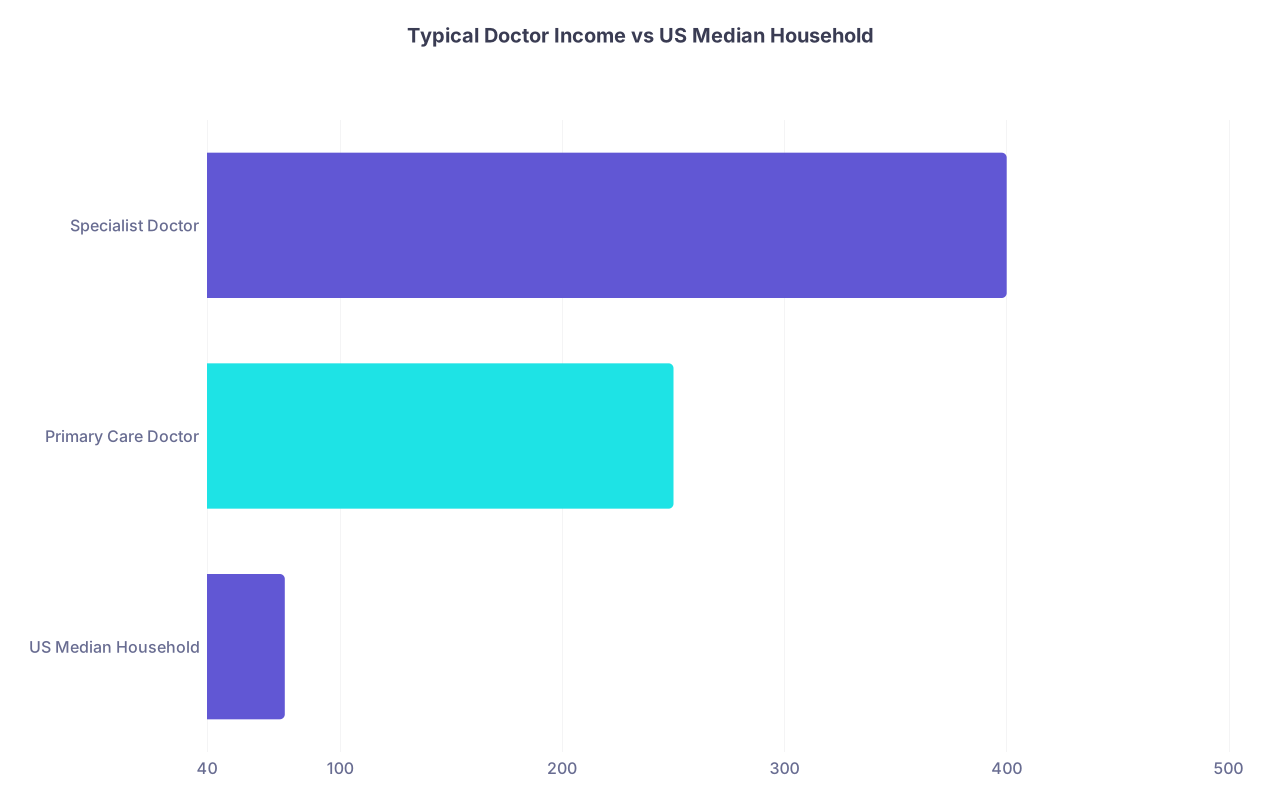
| Category | Value |
|---|---|
| US Median Household | 75 |
| Primary Care Doctor | 250 |
| Specialist Doctor | 400 |
So What Do You Do Now?
You can’t redo your match. You probably don’t want to switch specialties. You just don’t want to wake up at 50 broke and exhausted.
Here’s the mental shift: stop asking, “Can I build wealth in this specialty?” and start asking, “What would a serious wealth-building plan look like for this specialty?”
Because yes — you can build real wealth as a pediatrician, psychiatrist, family doc, hospitalist, you name it. People are doing it quietly all around you. They’re just not flexing it on Instagram.
They’re the ones who:
- kept housing reasonable
- drove normal cars
- got a clear loan plan early
- invested automatically and ignored market noise
- didn’t try to impress other doctors with their lifestyle
You don’t need to be perfect. You just need to stop drifting.
Here’s your next step — not 10 steps, just one:
Today, log into your retirement account (or open one if you don’t have it) and set up an automatic monthly contribution for an amount that feels slightly uncomfortable but not impossible.
$200/month in residency.
$500/month as a fellow.
$1,000–$2,000/month as a new attending.
Start it. Make it real. Don’t wait for “when I feel ready.”
That single move — automating money out of your checking and into investments — is how you stop being just a lower‑paid doctor and start being a lower‑paid doctor who’s actually building wealth.


