

Market crashes are only disasters for doctors who invested badly in the first place.
If that sentence bothers you a bit, good. Because the standard white-coat narrative—“The market is scary, I might lose everything, I should just hoard cash and maybe buy a rental”—is not just wrong. It is expensive. Year-after-year expensive.
Let me be blunt: if a 30–45% stock market drop can ruin your long-term financial life as a physician, the problem is not the crash. The problem is your strategy.
The myth that wrecks physicians: “A crash will erase my money”
I hear this in some form in almost every resident lecture and too many attending conversations:
- “What if I put in 200k and then the market crashes?”
- “I’ll invest once things look more stable.”
- “I’m waiting for the next crash before I really get in.”
All variations on the same myth: that the scary event is the crash itself.
Here’s what the data actually shows, looking at over a century of US stock market history: the scary event is failing to own productive assets when they are cheap. Crashes are not an exception to normal investing. They are normal investing.
Let’s put numbers on it.
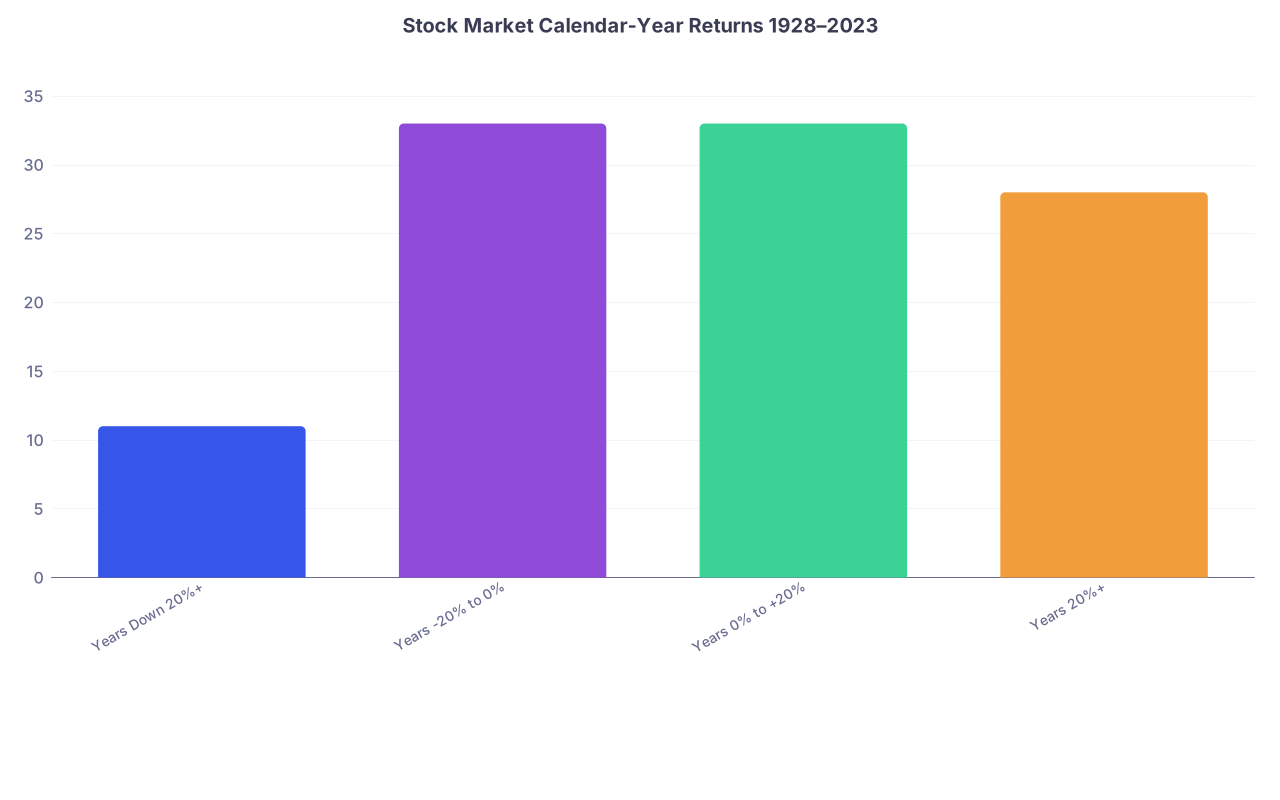
| Category | Value |
|---|---|
| Years Down 20%+ | 11 |
| Years -20% to 0% | 33 |
| Years 0% to +20% | 33 |
| Years 20%+ | 28 |
That’s almost 100 years. Huge crashes (down 20%+ in a calendar year) happened 11 times. Roughly once a decade. This is not a black swan; it’s baked into the system.
Yet over that same period, a boring investor who simply owned the market, reinvested dividends, and didn’t try to be clever turned $10,000 into well over $70 million before inflation (yes, million). After inflation, still tens of millions.
So no, crashes are not portfolio-killers.
What kills portfolios is:
- Panic selling at the bottom.
- Over-concentrated bets (single stocks, crypto, private deals you do not understand).
- Needing your money right when the crash happens because your plan was idiotic.
You fix all three with one thing: investing correctly.
What “investing correctly” actually means for a doctor
Let’s define this in plain language first, then we’ll get technical.
“Investing correctly” for a physician basically means you’ve set things up so that a crash is an inconvenience, not a catastrophe. Temporary paper pain, not a permanent loss.
That hinges on five ideas.
1. Your time horizon is brutally long
Most doctors forget this.
You start attending life at 30–35. You want to retire somewhere between 55–65. That’s 20–35 years of accumulation. Then you might live to 90. That’s another 25–35 years of spending.
So your overall investing horizon is 40–60 years. Even your “pre-retirement” money often has a 20-year horizon minimum.
What do long horizons do to crash risk? They crush it.
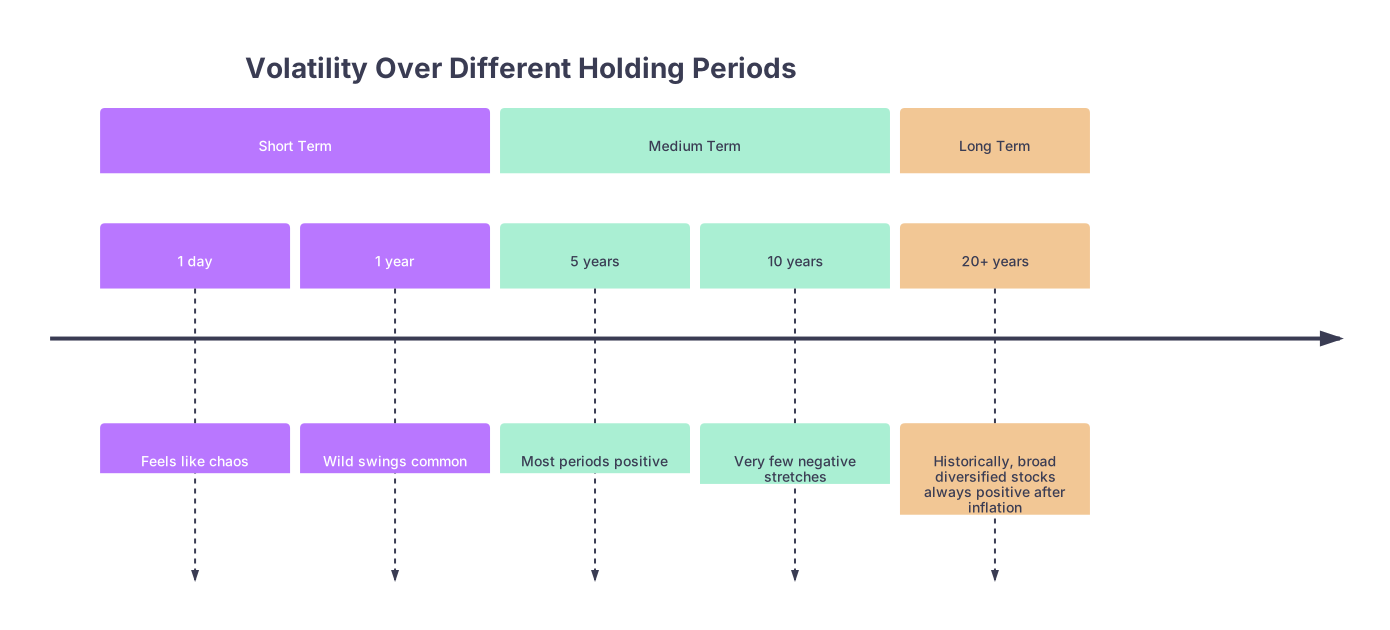
| Period | Event |
|---|---|
| Short Term - 1 day | Feels like chaos |
| Short Term - 1 year | Wild swings common |
| Medium Term - 5 years | Most periods positive |
| Medium Term - 10 years | Very few negative stretches |
| Long Term - 20+ years | Historically, broad diversified stocks always positive after inflation |
Over every rolling 20‑year period in US history, a diversified stock portfolio has beaten inflation. Even if you bought right before a crash. That includes 1929, 1973–74, 2000–02, 2008, and 2020.
You as a physician are the poster child for “long horizon.” If you act like a day trader instead, that’s on you.
2. You match the investment to the timeline
This is where most “smart” attendings get dumb.
They dump a house down payment into 100% stocks, then act surprised when a crash hits right before closing. Of course that hurts. Because you used a long-term investment for a short-term need.
Correct investing is ruthless about time buckets:
| Time Horizon | Primary Vehicle | Stock Allocation Guideline |
|---|---|---|
| 0–3 years | Cash / CDs / T-bills | 0% |
| 3–7 years | Bonds + some stocks | 20–50% |
| 7+ years | Mostly stocks | 60–100% |
If your portfolio “got wrecked” by a crash, one of two things was true:
- You were planning to spend that money within a few years and should not have had so much in stocks, or
- You panicked and sold when prices were low.
Both are strategy errors, not market tragedies.
3. You own boring, broad, low-cost funds — not stories
The disasters I’ve seen with doctors were not caused by an index fund dropping 35%.
They were caused by:
- 60% of net worth in employer stock that later cratered.
- Leveraged real estate deals with friends where no one read the loan docs properly.
- Chasing whatever CNBC, Reddit, or a “friend who knows a guy” was hyping that year.
Correct investing looks suspiciously dull:
- Total US stock market index fund (VTSAX, VTI, etc.)
- Total international stock index fund
- A high-quality bond fund or Treasury fund for the “near-term” bucket
- Maybe some real estate, but sized so if it goes bad, your life doesn’t implode
Boring funds don’t go to zero. A single “can’t lose” stock absolutely can. Ask anyone who worked at Enron, WorldCom, or just held a lot of airline stocks heading into COVID.
What actually happens to a doctor’s portfolio in a crash?
Let’s stop hand-waving and use actual mechanics.
Say you’re 38, an attending making $350k, putting away $60k/year between 401(k), backdoor Roths, and a taxable account. Your portfolio is 80% stocks / 20% bonds. After a few years, you’ve built up $300k invested.
Then a 40% stock crash hits out of nowhere.
- Your stocks drop 40%.
- Your bonds are roughly flat or up a bit.
On $300k at 80/20, that’s:
- Stocks: $240k → $144k
- Bonds: $60k → about $60–63k
Total: about $204–207k. A brutal 30% drawdown.
Is that fun? No. Is it a disaster? Not if you know math.
Because you’re still putting in $60k/year.
The next year, you buy that same stock fund 40% cheaper. Your future dollars are working harder for you.
Let’s quantify that over time.
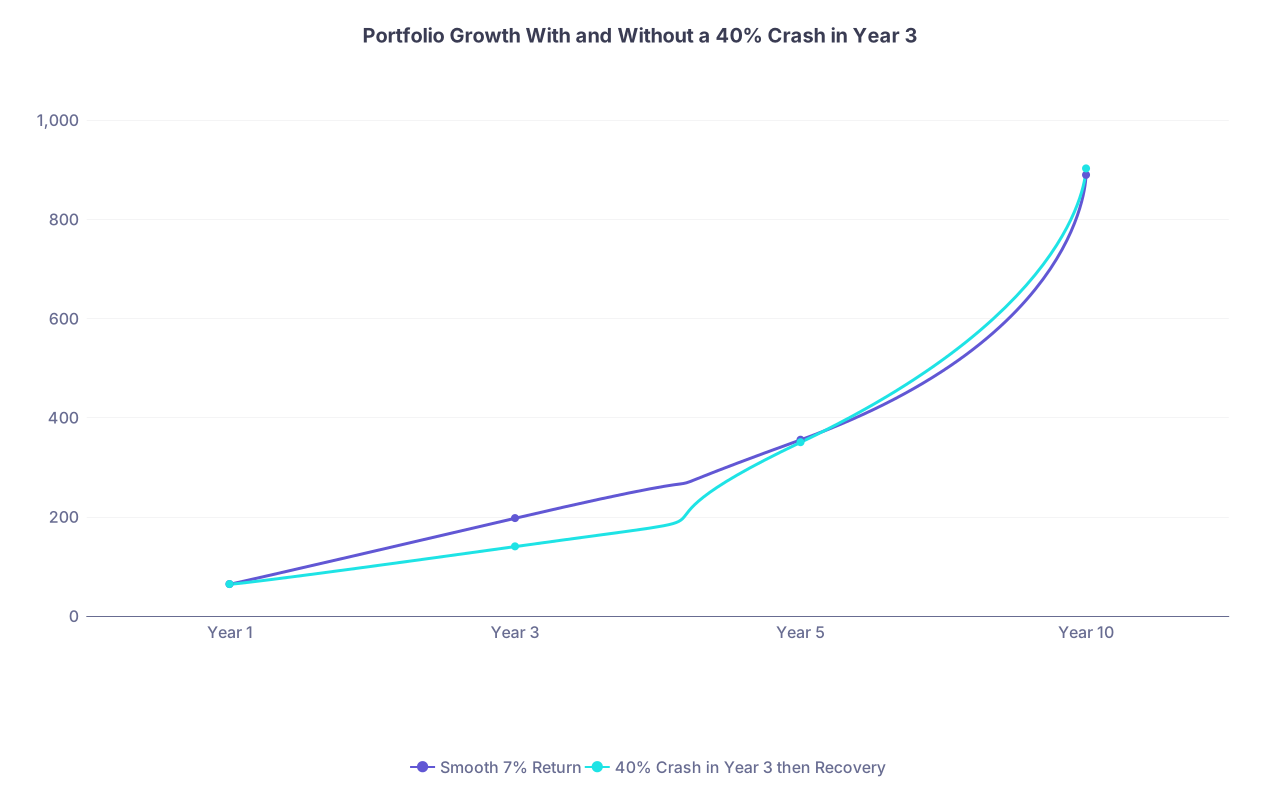
| Category | Smooth 7% Return | 40% Crash in Year 3 then Recovery |
|---|---|---|
| Year 1 | 64 | 64 |
| Year 3 | 197 | 140 |
| Year 5 | 355 | 350 |
| Year 10 | 889 | 902 |
Both scenarios assume $60k/year contributions. Over a decade, the “crash in year 3” scenario actually catches up and slightly passes the smooth-return scenario once the market recovers, because of all the cheap shares you bought.
The psychological pain is front-loaded, but the math is on your side.
Where it becomes a true problem is if:
- You stop contributing out of fear.
- You sell your stocks and lock in the loss.
- You never get back in until “it feels safe again,” which is usually when prices are high.
That turns a temporary crash into a permanent wound.
Why doctors are uniquely vulnerable to the wrong lessons about crashes
Physicians have training that’s perfect for medicine and terrible for investing.
You live in a world where:
- Intervening often helps. You cannot “do nothing” with a crashing ICU patient.
- Recency bias is baked in. You remember the last bad outcome vividly.
- Worst-case thinking is rewarded. Miss one rare diagnosis and you never forget it.
Markets are nearly the opposite:
- “Doing nothing” is usually the correct move.
- Recency bias (panicking after a drop, euphoric after a run-up) destroys returns.
- Worst-case thinking (“this time is different, everything is broken”) usually costs you huge upside.
So when you see a 20–40% decline:
You feel the same adrenaline spike as when a post-op patient suddenly desats. You want to do something — move to cash, change funds, find a “safe” alternative.
I’ve watched attendings in 2008 and 2020 move everything to cash at or near the bottom. They “protected” themselves from losses that already happened and then sat out the recovery. Some never fully went back into equities.
The data on this behavior is brutal.
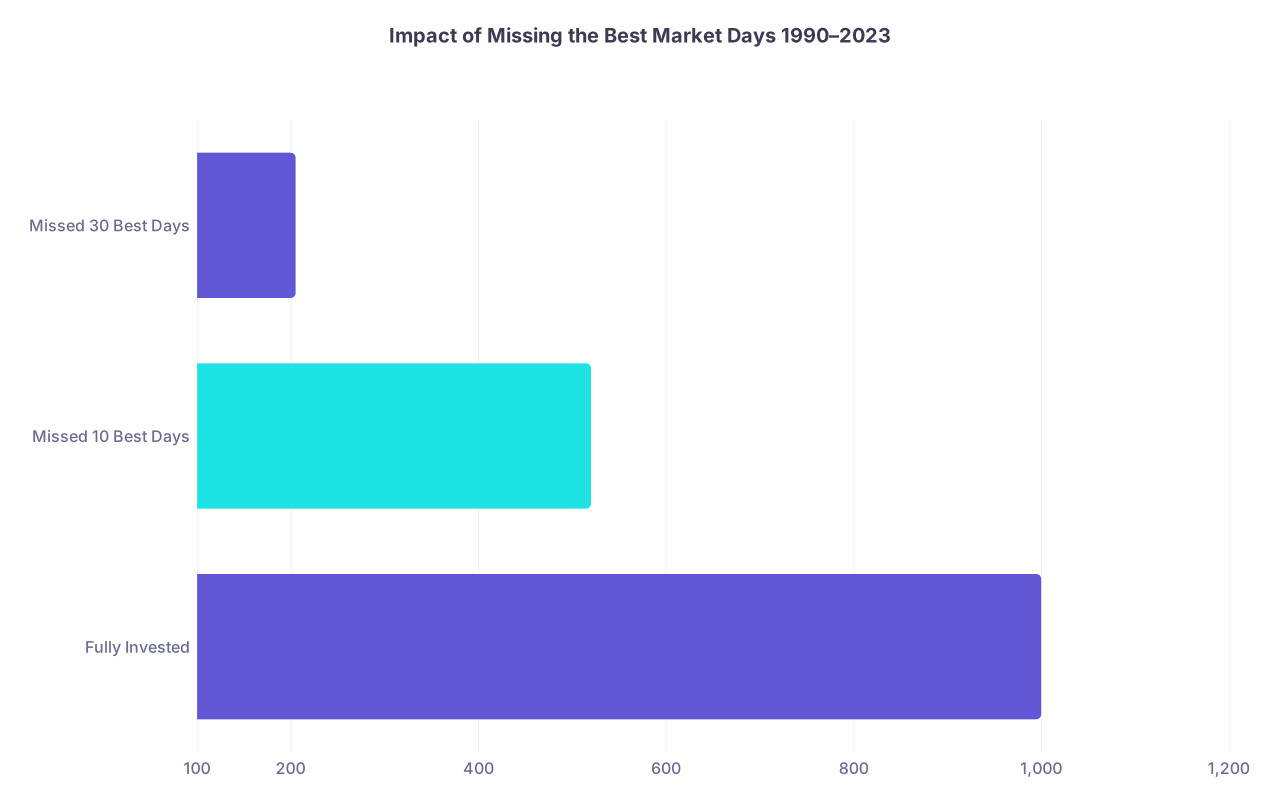
| Category | Value |
|---|---|
| Fully Invested | 1000 |
| Missed 10 Best Days | 520 |
| Missed 30 Best Days | 205 |
If you put $10,000 in the S&P 500 in 1990 and stayed fully invested through 2023, you wound up around $100k+. Miss just the 10 best days over that 33-year stretch and you cut that almost in half. Miss 30 and you royally sabotaged yourself.
The punchline: many of the “best days” cluster right after the worst ones. So if you panic out during a crash, you are almost guaranteed to miss some of those big snap-back gains.
Physicians who “make moves” in crashes usually lock in the worst possible sequencing: sell low, buy high later when headlines sound optimistic again.
What about doctors near retirement? Are crashes still “fine” then?
This is the only group legitimately at risk if they’ve invested wrong.
If you’re 64, planning to retire at 65, and everything is in stocks, a 40% crash is a problem. You do not have the income runway to confidently wait it out while drawing heavily from the portfolio.
But again, the villain is the strategy, not the crash.
Correct investing for a near-retirement doctor includes:
- A few years of expenses in safer assets (cash, CDs, short-term Treasuries, high-quality bonds).
- A measured equity allocation so you’re not forced to sell stocks when they’re down.
- A flexible mindset about retirement date and spending level.
The sequence-of-returns problem (bad returns early in retirement) is real. It’s why a 64-year-old should not be 100% in stocks. But if you start dialing in bonds and cash in the last 5–10 years pre-retirement, a crash becomes annoying, not fatal.
I’ve seen retired physicians sail through 2008 and 2020 with barely any lifestyle change because:
- They had 3–7 years of planned withdrawals in bonds/cash.
- They only sold bonds for living expenses while stocks were down.
- They let their stock allocation recover over several years.
This is not exotic planning. It is just basic asset-liability matching.
Why crashes are secretly a gift to young and mid-career doctors
You want something slightly uncomfortable? Here goes:
If you are under 50 and still accumulating, you should hope for one or two large crashes in your career — as long as you keep your job and your income.
Why? Because you are a net buyer of assets.
A 40% sale on the only asset class that has reliably beaten inflation over decades is not a “disaster.” It is a forced-discount sale. You don’t feel good buying into it, but future-you will be grateful.
Think of your career like this:
- Residency/Fellowship: You’re learning, maybe starting small contributions. Market volatility barely matters in dollar terms.
- Early attending (first 10 years): You are shoveling money into the markets. Crashes here are gold-if-you-don’t-panic.
- Mid-career (10–25 years in): Your portfolio gets big. Crashes hurt more emotionally but are still working for you mathematically because you’re adding new money.
- Near/early retirement: You’re transitioning from accumulating to drawing. Here you actively manage risk with bonds and cash buckets.
The people who get destroyed by crashes are the ones who:
- Start investing late,
- Invest sporadically,
- Concentrate their risk (single stock, speculative deals), and
- Then bail at the bottom.
Doctors do not have to be those people. But many are, because they never bothered to understand what the data actually says.
Legal and behavioral landmines in crashes
Since you asked for “financial and legal aspects,” let’s touch the quiet killers.
No, a plain-vanilla market crash does not create legal risk. But what you do in response can.
I’ve seen:
- Attendings jump into unregistered private placements being pushed by acquaintances as “crash-proof,” only to later deal with SEC investigations or lawsuits.
- “Friends’ funds” with no clear documentation, unclear risk disclosures, and ugly litigation when it all goes south.
- Physicians acting as informal investment advisors to partners, then getting blamed when things go badly, occasionally with real legal consequences.
During crashes, scammers and sloppy operators come out in force. Fear is their fuel.
Basic rules:
- Stick to regulated, transparent, boring vehicles for the bulk of your wealth: index funds, publicly traded securities, plain real estate with proper legal structure.
- If someone pitches something “uncorrelated” or “downside protected,” insist on clearly written offering documents, risk disclosures, and third-party verification. Then size it appropriately tiny.
- Do not become the unofficial financial advisor in your group. Share what you do, but do not tell coworkers what they should specifically buy or sell.
Fear makes people sign things they don’t understand. Lawyers get involved later. You want to be on the clean side of that, not the “I signed some subscription docs my buddy emailed me” side.
The bottom line: crashes test your strategy, not your luck
If you invest correctly as a doctor:
- With a long horizon for most of your money,
- With appropriate asset allocation for each time bucket,
- With boring, diversified, low-cost funds,
- With realistic cash and bond buffers near retirement,
then a crash is not a disaster.
It’s a loud, in-your-face audit of whether you truly believe the math you claim to understand.
For physicians, the real disaster is not the 30–40% drawdown. It is the 30–40 years of half-hearted, cash-heavy, panic-driven “investing” that quietly robs you of compounding.
So remember three things:
- Crashes are normal, frequent, and survivable — especially with a physician’s income and timeline.
- The danger is behavioral and strategic, not mathematical: panic selling, wrong assets for your horizon, and concentrated bets are the real threats.
- If a crash can ruin your plan, the plan was flawed. Fix the plan, not the market.


