
It’s 11:47 p.m. You’ve rewritten the same sentence ten different ways:
- “You are my top choice.”
- “I plan to rank your program highly.”
- “I intend to rank your program first.”
And you’re staring at them thinking: which of these will get me matched… and which will get my email screenshot into a group chat labeled “yikes”?
Welcome to the psychological torture chamber known as the Letter of Intent.
You want to be clear. But not clingy. Honest. But not reckless. And underneath all of it is that gnawing fear: What if I say the wrong thing and they cross my name off the list completely?
Let’s talk about that. Honestly. Because programs don’t all agree on LOIs, but there is a line between confident and cringey, and it’s not where a lot of applicants think it is.
First: What Programs Actually Care About (vs What We Obsess About)
Here’s the annoying truth I’ve watched play out over multiple cycles: applicants agonize over every syllable of LOIs, and most programs glance at them for 15–30 seconds, tops.
Not because they’re evil. Because:
- They’re ranking 100–300+ people
- It’s 10 p.m., they’ve been on service all day
- Half the emails say some version of: “You’re amazing, I love you, please pick me”
So what actually matters in your LOI?
Three things:
- Signal of real interest
- Evidence you paid attention on interview day (specific fit, not generic fluff)
- Whether you seem… normal (not desperate, not dishonest, not bizarre)
Everything else (exact wording, perfect transitions, “sincerely” vs “best”) is stuff we spin out about to feel some control.
Let’s ground this with a reality check.
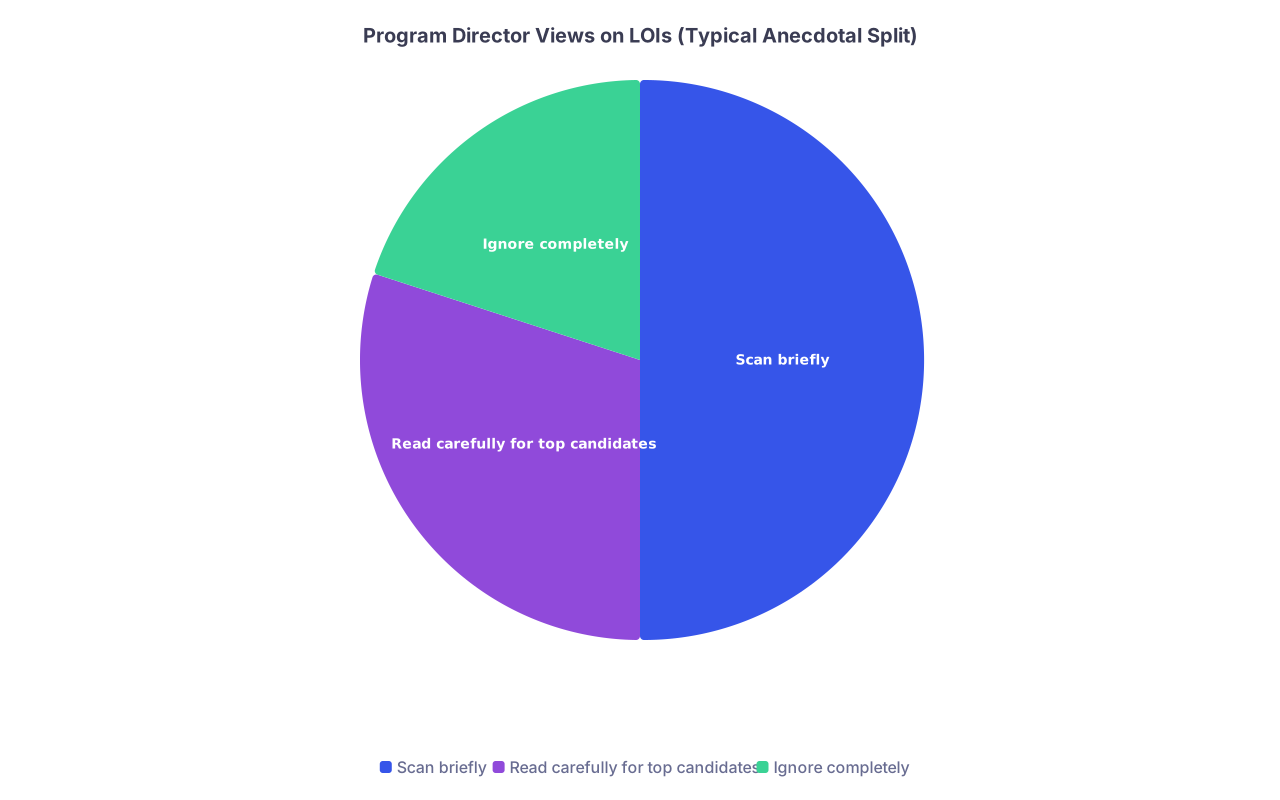
| Category | Value |
|---|---|
| Scan briefly | 50 |
| Read carefully for top candidates | 30 |
| Ignore completely | 20 |
Is this exact data? No. But it’s roughly what I’ve heard and seen across several specialties and cycles. LOIs are rarely the deciding factor. More like a tiebreaker or a nudge.
Which means your real risk is less “saying something that destroys your chances” and more “wasting your one solid shot sounding vague, weird, or dishonest.”
How Direct Can You Be Without Overstepping?
Let me cut to the chase:
Saying “I will rank your program first” to one program is not overstepping. It’s normal. Expected, even.
Where you do overstep:
- Saying that to more than one program
- Saying it when it isn’t true
- Making it weirdly intense or emotional
- Trying to negotiate or pressure them
Think of LOI directness in tiers:
| Level | Example Phrase | My Verdict |
|---|---|---|
| Mild | "I remain very interested in your program." | Too weak if it’s truly your #1 |
| Moderate | "I will rank your program very highly." | Safe, but noncommittal |
| Strong | "Your program is my top choice." | Good if you mean #1 |
| Max | "I will be ranking your program first." | Strongest, use for true #1 only |
If a program is 100% your top choice, you’re not overstepping by explicitly saying so. That’s literally what a letter of intent is.
Where people get themselves twisted:
- They try to be strategic and send “you’re my #1” to multiple programs
- They’re scared of commitment and end up so vague it sounds like a mass email
- They overcompensate with dramatic flattery that reads as fake
The “too direct” line is not “I will rank you first.”
The “too direct” line is more like: insane gushing, begging, guilt-tripping, or lying.
Big Ethical Landmine: Are You Lying to Someone?
This is the part that actually does keep PDs up at night: applicants telling multiple programs they’re #1.
And yes. They do talk. Not always, but enough that people get burned.
I’ve seen this scenario play out:
- Applicant tells Program A: “You’re my #1. I will rank you first.”
- Tells Program B the same thing.
- Both programs are in the same region. Faculty overlap at conferences. Someone mentions it in passing.
- Now this applicant is “the one who lied.”
Does it always get back to them? No. But if it does, your credibility is gone.
Here’s my blunt rule:
- One program gets: “I will rank you first”
- Other programs you like get: “I will rank your program very highly” or “You are among my top choices”
If you’re thinking, “But what if I change my mind later?” — then you’re not ready to send a true LOI. Wait until your rank list is basically set.
Stuff That Actually Sounds Creepy / Overstepping
This is the territory you’re afraid of, right? The email they read out loud in the workroom with the “y’all need to see this” tone.
The red flag patterns are usually:
Over-sharing personal desperation
- “I need to match here because my life will fall apart otherwise.”
- “I will be devastated if I don’t end up with your program.”
It puts emotional weight on them they didn’t ask for.
Trying to negotiate
- “If you rank me to match, I promise I will work harder than any other resident.”
- “If you can give me an idea of where I stand, I can commit to ranking you first.”
This veers into creepy transactional territory. Also violates NRMP communication guidelines.
Boundary-less familiarity
- “I felt an instant soul connection with your residents.”
- “I’ve imagined myself walking your halls every night since the interview.”
That’s not romantic. That’s how you get your email screenshotted.
Multiple follow-ups
- An LOI, then a “just bumping this up,” then an “any update?”
Rank lists are not something they “update you” about.
- An LOI, then a “just bumping this up,” then an “any update?”
If you’re staying away from these four buckets, you’re probably nowhere near overstepping.
What a Strong, Direct, Not-Weird LOI Actually Looks Like
Let’s talk structure, because that’s usually where people start spiraling and adding weird filler.
Basic LOI blueprint:
- Short opening: thank them, remind who you are (1–2 sentences)
- Clear statement of intent
- 2–3 specific reasons their program fits you
- Brief reaffirmation, sign-off
Here’s a max direct but normal example for a true #1:
Dear Dr. Smith and the [Program Name] Residency Selection Committee,
Thank you again for the opportunity to interview at [Program Name] on January 12. I enjoyed meeting your residents and faculty and learning more about your program.
I am writing to let you know that I will be ranking [Program Name] as my first choice for residency. After my interview day and further reflection, I’m confident that your program is the best fit for my training and long-term goal of becoming a [subspecialty/role].
Three aspects of your program especially stood out to me:
– The strong clinical training at [specific hospital/clinic, specific patient population you mentioned]
– The supportive culture I saw among the residents, particularly during the noon conference and resident panel
– The opportunity to be involved in [specific track, research area, curriculum] with Dr. [X], which aligns with my interests in [brief interest]I would be thrilled to train at [Program Name] and contribute to your resident community. Thank you again for your time and consideration.
Sincerely,
[Your Name], [Your Med School]
That’s about as direct as it gets. And it’s fine. This does not read as overstepping to any reasonable PD.
Now compare that to something weaker you might be tempted to send because you’re scared:
“I remain very interested in your program and will consider ranking it highly.”
Translation in PD brain: “They’re sending this to 10 places. Non-committal. Mild interest. Nice but not decisive.”
If they’re already ranking you highly, fine. If you’re on the bubble and you really want them? You just wasted your one good shot to stand out.
Timing, Frequency, and the Fear of “Too Much”
Another anxiety loop: "If I send this now, is it too early? Too late? Do I need a follow-up? Will no email hurt me?"
Some guardrails so you don’t overthink yourself into paralysis:
- One LOI per program. That’s it. No sequels.
- Send it after you’ve actually reflected and mostly built your rank list. Usually 2–4 weeks before rank lists are due feels right.
- You don’t need to email every program you interviewed at. Focus on:
- True #1
- Maybe a couple “I will rank you very highly” emails to strong contenders
Here’s what programs do NOT want:
- Weekly “just wanted to reiterate my interest” emails
- Random “quick question about where I stand on your list” emails
- Updates that are fake updates (“I am still very interested in your program” as a stand-alone email)
If you have a real update — new publication, major award, step score, big life circumstance affecting geography — that’s different. But that’s an update email, not a one-line “pls remember me.”
What Actually Moves the Needle vs What’s Just Anxiety Talk
Let’s be painfully honest about impact so you can stop catastrophizing every comma.
Things that can meaningfully help (especially if you’re already on their radar):
- One clear, honest LOI to your true #1
- A thoughtful, specific “very high on my list” note to a few others
- Letting a program know they’re your top choice in a way that’s consistent with how you talked on interview day
Things that matter way, way less than our brains insist:
- Whether you wrote “top choice” vs “first choice” vs “number one choice”
- Whether you used “Sincerely” or “Best regards”
- Whether you hit send at 8:12 a.m. vs 10:47 p.m.
- A single minor typo (yes, I said it; they’re not failing you for one missing comma)
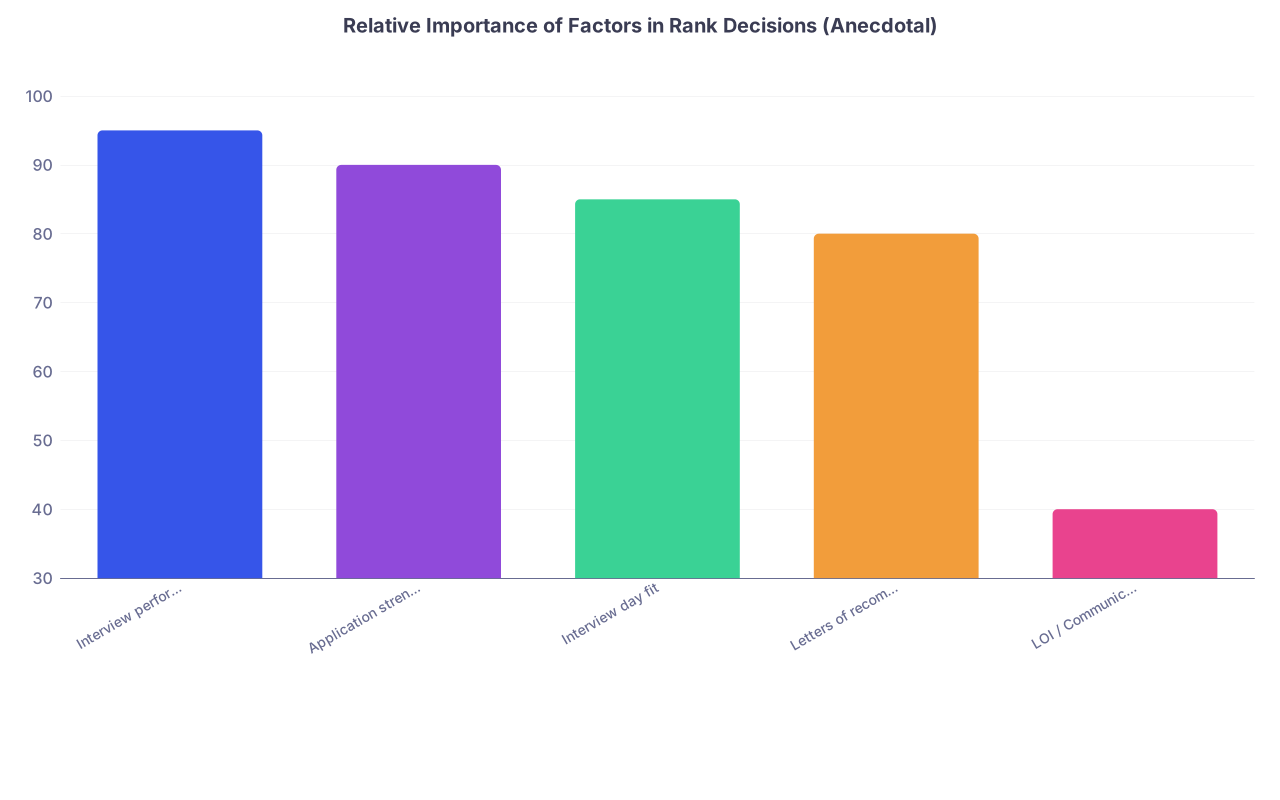
Here’s the rough “hierarchy of importance” as I’ve seen it for ranking decisions:
| Category | Value |
|---|---|
| Interview performance | 95 |
| Application strength | 90 |
| Interview day fit | 85 |
| Letters of recommendation | 80 |
| LOI / Communications | 40 |
So no, your LOI is probably not vaulting you from “no chance” to “#1 on their list.” But it can bump you when they’re debating between several similar candidates.
And it can reassure them you’re likely to match if they rank you highly, which most programs like.
The Future: Are LOIs Becoming More or Less Important?
LOIs live in this weird gray space:
- NRMP says no one is allowed to ask “How will you rank us?” or promise anything concrete in return.
- Applicants still send “you’re my #1” emails.
- Programs pretend they don’t rely on them much.
- But in tie-break situations? They absolutely get read.
I don’t see LOIs going away soon. If anything, with virtual interviews and compressed application windows, personalized signals of interest become more valuable.
But the arms race of intensity? That’s already getting old. PDs have told me bluntly:
“If I read one more email that says ‘I will be devastated if I don’t match with you,’ I’m going to scream.”
So the direction things are heading:
Shorter. More honest. Less performative drama.
You don’t need a page-long essay. You need clarity and normalcy.
Quick Sanity Check Before You Hit Send
When you’re staring at your LOI wondering “Is this too much?”, run this checklist in your head:
Am I telling the truth?
If you say “I will rank you first,” will that still be true on rank submission day?Have I said this same thing to anyone else?
If the answer is yes, and you’re claiming they’re your #1… that’s a problem.Does this sound like a normal, emotionally regulated adult wrote it?
Not a fan. Not a supplicant. A colleague-in-training.Am I making any demands, asking where I stand, or trying to bargain?
If so, delete that line.Could this email be read out loud in a workroom without everyone cringing for me?
Brutal metric. Very effective.
If you pass those five, you’re almost certainly not overstepping.
One Concrete Thing to Do Right Now
Open a blank document.
Write the single sentence you’re most afraid to commit to:
- Either: “I will be ranking [Program] first.”
- Or: “I will be ranking [Program] very highly.”
Then ask yourself:
Which program could I send this to and sleep at night if they published it on a bulletin board with my name attached?
That’s your real answer. Build the rest of your LOI around that one honest sentence. Cut the drama. Keep the specifics. Hit send once.
Then, seriously, close your email. The work of your LOI is done. The rest is noise your anxiety is trying to create so it feels useful.