
Most letters of intent are bland, interchangeable, and ignored. The distinction that actually matters—and that almost nobody structures correctly—is this: a letter of intent to a program where you rotated is a completely different genre from a letter to a “cold” interview program.
Let me break that down specifically.
Programs where you rotated know you. They have seen you pre-round late, forget to pend an order, save a crashing patient, present concisely in front of a grumpy attending. A “rotation LOI” that reads like a generic, polished love letter is a wasted opportunity.
On the other hand, a “cold interview” LOI (no prior rotation, only interview contact) is about controlled persuasion built on a tiny amount of data—one day, a few conversations, maybe one resident dinner.
You cannot send the same structure to both and simply swap the program name. That is how you end up in the “auto-skim” pile.
We are going to treat these as two different but related tools, and I will give you explicit, modular structures for each.
Core Reality: What LOIs Actually Do (and Do Not Do)
Before we get into structure, I want you aligned with how program directors (PDs) and coordinators actually think of these letters.
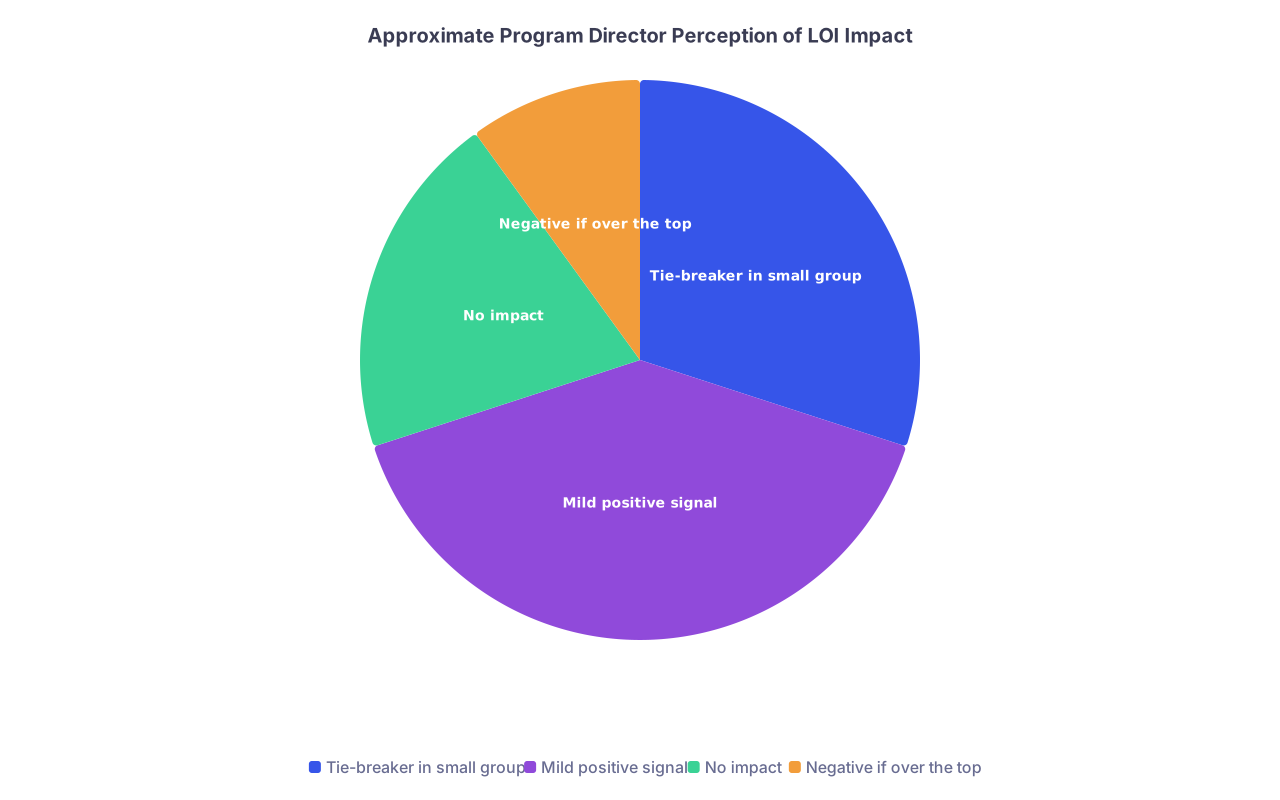
| Category | Value |
|---|---|
| Tie-breaker in small group | 30 |
| Mild positive signal | 40 |
| No impact | 20 |
| Negative if over the top | 10 |
LOIs:
- Rarely move you from the bottom of the rank list to the top.
- Sometimes bump you a couple of spots in a “small cluster” of similar applicants.
- Can hurt you if you come across as dishonest, overpromising, or unhinged.
They function best as:
- A clarifier of genuine intent (especially if geographic signals are noisy).
- A reminder of who you are when decisions are being finalized weeks after interviews.
- A signal of professionalism and fit, if written correctly.
Now, how that plays out differs dramatically between:
- Programs where you actually rotated, and
- Programs where you only interviewed (“cold interviews”).
Strategic Differences: Rotated vs Cold Interview LOIs
Here is the big picture before we go granular.
| Aspect | Rotated Program LOI | Cold Interview LOI |
|---|---|---|
| Relationship depth | High – you have a track record | Low – based on 1 interview day |
| Main leverage | Concrete shared experiences, evaluations | Alignment with mission, curriculum, vibe |
| Tone | Familiar, grounded, specific | Professional, targeted, slightly formal |
| Primary goal | Convert strong fit into ranking confidence | Stand out from similar applicants |
| Risk of genericity | Very high if you ignore rotation details | High if you repeat your PS or interview |
The mistake: Applicants often write both letters in the cold-interview style—vague praise, generic “top choice,” and zero evidence they actually touched the program.
Let us structure each correctly.
Part 1: Structuring LOIs for Programs Where You Rotated
Rotation LOIs are built on proof, not potential. They already know if you can function on their floors. Your task is to:
- Connect the dots between what they witnessed and why you belong there long term.
- Anchor your intent in shared cases, residents, and concrete experiences.
- Reassure them you will not flake if they rank you highly.
Here is the structure that works consistently.
Section 1 – Direct, Honest Opening (2–3 sentences)
Do not be coy here. You are writing to a program that has already invested 2–4 weeks in you.
You want something like:
- A clear statement of where they sit on your list.
- A concise reminder of which rotation and when.
Example:
Dear Dr. Patel and the Internal Medicine Residency Selection Committee,
I am writing to express my strong interest in the University Hospital Internal Medicine Residency and to let you know that it is one of my very top choices. After my four-week MICU sub-internship with your team in October, I am confident that your program is where I would like to train.
If (and only if) you are prepared to mean it, you can be absolute:
…and to let you know that your program is my first choice and the place I most hope to match.
Be aware: if you tell multiple programs they are your “#1,” you are lying, and PDs do talk. Use “top choice” plural if you are not ready to commit.
Section 2 – Acknowledge the Shared Rotation (2–4 sentences)
This is where most people are oddly vague. You were there. Name the service. Name the month. Name the people.
During my rotation on the MICU service in October, I worked closely with Dr. Singh, Dr. Alvarez, and several of your PGY-2 and PGY-3 residents. That month was the most formative clinical experience of my fourth year and solidified my desire to pursue rigorous, academic internal medicine training.
Two keys:
- Establish time and place so they can mentally place you.
- Gently trigger memory by naming 1–2 attendings or residents. Do not list a phone book.
This helps when they pull your file and think, “Right, this is the student who took care of the GI bleed on call.”
Section 3 – Specific Clinical Moments as Evidence (1–2 short paragraphs)
This is the main advantage you have over cold programs. Do not waste it on vague admiration.
Choose 1–3 specific experiences that:
- Show you functioning as a sub-I / rotator.
- Highlight program strengths you value.
- Are immediately recognizable as real experiences, not brochure-speak.
Example:
I still think about a night when our team admitted a young patient in septic shock from cholangitis. I appreciated how the senior resident guided me through creating the initial order set, then pushed me to present a clear assessment and plan to the attending in the ICU. That combination of autonomy with close supervision is exactly the environment in which I learn best.
Another:
I was also struck by morning report. The expectation that even students articulate evidence-based management, with residents regularly pulling up primary literature, aligns closely with how I want to develop as a clinician.
You are showing them:
- You remember their workflow.
- You thrived in that ecosystem.
- You are not just applying to the brand name; you like the way they work.
Section 4 – Integrate Feedback / Growth (optional but powerful)
Programs love seeing that you can absorb feedback. This is where you can discreetly bring in your evaluation content without attaching the PDF.
During my rotation, several residents commented on my thoroughness and my willingness to stay late to see cases through, and my final evaluation highlighted my growth in concise patient presentations. I am eager to continue that trajectory as an intern in a system that values both clinical rigor and teaching.
Do not quote exact evaluation phrases like you are copy-pasting from MedHub. Paraphrase. Show you internalized it.
If you had a specific growth moment:
Early in the month, my senior pointed out that my daily assessments were too problem-list oriented and not prioritizing the most acute issues. Working with the MICU attendings, I learned to restructure my plans, and by the end of the rotation I was presenting in a much more focused, critical-care style. That kind of rapid feedback loop is something I am actively seeking in a residency.
This reads as mature, coachable, and self-aware. Program directors like that far more than “I was great at everything.”
Section 5 – Program Fit and Long-Term Goals (1–2 paragraphs)
Now answer the unspoken question: “Why us, specifically, and not just any program where you rotated?”
This is where you connect:
- Their clinical profile.
- Their educational structure.
- Your goals (academic, community, fellowship, etc).
Example:
My long-term goal is to practice as an academic hospitalist with a focus on medical education. Your large, diverse patient population, the dedicated teaching services, and the robust clinician-educator pathway are exactly what I am seeking. During my month there, I saw residents leading chalk talks on the wards and working closely with students, and I can see myself in that role by my PGY-3 year.
Or for a fellowship-aimed applicant:
I am strongly interested in pursuing a cardiology fellowship. The volume and complexity of cardiac patients on your CCU and step-down services, combined with the exposure to advanced heart failure and structural interventions, make your program an ideal training environment for that path.
Avoid generic flattery (“amazing residents,” “supportive faculty,” “cutting edge research”). That is background noise. Tie your goal to specific program features.
Section 6 – Location / Life Reality Signals (short, direct)
Programs want to know you are likely to stay. Especially in smaller cities or less glamorous regions.
If you have strong ties, state them:
I grew up in the region and my family remains in the area, which makes University Hospital an especially meaningful place for me to train.
or
My partner has accepted a position in [City] beginning this summer, and we are both excited at the prospect of building our lives here.
Do not write an essay about your relationship. One or two sentences. Enough.
Section 7 – Clear Closing and Professionalism (2–3 sentences)
Close with:
- A restated expression of interest.
- A note of gratitude.
- A brief acknowledgment of the process.
Example:
Thank you again for the opportunity to rotate with your program and for considering my application. My experience on your MICU service reinforced that University Hospital is one of my very top choices, and I would be honored to train with your residents and faculty. Please let me know if I can provide any additional information.
That is it. No need to re-attach your CV. No seven-sentence paragraph about how the Match works.
Part 2: Structuring LOIs for Cold Interview Programs
Now let us talk about the other category: programs where you never set foot as a student, but you did interview.
These letters are persuasion based on a one-day sample. You do not have the credibility of shared cases, so you have to be disciplined with specificity and avoid sounding like you are reciting their website.
Section 1 – Direct Opening with Interview Anchor (2–3 sentences)
You still want a direct statement of interest, but you need to orient them to who you were on interview day.
Dear Dr. Nguyen and the Emergency Medicine Residency Selection Committee,
I am writing to express my strong interest in the City Medical Center Emergency Medicine Residency, which remains one of my very top choices after our interview day on November 15.
Anchor with date or interview group if possible. They are reading 200+ files.
You can mention a brief identifier:
I interviewed in the afternoon group and presented the case of the elderly patient with syncope during the conference discussion.
Now they remember, “Oh, the syncope case applicant.”
Section 2 – One or Two High-Yield Interview Impressions (short paragraph)
Do not regurgitate the whole day. Pull out the most distinctive, program-specific features you noticed.
The interview day highlighted several aspects of your program that strongly resonated with me, particularly the high-volume, county-style clinical experience combined with structured simulation training and the clear emphasis on resident wellness built into the schedule.
You are showing:
- You paid attention.
- You can summarize and prioritize.
- You are not just flattering randomly.
Section 3 – Program Features Mapped to Your Profile (1–2 paragraphs)
Here is where most applicants fall apart. They either:
- Talk about the program in isolation (“You have great research”) or
- Talk about themselves in isolation (“I enjoy teaching”).
You want to connect the two in concrete, almost causal language.
My prior experience working as an EMT during college taught me how much I value caring for underserved patients with limited access to primary care. Hearing about the large proportion of uninsured patients at your main site, and the strong role residents play in advocacy through your ED-based social work team, convinced me that I would thrive in your environment.
Or:
I am particularly interested in ultrasound and procedural education. The chance to work with Dr. Lee in your ultrasound fellowship and participate in the longitudinal ultrasound curriculum would allow me to build on my current skills and contribute to teaching junior residents and medical students.
Again: names, specific curricular elements, or structural features you learned on interview day.
Section 4 – Address Geography / “Why Here, Not Just Specialty” (short, but sharp)
For cold programs, geography is trickier. If you have no obvious tie, you still have to say something coherent.
If you have ties:
Having grown up in the Midwest and with my partner’s family in [Nearby City], training at City Medical Center would allow us to be close to our support system while practicing in a diverse, urban setting.
If you do not have ties, be honest but purposeful:
Although I have not previously lived on the West Coast, I am very interested in establishing myself in [City] long term. The combination of your program’s strong training and the city’s diverse patient population and outdoor opportunities makes this an excellent fit for me both professionally and personally.
Avoid: “I love your city’s culture and food scene.” That reads like tourism, not commitment.
Section 5 – Clarify Rank Intent Without Overpromising (2–3 sentences)
You do not have to say “number one” to be effective. But you do need to be clear that they are in your top tier, not just another name.
Various levels of commitment, in increasing order of strength:
- “one of my very top choices”
- “a top choice on my rank list”
- “the program where I most hope to match”
Use one. Do not mix them across programs in a way that would be impossible if read side by side.
Example:
After interviewing at several excellent programs, City Medical Center EM remains one of my very top choices, and I would be excited to train there if given the opportunity.
Notice: That is honest, strong, but not “you are my #1.”
If you truly have a single first choice and want to say it:
I want to be clear that City Medical Center is my first choice, and if matched to your program I will be thrilled to join your residency this July.
Again, only tell that to one program.
Section 6 – Close Professionally (1–2 sentences)
Same ending tone as with rotation LOIs:
Thank you again for the opportunity to interview and for considering my application. Please let me know if any additional information would be helpful as you finalize your rank list.
Do not go on a tangent about how stressful the Match is. They know.
Timing, Frequency, and Logistics
Structure is useless if you send your LOI at the wrong time or in the wrong way. Programs vary, but some patterns are consistent.
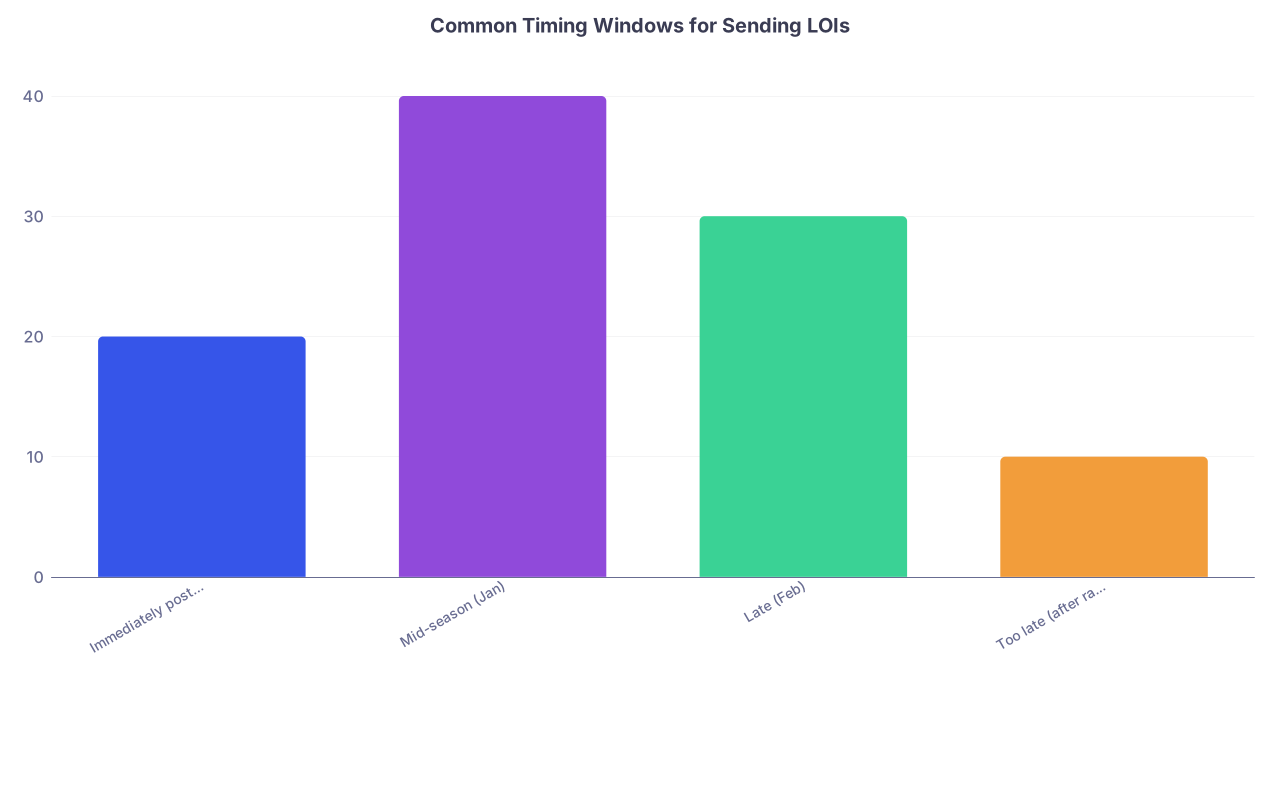
| Category | Value |
|---|---|
| Immediately post-interview | 20 |
| Mid-season (Jan) | 40 |
| Late (Feb) | 30 |
| Too late (after rank lock) | 10 |
When to Send
For both rotated and cold programs:
- Ideal window: 1–3 weeks before programs finalize rank lists. For most residencies, that is late January to mid-February.
- Acceptable: Within 1–2 weeks after your interview if you are sure about your interest.
- Too late: After the NRMP rank list certification deadline. At that point, it is just noise.
Practical approach:
- For a program you rotated at: a single, well-timed LOI in late January or early February is usually enough.
- For cold interviews: you can send a thank-you email immediately after the interview, then a single LOI later in the season if they stay high on your list.
Do not send weekly updates, “just checking in” messages, or obvious copy-paste letters.
Who to Send It To
Typical hierarchy:
- Program Director (PD) – always on the recipient list.
- Associate PD or Chair of Selection Committee – often included automatically if you e-mail the PD and CC the general residency e-mail.
- Program Coordinator – CC them; they often manage the flow of these messages.
- “Letter of Intent – [Your Name], ERAS ID [#######]”
- “Update of Continued Strong Interest – [Your Name], [Specialty] Applicant”
Do not bury your ERAS ID. Make it easy for the coordinator to match you in the system.
Common Structural Mistakes (and How to Avoid Them)
You can write 700 words and still fail if you fall into these traps.
Mistake 1 – The “Copy-Paste with Names” Letter
Symptoms:
- Paragraph 1: “Your program offers excellent clinical training and research opportunities.”
- Paragraph 2: “Your residents are supportive and collegial.”
- Paragraph 3: “I would be honored to train there.”
This could describe literally any mid-to-large residency in the country. If I can swap “Program A” with “Program B” and nothing breaks, you have written a useless LOI.
Fix:
- For rotated programs, use case-based recall and named individuals.
- For cold programs, reference specific interview-day content (unique clinics, call structure, curriculum design, research foci).
Mistake 2 – Overstating Rank Intent
If your structure includes:
“You are my absolute #1 choice and the only place I can see myself training.”
…in multiple letters, you are lying. And if two PDs show each other your e-mails at a conference, you will look ridiculous.
Fix:
Use graded language intentionally. Decide who (if anyone) gets the “first choice” statement. For everyone else, keep it at “one of my very top choices” and mean it.
Mistake 3 – Rewriting Your Personal Statement
An LOI is not your autobiography. It is a targeted memo late in the cycle.
If more than 30% of your LOI content could be cut and pasted from your personal statement (origin story, extended life history, full research narrative), you have missed the point.
Fix:
Focus the structure on:
- Rotation experiences (for rotation LOIs).
- Interview-day impressions (for cold LOIs).
- Updated intent and fit, not origin stories.
Mistake 4 – Length Creep
You are not writing a novel. Most PDs are skimming these between meetings.
Aim for:
- 3/4 to 1 full page, single spaced, in an e-mail body.
- Roughly 400–700 words. Longer only if your rotation was unusually complex and you have real substance to add.
If any paragraph runs longer than 6–7 lines in a standard e-mail view, consider splitting it.
Putting It All Together: Example Skeletons
I will outline lean skeletons so you can see the pieces click.
Rotation LOI Skeleton (Template-Level)
Greeting + Statement of Interest
- PD + committee greeting.
- “Your program is my [first choice / one of my very top choices].”
- Mention the specific rotation (service + month).
Rotation Acknowledgment
- 1–2 sentences naming team members / residents.
- Quick global impact statement.
Specific Experiences
- 1 paragraph describing 1–2 clinical moments that illustrate why you fit.
- Emphasis on autonomy, supervision, teaching, culture—whatever actually resonated.
Feedback / Growth
- 1 short paragraph about what you learned, how you improved, and any themes from your evals.
Fit + Goals
- 1 paragraph linking program features (curriculum, patient population, research, pathways) to your immediate and long-term goals.
Location / Stability
- Optional 1–2 sentences about geographic ties or reasons you are likely to stay.
Closing
- Restate strong interest.
- Thank them.
- Offer to provide more information.
Cold Interview LOI Skeleton
Greeting + Post-Interview Interest
- PD + committee.
- “After our interview on [date], your program remains one of my very top choices.”
Key Interview Impressions
- 2–3 specific aspects: curriculum, patient population, culture, unique pathways.
You + Program Alignment
- 1–2 paragraphs connecting your clinical interests / prior experiences to those features.
- Reference named faculty / specific clinics or tracks when possible.
Geography / Long-Term Plans
- 1 short paragraph about why this city/region legitimately makes sense.
Rank Intent
- One sentence clarifying that they are a top choice, or your top choice if you mean it.
Closing
- Thank them.
- Brief note of willingness to provide updates / additional info.
A Quick Structural Flow Check
If you want a visual, here is the mental flow I use when reviewing an LOI draft.

| Step | Description |
|---|---|
| Step 1 | Start LOI Draft |
| Step 2 | State rotation and top choice status |
| Step 3 | Describe 1 to 3 concrete rotation cases |
| Step 4 | Integrate feedback and growth |
| Step 5 | Connect program features to goals |
| Step 6 | Add geography and stability signals |
| Step 7 | Clear closing |
| Step 8 | Anchor to interview date |
| Step 9 | Highlight 2 to 3 interview impressions |
| Step 10 | Map your background to program strengths |
| Step 11 | Explain geography and life fit |
| Step 12 | Clarify rank intent |
| Step 13 | Rotated at program |
If your draft jumps around—goals first, then random flattery, then an anecdote, then another goal—you will exhaust the reader. Follow the flow.
Final Thoughts: What Actually Matters
Let me compress this.
Treat rotation LOIs and cold interview LOIs as different beasts.
Rotation LOIs should be anchored in shared cases, named people, and observed growth. Cold LOIs should be anchored in specific interview-day impressions and tight program–applicant alignment.Use clear, honest rank-intent language once, not everywhere.
Decide who, if anyone, gets the “you are my first choice” line. For others, “one of my very top choices” is strong and credible.Specificity is your only real leverage.
If someone could replace the program’s name with another and your letter still works, you have written a generic compliment sheet, not a meaningful letter of intent.