
The biggest lie people tell you about letters of intent is that “sincerity is all that matters.”
It’s not. Sincerity is the baseline. The price of admission. After that, it’s a war against sounding like every other desperate applicant who “loves the curriculum, values collaboration, and would be honored to train here.”
I’m writing this as someone who has stared at a draft LOI at 1:47 a.m. thinking: “This could’ve been written by literally any neurotic premed with access to Reddit.”
You’re not crazy for worrying your LOI sounds like everyone else’s.
You’re right to worry. And you’re also probably overestimating how bad it actually is.
Let’s unpack that tension.
The Fear: “My LOI Is Generic, So I’m Doomed”
There’s this specific spiral that happens with LOIs:
You write your first draft.
It sounds… fine. Polite. Slightly boring.
Then you read sample LOIs online. Or you see someone post theirs in a group chat.
Suddenly your brain goes: “Wait. We all sound the same. ‘Top choice.’ ‘Perfect fit.’ ‘Innovative curriculum.’ ‘Commitment to serving the underserved.’ Did I just write a word cloud?”
Then the real panic kicks in:
If I sound like everyone else, won’t they just ignore me?
If they ignore me, I don’t get an interview / an A / move off the waitlist.
If I don’t get that, maybe I don’t match / don’t become a doctor.
If I don’t become a doctor, what was the last 8 years of my life for?
That’s the spiral, right? Because it’s never just about the letter.
It’s about the whole dream.
Here’s the blunt truth: most LOIs do sound similar. Templates, advisors, Reddit, friends—everyone pushes the same polite formula. Programs know this. They’re not expecting Shakespeare.
The problem isn’t that your LOI overlaps with others.
The problem is when it’s so vague that it could be addressed to any program, any city, any specialty.
That’s what you actually need to be afraid of. Not “similar.”
Interchangeable.
What Programs Actually Care About (Harsh Version)
Let me say the quiet part out loud:
A letter of intent is not magic. It can’t resurrect a dead application.
Think of an LOI as a small nudge when:
- You’re already on their radar
- You’re competitive enough that they could realistically rank/accept you
- They’re trying to decide between several similar applicants
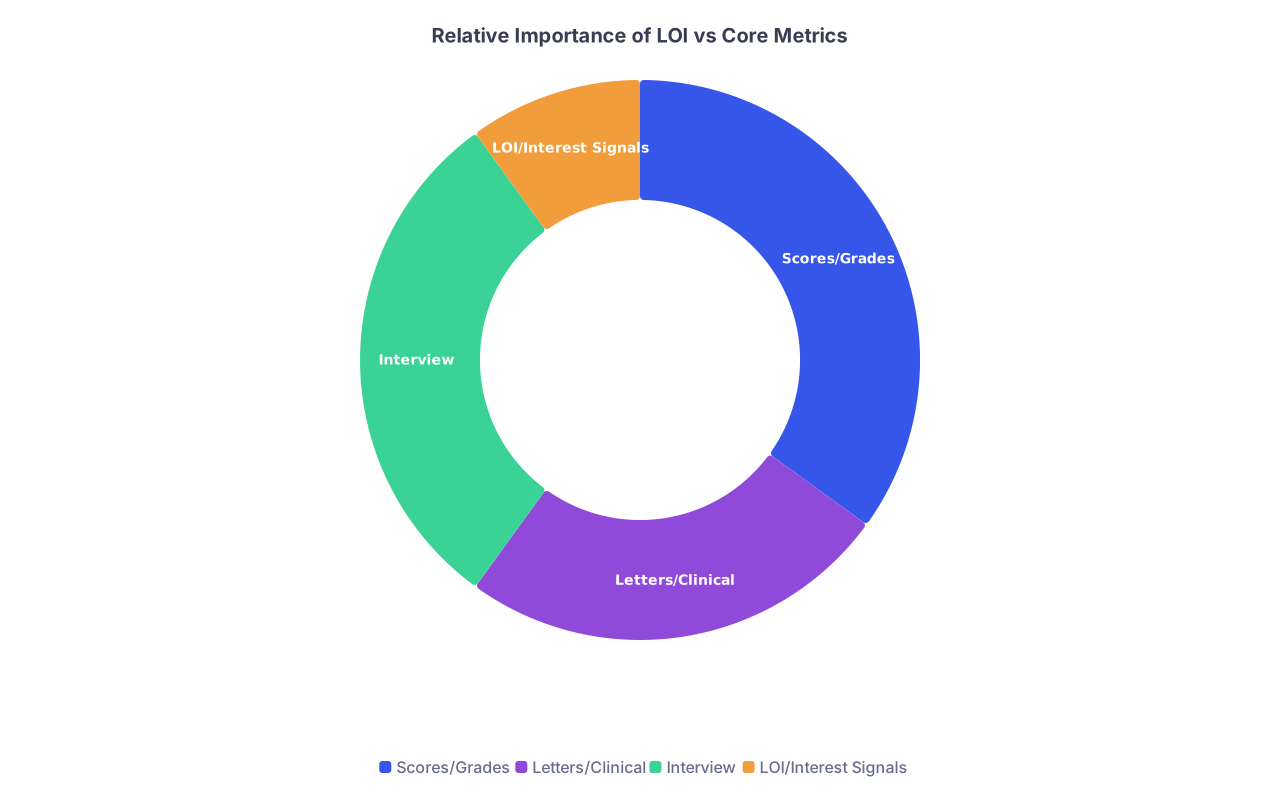
| Category | Value |
|---|---|
| Scores/Grades | 35 |
| Letters/Clinical | 25 |
| Interview | 30 |
| LOI/Interest Signals | 10 |
If your metrics are far below their typical range, they won’t suddenly say,
“Oh, but this letter of intent… they used the word ‘truly’ twice. Accept them.”
I’ve seen applicants convince themselves:
“If I don’t nail this LOI perfectly, I’ll lose my only chance.”
No. The LOI is not the main dish. It’s seasoning.
Programs mainly use LOIs to answer three questions:
- Are you actually serious about us, or are we just on your list as backup?
- Do you understand our program, or did you copy-paste this?
- Has anything changed (updates, new achievements, Step/board scores, positions, etc.)?
That’s it. They’re not running literary criticism on your metaphors.
So the real goal isn’t:
“How do I write the most unique letter anyone’s ever seen?”
It’s:
“How do I write a letter that makes it very hard to confuse me with someone who barely knows this program?”
Different bar. Much more achievable.
Why Everything You Write Feels Fake (Impostor Brain Doing Cartwheels)
Here’s the thing nobody really names: a lot of this fear isn’t actually about the letter. It’s about impostor syndrome.
You write: “This program is my top choice.”
Your brain: “Is it though? What if you’re lying? What if they can tell you’re lying?”
You write: “I believe I will thrive in your rigorous training environment.”
Your brain: “Thrive? You could barely handle 3 overnight calls on sub-I. You’re a fraud.”
You write: “I’m committed to contributing to your community.”
Your brain: “You forgot to answer that email from your volunteer supervisor two weeks ago. ‘Committed’ is a stretch, champ.”
So you second-guess every sentence. Delete. Rephrase. Overcomplicate.
The result? Generic mush.
Here’s the ugly truth: everyone uses the same vocabulary in LOIs.
“Thrilled.”
“Honored.”
“Top choice.”
“Mission-driven.”
That doesn’t make you fake. It makes you normal.
What makes you sound like an impostor is not using common phrases.
It’s when you:
- Don’t back those phrases up with anything specific
- Inflate your interest into melodrama (“It has been my lifelong dream to attend [program]” for a place you heard of 9 months ago)
- Sound like you’re auditioning to win a purity contest instead of a residency/fellowship spot
You are allowed to sound like a professional human being who wants a job.
You don’t need to sound like the protagonist of an inspirational documentary.
How To Make Your LOI Sound Less Like Everyone Else’s (Without Becoming Cringe)
Let’s keep this practical. You’re not trying to write poetry. You’re trying to not sound like a bot.
So here’s a structure that (1) works, and (2) still leaves room for you to sound like you:
- Clear, direct opening
- Concrete reasons why this program, not just any program
- Brief update(s) since your application/interview
- Reassurance of sincerity (yes, you have to say the “top choice” thing)
- Short, clean closing
1. The Opening: Stop with the Apologies
Bad version:
“Thank you so much for taking the time to review my application and for this opportunity. I know you’re busy and I deeply appreciate…”
They know. You don’t need three lines of groveling.
Better:
“I’m writing to reaffirm my strong interest in [Program Name] and to state that it is my clear first choice for residency.”
No fluff. No throat-clearing. You’re not wasting their time.
2. Specifics That Don’t Sound Like You Copied the Website
This is where most people fail. They say:
“I’m drawn to your strong clinical training, diverse patient population, and commitment to research.”
That sentence could be pasted into an LOI for 120 different programs.
Fix it by getting painfully specific:
Instead of:
“I appreciate your strong clinical training.”
Try:
“My sub-internship at a county hospital made me realize I want heavy exposure to uninsured and underinsured patients. The volume and acuity at [Hospital Name] and the fact that your residents are primary managers in the ICU are exactly what I’m looking for.”
Now it sounds like a person, not a brochure.

Do that for 2–3 points:
- Something about the clinical environment that actually matters to you
- Something about the culture/people that came from your interview day or talking to residents
- Something about your goals that lines up with what their program actually offers (not imaginary features)
If you can replace the program name and it still makes sense? It’s not specific enough.
3. Updates That Actually Add Weight
If your brain is doing, “I have no updates, I’m useless, they’ll think I’m stagnant”—calm down.
Not every update needs to be, “I published three first-author NEJM papers and discovered a new disease.”
Real, normal updates that matter:
- You took Step 2/COMLEX 2 and got a solid or improved score
- You started or took on a leadership role in something concrete
- You presented a poster or got a manuscript accepted
- You got meaningful feedback on your clinical work (honors, awards, evaluations)
You don’t have to oversell. Just be factual:
“Since interviewing at [Program], I have completed my sub-internship in [specialty] and received honors. I also presented my research on [brief topic] at [conference]. These experiences have further confirmed my desire to train in an environment like [Program], where I can continue building strong clinical and academic skills.”
Clean. Not performative.
4. The “Top Choice” Line You’re Overthinking
You’re probably terrified of this part.
“What if I say ‘top choice’ here and there’s another place I also really like? What if I change my mind? What if they somehow find out I wrote this to more than one program and I get blacklisted into oblivion?”
Here’s the ethical line I stick to, and yes—I’m taking a stance:
- Only say “this program is my clear first choice and I will rank it first” to one program.
- If you can’t honestly say that, then don’t. Use “very strong interest” instead of “first choice.”
- Do not send conflicting “I will rank you #1” letters. That’s not strategy. That’s lying.
Programs talk more than you think. Not hourly gossip, but enough that if you blatantly double-deal, it can burn you.
But here’s the other side:
If you genuinely know this is your first choice, it’s not manipulative to say it clearly. That’s the whole point of an LOI.
The Part You’re Really Scared Of: Being Forgettable
Let’s be honest. Underneath all the obsessing about wording is one simple fear:
“They won’t remember me. I’ll just be Applicant #127. The one with the ‘strong interest’ and the ‘great fit.’”
And yeah, that’s possible. You were one of dozens they interviewed. The coordinator has a spreadsheet the size of a novel. The PD has notes that literally say things like “good fit, quiet, researchy, liked ICU.”
You cannot control how they remember you.
You can control whether your LOI sounds like a mass email or a continuation of a real interaction you actually had.
Think about details from your interview day:
- A specific resident you talked to and what they said
- A particular case or patient story someone shared
- A moment that made you think, “Okay, I could actually see myself here”
Mention that. Briefly. Like a human.
“On interview day, talking with Dr [X] about how your interns present on rounds and are encouraged to make independent plans made a strong impression on me. That level of trust and responsibility is exactly what I’m hoping for in residency.”
Now they’re not just seeing “generic flattery.” They’re seeing,
“Oh, they remember something real that happened here.”
That’s how you cut through the sameness. Not by sounding “epic.” By sounding like you actually showed up, paid attention, and cared.

| Step | Description |
|---|---|
| Step 1 | Applicant |
| Step 2 | LOI Sent |
| Step 3 | Minimal Impact |
| Step 4 | Used in Tie Breakers |
| Step 5 | Shows Genuine Interest |
| Step 6 | Can Nudge Higher Rank |
| Step 7 | Already Competitive? |
Reality Check: What If Your LOI Really Does Sound Generic?
Let’s say worst case: you wrote it, sent it, reread it, and realized half of it sounds like ChatGPT on a bad day.
Does that ruin you? No.
Here’s the hierarchy of disaster:
- Catastrophic: You come off dishonest or send conflicting “rank you #1” letters.
- Bad: You claim things about the program that are obviously wrong or off (wrong hospital name, wrong specialty emphasis).
- Neutral: You sound generic but polite and accurate.
Neutral is fine. Neutral will not tank a file that was otherwise competitive. Programs don’t do, “We were going to rank them but this letter was mid, so never mind.”
Would a stronger, more specific LOI maybe have helped in a tie-breaker situation between you and someone almost identical? Maybe.
But you will never know that. They will never email you like, “You were one adverb away from matching here.”
There’s a point where more obsessing doesn’t change the outcome. It just wrecks your sleep.

Your job: make the letter honest, specific, and not embarrassing.
Not historic. Not legendary. Just solid.
The Future of All This: Are LOIs Getting Out of Control?
Yeah, a little.
The whole “letter of intent” economy has gotten kind of absurd. People are:
- Paying consultants hundreds to write “unique” LOIs that all say the same five things
- Sending LOIs to every program they interviewed at
- DM’ing faculty on LinkedIn to “signal interest” in increasingly elaborate ways
Programs are not dumb. They know this game. Some are starting to say outright:
“We do not take letters of intent into consideration”
or
“Please limit post-interview communication.”
And with signaling tokens, preference signaling in ERAS, and all the weird new tools coming, LOIs might matter less over time, not more.
So where does that leave you?
Use the LOI for what it is: a single, clear signal.
Not a personality test. Not your last stand as a human being.
| Factor | Impact Level |
|---|---|
| Clear first-choice statement | High |
| Program-specific details | High |
| Honest, concrete updates | Medium |
| Generic but polite language | Low |
| Overly emotional language | Negative |
| Conflicting ‘#1’ letters | Very Negative |
FAQs – Exactly What You’re Afraid To Ask
1. What if I already sent a kind of generic LOI—should I send another “better” one?
No. Do not start spamming them with “updated” LOIs unless you have actual new updates (new score, publication, major award). Sending a second version just because you’re suddenly embarrassed by the first one usually makes you look anxious and disorganized, not serious.
2. Will they compare my LOI writing style to my personal statement and think I got help or cheated?
Almost never. They’re not doing forensic linguistics on you. Everyone writes a bit more formally in LOIs, everyone gets some editing help, and everyone sounds more polished than they do in real life. As long as you didn’t have someone completely rewrite your voice into a different person, you’re fine.
3. What if I genuinely don’t have any major updates—should I even send an LOI?
Yes, if this program is truly high on your list. An LOI can still matter as an interest signal even without big new accomplishments. Just don’t stretch and invent “updates” out of nothing. You can say something like, “Since interviewing at [Program], I’ve reflected further on my goals and remain confident that your program is my top choice.”
4. Can I say “one of my top choices” to multiple programs, or does that sound weak?
You can. It’s honest. It’s also weaker than “clear first choice and I will rank you first,” but that’s the tradeoff. If you’re torn between a few places and can’t commit ethically to one #1, it’s better to be a little vague than to lie. Programs still appreciate hearing you’re very interested.
5. What if my LOI is only like 250–300 words—is that too short?
No. Too long is actually worse. Most PDs and coordinators prefer short, focused, non-rambling emails. Two or three short paragraphs that clearly state your interest, a couple specifics, and any updates is totally acceptable. They’re scanning, not studying.
6. Could a bad LOI actually hurt my chances?
Yes—but “bad” means things like: wrong program name, wildly generic flattery clearly copied, obvious exaggerations, or ethically sketchy stuff like promising them #1 while telling another program the same thing. Slightly boring? Fine. A little generic? Fine. Mildly awkward wording? Fine. Catastrophic dishonesty or sloppiness? That can hurt.
Keep three things in your head:
- Your LOI doesn’t need to be unique. It needs to be specific and honest.
- sounding like a normal, slightly anxious applicant is fine. Programs are full of those.
- Once you’ve written a clear, respectful, specific letter and sent it—your job is done. The rest is not in your control, no matter how many times you reread the Sent folder.