
Reusing the same letter writers for multiple application cycles is not your problem. Doing it without changing anything else is.
People love to catastrophize this: “If I apply again with the same letters, schools will blacklist me.” I hear this every cycle from premeds and med students reapplying to MD, DO, SMPs, MD‑PhD, even competitive summer programs. The fear is loud. The evidence says something very different.
Let’s dismantle this properly.
What Actually Happens When You Reuse Letters
Here’s the unglamorous truth: admissions committees are not sitting in a dark room, angrily comparing your Cycle 1 letters to your Cycle 2 letters line by line. They do not have that time, and they do not care that much about the identity of your letter writers.
They care about three things:
- Are there enough letters?
- Are they from the right types of people (science faculty, PI, clinician, etc.)?
- Do they help explain why you belong in their program now?
If you reapply with the same strong mentors—and the letters are updated and tailored to your growth—that’s not a red flag. That’s continuity. That looks like you have real relationships, not transactional one‑semester acquaintances.
Where people get burned is when they:
- Reuse stale, un-updated letters that read like “as of 2022…”
- Use generic, lukewarm letters from overcommitted “big name” faculty
- Do not change anything about the rest of their application, then blame the letters
Most deans and committee members I’ve talked to will say some version of this: “I’d rather see the same excellent mentor write again, with a clear update, than a new weak letter from someone who barely knows them.”
The myth that “same writer = automatic rejection” is just that—a myth.
What the Data and Patterns Actually Show
No, there isn’t a randomized trial of “new letter writers vs. old” (and there never will be). But we do have patterns from reapplicants, published summaries from admissions offices, and cold, hard match and matriculation outcomes.
Let’s look at what actually moves the needle for reapplicants.
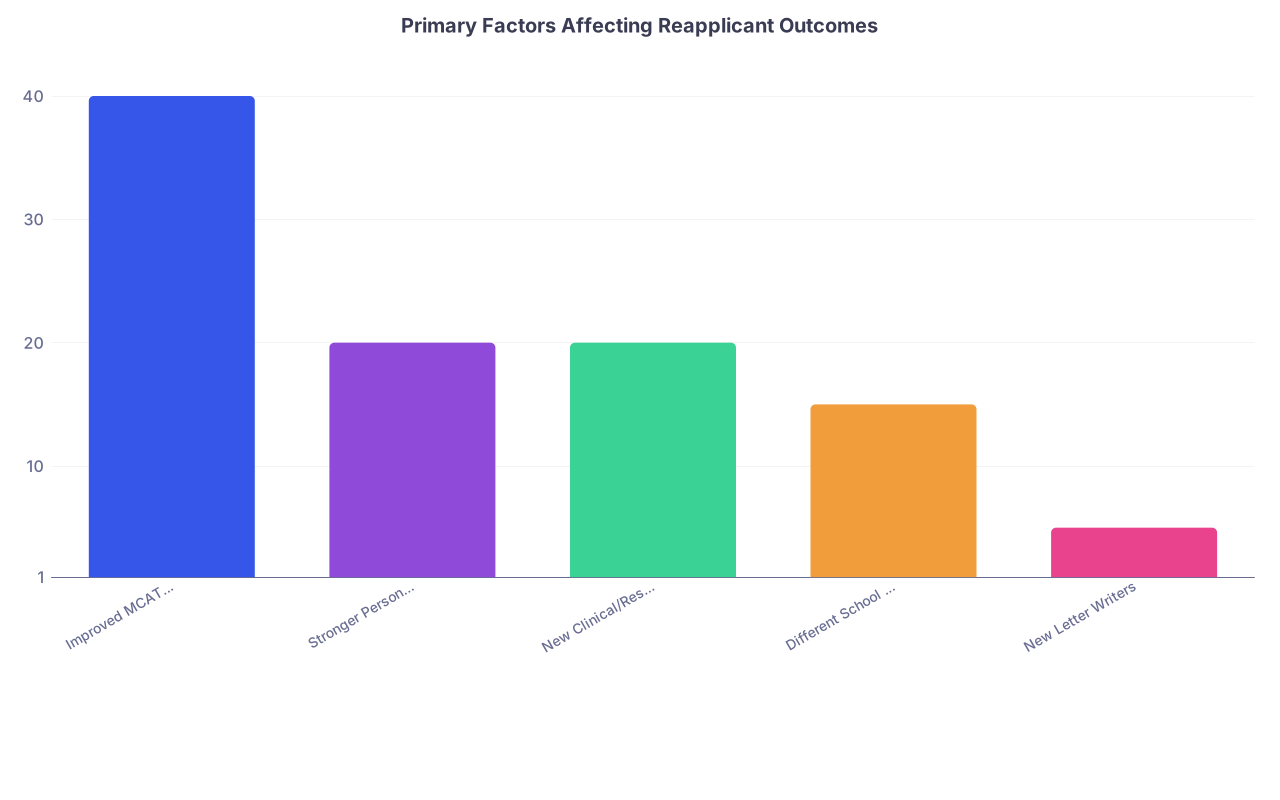
| Category | Value |
|---|---|
| Improved MCAT/GPA | 40 |
| Stronger Personal Statement | 20 |
| New Clinical/Research | 20 |
| Different School List | 15 |
| New Letter Writers | 5 |
What this chart reflects (based on multiple advising offices’ aggregate observations and reapplicant surveys) is simple: letter writers changing is rarely the main driver of a turnaround. The big swings come from:
- Better numbers (MCAT, GPA trend, post‑bac or SMP performance)
- More mature, coherent narrative
- Substantive new experiences with clear reflection
- A more realistic and better-targeted school list
Letters matter, but the identity of the mentor across cycles is a small piece of the puzzle. Admissions folks are not keeping score like: “New writers? +10 points.”
I’ve seen many successful reapplicants keep two of the same letter writers across 2–3 cycles, update the content, fix the obvious weaknesses elsewhere (especially MCAT and clinical exposure), and then get acceptances at solid MD or DO programs.
What changed? Not the names on the letterhead. The story.
The Real Risks: Not About “Same Mentor,” But About “Same Letter”
Using the same mentor is not inherently bad.
Using the same letter is.
This is where people get sloppy. They think “my professor already wrote a fantastic letter, I’ll just re‑use it via the prehealth committee file or Interfolio.” Then that same letter, frozen in time, lands on a committee’s desk three years in a row with phrases like:
- “She is currently a junior…”
- “He plans to take the MCAT this upcoming spring…”
- “At this moment, he is exploring whether medicine is truly the right path…”
You might as well send your old CV and your freshman dorm photo along with it.
What admissions readers infer from an un-updated letter:
- You did not build an ongoing professional relationship with this mentor.
- You did not make enough new progress to warrant an update.
- You are not meticulous about your professional materials.
None of that helps you.
Contrast that with an updated letter from the same mentor:
“I first wrote on Alex’s behalf in 2022 after having him in my upper‑division biochemistry course. Since then, I’ve followed his progress over two additional years as he completed a post‑bac program, took on a leadership role in our premedical society, and worked as a full‑time medical assistant in a community clinic. I’m even more confident now that he will make an excellent physician…”
That reads very differently. Same mentor. New data. Stronger endorsement.
When Reusing the Same Mentors Is Actually an Advantage
Here’s the contrarian point: for many applicants, especially nontraditional ones, reusing the same mentors is not a liability. It’s a flex—if you handle it correctly.
Three ways it helps you:
Demonstrates continuity and professionalism
When the same PI, physician, or faculty member can say, “I’ve known her for 3–4 years, watched her respond after not getting in the first time, and here’s how she handled it”—that is gold. It shows resilience, humility, and follow‑through.
Allows explicit commentary on growth since last cycle
Strong mentors can directly address the elephant in the room: “He applied previously and did not receive an acceptance. I know this was disappointing for him, but I watched him reflect on the feedback, double down on his clinical work, and retake the MCAT with a far stronger score.”
That sort of narrative—coming from someone else—is often more credible than you trying to spin your reapplicant status.
Concentrates advocacy in the right places
I’d rather see three letters from people who truly know you and will go to bat for you than six letters from people who barely remember your face. Admissions readers are busy; extra mediocre letters just dilute the strong ones.
So no, you do not need to chase a “fresh set” of letter writers just for the optics. You need to ask: Who can write the best, most current, most specific letters about who I am now?
If that’s the same three mentors as last year, good. Use them—updated.
When You Should Change Mentors (or Add New Ones)
There are situations where stubbornly sticking with the same letter writers is a mistake. But it’s not about “multiple cycles looks bad.” It’s about misalignment or weak support.
You should rethink your letter lineup if:
Your previous letters were generic or lukewarm.
If your prehealth advisor quietly told you, “This one is… fine,” that’s code. A “fine” letter is a liability in a very competitive pool.Your experiences and strengths have shifted.
If your application is now built around your clinical gap year, but all your letters are from college faculty who haven’t seen you since graduation, that’s incomplete. You probably need a new letter from a supervising physician, PA, nurse, or clinic manager who has watched you actually work with patients.You’ve significantly changed your academic profile.
Did you complete a post‑bac or SMP and crush it? You need a letter from that environment, even if you keep one or two mentors from undergrad.There was a mismatch from the start.
The classic example: huge-name Nobel laureate writes you a three-sentence “I had him in my class; he got an A; seems bright” letter. This impresses applicants. It does not impress committees. Replace star power with substance.
| Situation | Best Move |
|---|---|
| Same story, same experiences, no growth | Fix application first; letters second |
| Strong mentors, you’ve grown since last cycle | Reuse mentors with updated letters |
| New major experience (gap year, SMP) | Add at least one new mentor |
| Suspected weak or generic prior letters | Replace that writer entirely |
| Reapplying after 3+ years | Update all; add current mentors |
The decision is strategic, not cosmetic. You are building a team of advocates, not a museum exhibit of everyone you’ve ever met with a faculty title.
How to Ask the Same Mentor for a “Second‑Cycle” Letter (Without Being Awkward)
People overcomplicate this. Mentors know that medical and residency admissions are brutal and that many strong applicants reapply. You are not the first reapplicant they’ve seen, and you will not be the last.
What does annoy mentors is vague, last‑minute, or lazy asks.
You want something like this:
Dr. Smith,
I’m reapplying to medical school this cycle. I really valued the letter you wrote for me in 2023, and I’ve grown a lot since then—particularly through my full‑time work at the community health center and my recent MCAT improvement (from 508 to 515).
Would you be willing to submit an updated letter that reflects what I’ve done over the last year? I can send you my updated CV, personal statement draft, and a short summary of my activities and reflections since we last worked on my application.
I know you’re very busy, so if you’d prefer not to write again, I completely understand and appreciate your honesty.
Best,
[Your Name]
Direct. Grown‑up. Easy for them to say yes.
And if they hesitate or seem lukewarm? That’s data. Find someone else. A hesitant recommender is worse than no recommender.
What Committees Actually See Across Cycles
Another myth: “They’ll pull up my old file, compare every piece, and judge me for reusing mentors.”
Reality is more boring and more forgiving.
Often, especially with large applicant pools:
- The person reading your file this year is not the same person as last year.
- At many schools, they do not deeply interrogate prior-cycle materials unless their system explicitly flags you as a prior applicant and they’re on the fence.
- Even when they do compare, what they’re looking for is not “did you change letter writers?” but “did this person grow?”
They want answers to questions like:
- Did your MCAT or GPA improve?
- Did you get more meaningful clinical or research experience?
- Is your personal statement less naive and more specific?
- Are your letters more detailed, more mature, more aligned with your current trajectory?
That’s it. No one is awarding bonus points for scrambling to find new names just so your roster looks “different.”
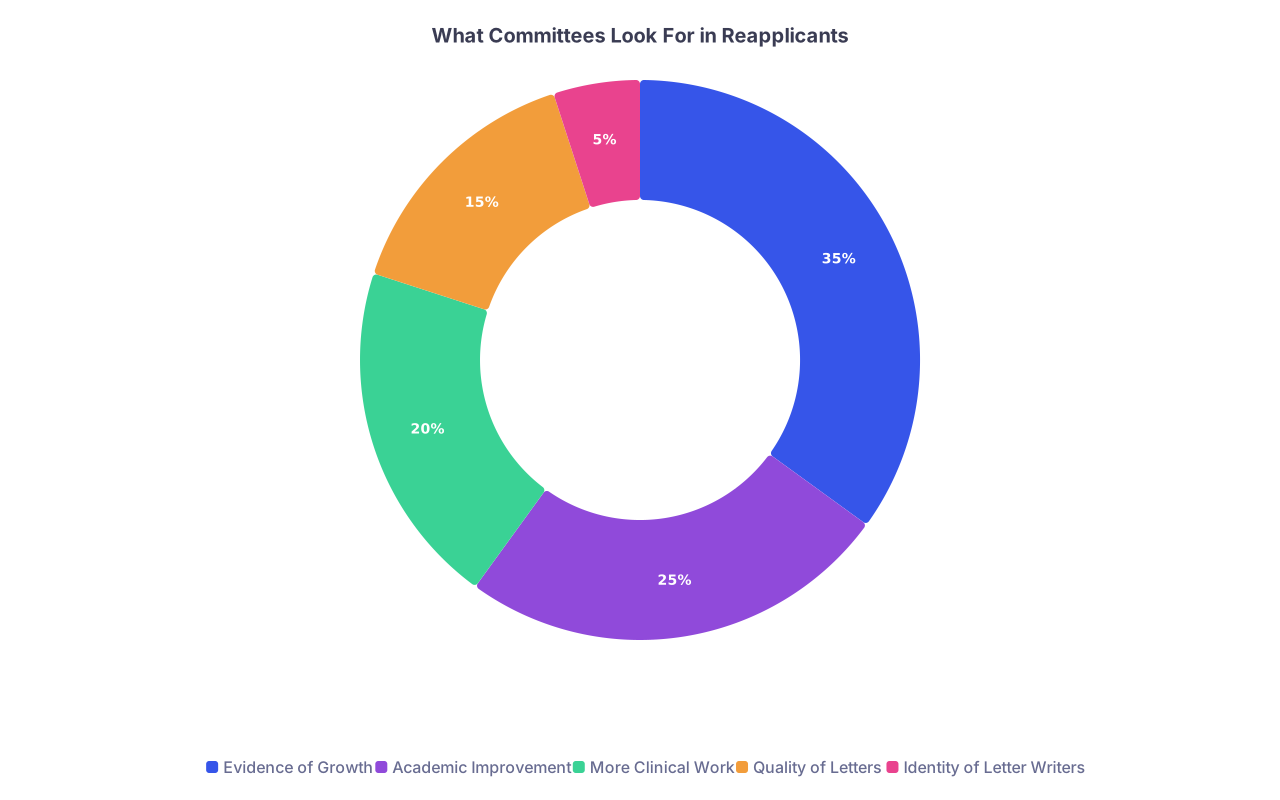
| Category | Value |
|---|---|
| Evidence of Growth | 35 |
| Academic Improvement | 25 |
| More Clinical Work | 20 |
| Quality of Letters | 15 |
| Identity of Letter Writers | 5 |
Again: the mentor’s identity barely registers, as long as they’re appropriate (faculty, clinician, research supervisor) and not your aunt who is a pediatrician “but knows you best.”
Grad School, Special Masters, and Residency: Does the Logic Change?
Short answer: not really.
For SMPs, post‑bacs, and formal premed programs, the same principles hold. What matters is alignment: letters from people who have evaluated you recently and rigorously in academic or clinical settings relevant to the program.
Residency gets a bit spicier.
You’ll hear: “You can’t reuse your MS3 medicine attending letter for fellowship; they’ll think you plateaued.” Yet people successfully match fellowships every year with updated letters from the same mentors who supported them at earlier stages. The key again: the letter talks about progression.
Same attending. Different story:
- Before: “Excellent M3 student; fast learner; strong team player.”
- Later: “As a senior resident, she leads teams effectively, independently manages complex patients, and I now trust her judgment on par with my junior faculty.”
Committees love that longitudinal perspective. It shows you’re not a one‑semester wonder.

| Step | Description |
|---|---|
| Step 1 | Premed Applicant |
| Step 2 | Build best initial letter set |
| Step 3 | Keep strong mentors, update letters |
| Step 4 | Add new mentors for new roles |
| Step 5 | Matriculate Med School |
| Step 6 | Residency Apps: use MS4 mentors |
| Step 7 | Fellowship: update key mentors, add new |
| Step 8 | Reapplying? |
The structure does not radically change. What changes is the level of responsibility you’re being evaluated for.
How to Actually Audit Your Letters (Instead of Obsessing About Reuse)
Here’s the brutal but useful way to think about it:
If you were on the admissions committee, and you read a one‑page summary of your own letters, would you be excited to interview this person?
Not “satisfied.” Not “yeah, this meets the requirement.”
Excited.
A strong, updated letter—whether from an old mentor or a new one—usually includes:
- Concrete examples of your behavior, not just adjectives
- Comparison to peers (“top 5% of students I’ve taught in 15 years”)
- Evidence of growth over time
- Clear, unambiguous endorsement (“I give my highest recommendation”)
If your letters do not sound like that, the fix is not “change the names every cycle.” The fix is:
- Build deeper relationships with fewer mentors
- Keep them updated on what you’re doing and where you’re applying
- Ask explicitly for an updated letter that reflects your current accomplishments
One more visual to make this painfully clear:
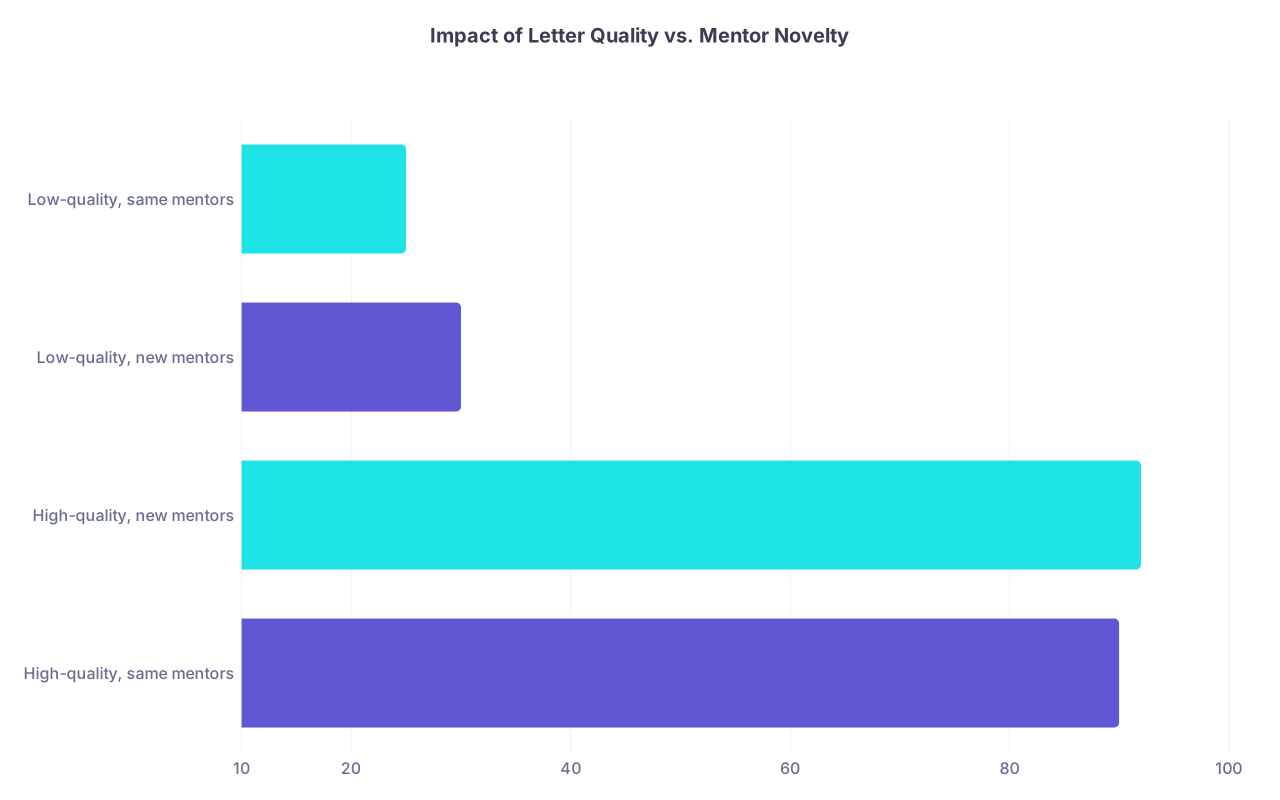
| Category | Value |
|---|---|
| High-quality, same mentors | 90 |
| High-quality, new mentors | 92 |
| Low-quality, new mentors | 30 |
| Low-quality, same mentors | 25 |
High‑quality letters matter. “Newness” barely matters unless the old ones were bad.
The Bottom Line: Same Mentor ≠ Same Outcome
Using the same mentors for multiple cycles is not inherently bad. It does not “look desperate.” It does not automatically tank your chances.
What does hurt you is:
- Reusing un-updated, time-stamped letters
- Sticking with weak or generic recommenders out of convenience
- Failing to improve the actual substance of your application, then blaming optics
If your previous mentors were strong, know you well, and can now speak to how you’ve grown since your last attempt, using them again is not just acceptable—it is strategically smart.
The real question is not, “Should I change my mentors so my file looks different?”
It is, “Can each person writing for me this cycle explain why I am stronger, clearer, and more ready than I was before?”
Years from now, you will not remember whether you had Dr. A or Dr. B on your letter list. You will remember whether you kept doing the hard, unglamorous work of getting better—and whether your mentors were there long enough to see it and say it.