

The panic you feel after matching to the “wrong” city or program is real—but the common advice you are hearing right now is mostly useless.
“Be grateful you matched.”
“You’ll love it once you get there.”
“Everything happens for a reason.”
Nice sentiments. Terrible strategy.
You do not need platitudes. You need a structured adjustment plan. A way to turn “This is not what I wanted” into “I have control over my life again.”
This is that plan.
Step 1: Diagnose the real problem (not the loudest one)
First rule: do not solve the wrong problem.
“I hate this city” usually means something more specific:
- I am far from my support system.
- The cost of living will crush me.
- The program’s culture worries me.
- I do not trust my training here.
- I matched into the wrong specialty, not just the wrong program.
You have to be brutally precise.
Do a 30-minute “Match Autopsy”
Sit down, no distractions, and answer these questions in writing. Not in your head. On paper or in a document.
What exactly feels wrong?
- City?
- Program?
- Specialty?
- Distance from partner/family?
- Lifestyle (night float, call, commute)?
Rate each of these from 1–5 (5 = huge problem):
- Training quality concerns
- Geographic distance from core support people
- Cost of living + finances
- Program culture / vibe
- Fit with your long-term career goals
- Mental health risk (based on what you know of yourself)
Write “If I stay and make this work, is that acceptable long-term?”
Answer honestly in 3–5 sentences. No fantasy transfers. Assume this is where you complete residency.
You are looking for patterns:
- If training quality and career alignment are low, that is a structural problem.
- If all the pain comes from distance, culture shock, or fear of unknown—this is often fixable with the right plan.
- If specialty fit is the real issue, “wrong city” is just the cover story.
Quick classification: which situation are you in?
Use this to orient your plan:
| Situation Type | Primary Issue |
|---|---|
| Type A | Great training, bad location/personal circumstances |
| Type B | Questionable training fit, okay location |
| Type C | Wrong specialty more than wrong program |
| Type D | Multiple serious mismatches (training + location + support) |
You will adjust differently depending on which box you fall into.
Step 2: Stop the bleeding – immediate damage control (first 72 hours)
You are emotionally flooded right now. You will make bad decisions if you act from panic.
Here is your 72-hour protocol.
1. Hard rule: No bridge-burning
Do not:
- Email programs asking for “swaps” in anger.
- Trash talk your matched program on social media or group chats.
- Tell everyone, “I hate this place” before you have even spoken to anyone there.
- Call attendings and say, “I want out,” in those exact words.
Those things close doors you might need later.
Do:
- A neutral, professional announcement post or message:
“Matched into Internal Medicine at [Program], excited to start residency this summer and grow as a clinician.” - Send a short thank-you email to:
- Your home PD or key faculty.
- Your letter writers.
- Anyone who advocated for you.
You are not lying. You are securing your future options.
2. Tactical emotional containment
You cannot “think your way out” of this in the first 2 hours after the email hits your inbox.
Your nervous system is in fight-or-flight.
Use a simple, evidence-based protocol:
- Sleep at least 6 hours that first night—even if you need melatonin or a short-term sleep aid (prescribed).
- Limit doom-texting. Pick 1–2 people you trust to vent to. Not 12.
- No big life decisions (reapplying, breaking up, quitting medicine) for 7 days.
You are not ignoring the problem. You are preventing emotional hemorrhage.
Step 3: Build a clear information map (1–2 weeks)
You are upset about a story you are telling yourself about this city or program. Some parts are true. Some are exaggerated. Some are pure fiction.
Your job now is to separate those.
A. Gather direct program data (not Reddit gossip)
Make a simple list of 10–15 questions under 3 buckets:
Training & career
- What fellowships do grads match into?
- How many go into academics vs community practice?
- Procedural volume? Case mix?
- Board pass rates?
- Autonomy level?
Schedule & workload
- Typical day on wards/ICU/clinic?
- Call structure?
- Night float?
- Vacation rules?
- Coverage for sick days?
Culture & support
- How approachable are attendings?
- How do seniors treat interns?
- Any prior resident attrition? Why?
- How is mistreatment handled?
Now get answers from:
- Current residents (not just chief residents, who are politically polished).
- Former residents if you can find them.
- Recent grads on LinkedIn (message: “Incoming intern, would love 10 min of your perspective. Especially on culture and career outcomes.”)
You are not interrogating. You are reality-checking.
Red vs yellow flags
Not every negative comment is a crisis. But some patterns matter.
Red flags (serious):
- Multiple residents say, “People leave here burned out or broken.”
- Consistent reports of ignored harassment or discrimination.
- Chronic under-staffing with unsafe patient loads.
- Board pass rates or fellowship outcomes significantly weaker than peers for your specialty goals.
Yellow flags (often manageable):
- “The hours are rough but doable.”
- “The city is quiet/boring.”
- “Administration is annoying but the residents are tight-knit.”
- “Housing is expensive but people share.”
If you are stacking mostly yellows with one or two borderline reds, this is usually survivable with a plan.
All reds? Different conversation (we will get there).
B. Reality-check the city
Stop saying “I hate this city” when you have never lived there and only know the airport.
Use a simple process:
Look up:
- Cost of living (Numbeo, salary vs rent calculators).
- Public transit vs car needs.
- Crime by neighborhood (not by TikTok rumor).
- Climate. Yes, winter exists. Plan accordingly.
Identify:
- 2–3 neighborhoods where residents actually live.
- Distance from hospital.
- Average rent for a studio / 1BR / shared.
Then talk to:
- 2–3 current residents: “Where do interns actually live? What would you do differently if you were starting again?”
Do this and you will often discover:
- Yes, rent is high—but everyone has 1–2 roommates and survives.
- No, you do not have to live in the “bad” part of town that Reddit fixates on.
- Yes, there are pockets of community, gyms, churches, temples, cultural groups, whatever you need.
You are not trying to fall in love with the city. You are trying to understand the terrain you are about to fight on.
Step 4: Decide: Adjust, Optimize, or Pursue Exit
Once you have real data, you pick a lane. You do not thrash between options for months.
Lane 1: Adjust – this is not ideal, but I can live with it
This is most people. The program is at least decent. The city is not your dream. But the combination is not career-ending.
Your goal = survive year 1 with your mental health and performance intact.
Here is your adjustment plan.
A. Design your support infrastructure before you move
Support does not magically appear. You build it.
Social
- Identify 1–2 co-interns you vibe with early. Message them pre-July: “Hey, I am moving up on [date], want to grab coffee or check out housing areas together?”
- Tell 2–3 key people at home: “I will probably crash emotionally at some point in the first 6 months. Can I schedule a weekly or biweekly call with you now?”
- Join 1 non-medical group in the first 2 months:
- Gym class
- Faith community
- Hobby meetup
- Language group
Clinical
- Ask senior residents: “What resources do you wish you had reviewed before intern year here?”
- Create a minimalist pre-start checklist:
- Local EMR tips (short video or cheat sheet).
- Admit note templates.
- Common order sets.
- Key local protocols (sepsis, DKA, stroke, ACS, OB emergencies, etc.).
Mental health
- Identify local or telehealth therapist options before you move. Not when you are already spiraling mid-October.
- Look into the GME wellness benefits—often underused but real: free counseling visits, confidential support, etc.
B. Use a 90-day adjustment framework
Think in concrete phases, not “I am miserable indefinitely”.
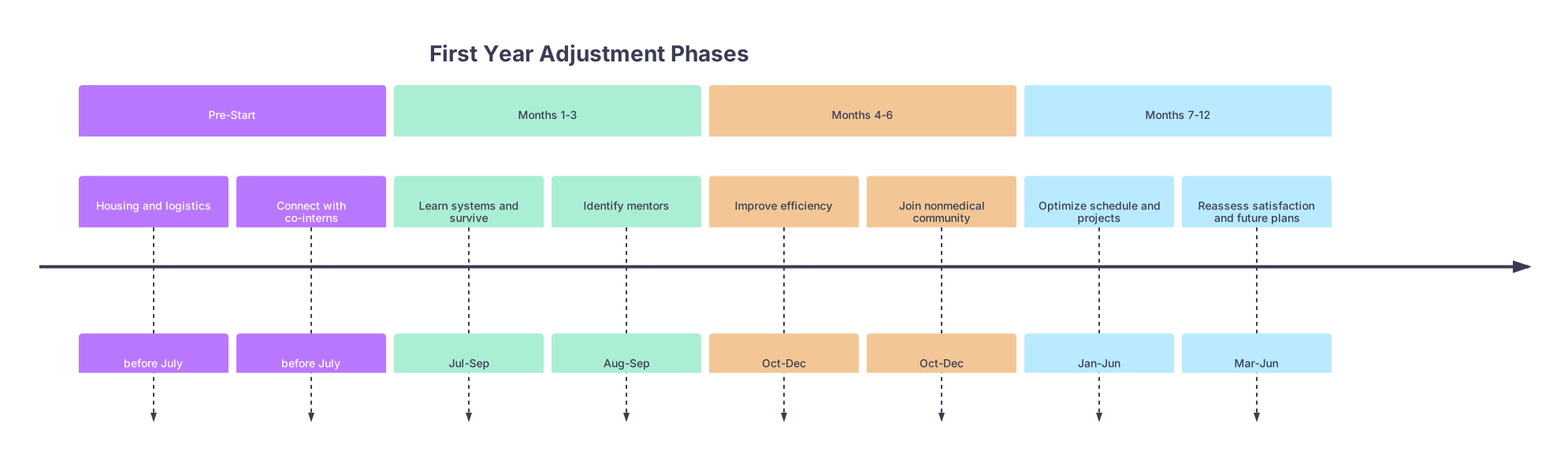
| Period | Event |
|---|---|
| Pre-Start - Housing and logistics | before July |
| Pre-Start - Connect with co-interns | before July |
| Months 1-3 - Learn systems and survive | Jul-Sep |
| Months 1-3 - Identify mentors | Aug-Sep |
| Months 4-6 - Improve efficiency | Oct-Dec |
| Months 4-6 - Join nonmedical community | Oct-Dec |
| Months 7-12 - Optimize schedule and projects | Jan-Jun |
| Months 7-12 - Reassess satisfaction and future plans | Mar-Jun |
You are not trying to “love it” by month 1.
You are trying to:
- Not drown.
- Learn the EMR.
- Know where things are.
- Build 2–3 resident friendships.
- Establish a life rhythm.
If by month 6 your baseline is:
- You have at least one close colleague.
- You can manage a call night without panic.
- You know 3 things you genuinely like about the city.
You are far better positioned than you feel on Match Day.
Lane 2: Optimize – this is workable, but I want leverage
Here, you do not hate the program. But it is not aligned with your long-term goals. Maybe you wanted academic cardiology and matched at a weaker community IM program. Or you wanted high-volume surgery and got a smaller place.
You accept where you are. Then you get strategic.
A. Find your “career wedge”
One focus area that will carry you forward no matter where you train:
- Research niche (e.g., HFpEF in Internal Medicine, or quality improvement in EM).
- Procedural expertise.
- Teaching/medical education.
- Leadership/admin exposure.
- Public health / community outreach.
Identify:
- 1 faculty member active in that world.
- 1 realistic project you can join or start in PGY1–PGY2.
You are building a “portable asset” that will matter for:
- Fellowship.
- Lateral program or job moves.
- Future positions anywhere.
B. Make your PD your ally, not your obstacle
Many residents treat the PD as a judge. Treat them as a partner.
Early in PGY1 or later PGY1, schedule a short meeting:
- “I am excited to train here. Long-term I am aiming for [career path]. I would appreciate your advice on how to best position myself from this program for that.”
You are not saying, “I want to leave.” You are saying, “I want to excel from here.”
This:
- Flags you as serious and purposeful.
- Gets you on their mental radar for opportunities.
- Gives you information about what is actually possible from your institution.
Step 5: When to seriously consider transfer or re-match
Now the hard part. Sometimes “make the best of it” is bad advice. Staying can do real damage.
A. Legitimate reasons to investigate leaving
These are not vague dislikes. These are structural issues:
Severe, persistent mistreatment or discrimination
- Racial or gender-based harassment.
- Retaliation when reported.
- Consistent reports of residents leaving due to abuse.
Training quality so poor it threatens your competence
- Very low clinical volume in your field.
- Chronic understaffing with unsafe ratios that put licenses at risk.
- No meaningful supervision on high-risk tasks or procedures.
Completely wrong specialty with clear, sustained regret
- You matched into Surgery but clearly wanted Psychiatry, and you knew it before Match.
- You forced yourself into a competitive field to “prove something” and now realize it was for ego, not fit.
- You are experiencing persistent dread and misalignment, not just normal anxiety.
Major family/medical circumstances
- New severe health condition, your own or a dependent’s.
- Partner or child requiring care that the current location makes impossible.
If one or more of these apply—and you have confirmed with data, not just feelings—you evaluate exit options.
B. How transferring actually works (not fantasy version)
Transfers are rare, bureaucratic, and slow. But they do happen.
Broad strokes:
- Intra-specialty transfer: You remain in the same specialty but move programs.
- Inter-specialty switch: You change specialties, sometimes with or without credit for prior training.
Both usually require:
- Your PD being informed (eventually).
- Existing open positions (often from other residents leaving).
- No major performance concerns on your record.
You do not:
- Secretly line up a transfer and then email your PD the night before you disappear.
- Publicly bash your current program as leverage.
You do:
- Document issues carefully (for genuine mistreatment/training problems).
- Seek confidential advice from:
- A trusted faculty mentor at your med school.
- A national specialty advisor (if you have one).
- In severe cases, GME office or ombudsperson.
If you are thinking “I might want out,” your next step is not “email other PDs.”
Your next step is: one confidential, honest conversation with a mentor who has seen this before.
Step 6: Build a personal survival system for year 1
No matter what you decide long-term, you still have to get through PGY1. Functionally. Safely.
Here is a template that works.
A. Non-negotiable routines
Pick one habit from each category you will protect on 80–90% of days, even on bad rotations.
Body
- 20–30 minutes of walking or light exercise (even around the block after a shift).
- Hydration + minimal real food (not candy and call-room pizza only).
- Consistent wind-down ritual for sleep: dim lights, phone away 20 minutes, same sequence nightly.
Mind
- 5–10 minutes of low-effort reflection: one line about what went well, one line about what was hard.
- If you are prone to anxiety or depression, brief grounding exercises during shifts:
- 5 slow breaths,
- Name 5 things you see, 4 you feel, 3 you hear, 2 you smell, 1 you taste. Cheap but effective.
Connection
- One standing weekly call or video with your core person / people.
- One shared meal or hangout with another resident per week (even cafeteria lunch).
You are not building a perfect wellness life. You are building minimum viable stability.
B. Professional growth micro-plan
You want to feel like you are becoming a better physician, not just surviving.
Pick one of these for the first 3–6 months:
- Master one common chief complaint per month deeply (e.g., chest pain, shortness of breath, altered mental status).
- Learn one procedure or skill more thoroughly (e.g., ABG sticks, central lines, bedside ultrasound basics).
- Take ownership of one small QI project (e.g., improving handoff consistency on your team).
This gives you a sense of forward movement even if you still dislike where you are.
Step 7: Reassess at 6 and 12 months—using data, not vibes
You do not stay in a miserable situation for 3 years just because “it will look bad to leave.”
You also do not blow up your training after 3 rough weeks.
Use scheduled check-ins.
At 6 months, ask:
Objectively, am I clinically growing?
- Am I more comfortable running a code, writing notes, presenting?
- Do seniors and attendings trust me more?
- Are there any performance concerns on file? (If yes, what is the plan?)
Has my emotional baseline improved at all?
- Still homesick? Normal.
- Still crying every single day and dreading going in? Not normal.
How many things about this place have moved from “I hate this” to “tolerable” or “actually okay”?
If I project this forward 2–3 years, can I see myself becoming the physician I want to be here?
At 12 months, decide:
You do a thicker version of that same review. Then you choose:
Commit and optimize
“This is not my dream, but I can become a competent physician and build a decent life here. I am going to stop fantasizing about elsewhere and double down on making this work.”Quietly explore structured exit options
- Honest conversation with a mentor about transfer or re-match.
- Begin information-gathering about open positions or specialty switches.
- Keep performance strong where you are to preserve your leverage.
What you do not do: live in a permanent mental limbo for three years.
A quick reality check on “wrong program” anxiety
I have seen residents from:
- “Top 3” academic programs who are clinically shaky and arrogant.
- Modest community hospitals who are absolute monsters in the ICU—in a good way.
- Non-name places who matched into Mayo, MGH, UCSF fellowships because they played their cards intelligently.
Your starting point matters less than:
- How seriously you take your clinical growth.
- How fast you adapt.
- How intentionally you build relationships and opportunities.
Is prestige real? Yes.
Is it destiny? Not even close.
Today’s action step
Do this today, before you go back to scrolling group chats:
- Open a blank page and write:
- The single biggest thing you are afraid of about your matched city or program.
- Three specific questions you need answered to know whether that fear is actually true.
- The names of two people you will contact this week (a current resident, a mentor, a classmate) to start getting real answers.
Then send the first message. Not next month. Today.


