
It’s June 10th. You’ve put down a deposit on your M1 seat. Your lease starts in August. And you’re staring at the MCAT registration page thinking: “If I take it this summer, I can ‘get it out of the way’ before med school… right?”
This is the point where people make really bad timing decisions.
Let me walk you through when a pre‑M1 summer MCAT actually makes sense, when it’s a trap, and how to structure the months, weeks, and days so you’re not walking into M1 already burned out or, worse, with a score you’re embarrassed to report.
Step 0: Where You Are on the Timeline
You’re somewhere in this rough sequence:
- You finished (or are finishing) junior or senior year.
- You either:
- Already applied and been accepted (pre‑M1 summer = “victory lap” summer), or
- Are planning to apply in a future cycle and are thinking of using a “gap summer” before M1 to take the MCAT.
Let’s pin your situation down, because timing advice changes a lot based on this.
| Situation | What You’re Trying to Do | Risk Level |
|---|---|---|
| Accepted, no MCAT required | Take MCAT “for fun/options” | Extremely high |
| Accepted, conditionally needs MCAT | Meet score minimum | Medium–high |
| Planning post-bacc or SMP | Use summer score for apps | Medium |
| Traditional junior → M1 | Last chance before apps | High |
| Reapplicant pre-M1 | Retake to improve score | Medium–high |
If you are already accepted to a medical school that does not require an MCAT for matriculation and you’re thinking of taking the MCAT “just in case I might want to transfer or reapply upward” — stop. That is almost always a bad idea. You’re gambling a guaranteed MD/DO seat against a test that can absolutely wreck you if you’re not fully prepared.
If your acceptance is conditional on an MCAT score, or you’re in a linkage/post‑bacc/SMP that requires a certain MCAT by a deadline, then we’re in “must plan this perfectly” territory.
From here on, I’ll assume:
- You have some academic background in the core sciences, and
- The MCAT score will matter (for your current offer, future apps, or scholarships).
Big Picture: When a Pre‑M1 Summer MCAT Is Actually Safe
Think of “safety” with three questions, in this order:
- Will this score affect my ability to start or stay in med school?
- Will this score be permanent on my record for future residency/program eyes?
- Will this prep wreck my transition into M1 (burnout, no recovery time)?
If the answer to any of those is “probably yes,” then the default answer is: don’t cram an MCAT into your pre‑M1 summer.
Here’s the basic calendar reality.
Core Rule: You Need a 3‑Month Clean Window
To take the MCAT safely in the pre‑M1 summer, you want:
- At least 10–12 weeks of mostly uninterrupted prep
- A test date that gives you 2–3 weeks of mental rest before M1 orientation
- Zero or minimal full‑time obligations (no 40‑hour jobs plus full prep)
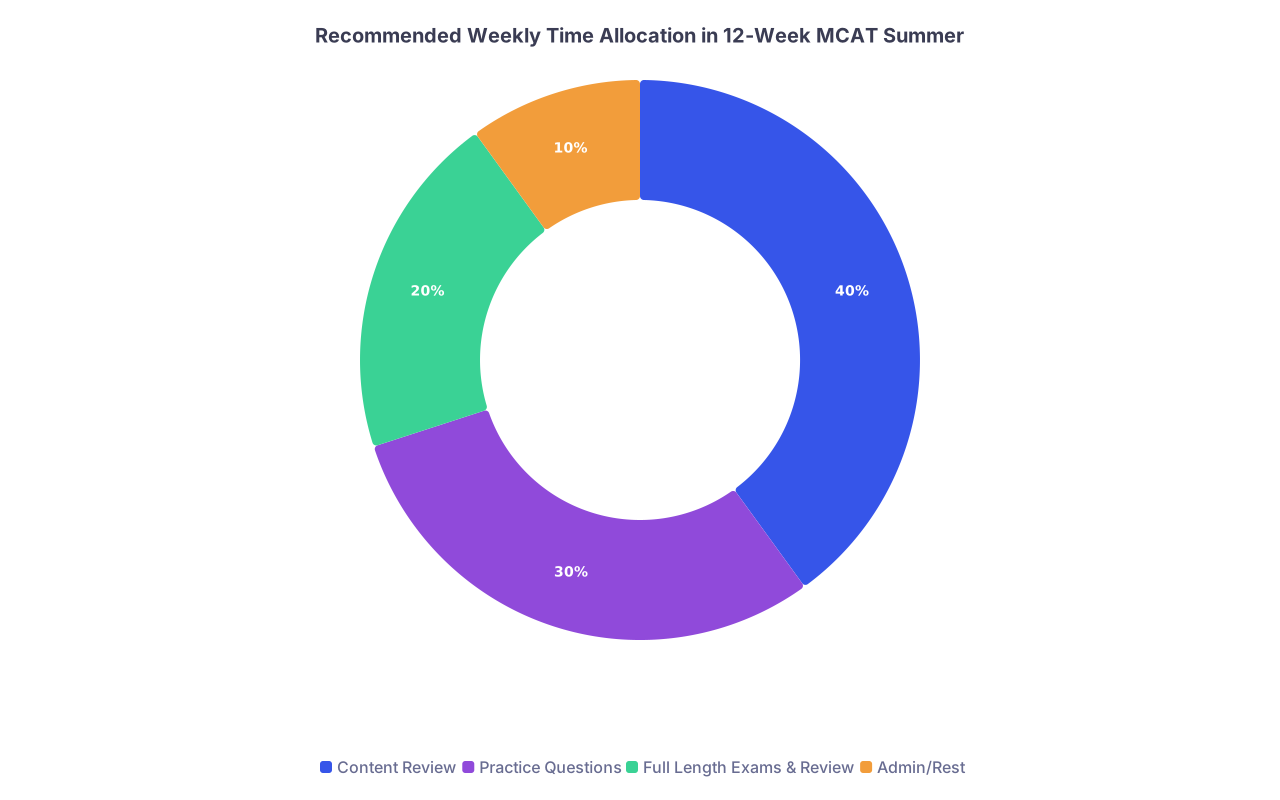
| Category | Value |
|---|---|
| Content Review | 40 |
| Practice Questions | 30 |
| Full Length Exams & Review | 20 |
| Admin/Rest | 10 |
If you cannot carve that out, you’re not “safely” preparing. You’re just rolling dice.
Month‑by‑Month: Safe vs. Risky Test Dates
Assume your M1 orientation starts early August (typical in the U.S.). Shift by 1–2 weeks as needed if yours is different.
If You Aim for a May MCAT
Who this works for:
- Students finishing classes in April with a light May
- People already 50–70% prepared from spring
Timeline:
- Feb–April: Heavy prep, mixed with class
- Early May: Final push + exam
- Mid May–July: Recovery + life logistics + light M1 prep
Safety rating: High — if your spring prep was real, not imaginary.
This is the best pre‑M1 timing. Exam is fully behind you months before M1.
If You Aim for a June MCAT
Who this works for:
- You finish exams early May and can treat May–June like a full‑time job for MCAT
- You have solid prereq foundation (no “learning orgo from scratch in 6 weeks” nonsense)
Timeline:
- Early May: Start/continue content review
- Late May–mid June: Mostly practice + FLs
- Late June: Score in; July becomes your “life + rest” month
Safety rating: Moderate. Fine if you’re disciplined and not starting from zero.
Key risk: a June exam can bleed into July with a retake decision if the score is worse than your FLs. That’s where people get stuck.
If You Aim for a July MCAT
Who this works for:
- Honestly? Very few people.
- Maybe those whose M1 doesn’t start until late August/September and who have been prepping since March.
Timeline:
- May–June: Full prep
- Early July: Test
- Mid/Late July: Score + immediate orientation for some schools
Safety rating: Low. You’re leaving no buffer for:
- Illness
- Family emergencies
- A bad test day demanding a retake
If You Aim for an August MCAT
No. If M1 starts in August, absolutely not. If your M1 starts in September and the MCAT is disconnected from that program (e.g., you’re applying to a different school later), maybe. But that’s not really “pre‑M1 summer” anymore; that’s an application‑cycle MCAT.
Back‑Planning: The 12‑Week Countdown
Take your target test date and walk backward 12 weeks. At each point you should be doing specific tasks, not just “studying.”
Let’s pick a concrete date: June 20th MCAT. Orientation: August 1st.
Your 12‑week block runs roughly from late March to June 20th.
Weeks −12 to −10 (Late March – Early April): Assessment & Setup
At this point you should:
Take a diagnostic FL (ideally AAMC FL1 or a high‑quality third‑party)
Map your schedule:
- Work / classes
- Family obligations
- Non‑negotiable events (weddings, travel, etc.)
Build a weekly template:
- 5–6 study days per week
- 1 rest day
- 25–35 hours/week if you have classes
- 35–45 hours/week if you’re post‑finals
Tasks:
- Identify weakest sections (CARS vs content-based sections)
- Choose resources and commit. Do not hop between 4 full courses; pick a lane.
Weeks −9 to −7 (Mid–Late April): Content Foundation, Light Practice
At this point you should:
Be systematically moving through:
- Physics and Chem topics
- Biochem / metabolism / genetics
- Core Psych/Soc frameworks
Begin discrete practice questions after each content block
If you’re still in school:
- Reserve 2–3 big MCAT blocks on weekends (3–4 hours each)
- Use weekdays for smaller bursts (1–2 hours) of CARS/Psych/Soc reading
Weeks −6 to −5 (Early–Mid May): Transition Toward Practice-Heavy
Finals are ending. You’re shifting gears.
At this point you should:
Finish 70–80% of content review
Start doing:
- 60–90 min of mixed practice daily
- 1 mini exam (section test or long block) per week
Identify “chronic weak areas”:
- e.g., electrochemistry, endocrine pathways, conditioning vs learning theories
Create a short list of high‑yield gaps. That list will drive your targeted review.
Weeks −4 to 0: The Final Month Before Your Exam
This is where most people mess up their timing. They either:
- Keep doing pure content review and never switch to test‑mode, or
- Burn themselves out with 4 FLs per week and zero review.
Here’s the safer structure.
Weeks −4 to −3: First Full‑Length Wave
At this point you should:
Spend 1–2 full days reviewing each FL:
- Every question, not just the ones you missed
- Log patterns: “Why did I miss this?” > “I need more facts”
Keep content review light and targeted:
- Only based on FL + practice gaps
Don’t wait to use the AAMC FLs. You want enough time to respond to what they show you.
Weeks −2 to −1: AAMC‑Heavy, Exam Conditions
At this point you should:
Take 2–3 AAMC FLs total across these two weeks
Simulate test day:
- Same start time as your real exam
- Same break structure
- No phone, no random browsing between sections
Tighten:
- Section strategies (e.g., passage mapping, timing checks)
- Nutrition and caffeine plan (don’t experiment on test day)
If your FL scores are significantly below your goal at this point (e.g., string of 503–505s when you need a 510+ for a conditional acceptance), this is exactly when you consider moving the test if there’s any flexibility.
Final 5–6 Days: Sharpen, Don’t Scramble
At this point you should:
- Stop full‑lengths. Last FL is typically 5–7 days before test day.
- Focus on:
- Light passage practice
- Rapid review of formula sheets, pathways, and common traps
- Sleep schedule aligning with test time
No 12‑hour cramming days. You’re managing arousal, not cramming for a college midterm.
Day‑By‑Day: The Last Week and Test Day
This is where the “safety” part gets real. A great 10‑week prep can be sabotaged by one unplanned ridiculous decision in the last 48 hours.
7 Days Out
At this point you should:
- Take your final full‑length under full conditions
- That night, start a quick high‑level review of:
- What consistently works for you
- What consistently fails (and what you’ll do instead)
Then you commit. No more major strategy overhauls.
5–3 Days Out
At this point you should:
Do 2–3 hours/day of:
- Targeted practice sets
- Reviewing errors from older FLs
- Flashcard touch‑ups
Handle logistics:
- Confirm test center location
- Print confirmation
- Plan transport + backup plan
2 Days Out
At this point you should:
- Cut work to 1–2 easy hours max
- Skim equations, basic content, big concepts
- Do something non‑MCAT in the afternoon/evening
You want to feel a tiny bit “underused” mentally going into the last 24 hours.
Day Before
At this point you should:
- No new content. No practice tests.
- Maybe:
- 30–60 minutes of light flashcards
- Visualization of test‑day routine
Then you shut it down:
- Normal meals
- Hydration
- Pack bag (ID, snacks, layers of clothing)
- Bed at a consistent time
Test Day
You already know what to do technically. From a timeline perspective, the key is: don’t let the morning chaos break your routine.
At this point you should:
- Wake up at least 3 hours before your test
- Light breakfast you’ve eaten before full‑lengths
- Arrival at center 30–45 minutes early
This is not the morning to reinvent your caffeine tolerance.
Special Scenario: Conditional Acceptances and Linkages
If your pre‑M1 summer MCAT is part of a conditional acceptance (“You must score ≥510 to matriculate”), your timeline buffer needs to be even more strict.
You need:
- A test date that allows one possible retake before the deadline
- Enough gap between the two dates to:
- Get your score
- Evaluate (2–3 days)
- Fix targetable issues (2–3 weeks)
So if the conditional deadline is August 1:
- First attempt should be by early June at the latest
- Second “backup” date in early/mid July
Anything later than that and you’re gambling your seat on a single performance with zero contingency.
Common Bad Timing Decisions (That I’ve Actually Seen)
Here’s where people blow up their pre‑M1 summer:
1. Working 40+ hours/week and still planning a June MCAT.
You’re trying to do two full‑time jobs. The timeline doesn’t care about your optimism.
Scheduling a July exam with M1 starting August 1st.
Result: zero recovery, no chance to retake, and you walk into anatomy already exhausted.Adding “just one more” application cycle with a late summer MCAT.
You already have an acceptance. You chase a hypothetical “better” one and eat a mediocre MCAT that now lives on your record.Letting travel / weddings / internships slice your 12 weeks into pieces.
If you lose 2 weeks to a trip and 1 week to finals, your “12‑week plan” is actually 9 disjointed weeks. That’s rarely enough.
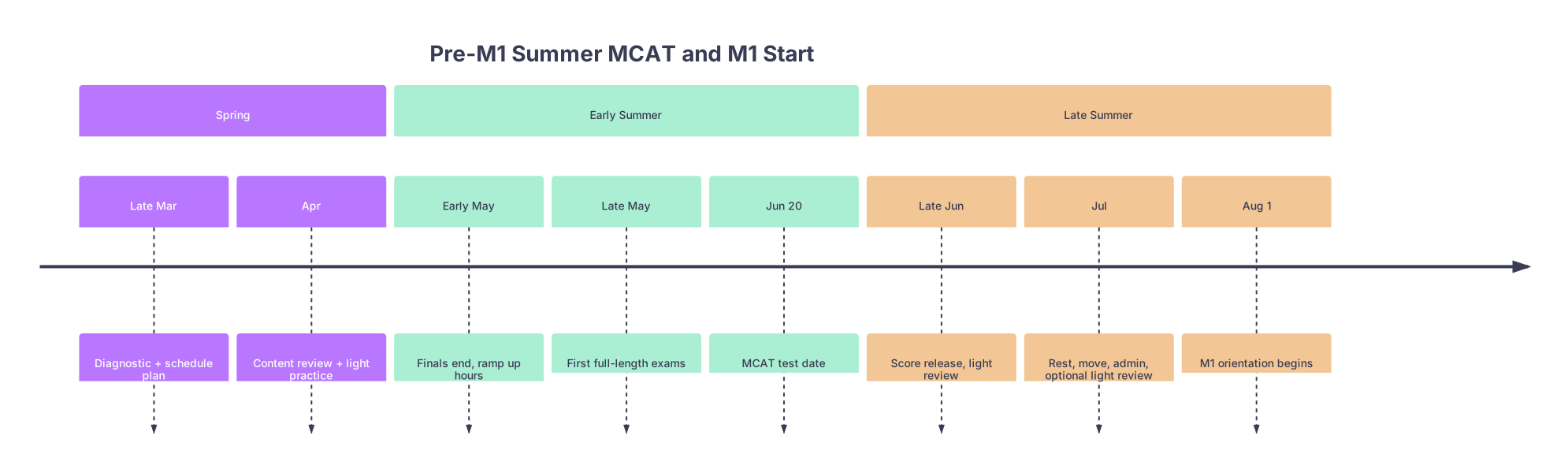
Example: Safe Summer Timeline for a June MCAT and August M1
Let’s put this together in a visual.
| Period | Event |
|---|---|
| Spring - Late Mar | Diagnostic + schedule plan |
| Spring - Apr | Content review + light practice |
| Early Summer - Early May | Finals end, ramp up hours |
| Early Summer - Late May | First full-length exams |
| Early Summer - Jun 20 | MCAT test date |
| Late Summer - Late Jun | Score release, light review |
| Late Summer - Jul | Rest, move, admin, optional light review |
| Late Summer - Aug 1 | M1 orientation begins |
Notice:
- June 20 exam
- Score in early July
- You still get a few MCAT‑free weeks before M1.
That gap matters more than people think. You need to arrive at orientation not already hating flashcards and schedules.
Quick Reality Check: Should You Even Use Pre‑M1 Summer for MCAT?
If you’re already accepted and the MCAT is not required:
- Taking it “for options” is usually a strategic mistake.
- You get:
- No benefit if you score average
- A major anchor if you score poorly
- Significant time and energy drained that could be used to actually rest or prep for M1 content
If you’re not yet accepted and the MCAT is central to your next cycle:
- A pre‑M1 summer is basically just “one more MCAT summer” with more risk because med school is starting.
- If possible, push the MCAT earlier (spring, previous summer) rather than cramming it into this narrow window.
Final 2–3 Key Points
- A “safe” pre‑M1 MCAT needs a clear 10–12 week prep block and at least 2–3 weeks of recovery before M1. Anything tighter is gambling.
- May or early June dates are usually workable; late June and July rapidly become high‑risk with almost no retake or recovery cushion.
- If you already have a med school seat and the MCAT isn’t required, a pre‑M1 summer MCAT is usually not “strategic”—it’s just unnecessary exposure to a permanent score.
Plan backwards from your M1 start date, protect your recovery window, and don’t let “I just want it out of the way” push you into a bad date.