
Are Gunners Really More Successful? What Outcomes Actually Show
What if the most aggressively competitive person in your class—the classic “gunner”—isn’t actually the one who ends up with the best career or the best life?
Medical students talk about gunners like they’re a necessary evil: annoying now, but “they’ll probably match derm at Hopkins.” That assumption quietly eats at everyone else’s mental health. Because the subtext is: If I don’t act like that, I’m falling behind.
Let’s dismantle that.
The short version: extreme gunning correlates much more strongly with burnout, isolation, and mental health problems than with objective long‑term success. The mythology around gunners is louder than the data.
First, what is a “gunner,” really?
Not every ambitious or high-performing student is a gunner. That’s where people get confused and defensive.
A gunner isn’t “someone who studies a lot.” It’s a specific behavioral pattern most med students can spot from a mile away:
- Hoarding or hiding resources (deleting shared Anki decks, refusing to share notes, giving misleading info about exam content).
- Performing in class: asking long-winded “questions” to show off, flexing obscure facts, constantly name-dropping research and mentors.
- Making everything a comparison: “What did you get?” “How many publications?” “How many programs are you applying to?”
- Competing against classmates instead of with them—seeing peers’ success as a personal threat.
You can be intense, driven, laser-focused, and still not be a gunner. You cross into gunner territory when your success strategy relies on:
- Undermining others
- Constant self-promotion
- Treating classmates as obstacles, not colleagues
Those behaviors are what I’m talking about here. Not “person who works hard and wants ortho.”
The myth: gunners climb higher. The data: not so clear.
The common story goes like this: sure, gunners might be obnoxious, but they crush exams, match into the most competitive specialties, and end up attending at fancy places. You may not like them, but they “win.”
That story sounds intuitive. It’s also mostly wrong when you look beyond Step scores and first jobs.
Let me separate this into short-term vs long-term outcomes.
Short-term: do gunners do better on exams and matching?
On pure exam performance, being obsessive and hyper-competitive can help—up to a point. Time on task matters. Self-discipline matters. Willingness to grind through UWorld twice matters. Some “gunnery” behaviors are just misdirected intensity.
But here’s where the fantasy falls apart.
Most top performers aren’t gunners.
I’ve seen many classes where the people at the top of the curve were quietly consistent workers who shared resources freely, tutored others, and didn’t talk about their scores. The loudest strivers are not always the best performers. They’re just loud.Curved exams are not zero-sum the way people think.
A lot of schools are pass/fail for preclinical. Shelf exams and Step rely on absolute performance. Someone else doing well doesn’t “steal” your score. So the competitive mindset often doesn’t even map to the actual incentives.Residency programs do not love obvious gunners.
Program directors consistently rate “team player,” “communication skills,” and “professionalism” extremely high on selection factors. The NRMP Program Director Surveys (for years) put:- Interactions with residents/faculty,
- Commitment to the specialty,
- Letters of recommendation,
at or near the top of the list—often above pure test scores once you’ve cleared basic thresholds.
If you think an attending writing, “Brilliant but very difficult to work with” is a flex, you have not read enough between the lines of LORs.
Here’s the rough pattern:
Extreme gunners may get high scores. But they’re also more likely to damage their reputation on the wards, get lukewarm letters, or be remembered as “that person” who nobody wants at 3 a.m. on call.
That shows up at rank-list time more than they think.
Long-term: who actually ends up “more successful”?
Here’s the uncomfortable truth: success in medicine past residency is driven less by your Step 1 score and more by:
- How reliably you do good clinical work
- Whether people trust you
- Your ability to function on a team
- Your capacity to sustain the grind without mentally imploding
And this is where gunners start losing ground.
Longitudinal data on physicians—burnout rates, job satisfaction, mental health, retention—tell you that unrelenting competitiveness and perfectionism are correlated with worse outcomes. Not better.
No, there’s not an RCT of “gunner vs non-gunner careers.” But we do have:
- Strong links between maladaptive perfectionism, impostor syndrome, and depression/anxiety in med students and residents.
- Robust associations between poor social support and higher burnout and suicidal ideation.
- Evidence that hostile or non-collaborative work climates drive turnover and lower performance.
The gunner style hits all those risk factors.
What the mental health data actually show
Let’s look at where the evidence lives: medical student mental health and related traits.
Perfectionism and pathology
Gunners often run on perfectionism. Not “I aim high.” More like, “Anything less than top 5% is failure.”
Studies across multiple med schools show:
- Higher levels of maladaptive perfectionism (concern over mistakes, doubts about actions) are associated with:
- Higher depressive symptoms
- Higher anxiety
- Greater burnout
Adaptive perfectionism (setting high standards, being organized) is fine. Helpful, even. The gunner pattern usually isn’t that. It’s shame-driven, comparison-obsessed, and unforgiving. That’s the emotionally toxic version.
Social comparison and isolation
The gunner mindset is fueled by comparison.
Step scores. Research numbers. Honors vs high pass. And social media just pours gasoline on that fire.
Research on med students shows that higher levels of upward social comparison (constantly comparing yourself to those “above” you) correlate with:
- More stress
- Lower self-esteem
- Higher depressive symptoms
Now take the classic gunner trait: making everything a competition. That doesn’t just mess with their classmates’ mental health; it screws with their own. You can’t live in that mental environment and not pay a price.
Support vs solo grind
Multiple studies show that strong social support is protective against burnout and depression in med students and residents. Pretty consistently.
Gunner behavior tends to:
- Alienate classmates
- Reduce trust
- Shrink the circle of people who will actually show up for you when you’re drowning on surgery nights
Short-term, maybe they get a slight edge from hoarded resources. Long-term, they lose the safety net that keeps people from breaking down.
That’s a terrible trade.
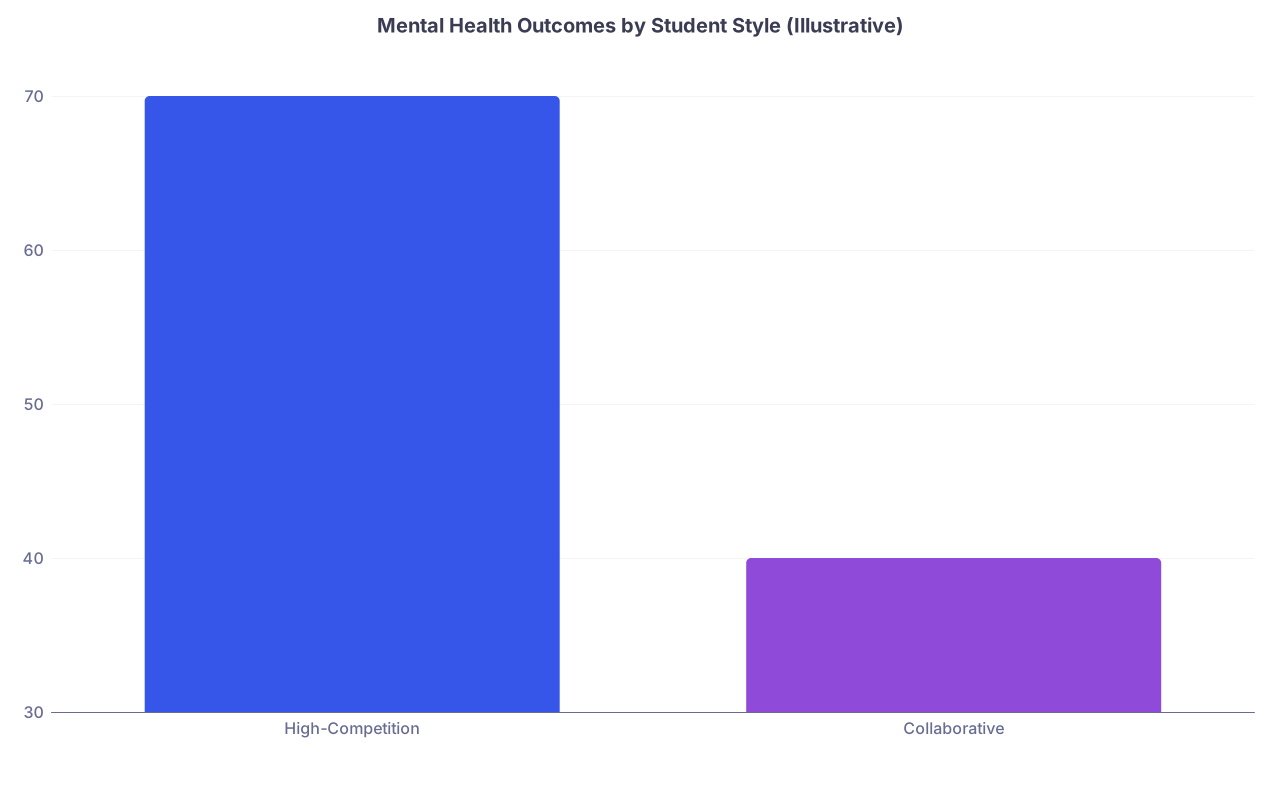
| Category | Value |
|---|---|
| High-Competition | 70 |
| Collaborative | 40 |
(Example concept: percent reporting high burnout symptoms in a hypothetical cohort—actual numbers vary by study, but the direction is consistent: hyper-competitive, low-support environments burn more people out.)
But don’t the cutthroat ones get the best specialties?
This is the myth that will not die: “Sure they’re miserable, but they’ll match plastics. That’s the trade-off.”
Let’s untangle that.
Competitiveness of specialty ≠ “better life”
Some of the “most competitive” specialties by Step scores—derm, plastics, ortho, ENT—are attractive for good reasons (income, procedures, lifestyle in some cases). But high barriers to entry don’t automatically mean “happier doctors” or “more successful humans.”
Burnout exists in every specialty. Malpractice risk, admin madness, EMR hell, productivity quotas—they’re everywhere.
If you destroy your mental health getting there, your “dream job” can very quickly feel like a gilded cage.
Programs filter out obvious red flags
Good residency programs become allergic to toxic personalities. Not always, but more than you think. Chiefs and PDs remember who was impossible to work with as a student.
On away rotations, the gunner who hogs procedures, corrects residents in front of patients, or brags nonstop might think they’re showing “initiative.” What evaluators actually write is closer to:
- “Needs to work on insight and humility.”
- “Strong fund of knowledge but not always aware of team dynamics.”
That kind of language can quietly kill an application at the margins where it matters most.
The solid, collaborative, competent student with slightly lower scores but glowing comments like “joy to work with” and “would love to have as a resident” wins that tie-break more often than gunners want to admit.
| Factor | Relative Weight (Conceptual) |
|---|---|
| Clinical evaluations/comments | High |
| Letters of recommendation | High |
| Step scores (above threshold) | Medium |
| Research output | Medium |
| Reputation for teamwork | High |
Again: not every PD is a saint or perfectly rational. But the idea that “everyone rewards gunners” just doesn’t hold up across the system.
The hidden cost: gunners poison the culture for everyone
This is the part people underplay. The damage isn’t just to the gunner. It’s to the whole class climate.
When you have a few loud, visibly competitive students:
- People become more secretive about their own struggles (“I can’t let them see me slipping.”)
- Normal grades feel like failure because someone is always flexing something higher.
- Group study morphs into subtle status comparison.
- Asking for help feels like weakness.
That kind of environment amplifies:
- Impostor syndrome
- Shame about struggling
- Reluctance to seek mental health care
Schools with cutthroat reputations consistently show higher reported stress in surveys. Culture is not a minor variable. It shapes how people experience the exact same workload.

What actually predicts sustainable success?
If pure gunning isn’t the winning strategy, what is? Let’s look at patterns that show up again and again in people who both succeed and stay (relatively) sane.
1. Strategic effort, not maximal effort
The winners long-term aren’t the ones who study the most hours. They’re the ones who:
- Identify what actually gets tested
- Use evidence-based study methods (spaced repetition, practice questions)
- Stop chasing diminishing returns out of fear
They don’t need to crush every exam. They need to consistently hit “good enough” while preserving bandwidth for clinical skills, relationships, and sleep.
2. Pro-social ambition
Ambition isn’t the problem. Anti-social ambition is.
Students who rise and stay there tend to:
- Share resources generously (ironically, this often gets them invited into more opportunities)
- Help juniors and peers
- Build genuine mentorship relationships rather than transactional ones
That creates a network that pays dividends for years—jobs, collaborations, references, emotional support.
3. Emotional regulation and self-awareness
I know, it sounds like a wellness lecture. It’s not. It’s a performance variable.
People who:
- Know their own triggers
- Can tolerate imperfection without spiraling
- Catch themselves when they head into comparison or catastrophizing
…are much less likely to burn out, quit, or implode during residency.

| Step | Description |
|---|---|
| Step 1 | MS1: High Aspirations |
| Step 2 | Short-term score focus |
| Step 3 | Balanced priorities |
| Step 4 | Weaker relationships |
| Step 5 | Higher stress & burnout risk |
| Step 6 | Strong support network |
| Step 7 | Stable performance |
| Step 8 | Risk of mental health crisis |
| Step 9 | Sustainable career satisfaction |
| Step 10 | Mindset |
4. Protecting mental health like a core competency
The students who last don’t treat mental health care as a last resort. They treat it like orthopedics treats physical therapy: part of the plan.
That can include:
- Therapy, especially for perfectionism and anxiety
- Medication when needed
- Actual boundaries (saying no to extra research when you’re already red-lining)
Gunners often wear exhaustion as a badge of honor. That’s not grit. That’s poor risk management.

How to survive gunners without becoming one
You can’t control whether your class has gunners. Odds are, it does. You can control how much space they rent in your head.
A few practical strategies that I’ve seen actually work:
- Limit score talk. If certain people only want to talk in Step decimals and percentile ranks, stop feeding that conversation. You’re allowed to say, “I’m good not discussing scores.”
- Choose collaborators, not competitors. Study with people who share, not people who interrogate. Your brain will thank you.
- Watch your own drift. It’s very easy to start mimicking gunner behavior out of fear. Notice when you’re tempted to hide resources or brag. That’s your warning sign.
- Anchor to your goals. If you don't actually care about matching neurosurgery, stop acting like you’re behind because you’re not living someone else’s life plan.
And if a gunner seems to be “winning”? Remember: you’re seeing a tiny slice. A score. An acceptance. A flex on Instagram. You are not seeing their anxiety at 2 a.m., their relationships, their sleep, their therapist’s notes.
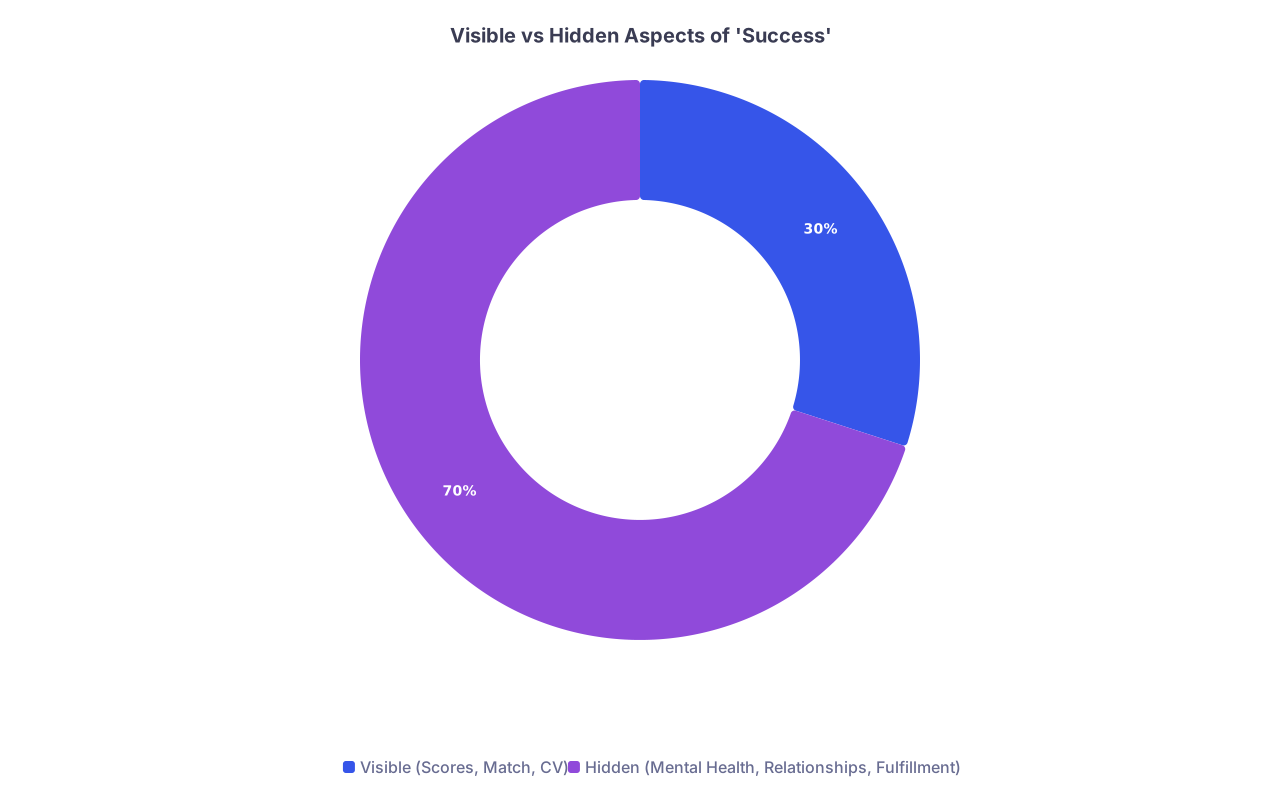
| Category | Value |
|---|---|
| Visible (Scores, Match, CV) | 30 |
| Hidden (Mental Health, Relationships, Fulfillment) | 70 |
The visible piece is seductive. The hidden piece is what determines whether your career is sustainable.
The bottom line
Let me be blunt.
Gunners aren’t systematically “more successful.” They’re often just louder, more anxious, and more externally validated in the short term. The actual data on long-term physician well-being and performance does not support “extreme competitiveness” as a winning strategy.
The traits that do predict sustainable success—collaboration, emotional regulation, social support, adaptive perfectionism—are almost the opposite of classic gunner behavior.
So no, you don’t need to become a gunner to succeed. You need to become the person people trust to have both competence and sanity at 3 a.m. on call. That’s who programs remember. And that’s who survives this career with a life still intact.