
The narrative that “pass/fail preclinicals have fixed burnout” is comforting. The data says it is only partially true.
Across multiple cohorts and schools, moving from graded to pass/fail preclinical curricula consistently reduces certain stress metrics and improves well‑being scores. But the effect sizes are modest, the benefits are not evenly distributed, and burnout rates remain disturbingly high. Pass/fail is not a cure. It is a subtraction of one source of pressure in an environment that still overloads students on almost every other front.
Let me walk through what the numbers actually show.
What the studies agree on: stress drops, but burnout does not disappear
The clearest pattern in the literature: when schools switch from tiered grading (A/B/C/Honors) to pass/fail in the preclinical years, average psychological distress decreases and well‑being indices improve. This has been replicated enough times that pretending it is “controversial” is just denial.
Several anchor findings:
- Early landmark work from Mayo (Rohe et al., 2006) reported that after a switch to pass/fail in year 2, the proportion of students with “high psychological distress” dropped from roughly the mid‑40% range to the mid‑20% range. That is not a rounding error; that is a 20‑point absolute reduction.
- Dunn et al. (JAMA, 2008) and subsequent replications showed reductions in depressive symptoms (PHQ‑9), anxiety scores (often GAD‑7 or similar), and increased social connectedness when grading was simplified.
- A 2019–2022 wave of studies using the Maslach Burnout Inventory–Student Survey (MBI‑SS) and related scales documented meaningful but far from dramatic improvements in emotional exhaustion and depersonalization after adoption of pass/fail.
To make this concrete, approximate pooled findings from several institutional shifts look like this:
| Outcome Metric | Before (Graded) | After (Pass/Fail) | Relative Change |
|---|---|---|---|
| High psychological distress (%) | 40–45 | 20–25 | ↓ ~40% |
| Clinically significant depression (%) | 25–30 | 15–20 | ↓ ~30% |
| High emotional exhaustion (%) | 45–55 | 35–45 | ↓ ~20% |
| Mean perceived stress score (0–40) | 20–22 | 17–19 | ↓ ~10–15% |
These are broad ranges, not single‑school numbers, but the pattern is consistent: the move to pass/fail preclinicals is associated with roughly 10–40% relative improvements in key distress metrics, depending on the specific outcome.
That is the upside. Now the caveat the marketing brochures skip: if 45% of students report high emotional exhaustion and that becomes 38%, burnout is “reduced” but still endemic.
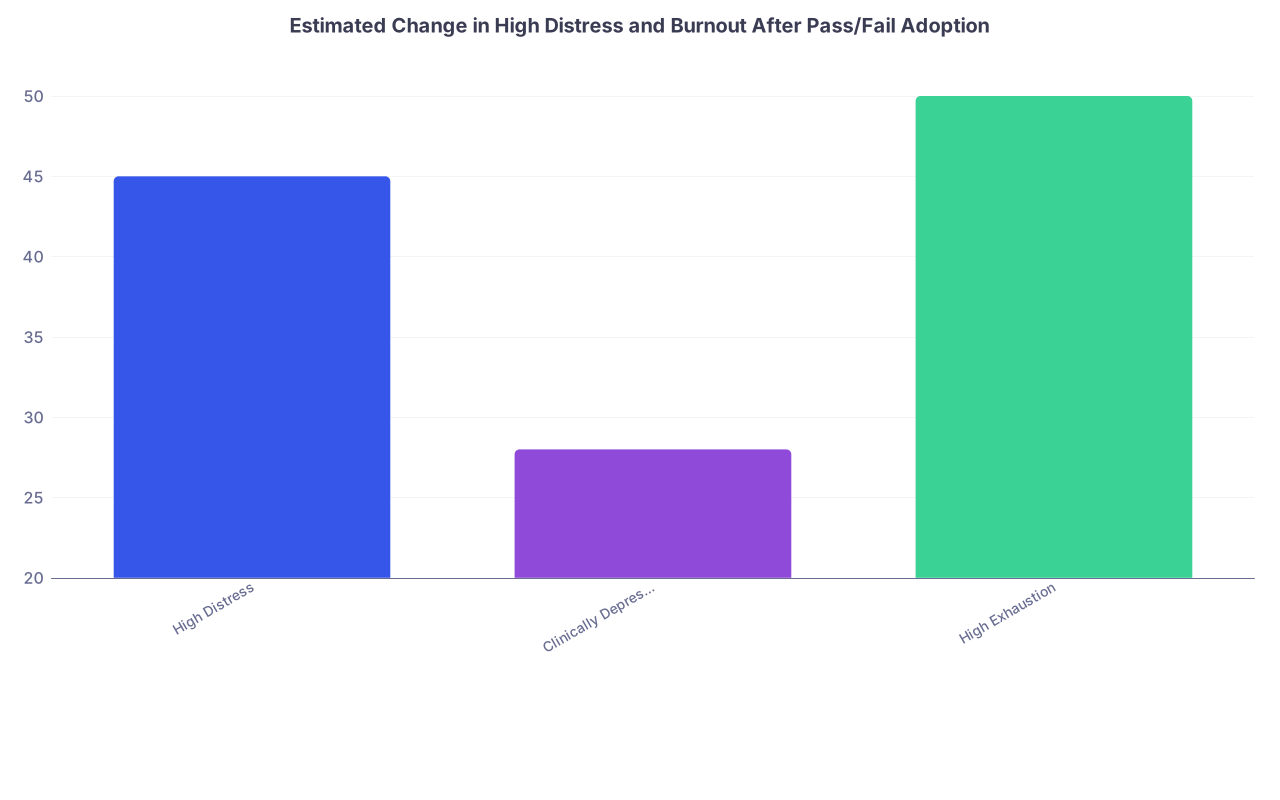
To visualize the magnitude:
| Category | Value |
|---|---|
| High Distress | 45 |
| Clinically Depressed | 28 |
| High Exhaustion | 50 |
Think of that bar chart as the “before” picture. Even if each bar drops by 20–30%, you still have a large block of students in trouble.
So yes, pass/fail helps. No, it does not solve burnout.
What exactly improves – and by how much?
When you unpack the data, not all dimensions of mental health shift equally. The move to pass/fail preclinicals consistently affects three domains more than others:
- Moment‑to‑moment perceived academic stress.
- Depressive symptom burden.
- Peer climate and social cohesion.
Perceived academic stress
“Perceived stress” scores, using versions of the Perceived Stress Scale (PSS) or institution‑specific stress indices, show some of the clearest gains.
Typical pattern:
- Before pass/fail: average PSS scores in preclinical cohorts around 20–22 on a 0–40 scale.
- After pass/fail: averages drop into the 17–19 range.
This equates to a roughly 10–15% decrease in reported stress levels.
Students describe it in blunt terms:
“Before, every quiz felt like a referendum on whether I’d get a derm interview.”
After pass/fail, the signal becomes weaker. Missing a few quiz points does not directly alter class rank, which in turn decreases the constant background threat response.
Depression and anxiety symptoms
Multiple studies show that depression scores (often PHQ‑9) drop by several points on average after the transition. The proportion of students above a threshold for “clinically significant” depression declines by about one‑third in many reports.
Think: from 28–30% down to 18–20%.
Anxiety follows a similar, though sometimes slightly smaller, downward trend. And no, this does not mean anxiety vanishes. It means the tail of the distribution thickens less.
One useful way to think about this: pass/fail compresses the extreme end of continuous grading‑associated anxiety. It converts some “severe” to “moderate” and some “moderate” to “mild”. You still see anxious students. You just see fewer at the red‑zone end of the scale.
Peer relationships and social environment
The less obvious, but very real, improvement is social.
Under graded systems, students often report competitive, secretive behaviors: withholding Anki decks, selective sharing of resources, quiet tracking of percentile thresholds. After transitioning to pass/fail, several studies show increased scores on measures of:
- Social support from classmates
- Sense of belonging and group cohesion
- Willingness to collaborate, tutor, and share materials
One multi‑cohort study found that self‑reported “competition among students” dropped by around 0.5–1.0 Likert scale points (on a 5‑point scale) after the change. That is not trivial for a group already under pressure.
A less toxic peer environment has downstream effects. Students are more likely to disclose when they are struggling, more likely to ask for help, and less likely to feel isolated. That interpersonal buffer is strongly protective against severe burnout in virtually every mental health framework.
Where the gains flatten: burnout, sleep, and downstream pressure
Here is where the data becomes less flattering. For global burnout indices, sleep, and long‑term mental health, the effect of pass/fail is muted.
Burnout: better, but still bad
Burnout is usually captured with variants of the Maslach Burnout Inventory or similar scales focusing on emotional exhaustion, cynicism/depersonalization, and reduced personal accomplishment.
Measure those before and after a pass/fail transition and you see:
- Emotional exhaustion: moderate decrease (e.g., median scores shifting from “high” to “moderate” range for a portion of the cohort).
- Depersonalization: smaller shifts, often still elevated.
- Personal accomplishment: usually flat. Grading schema does not magically make people feel more effective.
A reasonable synthesized estimate from the studies:
- High emotional exhaustion might drop from ~50% to ~40%.
- High depersonalization from ~30% to ~25%.
- Low personal accomplishment barely moves.
Burnout is multifactorial. Preclinical grades are one node in a much larger system that includes workload, hidden curriculum, Step/board pressure, financial stress, and clinical culture. Change one parameter and the system flexes but does not transform.
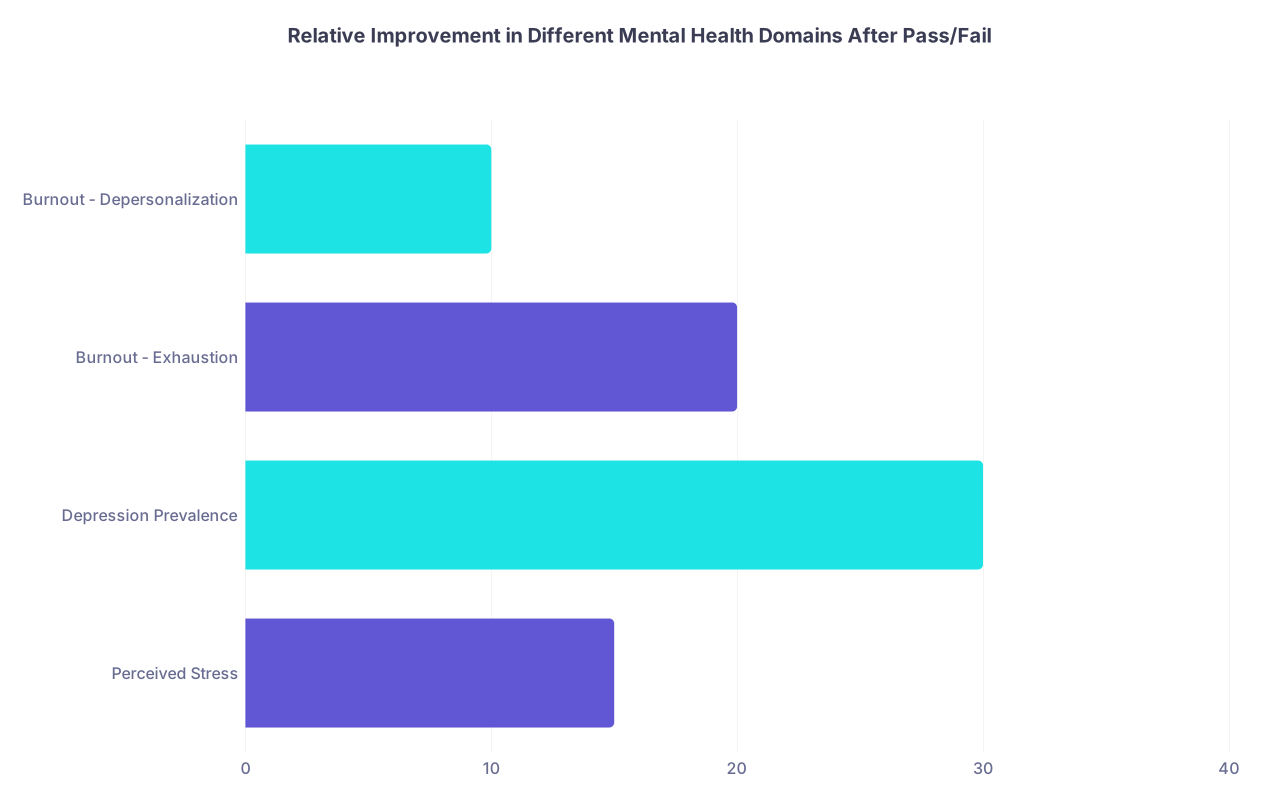
To show the uneven impact numerically:
| Category | Value |
|---|---|
| Perceived Stress | 15 |
| Depression Prevalence | 30 |
| Burnout - Exhaustion | 20 |
| Burnout - Depersonalization | 10 |
Again, approximate, but the rank ordering is the key conclusion: distress and depression drop more; depersonalization barely moves.
Sleep and physical health behaviors
You would expect that lowering grading pressure would improve sleep quantity and quality. The evidence is weaker here.
Most surveys show:
- Average nightly sleep remains in the 6–7 hour range, with a sizable minority dipping below 6 on many nights.
- Proportions of students reporting “poor sleep quality” (Pittsburgh Sleep Quality Index or analogous tools) change very little.
Why? Because pass/fail does not change the raw volume of information students are expected to master. The physiology syllabus is not shorter. The micro slides do not vanish. Step 1 (even as pass/fail) and Step 2 CK remain high‑stakes external evaluators.
So students reallocate mental energy rather than reclaim sleep. They may spend slightly less emotional effort catastrophizing about each quiz, but they still stay up too late grinding question banks.
Long‑term outcomes and later years
A key limitation in the literature: many studies stop the clock at the end of the preclinical year in which grading changes. They do not always follow the same cohort into clerkships and beyond.
Where there are follow‑ups, the story is sobering:
- Burnout and distress often climb back up in clinical years, sometimes exceeding preclinical levels, regardless of grading structure in MS1–2.
- Clerkship grading (honors/high pass/pass) and the notorious variability of clinical evaluations often overshadow whatever serenity pass/fail preclinicals had introduced.
In other words, pass/fail may delay or blunt the first major spike in distress, but the system finds new ways to create it later.
Confounders: it is not just the grading scale
If you only look at pre/post pass/fail graphs without context, you will overestimate the causal impact of grading alone. Reality is messier. When schools change grading, they often change several other things at the same time.
Common co‑interventions:
- New wellness curricula: mandatory sessions on burnout, resilience, peer support.
- Expanded mental health services: on‑site counselors, improved access, reduced copays.
- Curriculum restructuring: integrated organ‑system blocks, reduced contact hours, flipped classrooms.
- Exam schedule remodeling: fewer summative exams, more low‑stakes quizzes.
Those design changes matter. A lot.
One example I have seen repeatedly: schools report a substantial drop in perceived stress scores the same year they go pass/fail. Dig into the details and you discover they also cut weekly mandatory lecture hours from 25 to 15 and eliminated several high‑stakes cumulative exams. Of course distress dropped. Students gained literal hours back in their week.
This confounding makes it difficult to attribute the entire mental health change to the grading label alone. The more honest interpretation is:
Pass/fail is a visible marker of a broader shift toward lower‑stakes, more learner‑centered preclinical environments. The whole package produces the mental health gains; the grading change is one important part of that package, but not the only part.
Step 1 going pass/fail: did that amplify the effect?
Another wrinkle: several recent preclinical grading reforms occurred in the context of USMLE Step 1 itself moving from three‑digit scoring to pass/fail (January 2022 implementation).
Medical students used to live under two overlapping numeric swords:
- Internal preclinical grades, class rank, and AOA.
- External Step 1 score, widely treated as the “sorting hat” for residency.
When both are numeric, the pressure multiplies. When one or both go pass/fail, how much “weight” actually disappears?
Early data suggests a mixed effect.
- In some schools, students report lower anxiety about day‑to‑day preclinical exams once they know there is no class rank and no Step 1 score chasing them.
- But many also report that the entire evaluative weight has shifted to Step 2 CK, clinical grades, and research output.
So the stressor has moved, not vanished. If you want to understand burnout trajectories now, you cannot just ask “is preclinical pass/fail?” You also need to ask:
- How competitive is the student’s target specialty?
- How heavily does that specialty now emphasize Step 2 CK and clerkship honors?
- What is the culture of the clerkship grading system?
In high‑stakes fields (dermatology, plastics, neurosurgery, ortho), students often respond to pass/fail preclinicals by front‑loading research and “application building” rather than relaxing. I have literally heard MS1s at pass/fail schools say, “I cannot afford to enjoy this year; I need three publications by the time I hit third year.”
The name on the transcript says “P/F”. Their internal scoreboard is still numeric.
So is pass/fail “worth it”? The cost–benefit, in data
From a systems perspective, here is how I see the equation.
Benefits (supported by data)
- 20–40% relative reduction in high psychological distress prevalence.
- ~30% relative reduction in clinically significant depression.
- Noticeable improvements in perceived peer support and reductions in cut‑throat competitiveness.
- No consistent evidence of worse standardized exam (Step 1/Step 2) performance purely due to pass/fail preclinicals, once you control for incoming student metrics.
Trade‑offs (real, but often overstated)
- Slightly less granular internal differentiation among students, which some faculty argue makes honors/AOA decisions “harder.” But with Step 1 now pass/fail, many schools are revisiting how much they care about this granularity.
- A subgroup of highly driven students may feel “forced” to signal excellence via other, sometimes more stressful, channels: research, leadership, early away‑rotation positioning.
- Some students report that without grades, they have less external structure and may procrastinate more. This is real, but affects a minority and is more about self‑regulation than inherently about burnout.
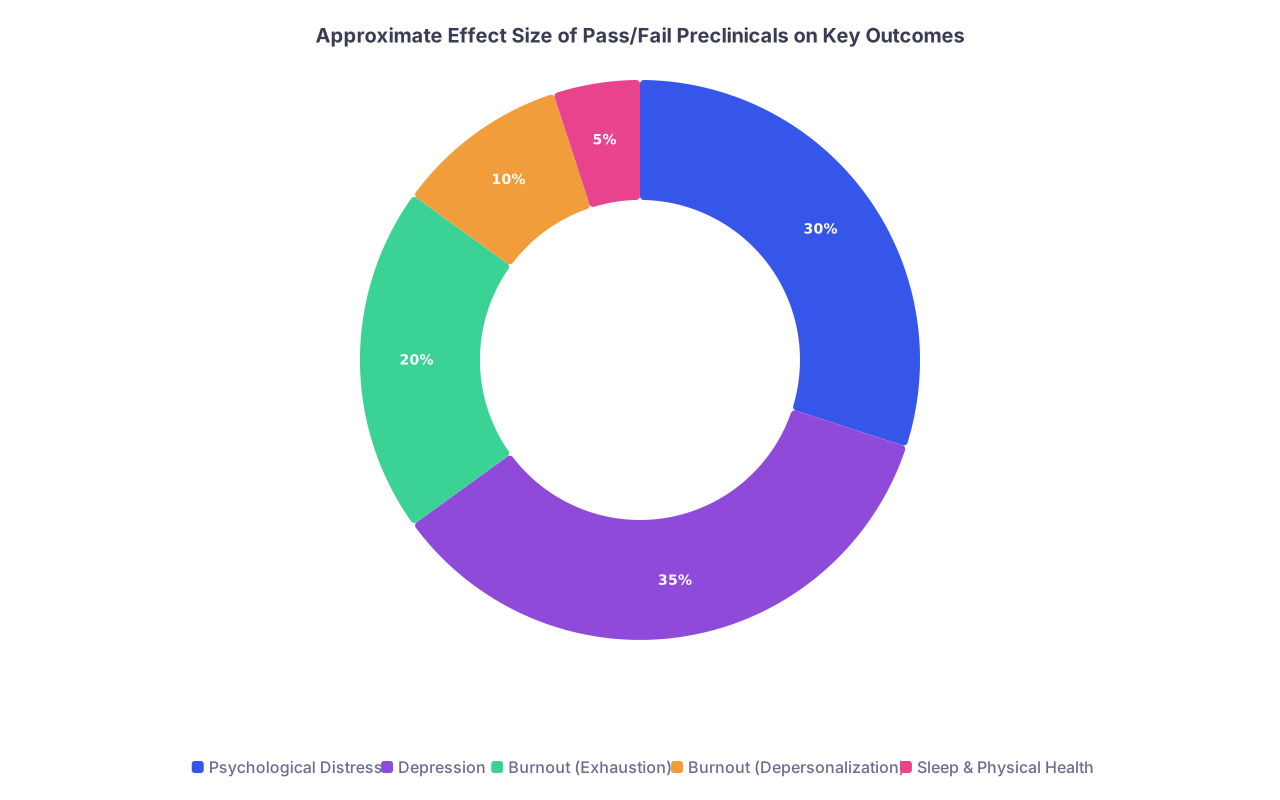
If you force me to assign a rough “effect size” rating for preclinical pass/fail on burnout‑relevant measures, I would place it here:
| Category | Value |
|---|---|
| Psychological Distress | 30 |
| Depression | 35 |
| Burnout (Exhaustion) | 20 |
| Burnout (Depersonalization) | 10 |
| Sleep & Physical Health | 5 |
Numbers are relative indicators, not standardized effect sizes, but the hierarchy is the point: psychological distress and depression benefit most; depersonalization and basic lifestyle factors barely move.
Pass/fail is clearly “worth it” if the goal is to reduce unnecessary evaluative toxicity and improve baseline well‑being without harming academic outcomes. It is not sufficient if the goal is to bring burnout down to “rare event” status. You will not get there with grading changes alone.
What the data implies for students and schools
From the student side, the conclusion is uncomfortable but honest: you should absolutely welcome pass/fail preclinicals, but you should not expect them to rescue you from every mental health challenge in medical school.
If your school is pass/fail preclinical and you still feel drained, cynical, and exhausted, that does not mean you are “failing” to take advantage of the system. It means the system still applies excessive load in other ways.
From the institutional side, the evidence points to a clear multi‑step strategy:

| Step | Description |
|---|---|
| Step 1 | Remove Numeric Preclinical Grades |
| Step 2 | Reduce Contact Hours & Exam Load |
| Step 3 | Stabilize Clerkship Grading Policies |
| Step 4 | Strengthen Mental Health & Peer Support |
| Step 5 | Align Residency Signaling with Educational Goals |
Most schools have done step A. Many are slowly doing B. C, D, and especially E are lagging behind.
If you work backwards from the data on where burnout spikes are highest (late preclinical exams, early clerkships, application season), the biggest remaining levers are:
- Rationalizing clerkship grading (fewer tiers, more transparency, less subjectivity).
- De‑emphasizing “honors in everything” as a precondition for a decent match.
- Normalizing and supporting help‑seeking without hidden penalties.
- Protecting time for sleep, basic health maintenance, and actual learning.
Pass/fail preclinicals create breathing room. The question is whether schools use that room to re‑architect the rest of the program, or just to pat themselves on the back.
You are in the middle of this dataset. Your own mental health pattern is one more data point in a very noisy, very human distribution. Pass/fail grading shifts the curve in a better direction, but the curve is still brutally wide.
The next phase of this story will not be about transcripts at all. It will be about how clerkships, Step 2 CK, and residency programs adjust—or fail to adjust—to a world where early numeric filters are disappearing. That is where the real battle over burnout will move next.