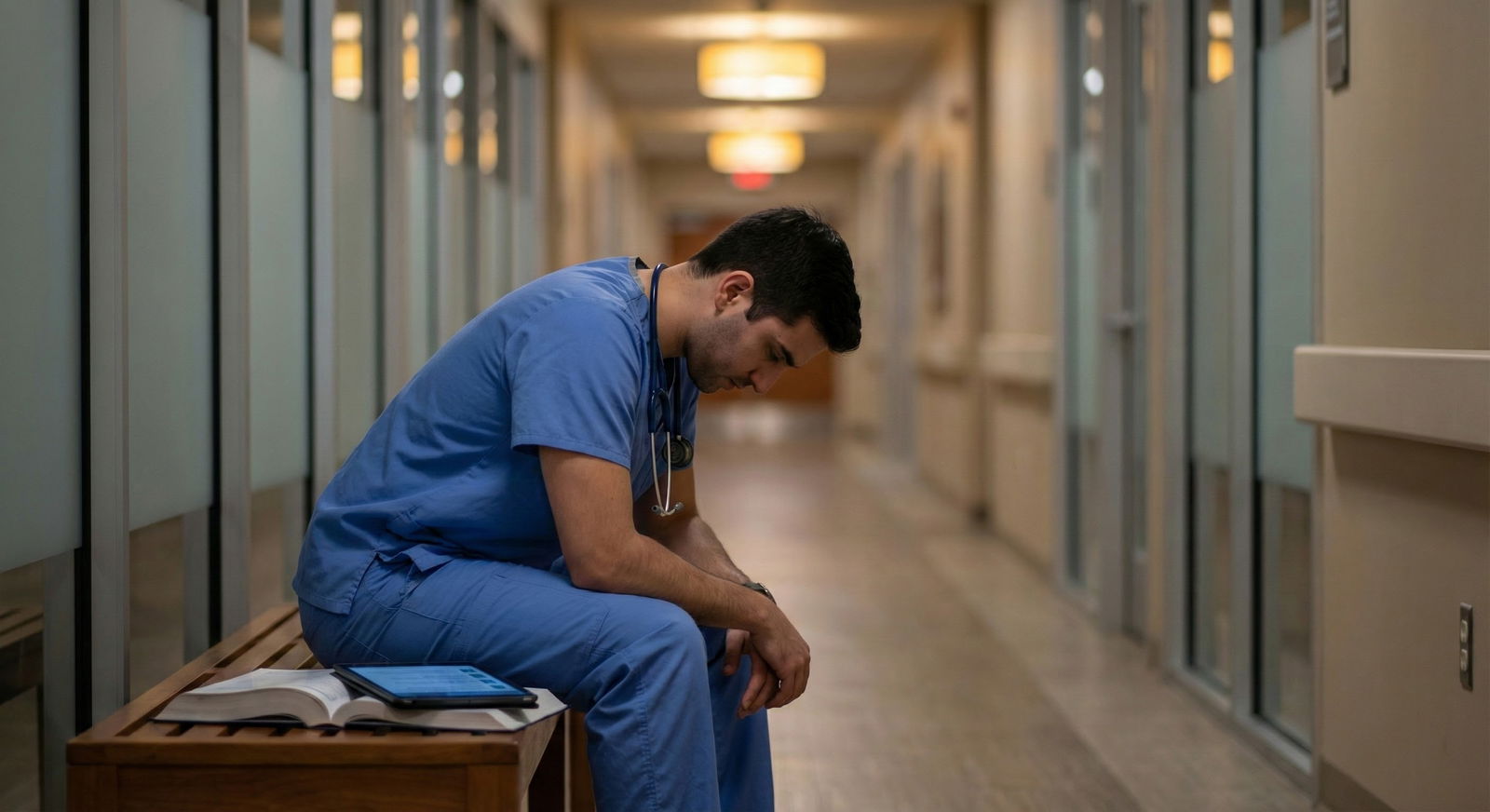
You’re post-call on medicine, it’s 5:30 pm, and your co-intern just said, “Bro, if you’re not at 8 hours of UWorld a day by now you’re not matching IM.” Your Step exam is eight weeks away. You’re still on full-time rotations. You’re tired, anxious, and asking the real question:
Can you safely combine a real USMLE dedicated prep with real clinical rotations… without blowing up your mental health or your exam?
Here’s the answer you’re looking for.
The Short Answer: Yes, But Not The Way Most People Try
You can safely combine USMLE prep with rotations if:
- You stop pretending you’re on “true dedicated.”
- You accept that you have two priorities, not one.
- You protect sleep like it’s a scheduled medication.
- You aim for efficient hours, not heroic ones.
If you try to do 8–10 hours of questions on top of 10–12 hours in the hospital, you will break. I’ve seen people do the “wake up at 4 AM, sleep at midnight” routine. By week three they’re crying in the stairwell, scoring worse on practice tests, and snapping at nurses. That’s not grit. That’s poor strategy.
The realistic target while on full clinical rotations:
- 2–4 hours of focused, high-yield study on work days
- 6–8 hours on lighter/off days
- Plus: embedding learning into the rotation itself
That works for Step 1 and Step 2 if you’re consistent for several months.
Let’s build what that actually looks like.
First: Know Your Risk Level
Not everyone should combine heavy rotations and heavy Step prep. Some situations are high-risk.
| Profile | Combining Is… |
|---|---|
| Strong test-taker, average/better schedule, 8–12 weeks out | Usually safe |
| Prior exam struggles, 4–6 weeks out, heavy rotation | High risk |
| Failing practice scores, no prior consistent prep | Not smart |
| Already at/near target score, spaced exam date | Very doable |
If any of these are true, you should not plan an aggressive combined schedule:
- You failed or barely passed a recent school exam.
- Your NBME/UWorld self-assessments are way below where you need (for Step 1: borderline pass; for Step 2: 30–40+ points below target).
- You’re on an 80-hour/week rotation with brutal call (e.g., surgery at a malignant site) and can’t protect nights.
In those cases, the safer mental-health move is:
- Push your exam date if possible or
- Dial back your test goals for this interval and accept slower progress until you’re on an easier block
“Safe” includes your score, your brain, and your relationships. Burning all three to maybe gain 5–10 points is dumb.
The Core Rule: Protect Sleep, Then Build Around It
Here’s the non-negotiable: 7 hours of real sleep per 24 hours, averaged over the week.
Not “I laid in bed scrolling for 1.5 hours.” Actual sleep.
Why? Because chronically sleep-deprived USMLE studying is fake productivity:
- Retention tanks.
- Question performance gets noisy and demoralizing.
- Mood spirals → anxiety and depression climb.
If you’re seeing:
- Crying spells
- Irritability at small things
- Can’t focus enough to finish a block
- Dreading both work and studying
You’re in the red zone. Cut 30–60 minutes of study and replace it with sleep for 3–4 days. Yes, really. Scores usually bounce back.
Realistic Daily Schedules That Don’t Break You
Let’s talk actual hours. Not fantasy.
Typical Medicine / IM Sub-I Day (6:30 am–5:30 pm)
You leave the hospital at 5:30–6:00 pm, home by 6:30.
Safe structure:
- 6:30–7:00 pm – Quick food + decompress (no Qbank yet)
- 7:00–8:15 pm – 1 timed block (40 questions) + fast review
- 8:15–8:45 pm – Flashcards / spaced repetition (Anki/whatever)
- 9:00–9:30 pm – Wind-down, no screens if you can
- Aim: asleep by 10:00–10:30 pm
That’s ~1.5–2 focused hours. If you’re doing that 5 days a week plus a bigger weekend push, you’re moving forward.
Lighter Rotation (Outpatient, Psych, Path, etc.)
You leave at 3:30–4:00 pm most days.
Safe structure:
- 4:30–5:00 pm – Snack, brief walk, reset
- 5:00–6:30 pm – 1–1.5 Qbank blocks + review key learning points
- 6:30–7:30 pm – Dinner + break
- 7:30–9:00 pm – Content review (Anki, First Aid/Boards & Beyond/OnlineMedEd, whatever your system is)
You get 3–3.5 solid hours. That’s major.
Call/Long Shift Days
Expect 0–60 minutes max. And that’s fine.
Your plan on these days:
- Do a tiny “maintenance dose” (e.g., 10–20 cards or 10 questions) if you’re safe and awake.
- Or do nothing. Protect sleep and sanity.
The trick is not judging yourself on call days. You plan for them. They’re baked into your weekly goal.
Weekly Study Targets That Actually Work
Think in weekly numbers, not daily perfection.
For combined rotations + USMLE prep, a common, sane target:
- Qbank: 140–200 questions per week (3–5 blocks)
- Anki/review: 30–60 minutes/day, 5–6 days/week
- NBMEs / Self-assessments: every 2–3 weeks if you’re within 6–10 weeks of exam
If you’re shooting for a top-tier score and still have 3–4 months, you can push to 200–280 questions per week by using weekends more heavily.
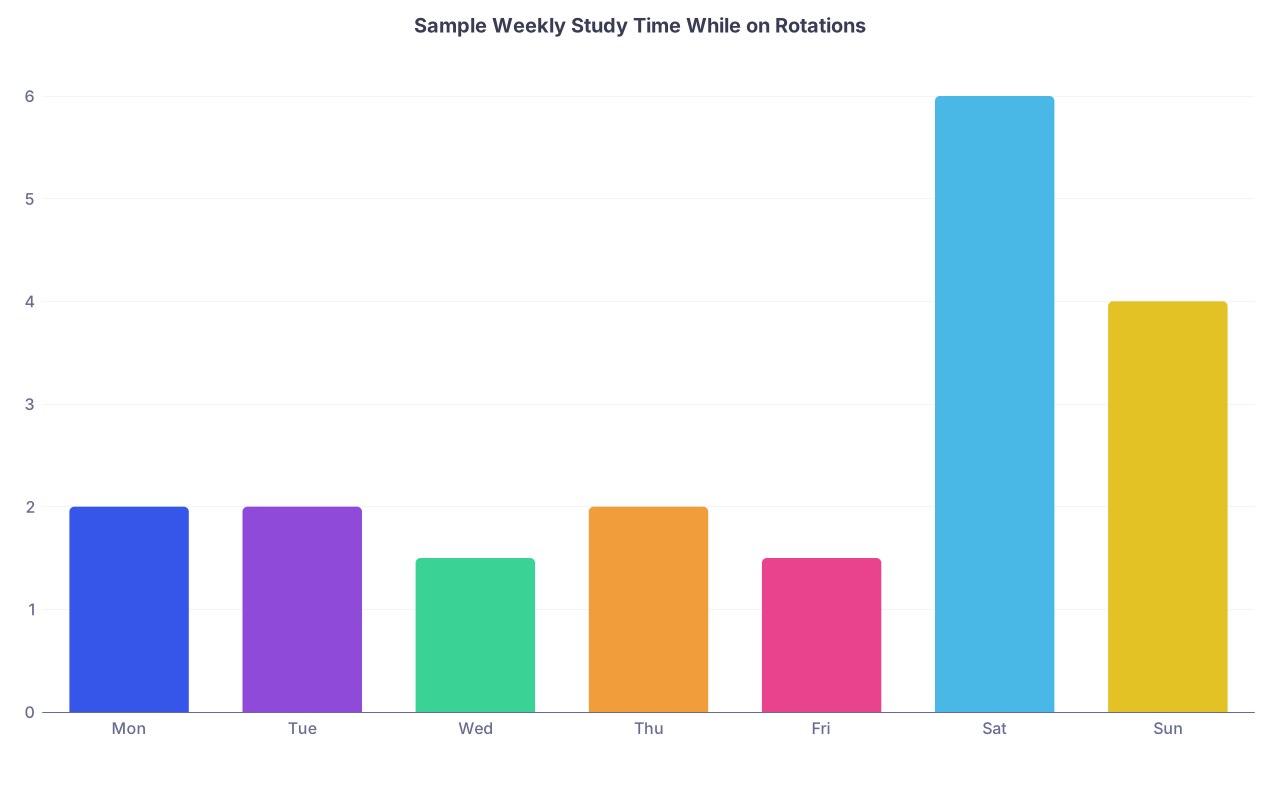
| Category | Value |
|---|---|
| Mon | 2 |
| Tue | 2 |
| Wed | 1.5 |
| Thu | 2 |
| Fri | 1.5 |
| Sat | 6 |
| Sun | 4 |
This is 19 hours. Notice the weekend load. That’s where you actually make the biggest gains when you’re still doing rotations.
Use the Rotation Instead of Fighting It
Most students make one big mistake: they treat rotations and Step prep as two competing worlds.
Smart play: merge them.
On the wards:
- Every patient is an NBME question. Ask: “What Step-relevant issue is hiding here?”
- CHF admission → diuretics, ACE-inhibitors, mortality benefits, guideline thresholds
- DKA admission → anion gap, insulin physiology, complications
- After seeing a case, do 5–10 targeted questions that night on that theme.
- Keep a tiny pocket list (physical or in your notes app) of daily “Step topics from clinic,” e.g.:
- “Acute kidney injury – prerenal vs intrinsic”
- “Antipsychotic side effects”
- “NSTEMI vs STEMI criteria”
That kind of contextual learning sticks better and reduces the amount of “fresh” material you have to brute-force in dedicated.

| Step | Description |
|---|---|
| Step 1 | See patient on rotation |
| Step 2 | Identify Step topic |
| Step 3 | Look up 1 key guideline or fact |
| Step 4 | Do 5-10 related Qs that evening |
| Step 5 | Add missed points to Anki/notes |
This isn’t fluffy theory. The students who do this walk into dedicated with a brain full of clinically anchored Step content. They don’t feel like they “wasted” their third year.
Mental Health Red Flags You Don’t Ignore
You’re in the MEDICAL SCHOOL MENTAL HEALTH zone here, not just “productivity tips.”
Combining USMLE prep and rotations can be safe. It can also quietly wreck you if you ignore clear signs.
Major red flags:
- You’re crying more days than not.
- You feel dread getting out of bed every day, not just “ugh, I’m tired.”
- You start having passive “would be easier if I got hit by a car” thoughts.
- Panic symptoms: chest tightness, racing heart, dread before shifts or study sessions.
- You’re blowing up at staff, friends, family over tiny stuff.
If those sound familiar:
- Tell someone – classmate you trust, family, partner.
- Tell a professional – student health, counseling, or a therapist. You are not the first med student to say, “I think Step is breaking me.”
- Adjust the plan – cutting back hours is not failure. Neither is pushing your test date.
I’ve seen people cling to a date “because that’s when everyone in my class is taking it” while clearly falling apart. You’re not everyone in your class. Your brain is not disposable.
Concrete Strategy by Exam Type
Step 1 vs Step 2 while rotating are slightly different beasts.
Combining Rotations + Step 1
Harder because:
- Step 1 is your first big standardized exam like this.
- Content feels more abstract and less clinic-linked.
What tends to work:
- Use preclinical content early. Don’t wait until third year to “start.”
- During rotations before Step 1, lean more on:
- 40–80 Qs/week of mixed systems
- Anki daily
- 1–2 evenings a week of deeper content review
Rotations aren’t super helpful for basic science, but they do reinforce pathophys and pharm if you actively tie them in (“Why did we choose this antibiotic?” → Step 1 territory).
Combining Rotations + Step 2 CK
This is actually where combining often makes sense.
Step 2 is:
- Heavily clinical
- Close to what you’re already doing all day
While on rotations:
- Make question blocks match your rotation when possible (OB questions on your OB block, etc.).
- Use cases to solidify management steps, not just diagnosis.
- During lighter rotations, this is prime time for a “soft dedicated” build.
| Category | Value |
|---|---|
| Start | 0 |
| 4 Weeks | 8 |
| 8 Weeks | 15 |
| 12 Weeks | 20 |
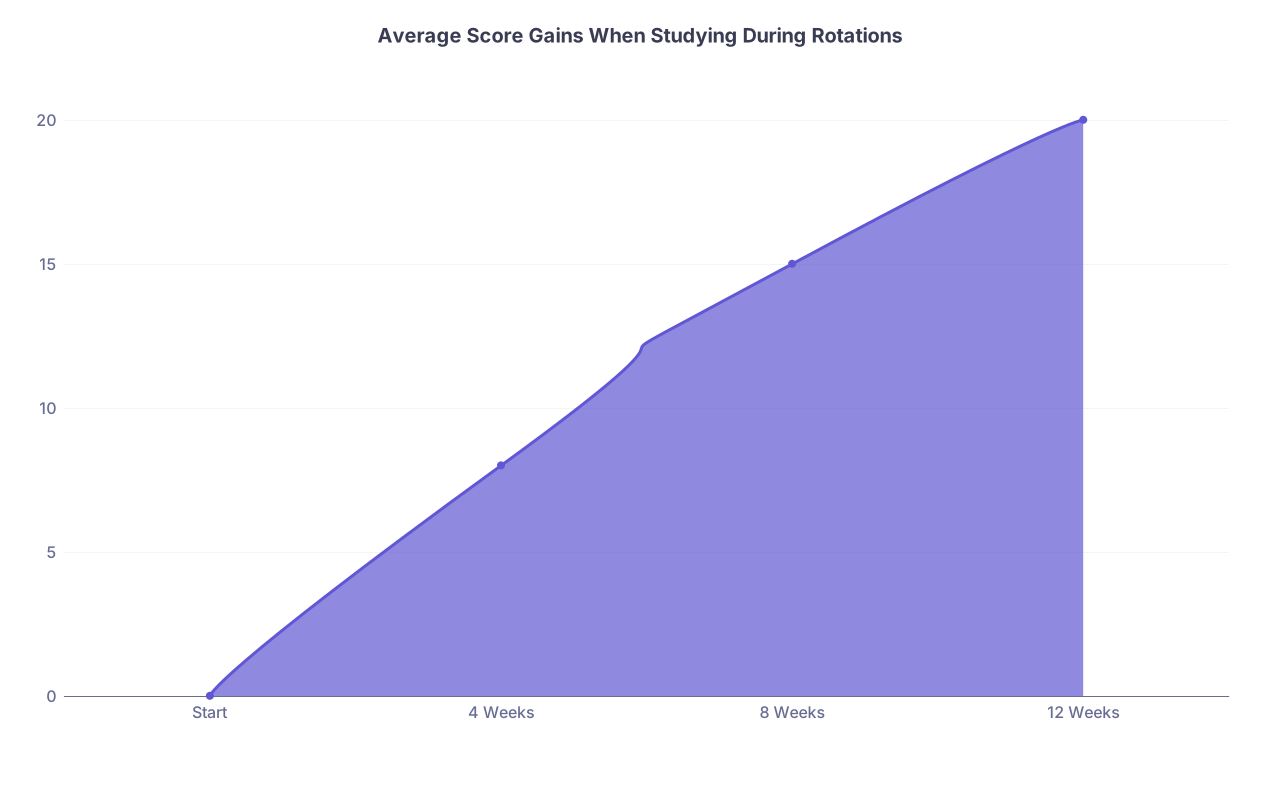
That ~15–20 point gain over 2–3 months is realistic if you’re consistent and not fried.
When You Should Say “No, I Can’t Combine These”
There are times the correct answer is: I need a real dedicated.
You should seriously consider a protected study period if:
- You’re aiming for a highly competitive specialty and currently 30+ points below typical matched scores.
- Your school allows a dedicated block and your mental health is already stretched thin.
- Your schedule is stacked with:
- ICU → surgery → night float → sub-I with no breather in sight.
Choosing “I’m not going to force both at once” is not weakness. It’s risk management.
Tight, Practical Rules To Keep You Safe
Here’s the no-BS list I’d give my own mentee:
- Cap workday studying at 3 hours. If you routinely push to 4–5 after a full clinical day, you’re asking for burnout.
- One totally off evening per week. No Step, no Anki. Go be a person.
- Never sacrifice 2 nights of sleep in a row for studying. One late night, fine. Two? You’ll pay for it for days.
- Schedule practice exams like clinic. Put NBMEs in your calendar early and treat them as immovable.
- If your score drops on 2 consecutive practice tests and your mental health feels worse, you change something. Fewer hours, easier rotation next, push exam date, get professional support—something.

Example 8-Week “Combined” Plan (Safe Version)
Say you’re 8 weeks from Step 2, on IM then outpatient.
Weeks 1–4 – IM rotation
- Workdays:
- 1 block (40 Qs) 3 days a week
- 20–30 min Anki daily
- Weekend:
- Saturday: 2 blocks + review (~4–5 hours)
- Sunday: 1 block + content review (~3–4 hours)
Total: ~160–200 Qs/week + consistent reviews.
Week 5 – NBME Week
- Lighter weekend:
- Full NBME on Saturday
- Minimal questions Sunday, more rest
Weeks 6–7 – Outpatient
- Workdays:
- 1 block 4 days/week
- More content review (e.g., 1–1.5 hours on weaker systems)
- Weekend:
- If still working: similar to earlier.
- If off: this is your “semi-dedicated” push (6–8 hours/day).
Week 8 – Taper
- Reduce total hours slightly
- Focus:
- Wrong questions review
- High-yield lists
- Sleep and mental reset before exam
Is this perfect? No. Is it safe and effective for most students with moderate baselines? Yes.
Bottom Line
Yes, you can safely combine USMLE dedicated-style prep with clinical rotations.
But only if you:
- Stop chasing fantasy “10-hour” study days on top of 12-hour shifts.
- Use your rotation to feed your learning, not compete with it.
- Anchor your schedule around sleep, not around fear.
- Recognize and respond to mental health warning signs early.
If you’re trying to brute-force it with guilt, caffeine, and panic, you’re not “dedicated.” You’re just self-sabotaging.
FAQ: Combining USMLE Prep With Rotations
1. How many hours per day should I study for Step while on full-time rotations?
For most people, 2–3 focused hours on workdays and 4–8 hours on weekend days is the sweet spot. More than that, sustained over weeks, usually leads to burnout and worse retention. The key is consistency, not extremes.
2. Is it better to delay my exam to get a full dedicated period?
If your practice scores are far below where they need to be and your rotation schedule is brutal, delaying is usually the smarter move. If you’re within striking distance and on a manageable block, you can often keep your date and rely on a well-structured combined plan. Don’t delay just because classmates are taking it later; delay because your actual data and mental health say you should.
3. What if I’m too exhausted after rotations to study at all?
First, check sleep. If you’re chronically sleeping <6 hours, fix that before adding more study. Then, scale your minimum: maybe it’s 20–30 minutes of Anki or 10–20 Qs on heavy days. Make the bar low but non-zero a few days a week, and do the heavier lifts on weekends or lighter days. If you’re always too exhausted even after adjusting sleep, your current combination might not be safe—time to talk to admin/mentors about schedule or exam timing.
4. How often should I take NBMEs or self-assessments while still on rotations?
If you’re within 6–10 weeks of your exam, aim for every 2–3 weeks. Treat those days like half-days of work: NBME in the morning, light review and rest afterward. Don’t cram a full clinical day + NBME + full review into one day; you’ll just burn out and get noisy data.
5. What’s one concrete change I can make to protect my mental health during this?
Pick one evening every week that is completely Step-free and protect 7+ hours of sleep that night. No Qbank, no Anki, no Reddit threads about scores. Use it to see a friend, walk, cook, or just zone out. That single boundary keeps your brain from living in constant threat mode—and paradoxically makes the other 6 days more productive.
Open your calendar right now and block off your next 7 days: mark your clinic hours, then schedule exactly when you’ll do each study block—and mark one full evening as “OFF – no Step allowed.” That’s how you start making this safe instead of chaotic.