
The idea that “real med students study every single day” is garbage.
Here’s the answer you’re actually looking for: No, you do not need to study every single day to succeed in medical school or crush exams. You do need consistency, but that doesn’t mean zero real breaks. You can absolutely schedule true off days—if you’re smart about how you do it.
Let’s break this down like an attending explaining the plan on rounds: clear, direct, and with a bit of judgment where people are doing it wrong.
The Core Answer: Daily Studying vs True Off Days
You’re in med school, not a 24/7 punishment camp.
The reality:
- Most successful med students study on most days
- The ones who last (without burning out) build in real, guilt-free off days
- The people who try to study 7 days a week, every week, either:
- Burn out
- Study “on paper” but are half‑effective zombies
- Quit the schedule and feel like failures
You don’t need 100% days-on. You need a system you can actually sustain for months.
A practical rule I like: aim for “6 days on, 1 real day off” during normal blocks, and adjust in the final stretch before big exams.
Will some gunner tell you they studied every single day for 18 months straight? Absolutely.
Will they also quietly mention their anxiety, insomnia, and near mental collapse? Often, yes.
You want performance and longevity. That requires recovery.
What “True Off Day” Actually Means (And What It’s Not)
A “true off day” is not “I’ll just review Anki for 30 minutes because it doesn’t really count.”
It means:
- No lectures
- No question banks
- No Anki/cards
- No “quick review” before bed
- No “let me just scan this PDF real fast”
It’s a day where you don’t touch your med school brain at all. That’s the point. Your nervous system needs a full reset, not partial downtime with background guilt.
On a real off day, you:
- Sleep more
- Go outside
- See people who don’t care what UWorld is
- Move your body in a non‑“productivity” way
- Let your brain be a brain, not a storage device
Is that “risky”? If you’re planning correctly, no. It’s actually a performance enhancer.
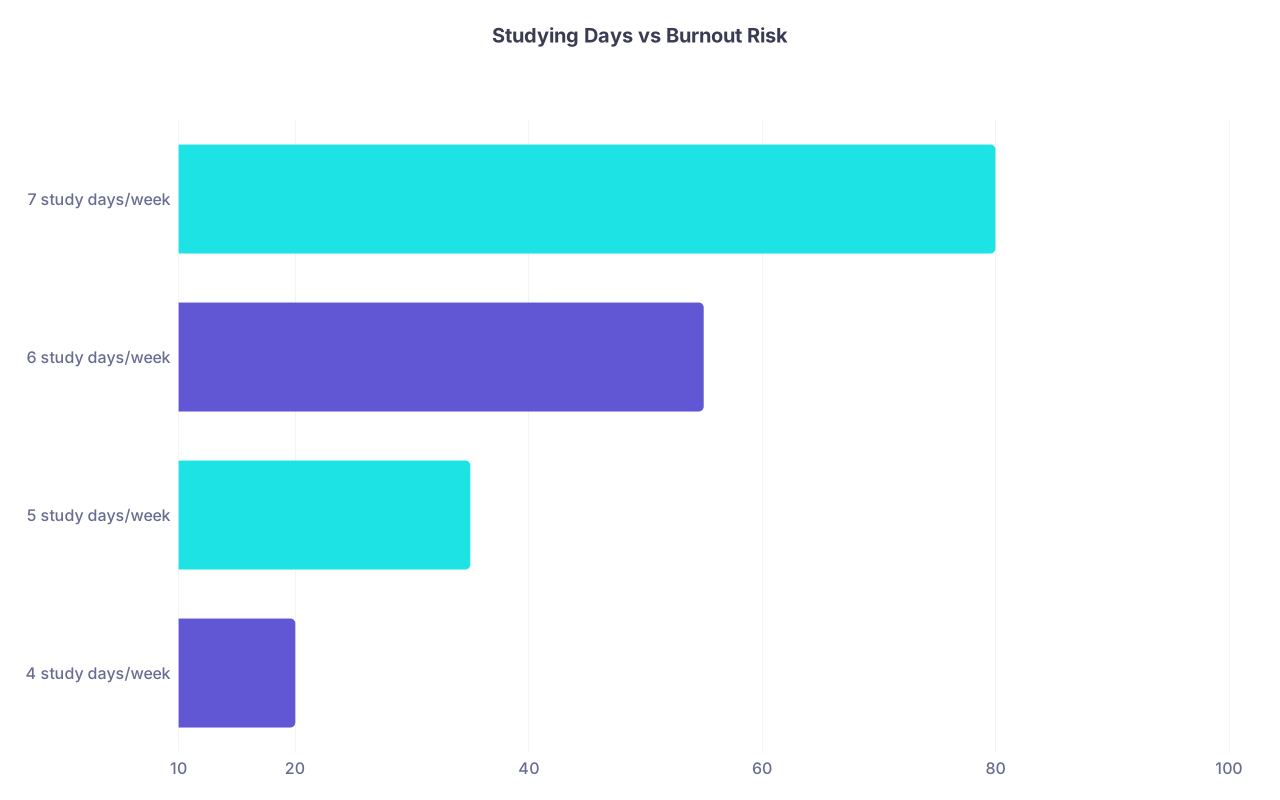
| Category | Value |
|---|---|
| 4 study days/week | 20 |
| 5 study days/week | 35 |
| 6 study days/week | 55 |
| 7 study days/week | 80 |
The Real Constraint: Spaced Repetition and Forgetting
Where the “you must study every day” myth has a tiny grain of truth is spaced repetition.
If you’re using Anki or any spaced repetition system, the algorithm doesn’t care about your mental health. Miss 3–4 days and your review pile explodes. That’s what scares people into thinking daily is mandatory.
Here’s how you work around that without becoming a robot.
You have three levers:
- Your daily load (how many cards/questions/chapters you expect of yourself)
- Your total runway (how far in advance you’re studying before an exam)
- Your tolerance for catch‑up days
To have true off days, you can:
- Cap your daily Anki new cards (e.g., 50–80 per day), so your reviews don’t spiral
- Allow for slightly heavier “catch-up” days after planned off days
- Accept that during peak exam windows you may pause new cards and just do reviews (and still keep 1 lighter day)
So: no, you don’t have to open Anki every day for life. But if you take lots of random, unplanned days off, yes—your spaced repetition system will punish you.
The solution is not “never rest.”
The solution is planned rest + sane daily limits.
A Practical Framework: How Many Days Off Can You Take?
Let’s get concrete. Here’s what I’ve seen work for most med students who pass comfortably and keep their head above water.
During “normal” pre‑clinical blocks (system exams, not Step/boards yet)
Baseline that works for most:
- Study days: 5–6 days/week
- True off days: 1–2 days/week
The more compressed and intense the block, the closer you move to 6 days on, 1 day off. The more review time you’ve built in, the more you can get away with 2 real days off.

Example sustainable week:
- Mon–Thu: Full study days (lectures, Anki, some questions)
- Fri: Normal/light day depending on schedule
- Sat: Strong study day (QBank + review)
- Sun: Completely off
If you tend to melt down by Friday, flip it:
- Wed: Half-light day
- Sun: Fully off
The exact day doesn’t matter. The rule does: at least one fully off day each week during most of med school.
During dedicated Step/COMLEX study
Very different beast. Anxiety goes through the roof, and students start thinking, “I’ll just grind every day until the exam.”
Usually a bad plan.
For dedicated, I like:
- First 3–4 weeks: 6 days on, 1 day fully off
- Final 10–14 days: 7 days on, but 1–2 of those are half‑days (e.g., finish by 2 pm, then true rest)
You switch from full rest days to “partial rest” late in dedicated only because the time window is short and stakes feel higher. But you still need some recovery.

| Step | Description |
|---|---|
| Step 1 | Define Exam Date |
| Step 2 | Count Weeks Until Exam |
| Step 3 | Plan 6 days study, 1 day off |
| Step 4 | Plan 6.5 days study, 0.5 day off |
| Step 5 | Set Daily Card & Question Targets |
| Step 6 | Schedule Specific Off Days in Calendar |
| Step 7 | Adjust Load After Each Week |
| Step 8 | > 4 Weeks? |
Red Flags: When “Off Days” Are Actually Avoidance
Now the uncomfortable part.
There’s a difference between a planned off day and an avoidance spiral.
Good off day:
- You decided it in advance (or at least the day before)
- You feel mostly calm about it, maybe slightly nervous but okay
- The next day, you do the work you planned
Avoidance:
- You bail on studying because it feels overwhelming
- You keep your books open “just in case” but never really start
- You scroll, feel guilty, think “I’ll start in an hour,” repeat 10 times
- The next day, you’re more behind and more anxious
If your “days off” are mostly choice #2, you don’t need rest planning. You need a structure that’s realistic enough that you don’t constantly run from it.
How to Schedule True Off Days Without Destroying Your Progress
Here’s a clean, usable process.
Step 1: Start from the exam date, not from your mood
Pick your upcoming exam (block exam, shelf, Step, whatever). Work backwards:
- How many weeks do you have?
- How many total topics/chapters/lectures/Anki cards/blocks of questions need to be done at least once?
- Divide that across 6 days per week, not 7.
That way, your plan already “bakes in” a weekly off day.
If you plan assuming 7 days of productivity, you will feel like you’re always behind. Because you’ll never be perfectly productive for 7 days straight.
| Day | Plan Type |
|---|---|
| Monday | Full study |
| Tuesday | Full study |
| Wednesday | Lighter study |
| Thursday | Full study |
| Friday | Full study |
| Saturday | Heavy QBank |
| Sunday | True off day |
Step 2: Lock your off day into your calendar like an exam
Literally block it as:
“OFF – no studying allowed”
Treat it like clinic time or OSCE. You don’t casually cancel an OSCE at 2 pm because “you’re in the mood to keep reading.” Don’t casually delete your rest day when the guilt kicks in.
If life happens (wedding, family event, call, illness), you can slide it. But you don’t delete it.
Step 3: Design the day before and after your off day
To keep your anxiety in check:
- Day before off day:
- Finish all reviews / QBank you planned
- Write a short plan for “tomorrow + the next day” so your brain trusts you’ll restart
- Off day itself:
- Do not “just peek” at your apps
- Know exactly when and what you’ll start with the next morning
The plan on paper calms the “you’re falling behind” chatter.
How Off Days Actually Help Your Brain (Not Just Your Mood)
This isn’t just touchy-feely self‑care talk. There’s hard neuroscience behind it.
You consolidate a lot of memory during:
- Sleep
- Rest
- Time away from active focus, when your default mode network is humming (walks, showers, mind‑wandering)
If you’re constantly cramming, sleeping poorly, and never mentally disengaging, you’re basically writing high‑yield facts in sand and then stomping all over them.
I’ve watched plenty of students “study” for 10–12 hours a day, 7 days a week… and retain less than the student doing 6 solid hours for 6 days with one real day off.
Brutal truth:
You don’t get points for suffering. You get points for recall on exam day.
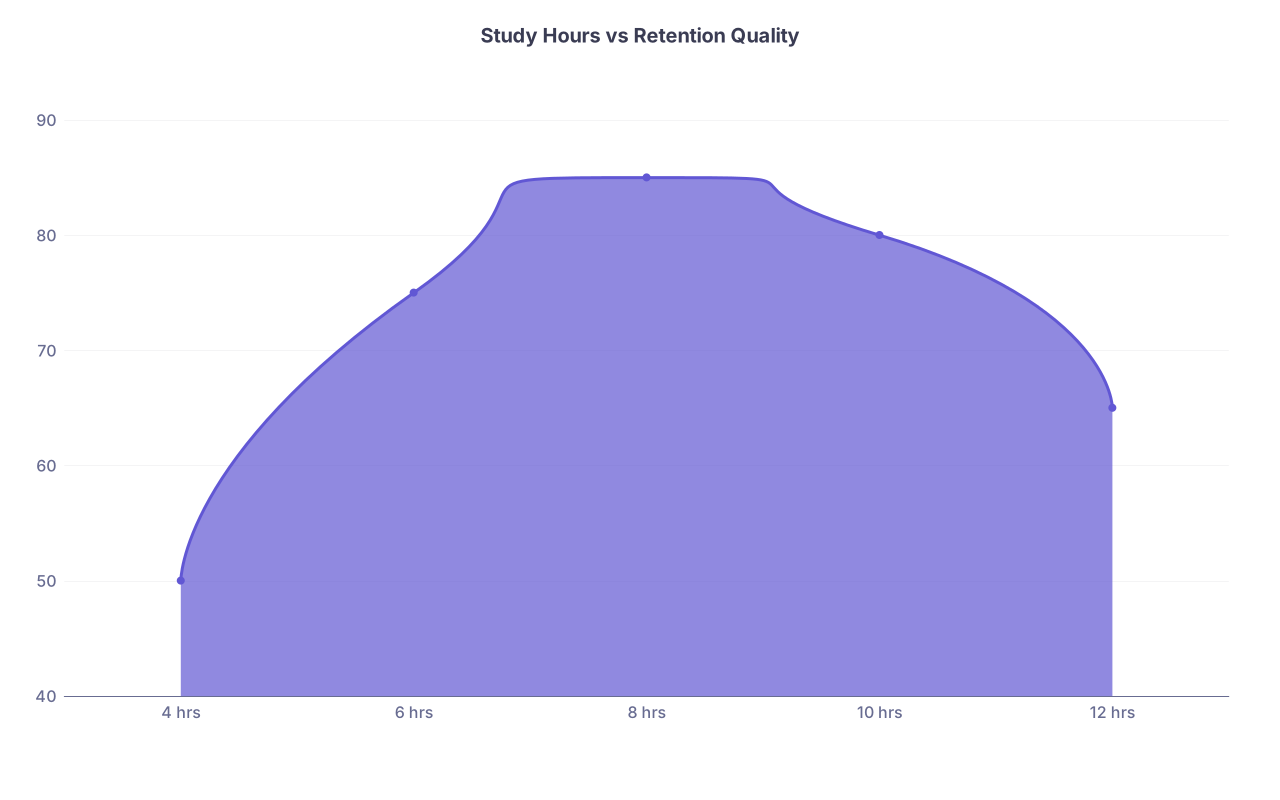
| Category | Value |
|---|---|
| 4 hrs | 50 |
| 6 hrs | 75 |
| 8 hrs | 85 |
| 10 hrs | 80 |
| 12 hrs | 65 |
Personalization: When You Might Need to Study Every Day for a Short Time
I’m not going to pretend everyone is in the same situation.
You might temporarily need closer to daily study if:
- You started way behind in a block and the exam is in 7–10 days
- You’re remediating an exam or course
- You’re in the last 5–7 days before a massive board exam and your baseline was weak
Even then, I still recommend:
- At least one half‑day of actual rest in that stretch
- Hard stop times (e.g., no work after 9 pm) rather than 16‑hour panic marathons
And for long phases (months of prep, full year of clerkships, multiple Step exams):
A “no off days, ever” rule is a great way to blow yourself up by winter.

Mental Health Reality Check: Signs You Need More Rest, Not More Hours
If you’re seeing this combo:
- You’re “studying” but re‑reading the same paragraph 5 times
- You’re snapping at people, crying randomly, or feeling numb
- You dread opening anything study-related
- Sleep is trash, you wake up already tired
That’s not a motivation problem. That’s a system overload problem.
In that state, forcing yourself to “just keep pushing” 7 days a week is like slamming the gas on an engine that’s already overheated. It doesn’t make you faster. It just breaks things.
A strategically placed real day off can restore more function than an extra 8–10 miserable hours of “studying.”

Quick Decision Framework: Do You Need True Off Days?
Ask yourself, honestly:
- Can I maintain my current schedule for the next 8–12 weeks without hating my life?
- Do I feel guilty anytime I’m not studying, even when I’m exhausted?
- When I sit to study, do I feel focused or just trapped?
- Do I have at least one day a week where I feel like a human being, not just a med student?
If:
- You’re performing well AND feel okay emotionally: you can lean slightly more aggressive—maybe some weeks are “7 days on but 1 is very light.”
- You’re performing okay but feel mentally fried: you need a protected weekly off day, non‑negotiable.
- You’re struggling academically AND mentally fried: don’t fix this by adding more hours. Fix it with:
- A realistic plan
- Fewer “pretend” study hours
- One real off day + 5–6 efficient days
- Possibly talking with academic support or counseling
FAQ (Exactly 7 Questions)
1. Will taking one day a week completely off hurt my Step/COMLEX score?
Not if the rest of your week is structured. A weekly off day, within a consistent 6-day plan, usually improves your performance by making your other days sharper. What tanks scores is inconsistent, last‑minute cramming, not one protected day off.
2. Should I at least do my Anki reviews on my “off day”?
If you want a true off day, no. Plan your new card limits and review load so that missing one day doesn’t create an impossible wall. Some students are comfortable doing a 15–20 minute “maintenance swipe,” but be honest: if that keeps you mentally tied to school, skip it and adjust on your next study day.
3. How many off days is “too many” during a regular block?
If you’re taking more than 2 full days off per week consistently, you’d better have a long runway and very efficient workdays. For most people, 1–2 off days per week is the upper limit if you want to stay comfortably ahead of exams.
4. What about during clerkships when my schedule is insane?
Your “off days” may be dictated by the rotation. On heavy services (surgery, OB), your post‑call day or weekend may naturally become a partial or full off day. On lighter rotations, you often can carve out a real off day if you protect your evenings on other days and keep up with required reading/shelf prep.
5. I feel guilty on off days—how do I handle that?
Write down your weekly plan, including the off day, before the week starts. When guilt shows up, remind yourself: “I’m following the plan.” That flips it from “I’m slacking” to “I’m executing a strategy.” Also, plan specific, non‑school activities on your off day so you don’t just sit and ruminate.
6. Should I pull all‑day study marathons instead of taking days off?
Occasional long days near big exams are fine. Making 10–12 hour marathons your default is dumb. The quality of your attention falls off a cliff, your recall drops, and your risk of burnout skyrockets. You’re better off with ~6–8 focused hours over 6 days than 10 sloppy hours over 7.
7. How do I know if my current balance is working?
Track three things for 2–3 weeks:
- Practice scores or quiz performance
- Hours actually spent studying (not just “calendar time”)
- Subjective mental state (1–10 burnout scale)
If scores are stable/improving and burnout is ≤6/10, your system is viable. If burnout is 8–10/10 or scores are dropping despite tons of hours, your setup is not sustainable—you need either more structure, more rest, or both.
Key Takeaways:
You don’t need to study every single day to be a good med student. You do need consistent, planned work on most days—and at least one true, guilt‑free off day per week during most phases. The goal isn’t to prove how much you can suffer; it’s to build a schedule your brain and body can actually carry for the long haul.