
Most medical licensure forms do not care that you used school counseling; they care whether you currently have an impairment that affects safe practice.
Let me be blunt: using your medical school’s counseling center is almost never the thing that triggers licensing problems. Avoiding help until you crash? That’s what actually ruins careers.
You’re asking the right question, though: “If I see a counselor in med school, will I have to disclose it on licensure forms later?” Here’s the real framework you should use to decide.
The core issue: treatment vs impairment (and what boards actually ask)
State medical boards do not all ask the same thing, but almost all of them orbit one central idea:
They’re supposed to protect the public from unsafe physicians, not punish physicians for getting therapy.
Most modern licensing applications have moved away from “Have you ever seen a psychiatrist or therapist?” to some version of:
- Do you have any condition that impairs your ability to practice medicine safely?
- Have you been impaired by substance use or mental health issues in the past X years?
- Are you currently under monitoring or restrictions because of a condition?
That’s a very different question than “Did you ever talk to a counselor when you were a stressed-out M2?”
So the key distinction you need to understand is this:
- Treatment or counseling by itself – usually not reportable
- Impairment or formal disciplinary/monitoring actions – often reportable
Seeing a campus counselor because you’re anxious about Step 1? No.
Placed on mandated monitoring after a substance-related incident that affected patient care? Very likely yes.
What “school counseling” usually looks like on paper
Let’s talk practically about what “using school counseling” means in most med schools.
Most of the time it’s:
- A short-term counseling service through student health / counseling center
- Visits coded as mental health visits in the student health record, not your “employee” or “credentialing” record
- Protected by the same privacy laws that cover any other medical care (HIPAA or FERPA, depending on how your school is structured)
Typical example I’ve seen dozens of times:
- M2 feeling overwhelmed before Step 1
- Books an appointment with the school counseling center
- Has 4–6 therapy sessions, maybe gets a short course of an SSRI from student health
- Symptoms improve, continues med school as usual, no leave, no academic discipline
Does that student later have to tell a licensing board: “Yes, I used school counseling in 2024”? In almost every state, with current questions? No.
Because the question isn’t “did you ever get help?” The question is whether you currently have a condition that impairs your ability to practice or you had documented impairment leading to action.
How licensure questions are actually worded
Here’s where people get anxious: the wording on some applications feels vague or intimidating.
Rough pattern you’ll see:
Time-limited questions:
“In the past 5 years, have you had any condition that impaired or might impair your ability to practice medicine safely?”Care-only questions (much less common now, and often being phased out):
“Have you ever been treated for…?” (These are increasingly criticized and sometimes legally vulnerable.)Action/discipline questions:
“Have you ever been required to seek treatment or monitoring as a condition of academic or professional discipline?”
“Have you ever been restricted from clinical duties due to a mental or physical condition?”
Notice the difference:
- Voluntarily booking an appointment with school counseling: usually not reportable.
- Being required by your school, after a serious concern about your behavior or safety, to enter a monitoring or fitness-for-duty program: often reportable.
| Situation | Usually Disclose? |
|---|---|
| Voluntary school counseling for stress, anxiety, or adjustment | No |
| Ongoing mental health condition that is well-treated and not impairing | Usually No |
| Leave of absence clearly documented as for medical/psychiatric reasons | Sometimes Yes (depending on question wording) |
| Formal fitness-for-duty evaluation ordered by program/school | Often Yes |
| Mandated monitoring program after substance-related incident | Yes |
If an application asks only about impairment and discipline, and you simply saw a campus counselor and kept functioning safely, you typically answer “No.”
Does anyone even know you used counseling?
Another fear: “Will my school or residency tell the board I used counseling?”
Short answer: they usually can’t, and they don’t want to.
- Counseling services are generally confidential.
- Your dean’s letter (MSPE) does not list “received therapy” or “saw counseling.”
- Residency program directors usually don’t have access to your campus counseling records.
What can show up:
- Documented leaves of absence
- Academic or professionalism issues
- Fitness-for-duty evaluations or serious incidents
Even then, most schools are careful with language. “Took a personal leave for health reasons” is common. They rarely spell out diagnoses.
So no, using counseling as a med student doesn’t put a big red flag in your file that follows you forever. The horror stories you hear are usually about major impairment, disruptive behavior, or substance issues that affected patient care—not quietly seeing a therapist.
When counseling might become relevant to licensure
There are scenarios where your mental health history could intersect with licensure questions. You deserve clarity on those too.
Here are the big ones:
You had a leave of absence clearly for psychiatric reasons
If your LOA paperwork says “medical” or “personal” only, you’ll usually discuss the gap if asked, but not necessarily on a separate “mental health” question.
If a board asks specifically: “Have you had any condition resulting in a leave of absence or inability to function as a student or resident in the past X years?” then yes, you answer truthfully. But again, that’s about impairment, not the fact you saw school counseling.You were declared unfit for clinical work for a period of time
For example: pulled from rotations after a serious suicide attempt, or after behavior that raised safety concerns. This can lead to documentation in your school file, and sometimes an official fitness-for-duty evaluation. That history may fit under “impairment” or “restrictions on clinical activities” questions.You entered a formal monitoring or physician health program
If you had substance use concerns or major impairment and were placed into a structured program with random testing or mandated therapy, that’s usually reportable when boards or hospitals ask about monitoring or restrictions.
Notice what’s missing from that list:
“Used school counseling because med school was stressful.”
That’s not what they’re after.
Why avoiding counseling is more dangerous for licensure
Let me flip this around because it’s the part people conveniently ignore.
What actually gets future physicians in trouble with boards isn’t “they used therapy early.” It’s:
- They ignored depression until they were drinking heavily and showed up impaired.
- They pushed through severe anxiety until they started making serious clinical errors.
- They hid a condition instead of getting treated, so when it finally exploded, it was catastrophic.
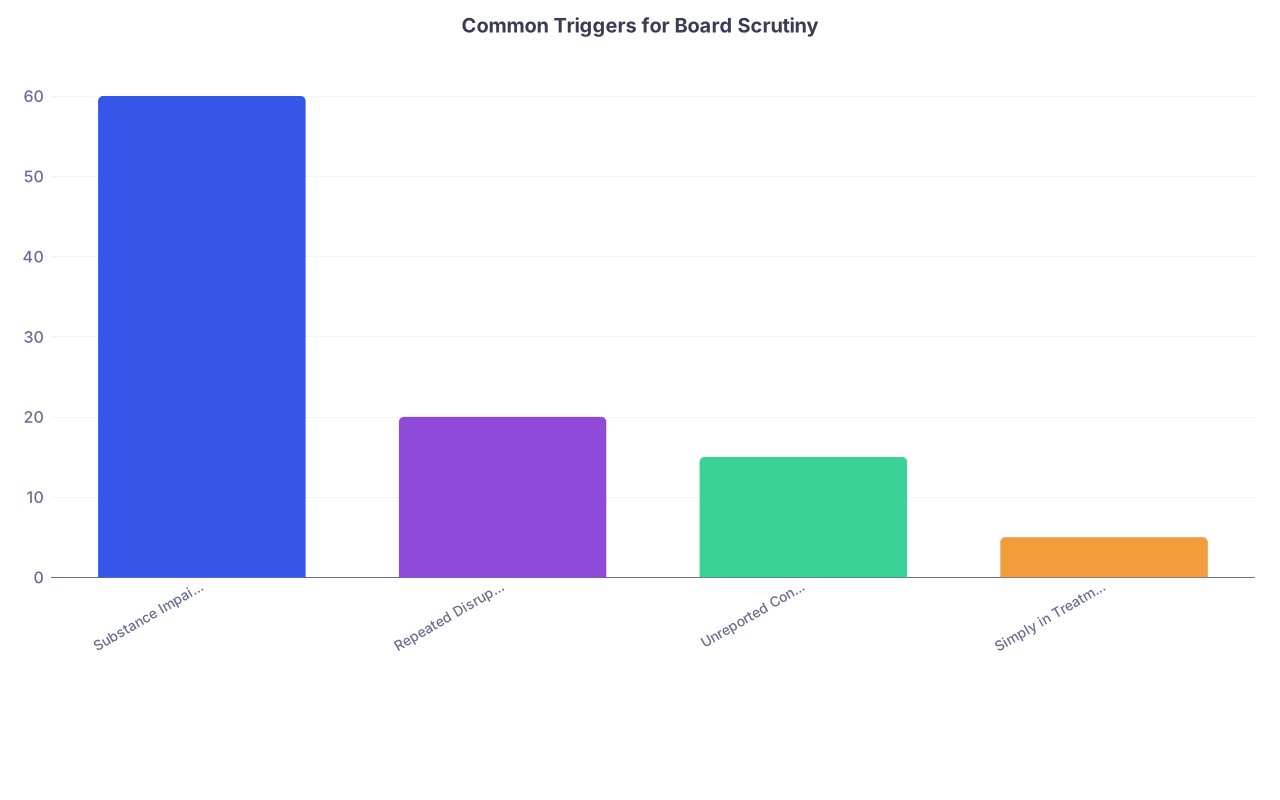
| Category | Value |
|---|---|
| Substance Impairment | 60 |
| Repeated Disruptive Behavior | 20 |
| Unreported Condition | 15 |
| Simply in Treatment | 5 |
You want to be the person who:
- Saw your stress, anxiety, or mood changes early
- Got counseling
- Maybe took meds
- Stabilized and functioned well without safety issues
Boards, hospitals, malpractice insurers—more and more of them actually like hearing that story when it’s relevant. It’s a “good judgment and insight” story, not a “risk to patients” story.
How to answer licensure and credentialing questions safely and honestly
Fast-forward a few years. You’re filling out a state license or hospital privilege application. You hit the “mental health” question. Here’s how I’d advise you to think through it:
Read the question exactly as written.
Do they ask:- About any treatment or just impairment?
- For lifetime history or a time window (like 2 or 5 years)?
- About voluntary care or only mandated monitoring/discipline?
Apply a simple rule:
- If the question is about impairment, ask yourself:
“Did I have a condition that actually limited my ability to function safely in training or practice during that timeframe?” - If the answer is “no, I was functional and in good standing,” then you typically answer “No,” even if you were seeing a therapist.
- If the question is about impairment, ask yourself:
If you’re unsure: talk to two people, not Reddit.
- A lawyer familiar with medical licensing in that state
- Your program’s GME office or physician health program (confidentially)
You do not need to volunteer extra information the form doesn’t ask for. Answer honestly. Don’t expand the question in your mind to “have you ever felt sad or anxious and talked to someone.”
Practical steps if you’re hesitating to get help
If what’s really underneath your question is: “I’m struggling, but I’m scared therapy will ruin my future,” here’s how to move forward intelligently instead of white-knuckling your way into a real problem later.
Use confidential campus counseling or off-campus therapy
Ask explicitly:- Do you share anything with the medical school administration?
- Are these records part of my educational record, or separate medical records?
Clarify documentation of any leave of absence
If you take a break for health reasons, talk with your dean about how it will be documented. Many schools can label it “medical” or “personal” without spelling out diagnoses in giant letters.Keep your own personal record
Jot down approximate dates and a simple summary:- Saw counseling for anxiety, no impairment, continued full duties.
- No disciplinary or fitness-for-duty actions.
If a board question years later ever legitimately applies to you, you’ll have precise, calm language ready—rather than panicking and oversharing.
Visualizing the typical trajectory
Here’s how this usually plays out for thousands of medical students every year.

| Step | Description |
|---|---|
| Step 1 | Medical student feels stressed/anxious |
| Step 2 | Uses school counseling / therapy |
| Step 3 | Condition managed, no impairment |
| Step 4 | Graduates, matches, licensed |
| Step 5 | Symptoms worsen |
| Step 6 | Leave, discipline, or monitoring |
| Step 7 | Reportable history & harder path |
| Step 8 | Seeks help? |
| Step 9 | Impairment or incident? |
The branch that uses counseling early is almost always the safer route, both clinically and on paper.
Quick reality check: step back from the fear
I’ve watched students whisper about this in library corners for years:
“If I go to counseling, will I ever get licensed?”
“If I admit I’m on meds, am I done?”
The real risk isn’t being in treatment. The real risk is:
- Being untreated and then actually impaired around patients
- Getting caught lying on an application
- Having a documented pattern of ignoring safety concerns
Use counseling if you need it. Use medication if it helps. Take a leave if you’re truly not safe to continue. Then recover, stabilize, and document that you’re functioning.
Licensing boards are slow and imperfect, but the trend for the last decade is clear: they’re moving away from punishing treatment and toward focusing on actual, present ability to practice safely.

FAQs: School Counseling and Licensure Disclosure
Do I have to disclose that I used my medical school’s counseling service on state licensure applications?
In most states, no. Licensure questions focus on conditions that impair your ability to practice safely, not on whether you ever went to counseling. Voluntary, confidential school counseling without impairment or discipline is usually not reportable, because it doesn’t meet the criteria those questions are targeting.Will my medical school tell residency programs or boards that I used counseling?
Generally no. Counseling records are confidential and kept separate from your academic file. What may be visible are leaves of absence, serious professionalism or safety issues, or fitness-for-duty evaluations—not the fact that you had regular therapy sessions. Schools don’t list “received counseling” in your MSPE.If I take a leave of absence for mental health, will that have to be disclosed?
Possibly, depending on how questions are worded. Many applications ask if you’ve had any condition that resulted in an inability to function or required a leave. You’d answer truthfully if that applies. But a well-managed, well-documented LOA with recovery is far less of a problem than pushing through until something dangerous happens.What if I’m on medication for depression or anxiety—do I need to mention that?
Typically no, unless the application specifically asks about treatment (which is less common now) or if your condition currently impairs your ability to practice safely. A stable, treated condition with no functional impairment is usually not something boards are targeting with their questions.Can answering “no” to a mental health question be considered lying if I’ve been in therapy?
It depends entirely on how the question is worded. If the question is about impairment, monitoring, or restrictions, and you’ve never been impaired or restricted, answering “no” is accurate—even if you’ve been in voluntary therapy. You are not required to mentally expand the question to include every counseling session you’ve ever had.Should I avoid counseling so I never risk having anything to disclose?
No—that’s backwards. Avoiding needed care increases the risk that you’ll eventually become impaired, make serious errors, or face disciplinary action. Those are the things that clearly do trigger disclosure and long-term career complications. Early, voluntary treatment makes license problems less likely, not more.Who can I safely ask about my specific situation without risking my records?
Start with:- Your school’s counseling center (ask about privacy and record-keeping).
- A lawyer familiar with physician licensure in your state.
- Your institution’s physician health program or wellness office, which often offers confidential guidance.
Don’t rely solely on classmates or random forums; they’re usually repeating half-remembered horror stories, not actual policy.
Bottom line
Two things you should walk away with:
- Using school counseling by itself almost never needs to be disclosed on licensure forms, because boards care about impairment and safety, not whether you were smart enough to get help.
- Getting early, voluntary support is far safer for your career—and your life—than silently deteriorating until something serious and genuinely reportable happens.