
You’re halfway through the semester. You have an exam in two days, you’re behind in every class, your brain feels like wet concrete, you’re not sleeping, and your group chat is just screenshots of Anki and NBME scores. And the thought you keep circling back to is brutal:
“Do I take a leave of absence…or just grind through this disaster and hope I survive it?”
You are not the first med student to land here. You won’t be the last. But the worst thing you can do is make this decision based on panic, shame, or vibes.
Here’s the answer you’re looking for: there is a structured way to decide if you should take an LOA or push through a terrible semester. And yes, one of those is clearly better in certain situations.
First: What “Pushing Through” Actually Costs (That People Underestimate)
Let me be blunt: “just push through” is wildly overprescribed advice in med school. Sometimes it’s correct. Often it’s what burned-out people say because no one helped them when they needed it.
Pushing through a bad semester can cost you in a few ways:
Academic damage
Failures and repeats are not harmless.Common Outcomes of 'Pushing Through' vs LOA Path Short-Term Outcome Long-Term Impact on Record Push through Risk of course/rotation fail Remediation, comments on MSPE Late LOA Withdrawal after failing F on transcript + LOA notation Planned LOA No fails this term LOA notation, usually explainable Push + barely pass Pass with low internal grades Weaker letters, weaker confidence A single failed course isn’t the end of your career, but multiple failures, repeated Step attempts, or chronic underperformance absolutely close doors.
Mental health damage
I’ve watched students go from “stressed” to “I do not care if I wake up tomorrow” in one block. That slide can happen faster than you think.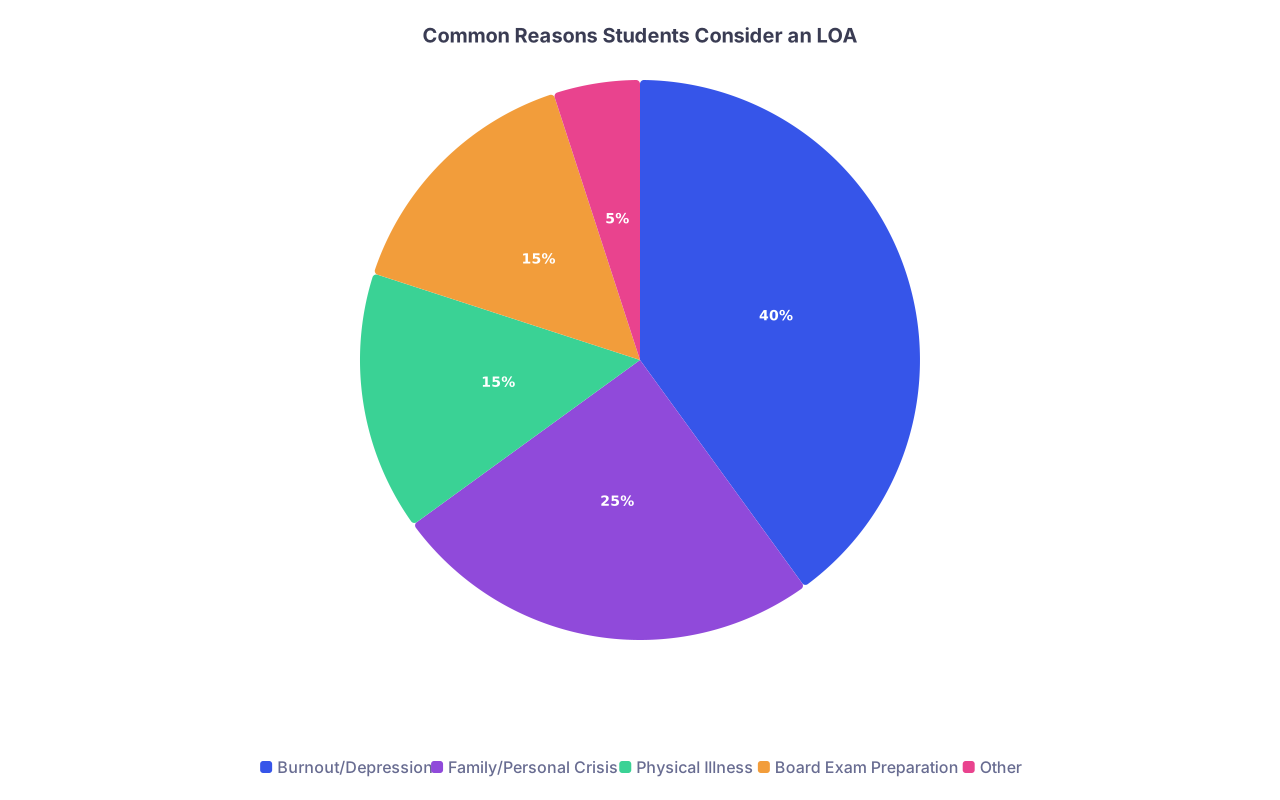
Common Reasons Students Consider an LOA Category Value Burnout/Depression 40 Family/Personal Crisis 25 Physical Illness 15 Board Exam Preparation 15 Other 5 Once you hit severe depression, anxiety with panic attacks, or complete emotional shutdown, you’re not just dealing with grades anymore. You’re dealing with basic functioning.
Reputation and relationships
When students burn out and keep forcing themselves, you often see:- Unprofessional behavior on the wards
- Snapping at residents, nurses, patients
- Missed pages, late notes, unexcused absences
That bleeds into your MSPE and letters. An LOA is usually easier to contextualize than “chronically unreliable on rotations.”
So no, “just push through” is not automatically the safer or braver choice. Sometimes it’s the reckless one.
When an LOA Is Clearly the Better Option
Let’s be very clear. There are some situations where I would strongly lean LOA over pushing through.
1. Your safety or basic functioning is compromised
If any of these are true, stop pretending this is just a study problem:
- You’re having active suicidal thoughts, even fleeting, with any level of planning
- You’re self-harming, or thinking about it
- You’re using alcohol, benzos, stimulants, or other substances to get through the day
- You can’t reliably get out of bed, shower, or feed yourself
- Panic attacks are frequent and interfering with exams, clinics, or daily tasks
That’s not “I’m bad at time management.” That’s a mental health crisis. An LOA with real treatment is infinitely better than white-knuckling your way into a full breakdown.
If you’re in that territory, your next step isn’t a pros/cons list. It’s:
- Contact student mental health or counseling today
- Tell them explicitly you’re worried you might not be safe
- Loop in your dean or student affairs after you’ve spoken to someone clinical
If you’re worried this will “ruin your record”: residencies are much more sympathetic to “I took a structured LOA to get treatment and came back stable” than to “I failed repeatedly and had professionalism flags.”
2. There’s a major life crisis you can’t ignore
Examples I’ve seen:
- Parent or partner with a new cancer diagnosis
- Death in the immediate family, and you’re the main support person
- Your own new serious medical diagnosis (autoimmune disease flare, cancer, severe chronic illness)
- Legal issues, housing instability, or domestic violence
Trying to memorize cytokines while your parent is in the ICU is absurd. You are not weak for needing to step away. You’re human.

3. You’re chronically behind with no realistic path to catch up
Key word: realistic.
If this sounds familiar:
- You’re 4–6 weeks behind in multiple courses
- You’ve already tried dialing up your study time and cutting nonessentials
- You’ve failed at least one major exam already this term
- Even with a perfect schedule, the math doesn’t work to fully catch up and perform well
Then pushing through might just be turning this into a slow-motion car crash.
An LOA before you start accumulating Fs looks better than scrambling to remediate a pile of failures.
When Pushing Through Might Actually Make Sense
Let me flip it. Sometimes you do not need an LOA. What you need is:
- Better structure
- Support you’ve been avoiding
- A reality check on perfectionism
Here are scenarios where I’d say: probably push through, but with adjustments.
1. You’re struggling academically but still basically functional
Signs:
- You’re stressed and tired, but you’re eating, sleeping (even if not perfectly), functioning
- You haven’t failed anything yet, or maybe you barely failed one exam but improved after reworking your approach
- Your biggest issue is efficiency and strategy, not total emotional collapse
This is where you:
- Meet with academic support and get a specific plan
- Cut nonessential commitments temporarily
- Accept “solid pass” instead of gunning for honors this term
An LOA just to “avoid an ugly transcript” when you could pass with help? Overkill.
2. The semester is rough, but the root problem is fixable quickly
Examples:
- Sleep completely trashed because you’re on screens until 2 a.m.
- Unrealistic study plan (14 hours of unfocused “studying”)
- No question-based learning, just re-reading notes
These are behavior and system problems. Fixable in weeks with:
- Sleep schedule guardrails
- Daily question quotas
- Tight, time-boxed blocks with real breaks
You don’t need to pause your entire education for that. You need deliberate changes and maybe someone to hold you accountable.
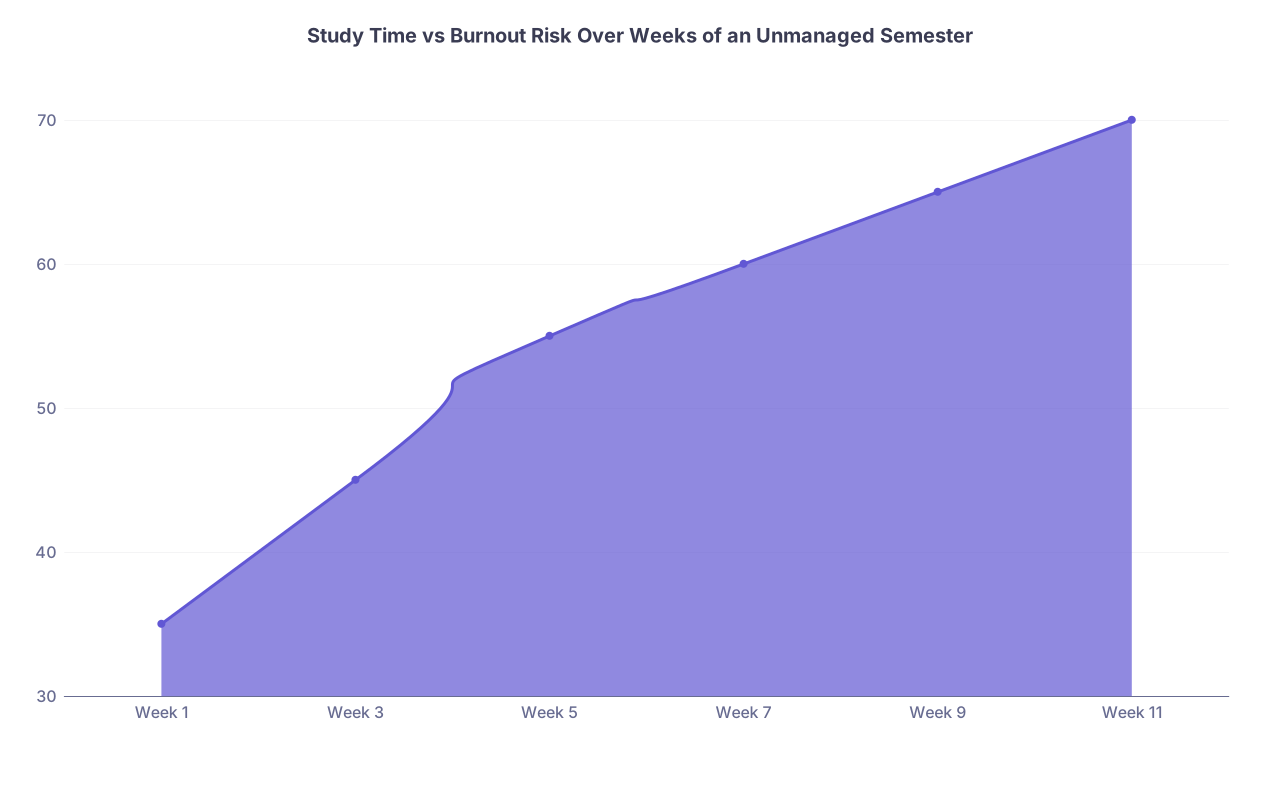
| Category | Value |
|---|---|
| Week 1 | 35 |
| Week 3 | 45 |
| Week 5 | 55 |
| Week 7 | 60 |
| Week 9 | 65 |
| Week 11 | 70 |
A Straightforward Decision Framework (Use This Today)
Stop spiraling. Sit down and walk yourself through this, honestly.
Step 1: Rate three domains from 1–10
1 = terrible / nonfunctional, 10 = totally fine.
- Mental health (mood, anxiety, safety, sleep)
- Academic standing (current grades, risk of fail)
- Life stability (family, finances, housing, health)
Now look at your lowest score.
- If any are 1–3 → LOA should be firmly on the table.
- If all are 4–6 → You’re in the gray zone. You need targeted help, decision depends on pattern.
- If most are 7–10 but you just “feel behind” → You probably need support and structure, not an LOA.
Step 2: Ask the “6-week question”
If you kept going exactly as you are now for 6 more weeks, what is realistically going to happen?
- Fail 1+ classes?
- Show up to a clinical site dangerously sleep deprived?
- Start or worsen self-harm or substance use?
- Or just feel miserable but probably pass?
If the honest answer is “things will fall apart harder,” that’s LOA territory.

| Step | Description |
|---|---|
| Step 1 | Feeling overwhelmed this semester |
| Step 2 | Strongly consider LOA |
| Step 3 | Talk to dean about LOA options |
| Step 4 | Push through with structured support |
| Step 5 | Reassess with mental health + dean |
| Step 6 | Safety or severe impairment? |
| Step 7 | High risk of course failure? |
| Step 8 | Functioning but stressed? |
Step 3: Talk to three people (not just your classmates)
You need three perspectives:
A mental health professional
School counselor, psychologist, psychiatrist, or therapist. You tell them exactly what’s happening—no minimizing “it’s not that bad.”Your student affairs / dean’s office
You want clear answers:- What does an LOA look like here?
- Is it “medical,” “personal,” or both?
- What shows up on my transcript/MSPE?
- How does tuition/financial aid/loans get handled?
- What happens with Step 1/2 timing?
Someone one or two years ahead of you who has actually done an LOA or repeated time
Ask them:- How did programs react on the interview trail?
- What would you do differently?
- What helped you come back stronger?
Not your panicked classmate who’s also on the brink. Not Reddit comment #284. Someone with distance and actual experience.
How LOAs Really Look on Applications (Not the Horror Stories)
There’s a lot of mythology about LOAs “ruining your chances.” Reality is more nuanced.
Here’s how programs usually interpret it:
| Scenario | Typical Program Interpretation |
|---|---|
| Single medical/mental health LOA, good performance after | Understandable, often neutral if explained well |
| LOA for research with strong output | Often positive, especially for academic fields |
| Multiple unexplained gaps + failures | Red flag, needs strong explanation |
| No LOA but repeated failures and professionalism issues | Worse than a clean, well-managed LOA |
Programs care more about:
- Pattern: Is this a one-time, clearly addressed event or ongoing chaos?
- Trajectory: Did you come back and perform well?
- Insight: Do you own the story without sounding fragile or evasive?
A single, well-justified LOA with a strong comeback usually plays fine. What doesn’t play fine is denial and spiraling academic/behavioral issues.

If You Decide to Take an LOA: Do It Right, Not Halfway
If you take an LOA and then spend six months doom-scrolling and stressing, you just stretched out the misery.
A solid LOA plan usually includes:
Clear goals
“Stabilize depression and get back to baseline functioning.”
“Support my parent through chemo and set up additional help so I’m not sole caregiver next year.”A treatment or support plan
Not “I’ll feel better somehow.”
Actual therapy, medication if indicated, groups, PCP follow-up, maybe occupational therapy or ADHD evaluation if that’s part of the problem.A re-entry plan
Talk with your dean before you leave about:- When you’ll likely return
- How they’ll assess readiness to return
- Any accommodations you might need (reduced load, step exam timing, etc.)
The goal of an LOA is not escape. It’s rehab. Academic and emotional.
If You Decide to Push Through: Don’t Go Solo Hero Mode
If you’re going to stay in, you don’t get to keep doing what got you into this mess. You need structure and an immediate reset.
Today, that means:
- Email academic support for the earliest possible appointment
- Set up mental health services if you’re not already in care
- Tell at least one trusted person (friend, partner, upperclassman) that this semester is rough and you’re committing to specific changes
Then:
- Ruthlessly triage: what actually matters for passing?
- Accept good-enough work over perfect, high-effort, low-yield studying
- Protect sleep like it’s on the exam—because your brain function basically is
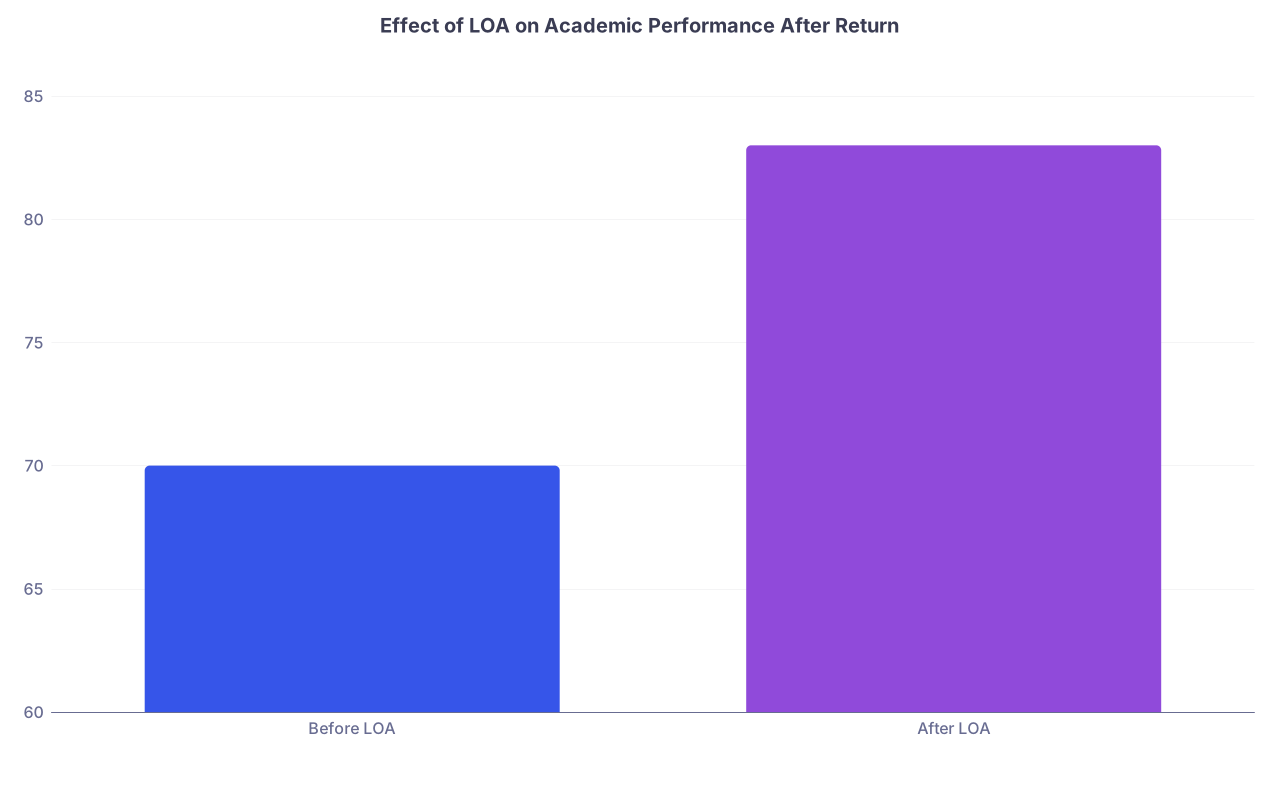
| Category | Value |
|---|---|
| Before LOA | 70 |
| After LOA | 83 |
Bottom Line: Is It Better to Take an LOA or Push Through a Terrible Semester?
Here’s the clean answer.
- If you are unsafe, nonfunctional, or in a major life crisis → It is better to take an LOA and come back intact than to push through and break.
- If you are on track to stack multiple failures or professionalism concerns → A planned LOA is usually better than a transcript full of damage.
- If you’re stressed but functional, with fixable study and time issues → It’s usually better to push through, with support and a concrete plan.
And if you’re still unsure after reading this? That’s your sign to stop trying to figure it out alone and pull in your dean and a mental health clinician.
FAQ (Exactly 5 Questions)
1. Will taking a leave of absence ruin my chances for residency?
No, not by itself. A single, well-explained LOA—especially for medical or serious personal reasons—with strong performance afterward is usually fine. Programs get more concerned by a pattern of unexplained gaps, repeated failures, or professionalism issues. How you frame the LOA and what your performance looks like when you return matter far more than the fact that an LOA exists.
2. Is it better to fail a course and then take an LOA, or take an LOA before I fail?
Better to take an LOA before formal failures whenever you can see the train coming. An LOA without multiple Fs is easier to explain than a transcript with several failed or remediated courses. But if you’ve already failed something, it’s still not game over. Talk to your dean early; sometimes they can convert to a withdrawal or structure your time so you do not compound the damage.
3. How do I even bring this up with my dean without sounding weak?
You’re not pitching weakness. You’re demonstrating insight. You say something like: “This semester my functioning has deteriorated. I’m concerned about my performance and my mental health. I want to talk about whether an LOA or some other structured support makes the most sense to preserve my long-term success.” Calm, factual, specific. You’re asking for a professional plan, not sympathy.
4. Will my classmates think less of me if I take an LOA?
Some might not understand it. That’s fine; it’s not their life. But many will quietly think, “I wish I’d had the courage to do that when I was drowning.” The longer you’re in medicine, the more you realize: people take different paths, and very few of them are perfectly linear. Your license, your health, and your future patients matter more than temporary gossip.
5. What if I take an LOA and then feel worse because I’m “behind”?
That happens when people take an LOA with no structure and then marinate in shame and isolation. Combat that directly: build a schedule for your LOA, stay connected to at least a couple of trusted classmates, meet regularly with mental health and your dean, and define what “ready to return” will look like for you. You are not behind. You are taking the time required to be someone who can safely and sustainably practice medicine.
Specific, actionable next step:
Right now, rate your mental health, academic standing, and life stability from 1–10 on a piece of paper. Then email your student affairs dean and your school’s counseling service and request appointments to discuss those numbers and whether an LOA or a structured push-through plan makes more sense. Don’t keep this decision locked in your own head.