
You’re two weeks into MS1. The adrenaline of orientation has worn off. Your calendar is a wall of lectures, you’re behind on Anki, and you just heard three different upperclassmen say, “Oh, it only gets worse.”
This is the point where most people make a quiet, dangerous decision: I’ll just grind harder and deal with my mental health later.
That’s how you end up in November crying in the bathroom before an anatomy practical, wondering when exactly things went sideways.
Let’s not do that.
You’re going to treat MS1 like what it is: a year-long endurance event. With checkpoints. At specific weeks and specific months, you’re going to stop, assess, and course-correct before you crash.
Below is a month‑by‑month mental health timeline for MS1, with concrete “at this point you should…” markers and specific corrections when things are off.
Big‑Picture Year Timeline
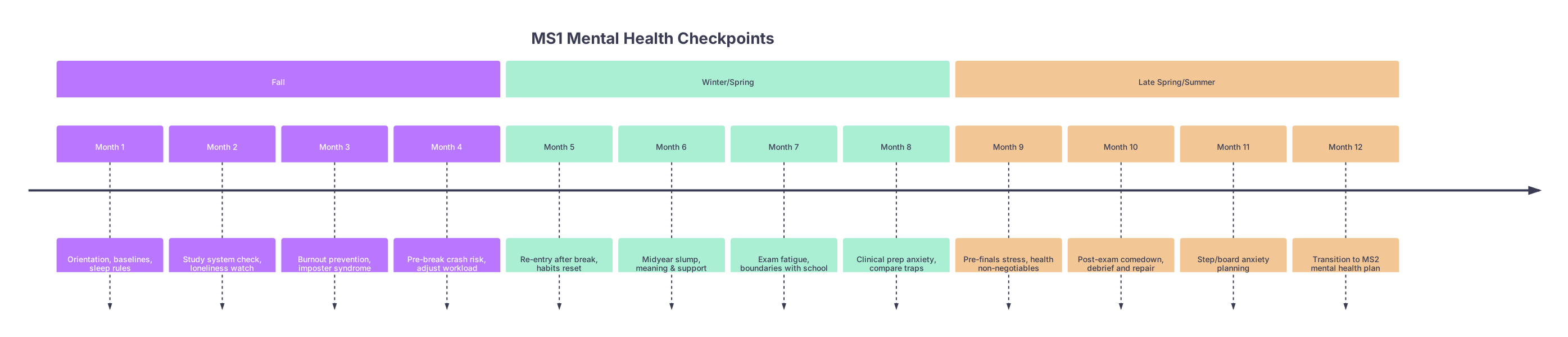
| Period | Event |
|---|---|
| Fall - Month 1 | Orientation, baselines, sleep rules |
| Fall - Month 2 | Study system check, loneliness watch |
| Fall - Month 3 | Burnout prevention, imposter syndrome |
| Fall - Month 4 | Pre-break crash risk, adjust workload |
| Winter/Spring - Month 5 | Re-entry after break, habits reset |
| Winter/Spring - Month 6 | Midyear slump, meaning & support |
| Winter/Spring - Month 7 | Exam fatigue, boundaries with school |
| Winter/Spring - Month 8 | Clinical prep anxiety, compare traps |
| Late Spring/Summer - Month 9 | Pre-finals stress, health non-negotiables |
| Late Spring/Summer - Month 10 | Post-exam comedown, debrief and repair |
| Late Spring/Summer - Month 11 | Step/board anxiety planning |
| Late Spring/Summer - Month 12 | Transition to MS2 mental health plan |
We’ll walk it month by month. Assume a traditional August start; shift by a month if your school is different.
Month 1 (Weeks 1–4): Orientation Buzz vs. Silent Panic
At this point you should be:
Still curious. A bit overwhelmed. Not yet fully exhausted.
Week 1–2: Set Baselines, Not Records
Your job right now is not to “get ahead.” It’s to establish sustainable baselines.
At this point you should:
- Know your minimum sleep: the number of hours below which you become useless (for most, 6.5–7.5).
- Have one primary study method chosen (Anki + boards-style Qs, or lecture notes + Anki, etc.)—not six half-started systems.
- Identify 1–2 humans you can actually be honest with (classmate, partner, sibling, therapist).
Red flags this early:
- You’re already routinely staying up past midnight “to keep up.”
- You’ve skipped meals more than 3 days this week because “no time.”
- You’re revisiting the thought, “I don’t belong here,” several times a day.
At this point, course correction for Month 1 looks like:
Daily (not negotiable yet):
- A fixed sleep window (e.g., in bed between 11–7). Not perfect, just aimed.
- One 15–20 min “non-medical” block (walk without podcast, call a friend, sit in the sun).
- A simple check-in question at night: “Did today feel sustainable if every day this month looked like this?”
If the answer is “no” more than 3 days in a row, that’s your warning light. Do not ignore it.
Month 2 (Weeks 5–8): The First Crash Test
By now the novelty is gone. Exams are real. Class group chats are constant low-grade stress.
At this point you should:
- Have gone through at least one exam or major quiz cycle.
- Know roughly how many hours of focused study you actually get per day (not “time in the library,” real focus).
- Notice how you react under academic pressure.
Week 5–6: System Check
Ask yourself, bluntly:
- Were you surprised by your first exam result?
- Did you have to pull late nights or panic-cram?
- Did your mood tank the week before the test?
Common Month 2 mental traps:
- “Everyone else seems fine.” (They don’t.)
- “I just need to work more hours.” (Wrong. You need to work smarter within bounded hours.)
- Social withdrawal because you “haven’t earned” a break.
Course corrections now:
1. Weekly Mental Health Standup (15 minutes max): Once a week, same time, you run through:
- Sleep: average hours, yes/no restful.
- Stress: 0–10 rating.
- Connection: Did I talk to someone about something non-school, at least twice this week?
- Enjoyment: Did anything this week feel fun or satisfying?
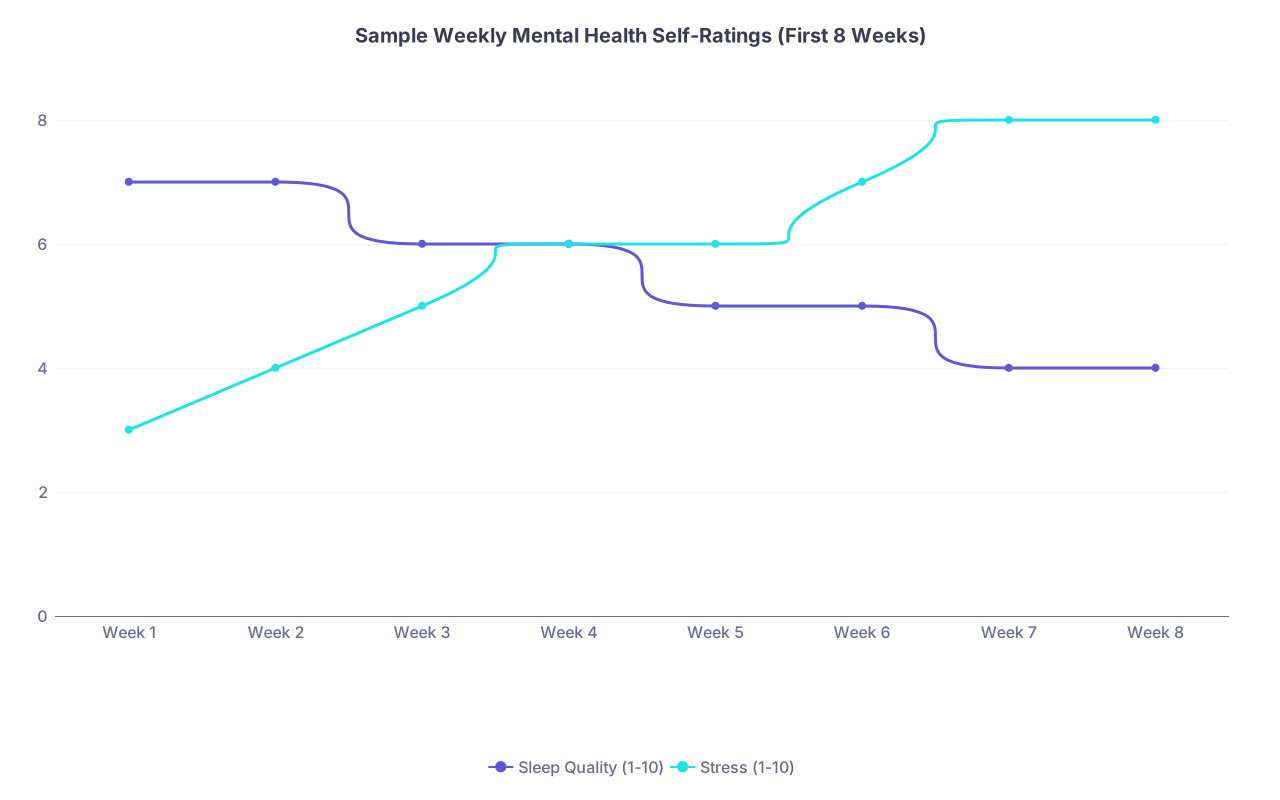
| Category | Sleep Quality (1-10) | Stress (1-10) |
|---|---|---|
| Week 1 | 7 | 3 |
| Week 2 | 7 | 4 |
| Week 3 | 6 | 5 |
| Week 4 | 6 | 6 |
| Week 5 | 5 | 6 |
| Week 6 | 5 | 7 |
| Week 7 | 4 | 8 |
| Week 8 | 4 | 8 |
If sleep is trending down and stress is trending up for >2 weeks, you intervene. Not later. Now.
2. Cap the Grind: Set an upper bound:
- Max focused study: 8–9 hours/day during exam week, 6–7 on normal days.
- You’re not a robot. If you’re at 11–12 “study” hours, you’re padding with low-yield guilt-scrolling.
Week 7–8: Loneliness and Identity Shift
This is where people start to feel the “I don’t recognize my life anymore” shift.
At this point you should:
- Have one recurring non-school activity in your week: intramural sport, religious service, therapy session, book club, whatever.
- Have talked to at least one M2/M3 about what they wish they’d done earlier for mental health.
If you don’t, your assignment this week is:
Email or message one upperclassman and ask:
“Can we grab 20 minutes sometime? I want to sanity-check my schedule and routines.”
It’s not weak. It’s efficient.
Month 3 (Weeks 9–12): Imposter Syndrome and Quiet Burnout
By this point, you’ve had enough exams to form a story about yourself.
For a lot of people, that story is toxic:
- “I’m only average here.”
- “If I was really meant to be here, this wouldn’t be so hard.”
- “Everyone else is keeping up with First Aid already.”
At this point you should:
- Be able to articulate your current narrative about yourself as a med student.
- Recognize your 2–3 biggest anxiety triggers (group chats, grade releases, talking to attendings, social events, etc.).
Reality Check: Where You Actually Stand
| Thought | More Accurate Translation |
|---|---|
| "Everyone else is ahead." | You see the 10 loudest people. |
| "I'm already behind forever." | You're 8–12 weeks into a 4-year arc. |
| "I shouldn't need help this early." | Early help is how people *finish* MS1. |
| "I must choose a specialty now." | No, you absolutely do not. |
Course corrections for Month 3:
1. Tighten Inputs, Not Outputs
If your stress is up and joy is down, you almost always have an input problem:
- Too much social media / class gossip.
- No protected decompression.
- All your conversations are about school.
At this point you should:
- Mute at least one high-anxiety group chat.
- Choose one evening per week where you do not talk about school at all.
2. Pre-Break Micro‑Goals
You’re aiming to hit the pre-winter break point without being fully fried.
Set 2–3 micro‑goals for your mental health before break:
- “I will still be sleeping 7 hours most nights.”
- “I will not have isolated myself from friends completely.”
- “I’ll have a therapist/counselor established, or be on a waitlist.”
Month 4 (Weeks 13–16): Pre‑Break Drag and “Just Survive” Mode
Everyone is tired. People are sick. Group study rooms smell like stress and cold brew.
At this point you should:
- Know what your body does under chronic stress: insomnia, headaches, GI issues, irritability, numbness.
- Have at least one “non-negotiable” still intact (sleep window, weekly dinner with partner, religious service, therapy).
This month, the risk isn’t acute panic. It’s numbness.
- You stop caring about results.
- You start doom-scrolling instead of sleeping.
- You say “I’m fine” because you don’t have energy to unpack not being fine.
Course corrections before break:
1. Pre‑Break Triage Plan (One Page, 10 Minutes)
Divide your life into three buckets:
Must Protect:
- Sleep floor (e.g., never under 6 hours 3 nights in a row).
- Basic food (real meals, not just snacks).
- One non-school connection per week.
Can Be Messy:
- Room slightly chaotic.
- Gym inconsistent.
- Email inbox less than ideal.
Must Not Do:
- New big commitments.
- Volunteering “just to pad CV” if you’re barely coping.
- All-nighters as a regular strategy.
2. Winter Break Recovery Plan
Write this before break when you still understand how tired you are.
Break week 1:
- Decompression only: sleep, sunlight, non-medical reading, people you like. Break week 2:
- Light structure: one or two hours a day of “future you” tasks (clean up notes, update Anki, pick resources), not hardcore studying.
Month 5 (Post-Break, Weeks 17–20): The Reset That Often Fails
You come back from break telling yourself you’ll “do it right this time.”
Then you copy‑paste your old schedule and wonder why you end up burnt out by February.
At this point you should:
- Review what actually broke first semester.
- Pick 1–2 things to do differently. Not 10. You won’t sustain 10.
Possible changes:
- Moving from 12-hour campus days to 8 hours on campus + 2 at home.
- Hard-start, hard-stop study times (e.g., 8–6 and then done).
- Blocking 2 half-days per month as truly off.
Week 17: 30-Minute Honest Debrief (alone or with a friend)
Answer these, no fluff:
- What was the ugliest week of last semester like? (Write it down.)
- What are the 2–3 leading indicators that a week is about to go that way? (e.g., skipping meals, canceling plans, snapping at people.)
- What will you do within 24 hours when those indicators show up?
That last part is non-optional. Write down the action:
“Text X: ‘I’m sliding back into bad patterns; can we walk tomorrow?’”
Or: “Email student wellness to schedule an appointment.”
Month 6 (Weeks 21–24): The Midyear Slump
Motivation drops. The material might be less glamorous. You’re far from Step, far from clinics, and very close to questioning life choices.
At this point you should:
- Expect at least one stretch where you feel detached or emotionally flat.
- Have some way of reconnecting with why you’re here that isn’t just “white coat ceremony pics.”
Course corrections for the slump:
1. Purpose Injection (Small, Not Grand)
No, you don’t need to go on a service trip to remember your purpose. Do something tiny but real:
- Shadow in clinic for 2–3 hours one afternoon.
- Volunteer once at a student-run free clinic.
- Ask a resident for a 15-minute chat about their worst day and why they stayed.
2. Structural Change, Not Just Pep Talks
If you’re dreading every day, tweak the actual day:
- Shift your heaviest cognitive work to when you’re most awake (for many, 8–11am).
- Move one demanding task out of your worst energy zone.
- Consolidate errands and life admin into one “operations hour” weekly so they stop leaking into everything.
Month 7 (Weeks 25–28): Exam Fatigue and Boundary Problems
By now, exams blur together. Your brain starts labeling everything as “just another test,” but your body still reacts like each one is life-or-death.
At this point you should:
- Recognize your pre-exam body script: tight chest, GI upset, insomnia, irritability.
- Have at least one pre-exam routine that lowers your baseline anxiety even a little.
Exam‑Week Boundary Rules:
- You do not need to read every message in the class chat.
- You do not schedule anything major the night before the exam.
- You do not experiment with brand-new study resources 3 days before.
If you find yourself breaking those, that’s your mental health checkpoint flashing red.
Course corrections:
- Create a 24-hour pre-exam script:
- Last question done by X pm.
- Light review of summaries only after that.
- Pre-decided dinner and bedtime.
- Post-exam decompression block (minimum 2 hours) where you:
- Do not discuss “what did you put for question 36?”
- Do move your body, eat real food, and do one enjoyable thing.
Month 8 (Weeks 29–32): The Comparison Olympics
People start talking about research, leadership, Step prep, competitive specialties. The “CV Olympics” begin.
At this point you should:
- Have a basic sense of your values (what actually matters to you), separate from what the loudest people in your class value.
- Know which conversations spike your anxiety—and be willing to exit them.
Course corrections for comparison overload:
1. Information Diet
Decide where you’ll get your “career guidance” from:
- 1–2 trusted faculty or mentors.
- 1–2 upperclassmen whose life you’d actually want.
Not:
- Every med Twitter hot take.
- The class group chat consensus.
2. Monthly Career Touchpoint (30 minutes)
Once a month:
- Write down any fleeting specialty interest (“peds? EM? ID?”).
- Write down 1 tiny action to explore one of them (podcast episode, shadow 2 hours, talk to one resident).
- Then shut it down. You’re not choosing a specialty; you’re exploring.
Month 9 (Weeks 33–36): Pre‑Finals / Pre‑Boards Rumblings
End of MS1 is in sight. That can either energize you or terrify you.
At this point you should:
- Be able to name what’s actually stressing you: exams, fear of MS2, Step anxiety, or general exhaustion.
- Have 2–3 health habits that are now “this is just what I do,” not constant battles.
If you have none, you still fix one thing now. Yes, this late. It still matters.
Course corrections: health non-negotiables
Pick one of these and lock it:
- Sleep: 7 hours except exam-eve outliers.
- Movement: 3x/week, 20–30 minutes (walk, jog, yoga, doesn’t matter).
- Food: No full days of “coffee and vibes” only.
You don’t optimize all three. Pick the one that gives you the biggest mood return and guard it.
Month 10 (Weeks 37–40): Post‑Exam Comedown and Emotional Whiplash
After a huge block final, there’s usually a weird hollow feeling:
- You’ve been running on cortisol.
- Suddenly it’s quiet.
- You feel either weirdly empty or irrationally agitated.
At this point you should:
- Expect to feel off after major exams for 24–72 hours.
- Not interpret that as “I hate medicine” or “I made a mistake.”
Course corrections:
1. Scheduled Emotional Lag
Literally block 1–2 days after big exams as:
- Lower-output days.
- Less social obligation.
- More sleep and unstructured time.
2. Debrief Before You Forget
Within a week of the exam:
- What went well the last block for your mental health?
- What clearly made you worse?
- What single change will you carry forward next block?
Write it down. Future you won’t remember the details.
Month 11 (Weeks 41–44): Step Anxiety Sneaks In
Even if your school is “integrated” and you’re technically far from the exam, your class will start buzzing. You’ll hear:
- “I already started UWorld.”
- “I’m on my second pass of Sketchy.”
- “If you’re not doing X by now, you’re behind.”
At this point you should:
- Have a realistic view of how much you can mentally add on top of MS1 without breaking.
- Decide whether early Step prep is protective or harmful for you, not your neighbor.
Course corrections:
- If thinking about Step spikes your anxiety to 8–10/10:
- Contain it. 1–2 hours per week of “board-adjacent” work, max: tagging Anki, light questions, or watching one video.
- If you have bandwidth and want to dip in:
- Cap it. 30–45 min, 3–4 days a week. No heroic plans. Heroic plans become anchor chains.
Month 12 (Weeks 45–52): Transition to MS2 Mindset
You’re no longer “new.” That’s both good and unnerving.
At this point you should:
- Be able to answer: “When do I start to slide mentally, and what do I do when I notice it?”
- Have some story of resilience from MS1: a time it sucked and you got through without destroying yourself.
End-of-year mental health audit (yes, actually do this):
What are the top 3 things that protected your mental health this year?
(Not theoretically. In practice. Might be “GroupMe muted,” “weekly therapy,” “Sunday dinners with X”.)What are the top 3 things that damaged it?
(Excessive doom-scrolling? Toxic study group? Saying yes to everything?)What’s one boundary you’ll carry into MS2?
Examples:- “I don’t talk about grades unless there’s a specific purpose.”
- “I don’t commit to new things on the spot; I say ‘let me check my week’.”
Who are your people now?
Name:- One peer for reality checks.
- One mentor/faculty.
- One non-med person who reminds you there’s a world outside.
Lock those in. This is your mental health safety net going into MS2 and eventually Step.
Quick Visual: Yearly Checkpoints at a Glance
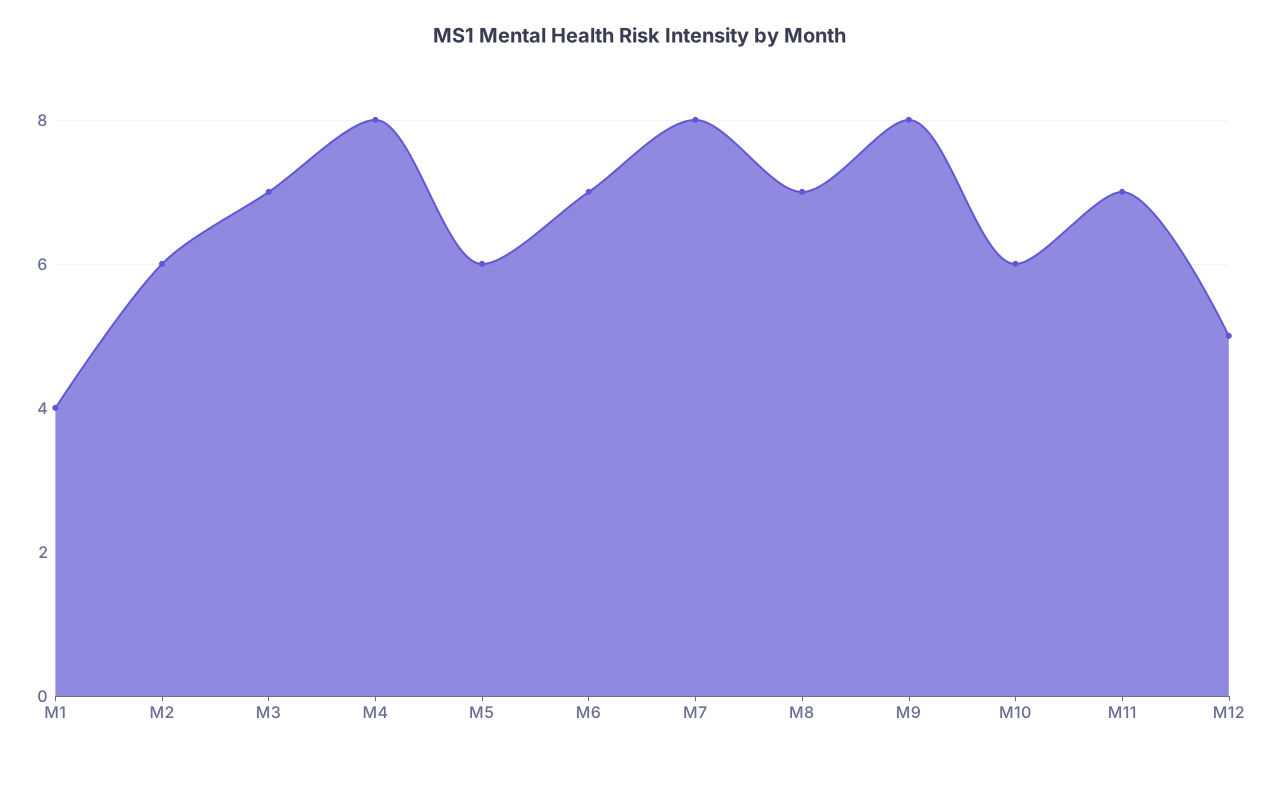
| Category | Value |
|---|---|
| M1 | 4 |
| M2 | 6 |
| M3 | 7 |
| M4 | 8 |
| M5 | 6 |
| M6 | 7 |
| M7 | 8 |
| M8 | 7 |
| M9 | 8 |
| M10 | 6 |
| M11 | 7 |
| M12 | 5 |
That rising and falling curve? You’re not supposed to flatten it to zero. You’re supposed to recognize the spikes before they wreck you.
When You Actually Need Professional Help (Not Just “More Resilience”)
Sprinkled anywhere in this year, if you notice:
- Sleep destroyed for >2 weeks (can’t fall asleep, wake up too early, nightmares).
- Persistent hopelessness or “what’s the point” most days.
- Passive or active thoughts of not wanting to live.
- Panic attacks that interfere with class or exams.
- New or worsening use of substances “just to get through.”
That’s beyond “normal med school stress.” I’ve seen people wait months because “everyone is stressed.” They lose years of quality of life they never get back.
At this point you should:
- Know how to contact:
- Student mental health/counseling.
- Your primary care provider.
- A crisis line in your country/region.
- Tell at least one human you trust what’s going on.
You’re not special enough that the rules of human physiology stop applying to you. Chronic unaddressed stress still breaks you, even if you aced the MCAT.
Your Next Step Today
Do one thing. Right now.
Open your calendar and block one 15-minute weekly mental health checkpoint for the rest of this semester. Name it something obvious: “MS1 Checkpoint.”
During that block you’ll ask:
- How was my sleep, stress, connection, and enjoyment this week?
- Which month-on-the-timeline pattern am I in right now?
- What is one small course correction I’ll make for the next 7 days?
Set the recurring event. That’s your first real act of mental self-preservation in med school.