The first eight weeks of medical school do not test how smart you are. They test how fast you break.
If you want to survive them without burning out, you need a timeline, not hope. So I am going to walk you through those first 56 days week-by-week and then day-by-day, with explicit “at this point you should…” guidance.
Big Picture: Your First 8 Weeks at a Glance
Before we zoom in, see the terrain. The pattern is brutally predictable.
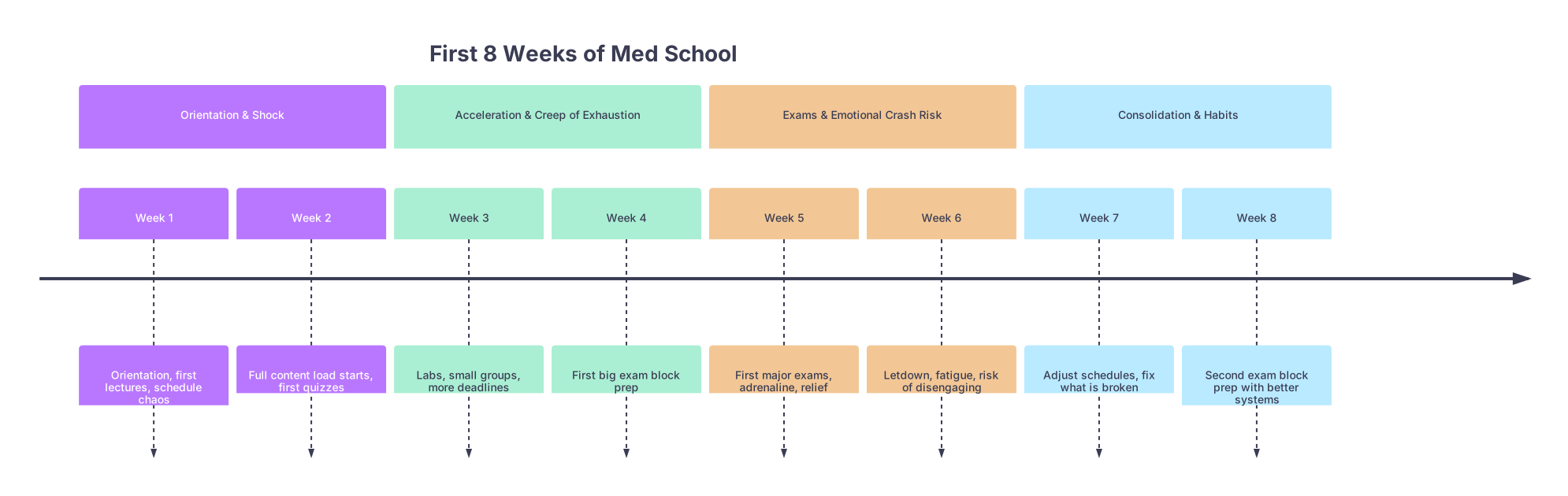
| Period | Event |
|---|---|
| Orientation & Shock - Week 1 | Orientation, first lectures, schedule chaos |
| Orientation & Shock - Week 2 | Full content load starts, first quizzes |
| Acceleration & Creep of Exhaustion - Week 3 | Labs, small groups, more deadlines |
| Acceleration & Creep of Exhaustion - Week 4 | First big exam block prep |
| Exams & Emotional Crash Risk - Week 5 | First major exams, adrenaline, relief |
| Exams & Emotional Crash Risk - Week 6 | Letdown, fatigue, risk of disengaging |
| Consolidation & Habits - Week 7 | Adjust schedules, fix what is broken |
| Consolidation & Habits - Week 8 | Second exam block prep with better systems |
Here is the non-negotiable truth: you must protect three things from day one, or you will pay for it by Week 4.
- Sleep window
- Minimum exercise
- Social contact with people who are not losing their minds
We will build those into the weekly timelines. Not as “nice to have.” As infrastructure.
Week 0–1: Orientation and Shock Management
This is where most students make their first big mistake: they treat orientation like a vacation. It is not. It is setup week for your entire mental health strategy.
Week 0 (The Weekend Before School Starts)
At this point you should:
Set your “life skeleton” schedule
- Choose:
- A fixed wake time (even on weekends; ±30 minutes max).
- A 45–60 minute daily movement block (walk, gym, yoga, I do not care, but it must be real).
- 1–2 “protected” evening blocks for social life each week.
- Put them in your calendar first, before classes. Yes, before.
- Choose:
Decide your study blocks
- Two core blocks on weekdays:
- Block 1: 2–3 hours after morning classes.
- Block 2: 1.5–2 hours in the evening.
- Weekend:
- One longer 3–4 hour “deep work” block each day.
- One 2–3 hour lighter review block each day.
- Two core blocks on weekdays:
Pre-commit your boundaries
- Examples I have seen work:
- No studying after 11 p.m.
- No changing exam-day sleep the week before an exam.
- One full half-day off per week (no lectures, no Anki, nothing).
- Examples I have seen work:
Write these as rules, not wishes. On paper, on your wall.
Week 1 (Orientation + First Lectures)
At this point you should:
- Attend orientation, but treat it as reconnaissance, not content.
- Start your real routine by Day 2, even if the “real” content has not hit yet.
Daily focus (Week 1):
Day 1–2: Map the workload
- Open the LMS (Canvas, Blackboard, whatever).
- Write down:
- Weekly lecture hours.
- Labs / small groups and their assignments.
- First quiz dates, first exam dates.
- If your school front-loads anatomy or histology, mark those weeks in red. Those are danger weeks for burnout.
Day 3–5: Build your “daily minimum” At this point your goal is not mastery. It is rhythm.
Your daily minimum should be:
- Attend or watch all lectures for that day (at 1–1.5x speed if recorded).
- Do:
- 20–40 new Anki (or other spaced repetition) cards.
- 40–60 review cards.
- Spend 30 minutes re-writing or summarizing the top 10–15 key points from that day’s material.
If you hit your minimum, you are allowed to stop. Even if there is more you “could” do. This is how you prevent overreach and early exhaustion.
Sleep and social sanity
- Bedtime within 1 hour of your target every night.
- See another human in a non-med-school context at least twice this week. Coffee with an old friend, a call home, whatever. It keeps your brain from collapsing into a single identity: “med student.”
Week 2: Full Load Begins and Overwhelm Peaks
Week 2 is when reality hits. Content accelerates. Everyone suddenly feels behind. This is where burnout trajectories start to separate.
At this point you should:
- Lock in your weekday structure.
- Stop changing your whole system every 48 hours.
Week 2 Weekly Plan
Academic structure
- Decide: live lectures or recorded. Commit for 2 weeks. Constantly switching will fragment your brain.
- Narrow resources:
- One primary textbook / resource per course.
- One flashcard system.
- One question bank (if offered early).
If you have more than 3 primary resources per course, you are building a burnout trap.
Mental health structure
Add explicit “off-switch” routines:
A 10–15 minute wind-down ritual:
- No screens.
- Stretching, shower, or reading something non-medical.
- Same sequence every night.
A 5-minute “shutdown” checklist before you leave your desk:
- Clear your workspace.
- Write tomorrow’s top 3 academic tasks.
- Write one non-academic thing you will do tomorrow.
Typical Day in Week 2 (Template)
At this point your day might look like this:
- 7:00–7:30: Wake, coffee, quick breakfast
- 8:00–12:00: Lectures / labs
- 12:00–13:00: Lunch + 20-minute walk
- 13:30–15:30: Study Block 1 – same-day lectures
- Re-watch or skim slides for difficult segments.
- Make or review Anki for today’s material.
- 16:00–17:00: Exercise (gym, run, or walk with a classmate)
- 18:00–20:00: Study Block 2 – yesterday’s and older material
- Spaced repetition.
- Low-stakes practice questions if available.
- 20:00–22:30: Dinner, light review only if needed, then wind-down
- 23:00: Bed
You will break this schedule sometimes. That is fine. But keep the structure: same-day review, older review, movement, consistent sleep.
Week 3–4: Acceleration and Exam Preparation Without Meltdown
By Week 3, the initial adrenaline is gone. This is where I see people start living off caffeine and anxiety, sacrificing sleep “just for this week,” and then never recovering.
You cannot let that happen.
Week 3: System Check and Adjustment
At this point you should:
Audit your last 14 days
- Questions to answer honestly:
- How many nights did you sleep less than 6 hours?
- How often did you move your body for at least 20 minutes?
- Are you routinely 2–3 lectures behind?
- If your answers are “often, rarely, yes” — you are on a direct path to burnout.
- Questions to answer honestly:
Fix the obvious leaks
- If you are consistently behind on lectures:
- Start triaging. Ask:
- Which sessions actually matter for exams? (Ask M2s; they know.)
- Which can you skim via slides instead of full watch?
- Start triaging. Ask:
- If you are spending 3–4 hours on Anki daily:
- Cap the card count. More than ~250–300 reviews per day in Week 3 is usually too much for most first-years.
- If you are consistently behind on lectures:
Solidify your pre-exam routine (2-week out)

- Two weeks before your first big exam block, you should:
- Identify all exam dates and content ranges.
- Allocate review days by system or theme, not by random lecture.
- Schedule at least one full “off” half-day the weekend before exams. Cramming until 2 a.m. every night the week before is how people show up mentally empty.
Week 4: First Exam Block Build-Up
This is the danger zone. Stress peaks. Sleep gets sacrificed. People brag about all-nighters like war stories. Ignore them.
At this point you should:
- Shift from acquisition → consolidation.
Study focus (rough split) in Week 4:
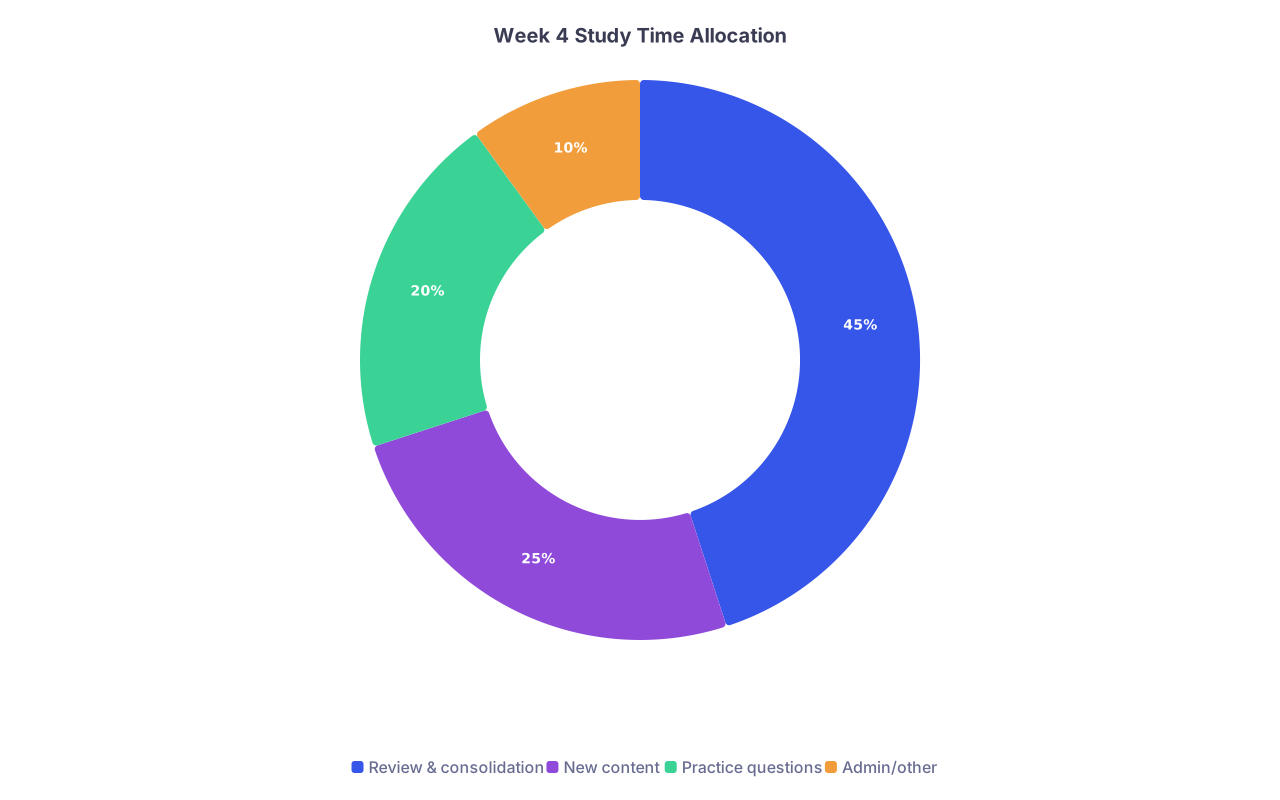
| Category | Value |
|---|---|
| Review & consolidation | 45 |
| New content | 25 |
| Practice questions | 20 |
| Admin/other | 10 |
Daily checklist in Week 4:
- Sleep: 7+ hours. Non-negotiable. You do not want to walk into your first med school exam with a 20% cognitive penalty.
- Movement: 20–30 minutes, even if it is just a walk.
- Food: actual meals, not just energy bars and coffee.
- Short daily decompression:
- 10-minute walk without your phone.
- 5-minute meditation or breathing exercise. Yes, it feels silly. It works.
Red flags this week:
If, on more than 3 days in a row:
- You forget simple words mid-sentence.
- You read the same slide 4 times and retain nothing.
- You feel completely numb (not just stressed).
Then you need to pull back intensity for 24–36 hours. That feels impossible. It is not. You will do better after a controlled slowdown than a crash.
Week 5: First Exam(s) and the Emotional Whiplash
Week 5 is strange. You are simultaneously terrified and exhausted. This is where you either learn a healthy exam rhythm or start the cycle of chronic burnout and recovery.
Exam Week Strategy
At this point you should:
- Stop adding new resources.
- Stop listening to what everyone else is doing.
3–4 days before the exam:
Focus on:
- High-yield summaries (class-provided objectives, peer-made outlines).
- Practice questions under mild time pressure.
- Reviewing missed questions and weak topics.
Decide your hard stop time nightly:
- Example: “I stop at 10:30 p.m. no matter what.”
- You will want to break it. Do not.
Day-before-exam plan (sample)
- Morning:
- 2–3 hours of targeted review of weak areas.
- Early afternoon:
- Light question sets, no more than 40–60 questions.
- Late afternoon:
- Go for a walk, talk to someone normal.
- Evening:
- Close the books. Watch something dumb. Stretch. Sleep.
No, you will not magically learn an entire system the night before. You will only trade long-term memory and mental health for a tiny, unreliable short-term gain.
Exam Day Itself
At this point you should:
- Keep the morning identical to your usual class mornings as much as possible:
- Same breakfast.
- Same wake time.
- Same coffee amount (do not suddenly double caffeine).
- After the exam:
- Do not autopsy every question with classmates for hours.
- Give yourself a real break that evening:
- No studying. At all.
- Social time, good meal, early sleep.
This is how you break the “exam → collapse → guilt → frantic catch-up” cycle.
Week 6: The Post-Exam Crash and Quiet Burnout Risk
Week 6 is sneakier than Week 4. You feel less acute stress, but your reserves are empty. This is when simmering burnout starts.
At this point you should:
Expect to feel off for 3–5 days
- You may feel:
- Weirdly unmotivated.
- Detached from material.
- Mildly depressed or anxious with no clear trigger.
- That does not mean you are not cut out for this. It means your nervous system just went through a grinder.
- You may feel:
Re-establish the base routine (no heroics)
For this week:
- Keep:
- Core study blocks.
- Sleep window.
- Movement.
- Lower:
- Ambition about “getting ahead.”
- Card counts, if needed.
- Extra-curricular commitments.
Think of Week 6 as an active recovery week. Like a lighter training week in athletics. You keep moving, but you stop maxing out lifts.
- Do a mental health check-in
At this point, ask:
- How often have you:
- Cried in the past 2 weeks?
- Thought “I hate this, maybe I should quit”?
- Used alcohol, weed, or other substances just to shut your brain off at night?
High frequency here is not a moral failing. It is a signal. This is when you reach out early:
- Campus counseling.
- A trusted attending or dean for student affairs.
- That one senior student who is actually honest about mental health.
You do not wait until you are failing exams to get help.
Week 7–8: Consolidation, Habit Repair, and Sustainable Pace
If you handled Weeks 1–6 reasonably, Weeks 7–8 are when things stop feeling like drowning and start feeling like a brutal but manageable job.
If you did not, this is your reset window.
Week 7: Fix the System, Not Just the Symptoms
At this point you should:
- Do a blunt review of your study methods
Ask three questions:
- What actually helped me feel calm and prepared for the first exam?
- What did I spend dozens of hours on that barely moved the needle?
- Where did my stress spike the highest?
Then adjust:
- If group study devolved into panic sessions:
- Drop it to once per week, max, with a clear agenda.
- If you were watching every lecture twice:
- Stop. Force yourself to extract what you need in one pass + targeted re-watch of the truly confusing bits.
- If Anki dominated your life:
- Tighten your card creation rules:
- Only make cards from:
- Learning objectives.
- Repeated themes.
- Missed practice questions.
- Only make cards from:
- Tighten your card creation rules:
- Rebuild a more humane weekly template
By Week 7, your schedule should look more like stable work than constant emergency.
Example weekly structure (for sanity):
| Day | Morning | Afternoon | Evening |
|---|---|---|---|
| Mon–Thu | Class / Lab | Study Block 1 (new content) | Study Block 2 (review) + gym |
| Friday | Class / Light Lab | Admin / catch-up / lighter SB1 | Social / early night |
| Saturday | Deep review (AM) | Practice questions (PM) | Off after 6 p.m. |
| Sunday | Light review (AM) | Plan week + short SB | Off after 5 p.m. |
You are intentionally building in real off-time. If you never fully unplug, your nervous system never resets.
Week 8: Second Exam Build-Up, This Time Smarter
The second exam block is where you see whether your adjustments worked. It is also where you prevent “chronic stress” from becoming your new baseline.
At this point you should:
Start exam prep earlier but gentler.
- Instead of panicking 7 days before, ramp up 10–14 days before with:
- Incremental increases in review questions.
- Slightly longer weekend blocks.
- But still preserving sleep and exercise.
- Instead of panicking 7 days before, ramp up 10–14 days before with:
Structure the final 5 days before exams like this:
- Day –5 to –3:
- Heavy on questions and targeted review.
- Normal sleep.
- Day –2:
- Prioritize weak topics.
- Moderate questions.
- Movement + real downtime in evening.
- Day –1:
- Light review only.
- Maximum 3–4 hours of focused studying.
- Early bed.
- Day –5 to –3:
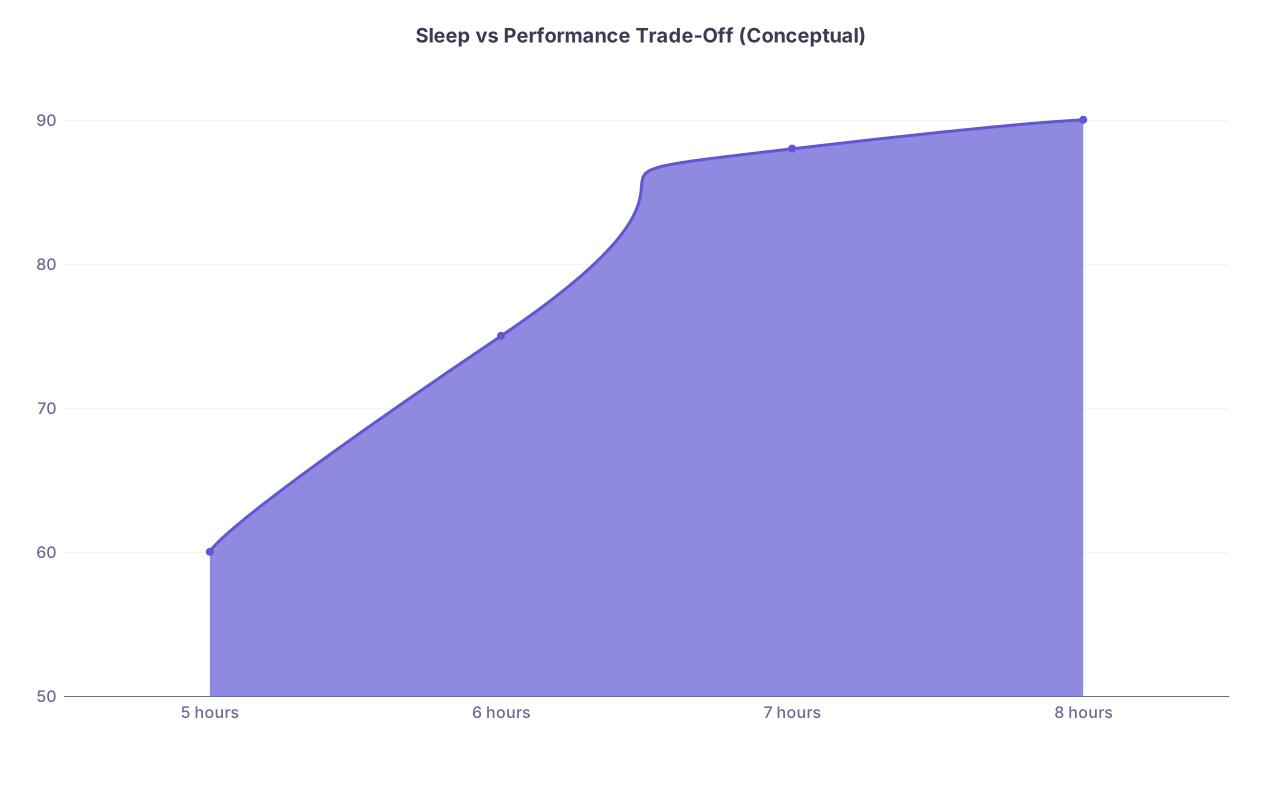
| Category | Value |
|---|---|
| 5 hours | 60 |
| 6 hours | 75 |
| 7 hours | 88 |
| 8 hours | 90 |
You can shave a point or two of performance by being underprepared. You can destroy 10–20% by walking in sleep-deprived. Make the obvious choice.
Day-by-Day Non-Negotiables for All 8 Weeks
Regardless of week, there are daily anchors that keep you from burning out. Treat these like vital signs.
At this point, on any given day, you should have:
One defined start and stop time
- You begin work at a set hour.
- You end work at a set hour.
- The hours in between are allowed to vary. The endpoints are not.
A simple 3-item task list
- Written the night before or first thing in the morning.
- Example:
- Finish cardio lecture notes and cards.
- Do 60 Anki reviews.
- 25 practice questions on renal physiology.
Movement
- Minimum:
- 10–15 minutes of brisk walking between study blocks.
- Ideal:
- 20–45 minutes of real exercise most days.
- Minimum:
Human contact
- At least one conversation not about exams, grades, or “how screwed we are.”
- Text, call, or in person. Does not matter. Your brain needs social reality outside the med school bubble.
A “check engine” moment
- 30 seconds at night:
- How is my mood? 1–10.
- How is my stress? 1–10.
- If either is ≥7 for more than 3 days, you take action:
- Shorten study blocks.
- Talk to someone.
- Adjust sleep or workload.
- 30 seconds at night:

When You Are Actually Burning Out (Not Just Tired)
You will feel tired. That is normal. But burnout has a different flavor: persistent exhaustion, cynicism, and feeling like nothing you do matters.
Clear signs in the first 8 weeks:
- You dread every day, not just exam days.
- You feel detached from classmates, like you are watching your life.
- You have no capacity for joy in anything you used to enjoy.
- You start thinking “If I got in a minor accident and had to take time off, that might be a relief.”
If you are here at any point:
At this point you should:
- Tell someone. A real human.
- Decrease, not increase, your study hours for a few days.
- Look for professional help on campus or outside. Early.
You are not “weak” for doing this. You are doing system maintenance on a brain being asked to process absurd volumes of information under constant evaluation.
Final Summary: What Actually Keeps You From Burning Out
Keep three things in your head:
Structure beats willpower.
Fixed wake/sleep, study blocks, and movement built in from Week 0 will protect you more than any “I will just push through” mindset.Early, small corrections beat late, heroic interventions.
Adjusting your schedule in Week 2–3 and honoring recovery in Week 5–6 keeps you from hitting the wall in Week 8.You are a human first, student second.
Sleep, food, movement, real conversations, and asking for help are not luxuries. They are the only reasons you will still care about medicine by the end of the year.
Follow the timeline. Protect the basics. The first 8 weeks will still be hard. But you will not break.