

Your career will not be destroyed because you followed your conscience — but the way you do it can absolutely hurt you.
That’s the uncomfortable truth. It’s not “do what’s right and nothing bad will ever happen.” It’s “do what’s right in a system that doesn’t always make that easy, and you need to be smart about it.”
You’re not crazy for worrying. I’ve heard versions of this from premeds, MS3s on OB, interns on surgery:
“If I refuse this procedure on ethical grounds, will they blacklist me?”
“Can a resident be kicked out for saying no?”
“Will this follow me forever in my file?”
Let’s walk through the real risks, the legal and ethical protections, and what actually happens in hospitals when someone refuses to do something on conscience grounds.
1. The scary part: ways this can hurt you (if handled badly)
Let me start with the nightmare scenarios your brain is cycling through, because pretending they don’t exist doesn’t help.
Here are the ways refusing to perform a procedure can hurt your career if you handle it impulsively or sloppily:
- You get labeled “difficult,” “not a team player,” or “has attitude issues”
- An attending writes a nasty evaluation: “Refused to participate in indicated care; poor professionalism”
- You clash publicly with a senior physician in front of staff or patients
- You refuse at the last minute without arranging alternative coverage, and a patient’s care is delayed
- You refuse in a way that looks like discrimination (e.g., you’re fine doing X for one group but not another, and it sounds biased)
Any of those can:
- Tank a clerkship evaluation
- Trigger a professionalism referral
- Create a paper trail that shows up in MSPE (“Dean’s letter”), internal files, or, for residents, program director impressions and letters
So yes. The vague fear you have — “people might quietly hold this against me” — that’s not invented. That happens. I’ve seen a student get unofficially labeled “the one who refuses terminations” and suddenly everyone is “concerned about fit” for OB.
But that’s not the whole picture.
2. The part no one tells you: you are allowed to refuse (within limits)
Here’s the other side: medicine is not the military. You are not obliged to do every legal procedure just because someone above you says “do it.”
Ethically and legally, several things are on your side:
Professional ethics recognize conscientious objection.
AMA Code of Medical Ethics, specialty societies, nursing codes — they all accept that clinicians may refuse to participate in certain procedures if they conflict with deeply held moral or religious beliefs.You can’t be forced to violate basic human rights standards.
Nobody can legally force you to participate in torture, abuse, or blatantly illegal acts. That’s not controversial. If what you’re resisting is clearly illegal or abusive, you’re on even stronger ground.Many hospitals and training programs formally recognize conscientious objection.
This is especially explicit for:- Abortion and reproductive procedures
- Physician aid in dying (where legal)
- Certain end-of-life situations
- Sometimes gender-affirming care, depending on region and institution policies
Retaliation for certain types of refusals can be legally risky for institutions.
When conscience or religious freedom is involved, you can have protections under:- Title VII (U.S.) for religious accommodation
- Specific conscience clauses at federal or state level (especially around abortion)
- Institutional policies that promise accommodation (and programs really hate being caught violating their own policy)
So the raw, blunt version:
You can refuse on ethical grounds. The key question isn’t “am I allowed to?” The key questions are:
- How do you refuse?
- When do you refuse?
- What are you refusing?
- Do you help ensure the patient still gets appropriate care?
That’s what people above you are watching.
3. Different situations = different risk levels
Not all refusals are created equal. Saying no during a scheduled elective case at 10 am is very different from backing out during a code at 3 am.
Here’s how the risk usually shifts:
| Scenario Type | Career Risk Level |
|---|---|
| Early, proactive refusal with notice | Low |
| Quiet, respectful objection with backup arranged | Low–Moderate |
| Last-minute refusal in non-emergent case | Moderate |
| Refusal that delays emergency care | High |
| Public, confrontational refusal | High |
Low-risk scenarios
Examples:
- Before starting your OB rotation, you tell the clerkship director: “For religious reasons, I can’t participate directly in elective abortions, but I’m fully willing to care for these patients before and after, and cover everything else.”
- You’re a resident who has moral objections to physician aid in dying. Your program already has an opt-out process. You follow the process, and your attending knows weeks in advance.
These usually don’t tank your career. People may disagree with you, sure. But it’s rarely career-ending because:
- You were early and honest
- You showed you care about patients still being cared for
- You didn’t bail at a critical moment
Moderate-risk situations
Examples:
- You’re scrubbed in and mid-procedure you suddenly think, “I don’t believe in this,” and say you won’t continue.
- You refuse a procedure that’s considered standard of care, but your explanation sounds vague or unprepared: “I just… don’t feel okay about this, I dunno.”
These situations raise eyebrows. Now people wonder: Is this about ethics, or is this about anxiety, competence, or professionalism? Programs do get nervous when they can’t tell.
High-risk situations
This is the scenario that fuels your 3 am stress spirals:
- It’s an emergency. No one else is available. You refuse to perform an indicated intervention, the patient is harmed, and there’s no reasonable alternative quickly available.
Now you’ve got:
- Patient harm
- Documentation risk
- Angry staff
- Potential legal exposure
This is where a refusal can blow up in a big way — not just for your reputation, but possibly in a morbidity and mortality conference, or even in litigation. It still doesn’t mean you must violate conscience, but the stakes are much higher and the scrutiny will be intense.
4. The line you cannot cross: abandoning patients
The system will tolerate, even grudgingly respect, conscientious objection.
It will absolutely not tolerate clear patient abandonment.
So if your ethical stance leads to:
- You walking away without ensuring someone else can safely step in
- Delayed emergent care because “I’m not comfortable”
- Refusing all involvement with a patient as a human person (not just the specific procedure)
…that’s when professionalism alarms go off.
The safe framing is this:
“I can’t participate in this specific intervention because of my ethical beliefs, but I will absolutely help with everything else to make sure the patient is cared for.”
You’re objecting to the procedure, not the person.
5. How to refuse in a way that protects both your conscience and your career
Here’s where your anxiety can actually be useful. Catastrophizing makes you think about worst-case scenarios; let’s harness that and build a plan so you’re not improvising mid-crisis.
Step 1: Clarify your own boundaries before you’re on the spot
Don’t wait until you’re gloving up to decide how you feel about:
- Abortions (elective vs medical indication vs later gestation)
- Gender-affirming surgeries or hormones
- Sterilization procedures (tubal ligation, vasectomy)
- Physician aid in dying (where legal)
- Withdrawing life support, DNR orders, terminal extubation
- Restraints, forced feeding, forensic exams, etc.
You’re allowed to be unsure, but the more you’ve thought about it, the less likely you are to panic-freeze when it’s go time.
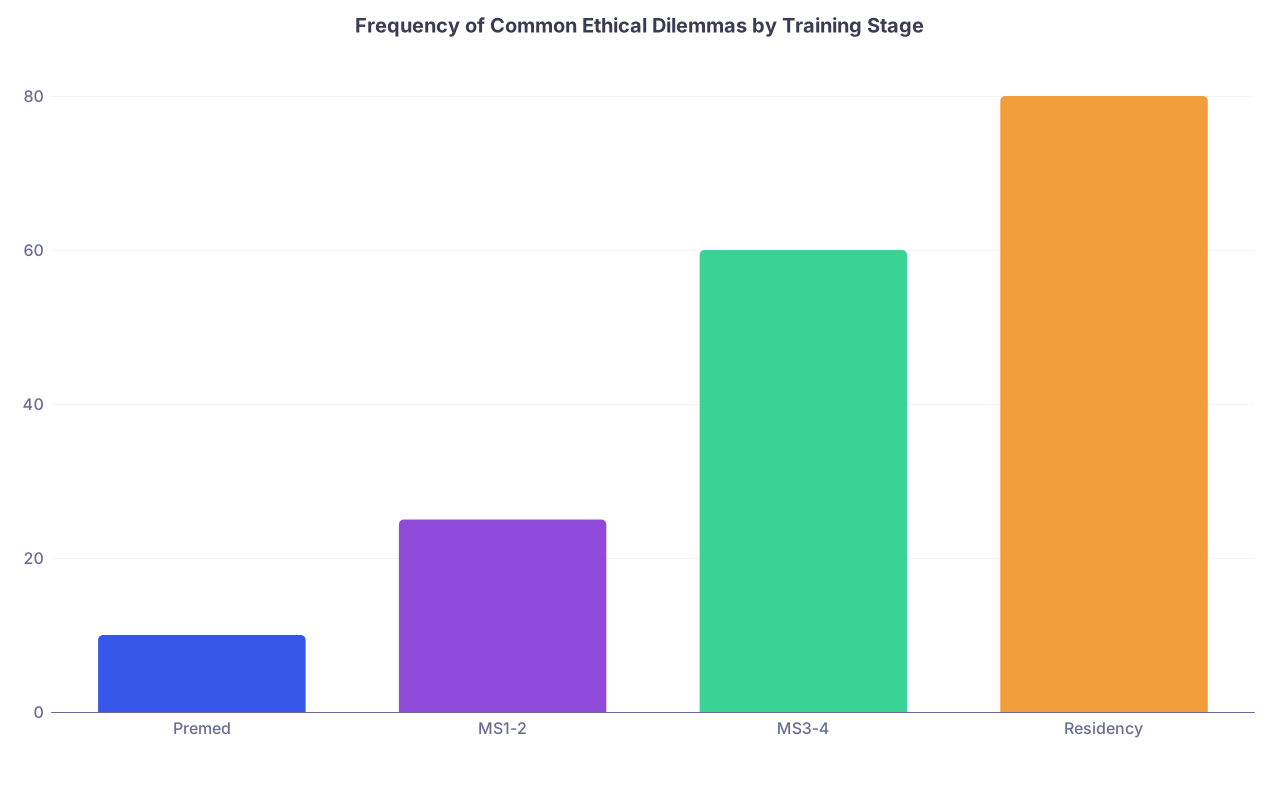
| Category | Value |
|---|---|
| Premed | 10 |
| MS1-2 | 25 |
| MS3-4 | 60 |
| Residency | 80 |
Step 2: Learn your institution’s policy
Yes, I know, policy PDFs are soul-crushing. But this one’s worth it.
Look for:
- “Conscientious objection”
- “Religious accommodation”
- “Abortion policy”
- “Physician aid in dying policy”
- “Student / resident responsibilities”
If you’re a student, your med school might have guidance on:
- What you can opt out of
- How it affects your clerkship grading
- Who to talk to (clerkship director, student affairs, ethics committee)
If you’re a resident, check:
- GME (Graduate Medical Education) policies
- Program handbook
- Any state-specific conscience protections
Step 3: Identify a safe person to talk to early
You do not want your first conversation about this to be:
Scrub nurse: “Knife.”
Attending: “Alright, let’s start the termination.”
You: “Uh… actually I refuse on moral grounds.”
No. Don’t do that to yourself.
Instead, ahead of time:
- Tell your clerkship director, faculty advisor, or chief resident
- Use language like:
“I have a conscience-based objection to participating directly in [X], but I’m committed to providing excellent care for all patients and being a reliable team member. How do you usually handle this?”
That line — “committed to providing excellent care for all patients” — is critical. Because your refusal is already going to stress people out; you have to immediately show them you’re not going to abandon the patient or dump work.
Step 4: When the moment comes, be calm, brief, and solution-oriented
You don’t need to give a TED Talk on your beliefs.
Something like:
“Dr. Smith, I need to let you know that I have a conscience-based objection to performing this particular procedure. I’m happy to assist with pre- and post-care and any other aspects of this patient’s care, but I can’t directly perform this intervention. Is there another provider who can step in?”
Notice the components:
- “Conscience-based objection” — signals this is about ethics, not laziness or fear
- You offer what you can do
- You ask for an alternative without being accusatory
What you avoid:
- “I think this is murder.” (Instantly inflammatory, not helpful.)
- “This is against my religion” followed by nothing else. (Too vague for people to plan around.)
- Rolling your eyes or making faces. (Yes, people absolutely report that as unprofessional.)
6. Will this follow me forever?
This is the piece that keeps looping in your head: “Will this be on my record? Will programs talk? Is this match-killing material?”
Reality check:
- Most isolated, well-handled conscientious refusals do not become a permanent career stain
- What does follow you is a pattern of:
- Unreliability
- Last-minute refusals
- Unprofessional behavior in conflict situations
- Documented patient harm because you backed out badly
If you’re a student:
- Your MSPE might include generic comments about professionalism if there’s drama, but most schools are pretty careful
- One respectful, early, well-communicated refusal will usually not be highlighted as a “problem”
If you’re a resident:
- PDs remember big conflicts and patient harm, not a single ethically mature conversation
- But yes, if your program thinks you “refuse standard care all the time,” that can impact letters and fellowship options
I’ve watched this in real life:
- Student A quietly opted out of terminations on OB, always arranged coverage, showed up for everything else, and still got honors.
- Student B made moral speeches in front of patients and nurses, refused to write orders for post-op pain meds “because I don’t support what she did,” and… yeah, that went into the professionalism file.
Same belief. Completely different impact.
7. Special legal landmines you’re right to be scared of
There are a few areas where your fear is actually your brain trying to protect you from real landmines:
Discrimination:
If your “ethical objection” is selectively applied in a way that looks like discrimination (e.g., only refusing to treat certain groups of patients, or making moral judgments about who deserves care), you’re in dangerous territory. That can absolutely wreck a career.Standard of care:
Ethically, you can’t be forced to do something against conscience. Legally, if you are the only one there and your refusal clearly results in harm that any reasonable clinician would have prevented, you may be questioned very hard about your choice.Documentation:
If there’s an adverse outcome and the chart reads like: “Resident refused to perform indicated intervention,” you can guess how that looks in court. This is where involving your attending and sometimes risk management/ethics is essential.

| Step | Description |
|---|---|
| Step 1 | Recognize ethical conflict |
| Step 2 | Seek immediate backup if possible |
| Step 3 | State objection briefly |
| Step 4 | Assist with other care |
| Step 5 | Notify supervisor early |
| Step 6 | Review policy or ethics consult |
| Step 7 | Arrange alternative provider |
| Step 8 | Emergency? |
8. How to live with the anxiety and still be a good doctor
You’re scared that being a “good person” will make you a “bad doctor” in the eyes of the system. That’s the core tension, right?
Here’s the truth I’ve seen play out over and over:
- People respect consistency more than perfection
- Colleagues can work with someone who says, “Here’s where my line is, and here’s how I’ll still support the team”
- What destroys trust is unpredictability, drama, and patient harm
Your conscience isn’t the problem.
Your lack of a plan is.
So build the plan:
- Decide your boundaries in advance.
- Read your institution’s policy this week. Not someday. This week.
- Identify one faculty, advisor, or chief you could talk to confidentially.
- Script your 2–3 sentence “ethical objection” line and practice it out loud so you don’t choke on it when you’re stressed.
- Commit to always pairing refusal with: “Here’s how I’ll still help.”
You’re allowed to be the person who doesn’t just follow orders blindly. You just have to be the person who balances conscience with responsibility.
FAQ (exactly 4 questions)
1. Can my school or residency kick me out just for refusing a procedure on ethical grounds?
They could discipline or even dismiss someone over patterns of refusal if it leads to patient harm, chronic unreliability, or serious professionalism concerns. But a single, respectfully handled conscientious objection, especially in a non-emergent context with proper notification and alternative coverage, is very unlikely to trigger dismissal by itself. Programs know these issues are legally sensitive; they usually try to accommodate before escalating.
2. Should I mention my conscientious objections in residency applications or interviews?
Usually not in your personal statement unless it’s central to your story and clearly shows maturity, not rigidity. In interviews, don’t lead with it, but if asked directly (e.g., “How do you handle ethical conflicts?”), you can talk in general terms about balancing conscience with patient care and team responsibility. You don’t need to list every procedure you might refuse. Focus on your process, not your specific hot-button positions.
3. What if I’m not sure if it’s ethics or just fear/inexperience making me want to refuse?
That’s incredibly common. The best move is to talk it through early with someone you trust: ethics committee, mentor, chief, or student affairs. Say, “I’m struggling to tell if this is a true conscientious objection or just discomfort.” That alone signals maturity. They can help differentiate: Is this about moral belief, or do you need more education, support, or supervision?
4. What’s one thing I can do today to protect both my conscience and my career?
Right now, open your school or hospital website and search for “conscientious objection” or “religious accommodation.” Find one relevant policy and skim it. Then write a two-sentence script you’d use if you needed to refuse a procedure, including how you’d still support the patient. Put it in your notes app. You’ll feel less like you’re free-falling if the moment ever comes.


