

The most dangerous ethical errors in fertility preservation for cancer patients are not technical. They are quiet omissions: not asking, not telling, not documenting, and assuming “they won’t care about kids right now.”
Let me break this down specifically.
Oncology moves fast. Chemo needs to start. Operative slots are limited. Radiation is booked. Fertility preservation, by contrast, requires slowing down: time to counsel, time to coordinate, time to obtain consent, time to clarify finances, time to confront prognosis honestly. That clash—between urgency of treatment and deliberation required for reproductive decisions—is where the real ethical problems live.
1. The Core Tension: Life-Saving Treatment vs Future Fertility
At the center of this topic is a brutal trade‑off: preserving life now versus preserving the possibility of biologic parenthood later.
In practice, the conflicts tend to look like this:
- A 27‑year‑old man with acute leukemia: oncologist wants to start induction chemo tomorrow; sperm banking requires at least one (ideally multiple) collections and possibly lab coordination over several days.
- A 15‑year‑old girl with Ewing sarcoma: pelvic radiation is planned; ovarian tissue cryopreservation is possible but experimental locally, and she needs general anesthesia during an already overloaded OR schedule.
- A 35‑year‑old woman with hormone‑receptor positive breast cancer: her fertility doctor recommends controlled ovarian stimulation and egg retrieval; the breast oncologist worries about delaying endocrine therapy and stimulating estrogen levels.
The ethical fault lines here are fairly consistent:
Respect for autonomy vs beneficence
Do you prioritize the patient’s long‑term wishes about having children or the oncologist’s judgment about immediate survival?Best interest vs realistic options
“Best” for the patient medically might be fastest chemo start with no delays. “Best” for the patient as a person might include taking a few weeks to bank embryos.Justice and resource allocation
Fertility preservation is often expensive, under‑funded, and logistically tricky. Who gets access? Who pays? Who decides which patients are “worth” referring?
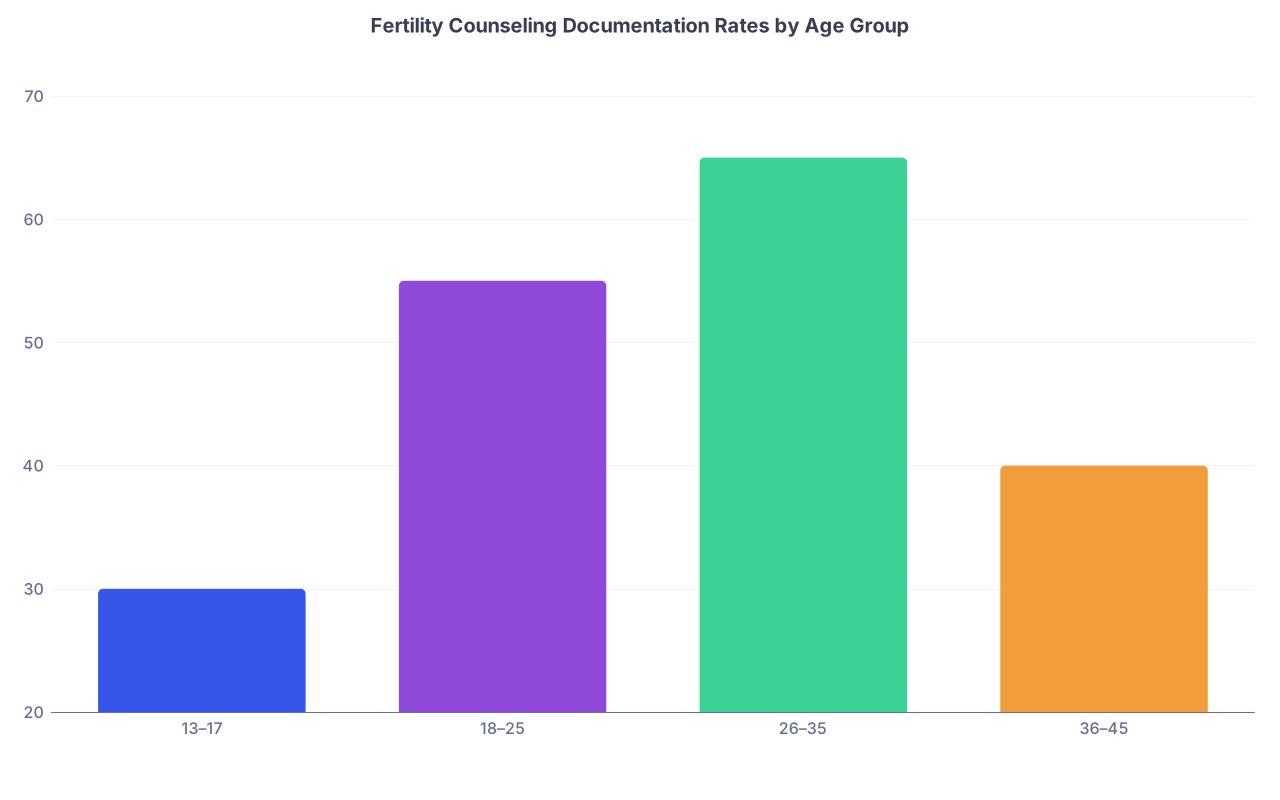
In law and ethics, there is now a strong expectation—borderline standard of care in many jurisdictions—that physicians at least discuss fertility risks and options with reproductive‑age cancer patients. Failure to do this is drifting from “unfortunate oversight” into “actionable negligence” territory.
| Category | Value |
|---|---|
| 13–17 | 30 |
| 18–25 | 55 |
| 26–35 | 65 |
| 36–45 | 40 |
Those numbers (from several observational studies) are ugly. And revealing. Younger adolescents and older adults are the ones most likely to be silently skipped.
2. Informed Consent: What “Good” Looks Like (and Where It Fails)
Ethical practice here lives or dies on the quality of consent. Not just a checkbox that “fertility discussed,” but actual comprehension.
To be meaningful, consent for fertility preservation in cancer care has to cover at least:
- The specific fertility risks of the planned treatment (e.g., alkylating agents, pelvic radiation, stem cell transplant).
- The existing and experimental preservation options.
- The impact of preservation on cancer treatment timing, risks, and prognosis.
- The success rates and uncertainties for fertility procedures.
- The financial implications: direct costs, insurance coverage, storage fees.
- The patient’s values around genetics, gestational parenthood, and alternative paths (donor gametes, adoption, child‑free life).
When is this done badly? I’ve seen several patterns:
Vague warnings
“This chemo might affect fertility.” That phrase is almost useless. Patients interpret it as “low chance” unless you specify actual risk categories.Over‑simplifying success probabilities
“Egg freezing is very successful now” is not the same as: “At your age, with your ovarian reserve, and the number of cycles we realistically can do before chemo, here’s what your chances look like.”Rushing past prognosis
In advanced disease, nobody wants to say aloud, “We are fighting to extend your life, not cure.” Yet that honesty is central: is it ethical to push expensive fertility preservation in a person with very low five‑year survival probability?Not revisiting the conversation
Consent is treated as a one‑time event. That is ethically lazy. Fertility concerns often spike later—during consolidation chemo, after transplant, or when the patient is in remission and finally able to look beyond next week.
Legal overlay
From a legal standpoint, failing to mention material fertility risks can be classic informed consent failure. There are now malpractice cases where survivors successfully argued that, had they been told early on, they would have pursued preservation.
Law and ethics align on one critical point: you do not get to decide that someone “has bigger things to worry about than kids.” You have to tell them, in a way they can process, within the time frame you realistically have.
3. Special Populations: Where the Ethical Pressure Intensifies
Some groups are systematically shortchanged. Not by design, but by bias and structural inertia.
A. Adolescents and Young Adults (AYA)
Clinicians routinely underestimate how much teenagers care about fertility. They are wrong.
Ethical flashpoints with adolescents include:
Assent vs consent
Legally, parents usually provide consent. But ethically, a 16‑year‑old absolutely deserves a meaningful say. Overriding a teen who strongly wants to preserve fertility because “the parents don’t think it matters” is a problem.Privacy and sexuality
Sperm banking requires masturbation. Many clinicians pull the “he seems too immature” card and never even bring it up. That is paternalism masquerading as sensitivity.Future autonomy
Some parents push to create embryos with the teen’s gametes and a partner or donor. You are now locking a minor’s genetic material into complex future legal and relational entanglements. Extremely fraught.
You need a clear structure: private time with the adolescent, clear explanation in age‑appropriate language, plain acknowledgment of sexual aspects without euphemisms, and careful documentation of the teen’s wishes—even when parents disagree.
B. Patients without partners
For a 30‑year‑old woman newly diagnosed with lymphoma, freezing embryos (with a partner) gives higher success rates than eggs alone. But what if she is single?
The problematic pattern:
“Well, without a partner, your options are limited and more experimental. We should just move to treatment.”
The ethical alternative: lay out the real menu:
- Oocyte cryopreservation alone (now standard of care in many countries).
- Utilizing donor sperm to create embryos if she wants that option and understands the implications.
- Ovarian tissue cryopreservation where available (still considered experimental in some jurisdictions).
Avoid the subtle bias that assumes women without partners are somehow “less deserving” or “less likely to use” preserved gametes.
C. Gender‑diverse and LGBTQ+ patients
Cancer guidelines are gradually improving, but many clinics still implicitly design their processes for cisgender, heterosexual patients. That translates into:
- Intake forms with only “male/female,” “husband/wife.”
- Counseling that assumes a cis woman wants to carry a pregnancy and a cis man wants a genetic child.
- Dead‑silence on options for trans patients, NON‑binary individuals, or same‑sex couples.
Ethically competent care requires:
- Asking about gender identity and fertility desires without assumptions.
- Discussing how hormone therapies, gonadectomy, and reconstructive surgeries intersect with fertility and cancer risk.
- Recognizing that for some trans individuals, preserving gametes pre‑transition is deeply distressing, yet still a real option that must be presented non‑coercively.
4. Experimental vs Standard: Walking the Line Without Exploitation
Not every fertility preservation method sits on the same ethical footing. Some are standard, others still experimental or context‑dependent.
| Method | Typical Status | Common Group |
|---|---|---|
| Sperm cryopreservation | Established | Post‑pubertal males |
| Oocyte cryopreservation | Established in many | Post‑pubertal females |
| Embryo cryopreservation | Established | Partnered adults |
| Ovarian tissue freezing | Emerging/experimental | Pre‑pubertal & adults |
| Testicular tissue freezing | Experimental | Pre‑pubertal boys |
The ethical risks here:
Therapeutic misconception
Patients (and parents) hear “potential fertility” and mentally upgrade that to “this will work.” That is false, especially in pediatric tissue cryopreservation.Research vs clinical care mixing
Many centers only offer experimental methods under research protocols. If the line between “for your future fertility” and “because we need data” blurs, consent is compromised.Financial exploitation
Offering high‑cost, low‑probability interventions to desperate families without crystal‑clear disclosure of success rates is ethically questionable at best.
Here is the bar you need to clear: when you offer an experimental option, the parents (or patient) should be able to state back, in their own words, “We understand this may never lead to a pregnancy. We are choosing it for the possibility, not because it is likely.”
If they cannot articulate that, your consent process is not adequate.
5. Timing, Treatment Delay, and “No Time to Talk”
Oncologists often say, in hallway conversations: “I am not going to lose a window to treat leukemia so we can wait for an egg retrieval.” That concern is not imaginary. Some cancers do not tolerate delays.
But here is where many teams go wrong: they present the delay question as binary and unquantified. “We can’t delay.” Versus, “In your case, a 10‑day delay is unlikely to change prognosis meaningfully, but a 3‑week delay probably would.”

| Step | Description |
|---|---|
| Step 1 | New Cancer Diagnosis |
| Step 2 | Assess Treatment Urgency |
| Step 3 | Document counseling not feasible |
| Step 4 | Refer to fertility specialist |
| Step 5 | Estimate delay duration |
| Step 6 | Discuss risk of delay vs benefit |
| Step 7 | Implement fertility plan |
| Step 8 | Proceed with cancer treatment |
A defensible, ethically sound process looks like this:
Evaluate whether any delay is acceptable clinically.
For some acute leukemias, the answer really is “no.” Document that explicitly.If some delay is tolerable, quantify it: “We have a maximum of X days.”
Arrange rapid‑access fertility consult pathways. The ethical problem is multiplied when delays are exaggerated because the system is slow, not because the cancer is aggressive.
Make the decision a joint one: patient + oncology + fertility specialist. Not a unilateral oncology edict.
The medicolegal risk rises sharply if nobody documented the reasoning and nobody gave the patient a real choice.
6. Cost, Insurance, and Justice: Who Actually Gets Access?
This is where the rhetoric about “patient autonomy” can become hollow. Autonomy without affordable options is a slogan, not ethics.
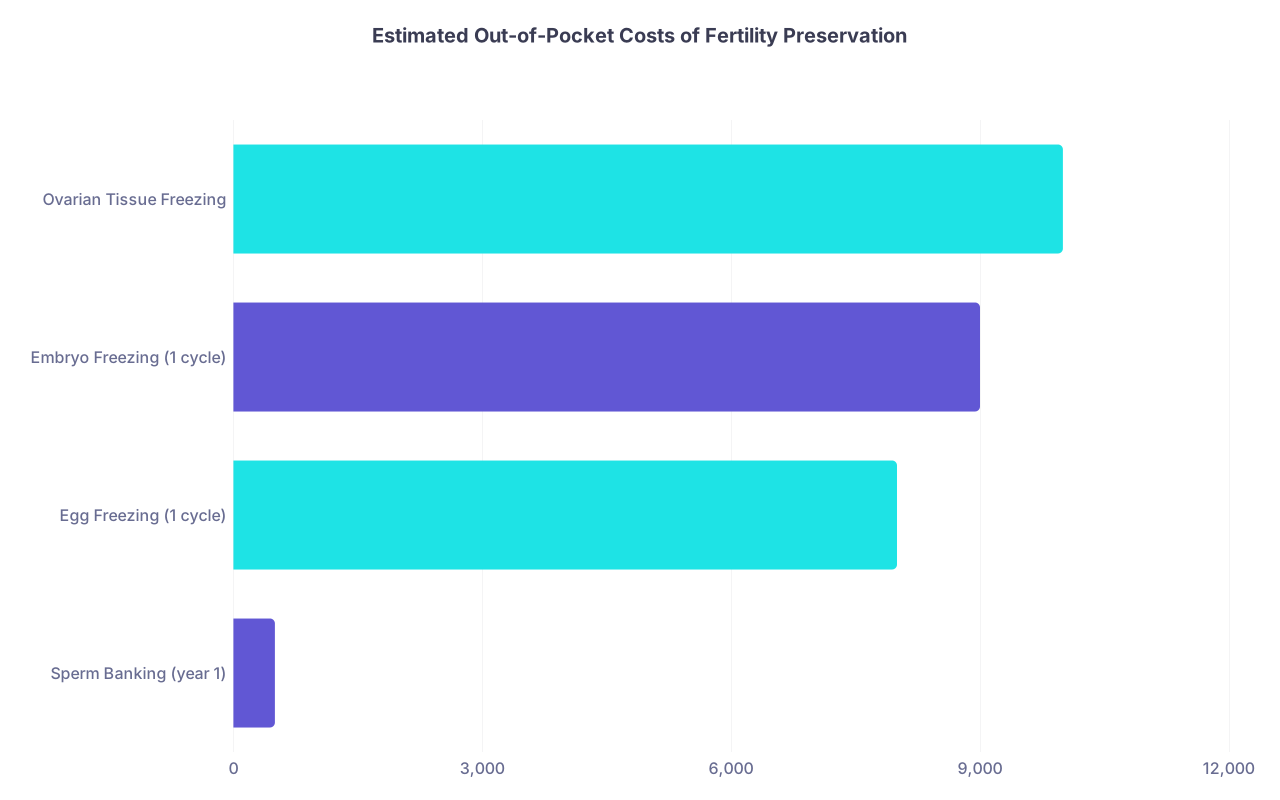
Fertility preservation can cost:
- Sperm banking: relatively inexpensive up front, but long‑term storage fees accumulate.
- Oocyte/embryo cryopreservation: thousands of dollars per cycle, plus storage.
- Tissue cryopreservation: surgical costs, anesthesia, later re‑implantation.
| Category | Value |
|---|---|
| Sperm Banking (year 1) | 500 |
| Egg Freezing (1 cycle) | 8000 |
| Embryo Freezing (1 cycle) | 9000 |
| Ovarian Tissue Freezing | 10000 |
Ethical and legal trouble spots:
Socioeconomic discrimination
Patients with private insurance and savings get “we’ll do everything.” Lower‑income patients get “your options are limited” with no attempt to connect them to grants, foundations, or clinical trials.Inconsistent institutional policies
One hospital quietly waives storage fees for pediatric cancer survivors. Another discontinues storage after a few years unless families pay, sometimes discarding tissue with minimal outreach. Same city, completely different justice landscape.Opaque billing
Patients sign up for procedures in crisis and are shocked later by annual storage bills or out‑of‑network lab fees. Hidden financial toxicity is an ethical failure.
As a clinician or ethicist, you should be pushing for:
- Clear written materials about typical costs and ongoing fees.
- Social work involvement early in the process.
- Advocacy for legal mandates (where you are) that cancer‑related fertility preservation be covered as part of essential cancer care, not elective “infertility treatment.”
7. Ownership, Control, and Disposition of Gametes and Embryos
Here is where law, ethics, and messy human relationships collide.
Common scenarios:
- A couple creates embryos before the partner starts chemo. They later divorce. One partner wants to use the embryos; the other objects.
- A patient dies. Their stored sperm or eggs remain. The surviving partner wants to use them. The parents object—or vice versa.
- A young adult preserved gametes as a teen, never updated their wishes, and is now incapacitated.
Legally, many jurisdictions treat embryos and gametes as a special category: not full “persons,” but not just property either. Ethically, the best you can do is insist on very explicit consent documents that cover:
- Who owns the material.
- What happens in case of:
- Death
- Divorce or relationship dissolution
- Long‑term non‑payment or lost contact
- Whether posthumous use is allowed and under what conditions.
From an ethical standpoint, using someone’s gametes posthumously without clear prior consent is extremely dubious. The fact that a grieving parent or partner “knows they would have wanted children” is not a substitute for documented wishes.
Yet, clinicians do get requests like: “He banked sperm before chemo but was too overwhelmed to fill out the extra forms. Can we still use it?” The ethical default answer, unless your local law clearly allows otherwise, is no.
8. Pediatric Tissue Cryopreservation: The Sharp Edge of Hope
Let me be blunt: pre‑pubertal ovarian or testicular tissue freezing is one of the most ethically precarious practices in this field.
The reasons:
- These children cannot produce mature gametes, so standard sperm or oocyte freezing is impossible.
- Tissue freezing and later re‑implantation is still imperfect, with limited numbers of live births reported in some series, and near‑zero for testicular tissue.
- Long‑term risks (e.g., reseeding malignancy with tissue re‑implantation) remain under study, especially in leukemias and some solid tumors.
Ethically, you balance:
- The parents’ desire to offer “every possible chance” for a future biologic child.
- The child’s future autonomy (they did not choose this).
- The experimental nature and cost of the procedure.
The critical moves:
- State clearly: this is more research‑level than treatment‑level in many cancers.
- Separate parental guilt from child benefit. Parents often view doing “nothing” as intolerable. You must help them see the difference between therapy that helps now and speculative future benefit.
- Document the child’s assent where meaningful—even at 7 or 8 years old, they can often express whether they are willing to undergo an extra surgery.
If you cannot in good conscience defend the risk‑benefit ratio to a neutral ethics committee, you should not be offering it outside a tightly governed protocol.
9. Clinical Communication: How to Actually Have the Conversation
This is where theory meets the 15‑minute outpatient slot.
Here is a practical, ethically solid structure for a first discussion with a newly diagnosed reproductive‑age cancer patient:
Name fertility explicitly and early
“I want to talk about how this treatment might affect your ability to have biological children in the future.”Give a concrete risk estimate
Not “might,” but: “With this regimen, the chance of permanent infertility is high / moderate / low.”Check whether fertility is important to them
“Is having the option of biological children in the future something that matters to you? There is no right or wrong answer here.”Outline time constraints honestly
“We have about X days before we need to start treatment. Within that time, we could consider options like sperm banking / egg freezing / referral to a fertility specialist.”Offer immediate referral or follow‑up
Do not make the oncology clinic a dead end. A simple phrase: “We work with a fertility team that specializes in cancer. I recommend you speak with them even if you are not sure.”Clarify costs and uncertainties at a high level
“These procedures can be costly, but there are sometimes support programs. Our team can help look into what your insurance will cover.”Document both the offer and the patient’s response
If they decline, write why: “Patient states they do not wish to pursue fertility preservation because they do not desire future biological children / are focused on faster treatment / financial concerns.”

That documentation is not just defensive medicine. It is a written record that you treated this as a serious, autonomy‑defining decision, not an afterthought.
10. Institutional and Policy Responsibilities
This topic cannot be fixed by one conscientious oncologist. The ethical failures here are baked into systems.
A minimally responsible institution should:
- Have a written fertility preservation policy for oncology patients.
- Integrate fertility risk prompts into electronic order sets for gonadotoxic regimens.
- Maintain rapid‑referral pathways to reproductive specialists (ideally seen within 24–72 hours).
- Train staff in basic fertility counseling language, so the first mention is not clumsy or evasive.
- Establish clear storage and disposition policies for stored gametes and tissues, with robust consent procedures.
At the policy level, advocacy matters:
- Pushing insurers and legislators to classify oncofertility services as essential components of cancer care.
- Encouraging professional societies (ASCO, ASRM, ESMO, etc.) to tighten guidelines and tie quality metrics to documented fertility discussions.
- Supporting research that actually follows children into adulthood, to understand what they think about decisions made for them.

11. Your Role as a Developing Clinician or Ethicist
If you are in training, this is not a “nice to know” domain. It is core professional competence.
Concrete steps:
- Learn which regimens in your specialty are gonadotoxic and at what approximate risk.
- Watch a fertility clinic consultation (in person or video) to see how specialists frame options.
- Ask your institution whether there is a dedicated oncofertility coordinator. If not, that is a red flag.
- When you present a new cancer case, include: “Fertility risk: X. Fertility counseling: done / pending.”
And one more thing: challenge the quiet, off‑hand comments. The resident who says, “He’s 60, who cares about fertility.” The consultant who waves away the 17‑year‑old with, “Let’s not complicate this with sperm banking.” Those are exactly the moments where the ethical culture is set.

Three points to carry forward:
- Fertility preservation in cancer care is not optional “extra counseling.” It is an ethical and increasingly legal obligation tied directly to autonomy and long‑term quality of life.
- The hardest problems sit at the margins: adolescents, experimental tissue freezing, posthumous use, and patients with poor prognoses. Those are where you must slow down, be explicit, and involve ethics support early.
- Individual good intentions cannot overcome bad systems. Push for clear policies, rapid referral structures, and transparent consent and cost practices. If those are missing where you train, you have identified real work that needs to be done.


