
You are in a busy Tuesday afternoon clinic. Room 4 has been “ready” for 25 minutes. Inside is a 15‑year‑old with moderate Crohn’s disease, quietly scrolling on their phone, and a parent who has already told the nurse they “absolutely will not do biologics.”
The GI attending wants to start infliximab. The parent is focused on rare side effects and “not wanting my kid to be a guinea pig.” The teen looks you straight in the eye and says: “I want the medicine. I am tired of feeling sick all the time.”
You are stuck right in the crosshairs of assent vs consent. Legally, ethically, and emotionally.
Let me break this down very specifically.
1. The Core Distinction: Assent vs Consent
Most people hand‑wave this and say “kids can’t consent, they just assent.” That is partly right and mostly too shallow.
What “informed consent” actually means
For an adult patient, valid informed consent requires all of the following:
- Capacity: They can understand, appreciate, reason about, and communicate a choice regarding the decision.
- Disclosure: Material information about condition, options, risks, benefits, and uncertainties is provided.
- Voluntariness: Choice is made free of coercion or undue influence.
- Understanding: They genuinely grasp the relevant information at their level of education and health literacy.
- Authorization: They explicitly agree to the proposed plan (or refuse it).
With adults, this is both a legal and ethical requirement.
What “assent” actually means in pediatrics
Assent is not a weaker version of consent. It is a different construct.
Pediatric assent includes:
Developmentally appropriate explanation of:
- Diagnosis and prognosis (as appropriate).
- Proposed intervention and alternatives.
- Why the clinician thinks one option is recommended.
Assessment of the child’s:
- Understanding of what is happening.
- Ability to reason about options in a basic way.
- Preferences and values (even if shallowly articulated).
A real opportunity to:
- Ask questions.
- Agree or disagree.
- Express fears or doubts.
Ethically respecting the child’s viewpoint, even though they do not have full legal authority to bind the decision.
Assent is the child’s meaningful moral participation in decisions that affect them. It is not just “getting the kid to say yes for the chart.”

2. Legal Reality Check: Who Can Actually Consent?
Ethics and law overlap but are not identical. You need both in your head at the same time.
General rule (United States, broadly)
Minors (under 18) generally cannot give legally binding consent for most medical care. Parents or legal guardians do that.
But there are key exceptions and nuances.
| Category | Typical Examples |
|---|---|
| Emancipated minor | Living independently, married, military |
| Mature minor doctrine | Older teen with demonstrated capacity |
| Sexual health | STI testing, contraception, pregnancy care |
| Substance use | Alcohol/drug treatment |
| Mental health | Outpatient counseling in some states |
Those categories are state‑specific. The “mature minor doctrine” is especially messy: some states recognize it explicitly, others implicitly, and some barely at all.
The punchline:
- In most routine pediatrics, parents consent; the child assents.
- In some specific areas (sexual health, substance use, certain mental health services), older minors can consent on their own, and parents may not even have a right to know details.
So in your Crohn’s disease case: the 15‑year‑old’s preference carries ethical weight, but legal authority is almost certainly with the parent.
3. Developmental Nuances: Capacity Is Not Binary
You will hear people say: “He’s 7, so he cannot understand.” That is wrong. He might not grasp risk percentages, but he surely can understand pain, time in the hospital, missing school, and “this will help you breathe more easily.”
Think in gradients, not categories.
Rough developmental strata (not strict age cutoffs)
Early school age (~6–8)
- Can understand: “This is to help your lungs,” “You might feel sore,” “You’ll stay overnight.”
- Limited ability to project into the future or weigh long‑term outcomes.
- Assent process: very concrete, focus on immediate experiences and simple cause‑effect.
Middle childhood (~9–12)
- Can understand basic disease concepts and common risks.
- Can compare options in a simple way (“this hurts more but works better”).
- Start forming values about school, sports, appearance, independence.
- Assent process: more nuanced explanation, ask them to reflect: “What matters most to you here?”
Early adolescence (~13–15)
- Abstract thinking is emerging.
- Can understand low‑probability/high‑severity risks, chronic disease trajectories.
- Strong desire for autonomy, privacy, and control of their body.
- Assent process: treat them nearly like an adult cognitively, but still respect parental role.
Late adolescence (~16–17)
- Many are functionally identical to adults in decision‑making capacity.
- The legal framework may still treat them as minors, but ethically, their wishes should carry substantial (often primary) weight.
- Assent process: you are effectively doing an adult‑level consent conversation, plus navigating the legal parent overlay.
So when you ask a 16‑year‑old with Hodgkin lymphoma about fertility preservation and they give you a coherent explanation of risks and values, from an ethical point of view they are very close to an adult. Treat them accordingly.
4. When Parents and Teens Directly Disagree
Here is where most clinicians flinch. You are standing in the room when the disagreement surfaces:
- Teen: “I do not want that surgery. I am not ready.”
- Parent: “You are a child. You are having the surgery. Stop being dramatic.”
You now have at least three obligations:
- Respect the emerging autonomy of the teen.
- Respect the legal authority and protective role of the parent.
- Protect the teen’s interests, including from harm caused by either party.
Scenario 1: Teen wants treatment, parent refuses
Example: A 15‑year‑old wants antidepressant medication and weekly therapy. Parent says “we do not believe in pills” and wants to “just pray and do some sports.”
Ethically:
- The teen’s right to relief from suffering and to evidence‑based treatment carries major weight.
- The parent’s religious or personal beliefs matter, but do not automatically justify denying effective, standard care.
Legally:
- In many states, a teen can consent to some mental health treatment without parents.
- But prescribing certain meds, or long‑term therapy, may still involve parental consent or at least notification.
Your move:
Separate conversations:
- Talk alone with the teen: clarify understanding, risks, benefits, what they hope to gain.
- Talk alone with parent: explore fears, misinformation, cultural or religious framing.
Clarify stakes:
- If this is moderate depression with suicidal ideation, you are not in the “parental preference” zone anymore. You are in the “duty to protect” zone.
Escalate when needed:
- If a parent’s refusal reaches the threshold of medical neglect (e.g., refusing all viable treatment for a serious condition), you get social work, ethics consults, and sometimes child protective services involved.
I have seen this in diabetes management as well. A parent refusing insulin dose adjustments for a brittle type 1 diabetic because of fringe “natural cure” theories. That crossed into neglect. The teen’s wish to live without constant DKA episodes pushed the team to act.
Scenario 2: Parent wants treatment, teen refuses
Classic example: Chemotherapy for a curable malignancy with a high survival rate. The 14‑year‑old, already traumatized by prior hospitalizations, now refuses further chemo.
Ethically:
- The state (and you) have a strong duty to preserve a child’s future ability to make choices. Lifesaving care with high success rates is heavily favored.
- But that does not erase the teen’s current suffering or their right to be honestly engaged.
Legally:
- In most jurisdictions, parents and the state can override a minor’s refusal of life‑saving treatment.
- Courts routinely authorize chemo, transfusions, and surgeries over older minors’ objections in high‑survival situations.
What you do:
Take the refusal seriously. Do not treat their “no” as noise.
- Explore: Is the refusal about pain, mistrust, prior trauma, fear of hair loss, school disruption, or spiritual beliefs?
Identify modifiable barriers.
- Can you change pain control strategies?
- Provide better psychological support?
- Adjust the schedule to preserve school or social life?
Still respect the teen as a moral agent.
- Explain clearly that the team, plus parents and possibly a judge, may still recommend or require treatment.
- But make it clear you are not just steamrolling them; you are acknowledging their experience and trying to mitigate harm.
This is where clinicians often fail. They say “You have no choice, you are a minor.” That is lazy and ethically thin.
5. Subtle Power Dynamics: Coercion, “Choice,” and Performative Assent
The word “assent” gets abused. I have seen progress notes that say “Patient assented to procedure” when what actually happened was: the nurse told the 8‑year‑old, “We are doing this shot now, okay?” and the child nodded, terrified.
That is not assent. That is compliance under power.
Hidden coercion you should notice
- Saying “If you do not take this medicine, you will die” in an oversimplified, fear‑based way to a 10‑year‑old.
- Telling a teen “You are putting your mother through hell” when they hesitate about chemo.
- Using time pressure in non‑emergent situations: “You have 5 minutes to decide.”
You are allowed to be clear. You are not allowed to manipulate.
A better approach:
- “This is strongly recommended, because without it your heart will get weaker and you could eventually die from this. That is why I am pushing for it. But I want to understand what makes you hesitant.”
You make your recommendation explicit. But you leave room for real dialogue.
6. Documentation and Risk: How You Protect Yourself and the Patient
If you end up in an ethics consult or court affidavit, your notes will be dissected. The specific language matters.
At minimum, document separately:
Information disclosed:
- Diagnosis and prognosis.
- Main options considered.
- Key risks and benefits mentioned.
Participants:
- Who was in the room for each conversation (teen alone, parent alone, together).
The teen’s understanding and preference:
- “Patient was able to paraphrase rationale for surgery and main risks in their own words.”
- “Patient expressed strong preference to avoid hospitalization this month due to finals week.”
Parental position:
- “Mother declines recommended treatment due to concerns about long‑term side effects; acknowledges risk of disease progression and possible death.”
Efforts to resolve conflict:
- “Offered second opinion, social work consult, chaplain visit. Parent accepted/declined.”
- “Discussed option of ethics consultation.”
If you override a teen’s refusal (or support them against a parent), your justification must be crystal clear: severity of illness, prognosis, legal framework, and the teen’s expressed values.
7. Practical Tools: How To Actually Run These Conversations
Clinicians tend to say “use shared decision‑making” and then promptly give a lecture with a yes/no question at the end. You can do better, with specific moves.
3‑phase structure that actually works
Phase 1 – Information and perspective setting (with both present)
- Keep jargon low, avoid talking about the teen as if they are not there.
- Invite both to identify their top concern: “What is the most important thing for you here?”
Phase 2 – Private check‑in
- Teen alone: “You can tell me what you really think, even if it is different from what your parents want. I may still need to share some safety‑related things, but I want to understand you clearly.”
- Parent alone: explore values, cultural and religious lenses, fears about blame.
Phase 3 – Negotiation and framing (together)
- Summarize neutrally: “Here is what I heard from each of you…”
- Name shared goals: “You both want you to have less pain and be able to stay in school.”
- Offer a structured recommendation: “Given that, my medical recommendation is X, because…”

| Step | Description |
|---|---|
| Step 1 | Identify Decision |
| Step 2 | Explain Options |
| Step 3 | Teen Private Talk |
| Step 4 | Parent Private Talk |
| Step 5 | Clarify Teen Values |
| Step 6 | Clarify Parent Values |
| Step 7 | Joint Meeting |
| Step 8 | Document and Proceed |
| Step 9 | Ethics or Legal Consult |
| Step 10 | Agreement? |
Notice the structure: not complicated, but very few people stick to it.
8. Special Case: Confidential Care and Partial Information Sharing
Adolescent care is a privacy minefield. The law often lets teens consent to certain sensitive services and restricts what you can disclose to parents without the teen’s permission.
Typical areas:
- Contraception and STI testing/treatment.
- Pregnancy care and abortion (state‑specific).
- Substance use treatment.
- Outpatient mental health counseling.
Ethically, this sets up an odd tension:
- In those domains, the teen is not just assenting; they often truly consent.
- Parents may disagree entirely and feel morally betrayed.
Your task:
Know your jurisdiction’s laws cold.
Set expectations early.
- For example: At the first adolescent visit, say to parent and teen: “I spend a part of visits alone with teens and some of what they share is confidential by law, especially around sexual health, substance use, and mental health. I still want us working as a team, but I will not share everything unless the teen agrees or safety is at risk.”
Distinguish safety breaches from preference disagreements.
- Active suicidal intent = you break confidentiality and involve parents / emergency services.
- Request for contraception with no safety red flags = you respect confidentiality if law permits, even if the parent would be furious.
This is one place where “assent vs consent” is not theoretical. The teen holds the legal keys, not the parent, and you are obligated to protect that.
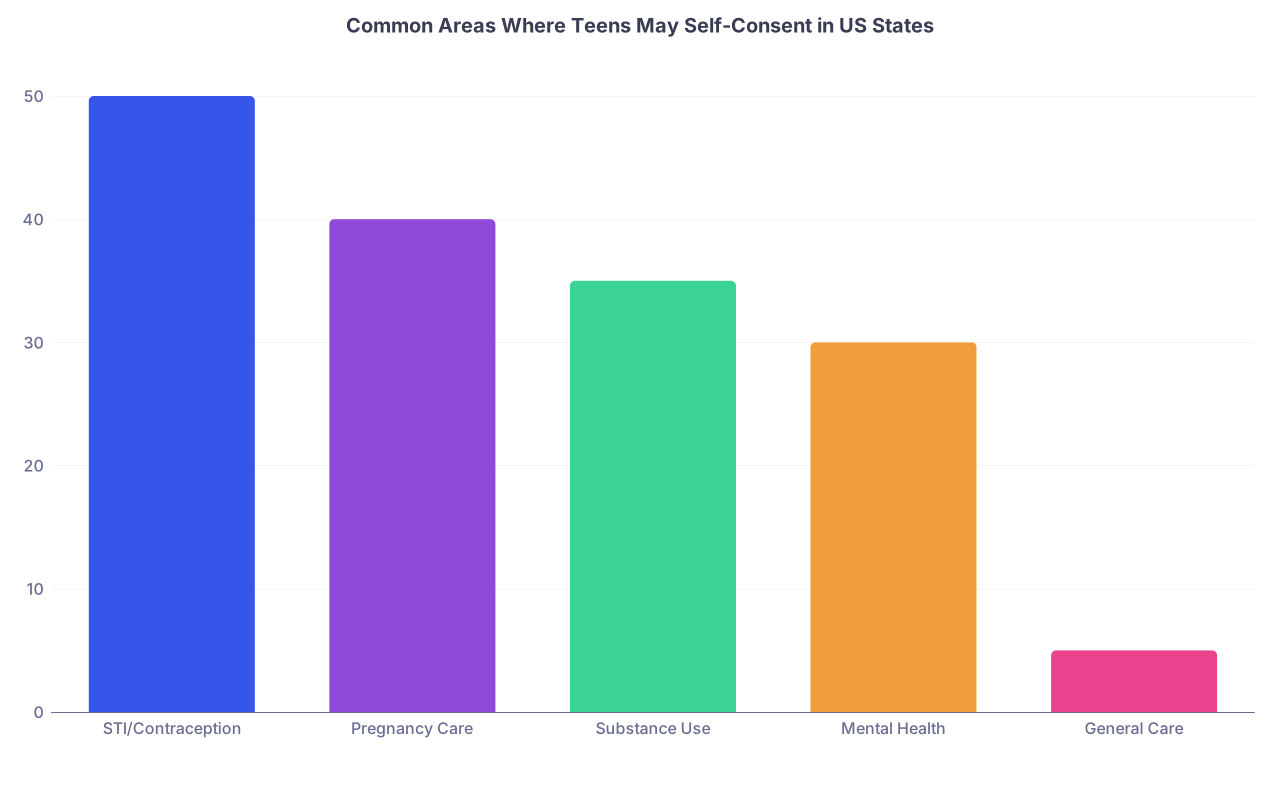
| Category | Value |
|---|---|
| STI/Contraception | 50 |
| Pregnancy Care | 40 |
| Substance Use | 35 |
| Mental Health | 30 |
| General Care | 5 |
(Values are approximate number of states with broad minor consent laws in that category; the exact map changes over time.)
9. When Assent Should Be Treated Almost Like Consent
Some cases are ethically straightforward even if the law lags behind.
Example: A 17‑year‑old with advanced metastatic cancer, clearly dying, refusing further aggressive treatment and asking for hospice.
From a pure capacity standpoint:
- They usually understand diagnosis, prognosis, risks, and benefits better than many adults.
- They often articulate consistent values about quality of life and dying at home versus in an ICU.
If a parent wants “everything done” but the teen consistently wants comfort‑focused care, ethically you should weigh the teen’s voice very heavily—sometimes as decisive.
I have seen ethics committees side primarily with the teen’s expressed wishes in these end‑of‑life decisions, using arguments like:
- Respect for emerging autonomy in late adolescence.
- Minimizing suffering.
- Futility of proposed interventions.
The law might still involve a surrogate decision‑maker (parent or guardian), but your ethical recommendation can and should reflect the teen’s wishes as central.
10. Concrete Red Flags: When You Need Help
You should not try to solo every complex case. Specific triggers for escalating:
- A teen with good understanding is making a choice that will likely lead to death or serious disability, while a reasonable alternative exists.
- A parent is refusing standard, evidence‑based care for a serious condition and the teen either wants it or seems indifferent.
- Clear signs of coercion, abuse, or parental domination (threats, financial blackmail, religious shaming to the point of psychological harm).
- Multisystem conflict: school, juvenile justice, child protection, and medical team all disagree.
Get:
- Hospital ethics consult.
- Social work and psychology.
- Possibly legal counsel or child protective services.
Do not be the lone hero. That usually ends badly for everyone.
11. Quick Comparison: Where Assent vs Consent Really Diverge
| Feature | Assent (Child/Teen) | Consent (Parent/Adult) |
|---|---|---|
| Legal authority | Usually no | Yes |
| Ethical weight | Increases with age/capacity | High, but not absolute |
| Can override refusal | Often, if life‑saving and high benefit | Rare (adult autonomy dominates) |
| Confidential by law | Limited, except special areas | Adult consent is generally private |
| Goal | Respect emerging autonomy, build trust | Legitimize and authorize intervention |
12. Personal Development Angle: Who You Become in These Rooms
This is under “PERSONAL DEVELOPMENT AND MEDICAL ETHICS” for a reason. These cases shape who you become as a clinician more than any guidelines PDF.
Questions you should be asking yourself after a hard case:
- Did I actually hear the teen, or did I use them as a prop in a parent‑clinician debate?
- Did I default to “parent knows best” because it was easier, or because it was genuinely in the teen’s best interests?
- Did I explain my recommendation clearly enough that both teen and parent could disagree intelligently?
- Did I document what the teen said in their own words, or did I sanitize it into “patient understands”?
If you repeatedly override teens without serious engagement, you will notice it later. They stop trusting you. They ghost follow‑up appointments. They nod and then do the opposite at home.
Assent done properly is not just a box. It is your chance to build a relationship with someone who may be your adult patient for decades.

FAQs
1. If a 16‑year‑old clearly understands and refuses treatment, can I ever just respect that refusal?
Sometimes, yes, especially for non‑life‑saving, preference‑sensitive treatments (e.g., elective orthopedic surgery, certain cosmetic procedures, or noncritical medication adjustments). Ethically, a well‑reasoned refusal from a competent 16‑ or 17‑year‑old should carry major weight. For life‑saving treatments with strong evidence of benefit, the bar to respecting refusal is much higher, and legal frameworks often allow overriding their decision. You treat their “no” seriously, explore it fully, and then decide if the risk profile morally justifies overriding it.
2. What if the parents and teen both agree on a decision that I think is clearly harmful?
You are not a mere technician. You are not required to implement care you believe is clearly harmful or outside standard of practice. If both want a dubious “alternative” instead of effective treatment for a high‑risk condition, you push back, offer second opinions, and, if necessary, involve institutional and legal mechanisms to protect the teen. Your duty to the patient’s welfare can override family consensus when that consensus amounts to medical neglect.
3. Should I ever talk to a teen alone if the parent refuses to leave the room?
Ideally, yes, you should have private time with adolescents. If a parent refuses, you still try: explain that standard adolescent care includes private time, and it does not mean excluding the parent from major decisions. If they still decline, you proceed carefully, but you document their refusal and the limitation it imposes. In some sensitive areas (e.g., suspected abuse, safety concerns), you may need to involve social work or child protection to create a safe space for the teen to speak.
4. How do I handle a situation where a teen consents to contraception but begs me not to tell their parents?
First, check your jurisdiction’s laws on minor consent and confidentiality for reproductive health. If the law allows confidential contraception and there are no safety red flags (coercion, abuse, large power differentials), you generally honor that request. You can strongly encourage the teen to involve a trusted adult and offer help in how to have that conversation, but you do not unilaterally break confidentiality simply because you think the parent “should know.” Your legal and ethical obligation is to the teen’s health and trust.
5. When should I call an ethics consult in parent–teen disagreement cases?
Call early when three conditions cluster: the medical decision is high stakes (life‑threatening or life‑altering), there is a persistent disagreement between parent and teen (or between family and team), and your standard negotiation and explanation efforts have stalled. Ethics consults are especially useful when you are torn between respecting the teen’s emerging autonomy and preventing serious harm, or when you suspect parental decisions are drifting into neglect but the situation is not blatantly clear.
Key points to carry out of the room:
- Assent is not decorative. It is the structured, serious involvement of minors in decisions that affect them, scaled to their developmental level.
- As teens approach adulthood, their expressed, well‑reasoned preferences deserve ethical weight close to full consent, even when the law still labels them “minors.”
- When parents and teens disagree in high‑stakes situations, you do not wing it. You anchor in capacity, risk, legal frameworks, clear documentation, and, when needed, ethics and legal back‑up.