

How Honest Should I Be About Prognosis When Uncertainty Is High?
What do you actually say when a patient looks you straight in the eye and asks, “So… how much time do I have?” and you honestly have no idea?
Here’s the blunt answer: you should be fully honest about the uncertainty itself, and carefully specific about what you do and do not know. Hiding uncertainty is unethical, legally risky, and clinically counterproductive. But dumping raw guesswork on a patient without context is just as bad.
Let’s walk through what “the right level of honesty” really looks like in high-uncertainty prognostic situations.
Core Principle: Be Honest About Uncertainty, Not Just About Numbers
You’re not obligated to be right. You are obligated to be truthful.
That means:
Do not pretend you know when you don’t.
“You’ve got 6 months” when you’re guessing? That’s lying, even if your guess happens to be correct.Do not hide uncertainty to make things feel cleaner.
Saying “We’ll do everything; let’s stay positive” without admitting how unpredictable the course is? That’s incomplete disclosure.Do express prognosis in ranges and scenarios, not single-point predictions.
“Best case / typical / worst case” is more honest and usually more helpful.
Legal and ethical frameworks (informed consent, autonomy, professional codes) all converge on the same point: patients have the right to a truthful, understandable picture of their situation, including the fact that medicine can’t forecast everything.
The Ethical Backbone: Autonomy, Beneficence, Nonmaleficence
Every time you talk prognosis with uncertainty, you’re juggling three principles.
Autonomy – The patient’s right to make informed choices about their life and care.
You respect autonomy when you:
- Share that the future is uncertain and what that means for decisions.
- Make it clear what’s likely vs. unlikely, and where you’re really guessing.
You violate autonomy when you:
- Downplay risk because you’re worried about upsetting them.
- Overstate certainty (“This will definitely work”) to get them to choose your preferred option.
Beneficence – Acting in the patient’s best interest.
Honest uncertainty helps beneficence when:
- It guides realistic planning (advance directives, financial/legal planning, bucket-list stuff).
- It prevents futile or burdensome interventions based on false hope.
You undermine beneficence when:
- You sugarcoat prognosis to keep the “mood positive,” leading to poor choices.
- You swing to brutalism (“You’re dying, nothing to do”) and strip away reasonable options.
Nonmaleficence – Do no harm.
You cause harm when:
- A patient quits treatment or planning because you gave an overly pessimistic guess.
- A family accuses you of “lying” later because your overly optimistic forecast was way off.
You reduce harm by being explicit: “I’ve seen people do better and people do worse; here’s the range I think is realistic.”
In short: you’re not obligated to have a crystal ball. You are obligated not to fake one.
What the Law Actually Cares About
Legally, this is about informed consent and avoiding misrepresentation.
Most jurisdictions and professional standards expect that you:
Disclose material information
Material = what a reasonable person would want to know to make decisions. Prognosis is usually material, especially in serious illness.Avoid false reassurance or false despair
“You will definitely beat this” or “You have no chance” with no solid basis? That’s risky. If it affects decisions (like choosing or declining treatment), it’s even more dangerous.Document your discussion
Not a novel. Just enough to show you:- discussed prognosis in general terms
- acknowledged uncertainty
- aligned with the patient’s preferences for detail
Here’s the real legal trap: not that your estimate was wrong, but that you gave the impression of certainty you didn’t have, or withheld information that would have changed decisions.
If you can honestly say (and document), “I explained this was an estimate, discussed possible better and worse outcomes, and the patient understood there was uncertainty,” you are usually on solid ground—ethically and legally.
What To Actually Say: A Simple Structure
Let’s get practical. You’re in the room. The prognosis is truly uncertain.
Use this four-part structure:
Ask how much they want to know.
“Some people want every detail and every number I can provide. Others prefer a general sense. What feels right for you today?”Name the uncertainty explicitly.
“With this kind of illness, our predictions are often wrong by a lot. I can give you a range and what I’ve seen before, but I can’t be exact.”Offer scenarios, not a single number.
“If things go better than average… If things go as we often see… If things go worse than we’d like…”
Then give rough time frames or functional expectations.Tie it back to decisions and planning.
“Given that range, we should plan for months, hope for more, and be ready if it’s less. That affects how we think about treatment intensity, home support, and your priorities day to day.”
This respects autonomy, is honest about uncertainty, and is clinically useful.
Tools: Ranges, Probabilities, and Plain Language
Ranges and “Best / Typical / Worst” framing
Instead of: “You have 6–12 months.”
Try:
- “If things go better than average, I’ve seen people live a year or more.”
- “If things go as we typically see, we may be talking about months, not years.”
- “If things go faster than we hope, it could be as short as weeks.”
That’s honest. It’s not soft. And it’s less likely to mislead.
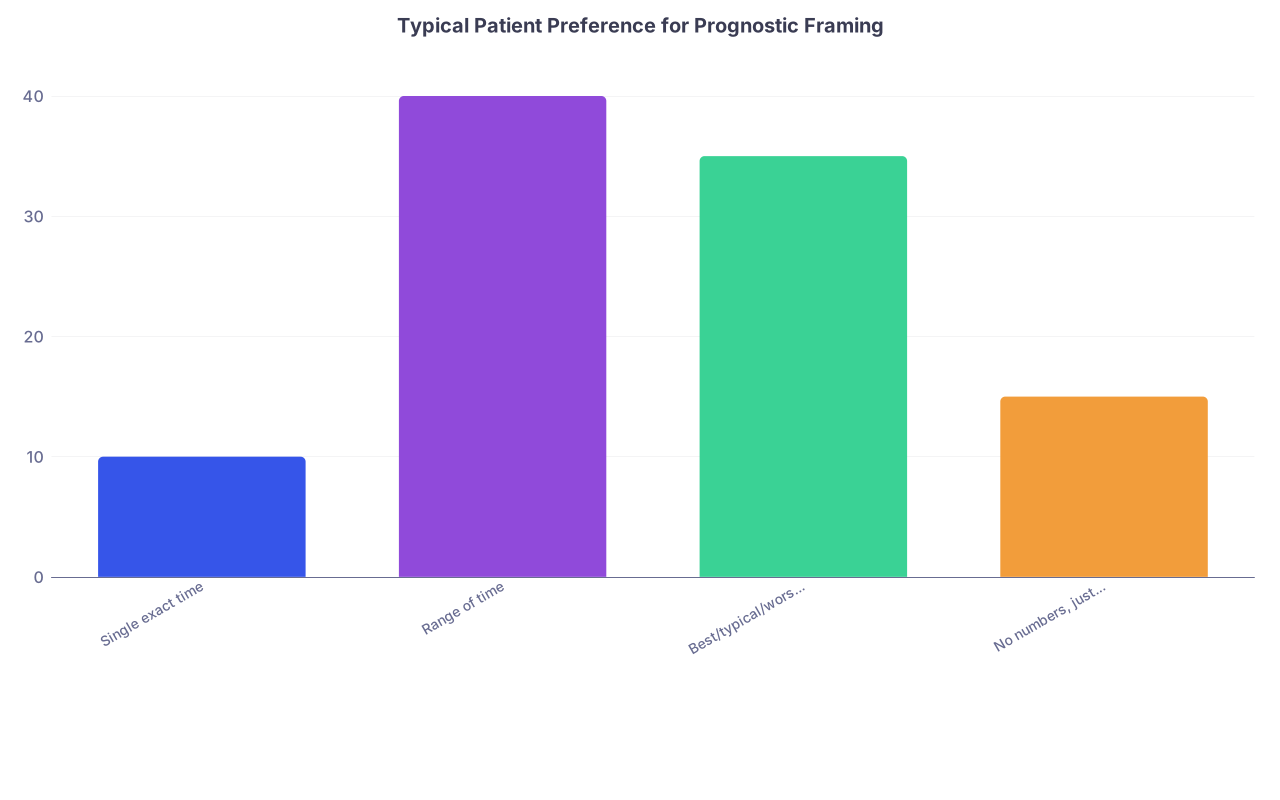
| Category | Value |
|---|---|
| Single exact time | 10 |
| Range of time | 40 |
| Best/typical/worst scenarios | 35 |
| No numbers, just general | 15 |
Probabilities (use carefully)
Saying “you have a 20% chance of surviving 5 years” works only if the patient:
- understands what 20% means
- wants that level of detail
- won’t fixate on the number as a promise
Often better: “Most people in your situation do not live beyond 5 years, though a minority do. I can’t tell which group you’ll be in.”
Plain, direct language
Avoid jargon and euphemisms. “Pass away,” “do poorly,” “it might be serious” often confuse.
Say:
- “This illness is serious and can be life-shortening.”
- “I’m worried you could die from this in the next few months.”
- “I don’t know exactly how long you have, but I think your time is likely limited to months or less.”
Painful to say. Necessary to be honest.
Handling High Emotional Stakes Without Lying
A lot of dishonesty about prognosis is emotional self-protection. For the clinician.
You see the spouse crying. The adult daughter asking, “He’ll be here next Christmas, right?” You want to give hope. You also want to get out of that room.
Here’s the line you need to hold:
- You can protect hope without distorting reality.
Hope doesn’t have to be “hope for cure.” It can be:- hope for good days
- hope for time with family
- hope for a peaceful death
- hope for being at home, not in an ICU
Phrase it like this:
- “I’m worried he may not be here next Christmas. I wish I could say otherwise. What we can still hope for is quality time now, comfort, and making sure his wishes are honored.”
That’s honest. It acknowledges uncertainty (you’re not giving a guaranteed expiration date) but also doesn’t dodge likely realities.

When You Really Have No Good Data
Sometimes you’re off the evidence-based map:
- Super-rare disease
- Young patient with combination of conditions
- Failed standard therapies, new experimental option
- ICU course with wildly unpredictable turnarounds
Here’s what to do:
Say explicitly that data are weak.
“We don’t have good studies to guide us in your exact situation.”Use analogies and ranges from what you do know.
“In patients a bit like you, we’ve seen courses from weeks to many months. I wish I could be more precise.”Be transparent about your reasoning.
“I’m basing this on your current organ function, the rate of change we’re seeing, and my past patients with similar issues.”Revisit and update.
“Given the uncertainty, I want us to check in again in a few days/weeks as we see how things are evolving.”
Patients handle “we genuinely don’t know” better than manufactured certainty. What they hate is finding out later that you pretended to know.
Using Prognostic Uncertainty to Guide Care, Not Paralyze It
Uncertainty doesn’t mean “say nothing and wait.” It means you:
- Plan along multiple potential paths
- Anchor decisions in the patient’s values, not your anxiety about guessing
- Use “time-limited trials” of treatment
A powerful move in ICU or oncology:
“Given the uncertainty, let’s try this treatment intensely for 3–5 days/weeks. We’ll watch for specific signs that it’s helping—like improved breathing, better lab trends. If we’re not seeing those, it’s a signal we should reconsider and maybe focus more on comfort.”
That makes use of uncertainty instead of denying it.

| Step | Description |
|---|---|
| Step 1 | Patient asks about future |
| Step 2 | Ask preference for detail |
| Step 3 | Explain uncertainty |
| Step 4 | Describe best typical worst |
| Step 5 | Link to decisions and planning |
| Step 6 | Offer follow up check in |
Balancing Honesty with Cultural and Individual Preferences
Not everyone wants the same level of detail. And not every family wants full disclosure to the patient.
Common scenario: family member in the hallway says, “Please don’t tell her it’s cancer / that it’s terminal.”
You cannot ethically collude in outright deception. But you also do not have to bulldoze the family.
Do this instead:
Clarify with the patient, privately, early.
“Some people want all the details about their illness and prognosis. Others prefer that I talk more with family and keep things general. What feels right to you?”Follow the patient’s wishes.
If they say “Tell me everything,” you’re obligated to do so—even if the family protests.
If they say “Talk to my son; I don’t want details,” respect that, while still ensuring the patient has basic understanding for consent.Be honest with language, even if general.
If a patient doesn’t want numbers, you can still say, “This is serious and could limit your life expectancy,” instead of pretending it’s minor.

Quick Comparison: Helpful vs Harmful Prognostic Statements
| Situation | Harmful Statement | Better Statement |
|---|---|---|
| Metastatic cancer, new diagnosis | “You’ve got about 6 months.” | “Many people in your situation live months, some longer, some shorter. I wish I could be exact.” |
| ICU, multi-organ failure | “He’s not that sick, we’ll see.” | “I’m very worried. This is life-threatening, and the next 24–48 hours are critical.” |
| Unproven treatment option | “This will fix it.” | “This might help, but we honestly don’t know. Here’s what we do and don’t know.” |
| Family wants “no bad news” | “Everything is fine” (when it isn’t) | “There are serious risks and I’m worried. How much do you want to know right now?” |
| Unexpected improvement | “You’re cured, no worries now.” | “You’re doing better than we expected, which is great. I still want us to stay realistic about future risks.” |
Personal Development: Growing Your Tolerance for Uncertainty
If you’re uncomfortable with these conversations, join the club. Most clinicians are, at first.
But you can get better at this in very deliberate ways:
- Practice concrete phrases and structures. Don’t improvise everything.
- Watch a good palliative care clinician do family meetings. You’ll learn more in one hour than in ten ethics lectures.
- Reflect after tough conversations:
- Did I overpromise?
- Did I dodge the question?
- Did I name my uncertainty clearly?
And remember: “I don’t know, but here’s what I’m thinking and how we’ll keep reassessing” is the right answer far more often than you were trained to admit.
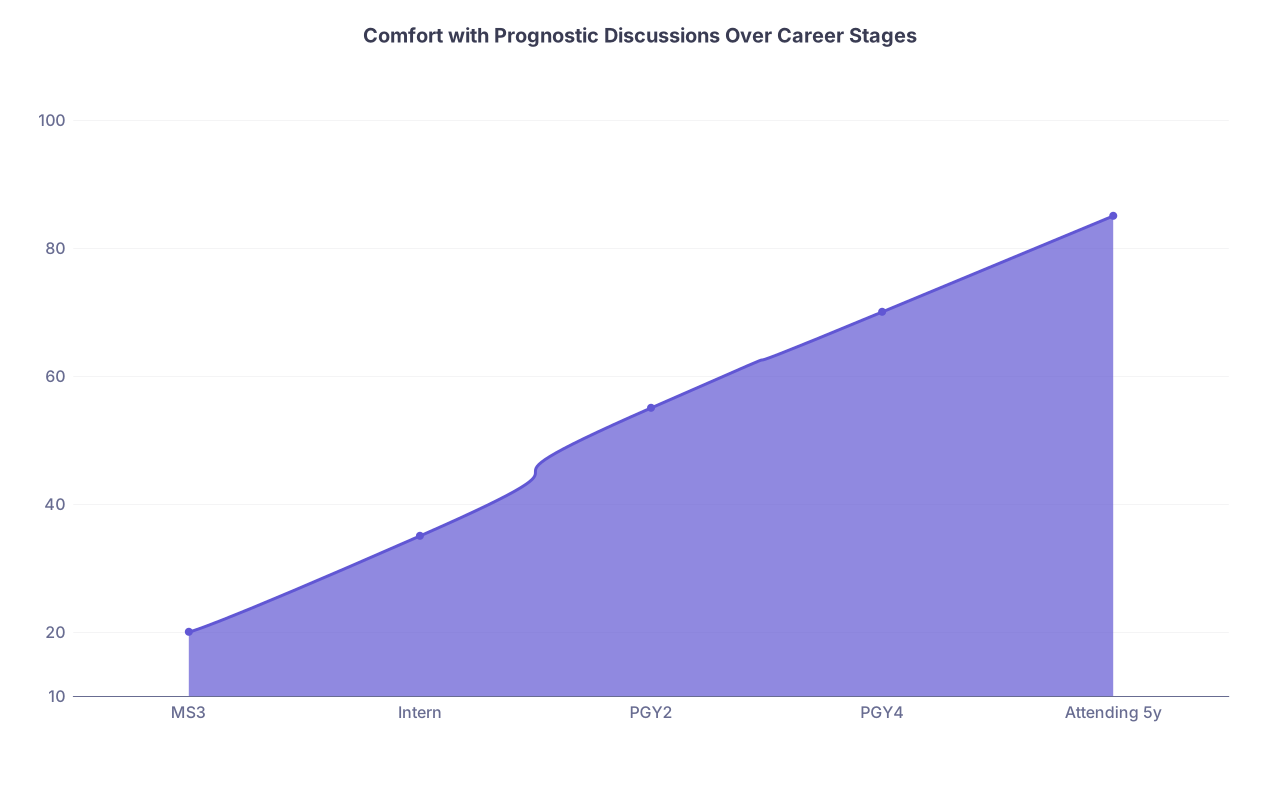
| Category | Value |
|---|---|
| MS3 | 20 |
| Intern | 35 |
| PGY2 | 55 |
| PGY4 | 70 |
| Attending 5y | 85 |
FAQ: Prognosis and Uncertainty
1. Is it ever acceptable to give a specific time estimate (like “6 months”)?
Yes, but rarely, and only if you frame it as a rough estimate with a wide margin of error. Instead of “You have 6 months,” say, “If I had to guess, I’d say on the order of months, maybe around 6, but I’ve been wrong both ways. Some people surprise us and live longer; some decline faster.” Always emphasize it’s not a clock.
2. What if a patient demands, “Just tell me—how long?” and refuses ranges?
Acknowledge their frustration, then hold the line: “I hear that you want a clear answer, and I wish I had one. Medicine just isn’t that exact. If you force me to say a single number, I’ll likely be wrong. What I can say honestly is that we’re probably talking months rather than years, and we should plan with that in mind.” Do not invent false precision just because they demand it.
3. Can being too honest about poor prognosis make patients lose hope and do worse?
Badly delivered information can crush people, yes. But clear, compassionate honesty—combined with a focus on what you can still hope for—usually helps patients and families cope and plan. The bigger danger is dishonesty that leads to regret: “If I’d known it was this bad, I would have…” Your job is reality with support, not blind optimism.
4. How do I handle a family that insists I not tell the patient the truth?
First, clarify privately with the patient how much they want to know. If the patient wants full information, you must honor that, regardless of family wishes. You can tell the family, “I respect your desire to protect her, but she has told me she wants to know the truth about her condition. I’m obligated to follow her wishes, and I’ll do it as gently and supportively as I can.” Document that conversation.
5. What if my attending pushes me to be more “reassuring” than I think is honest?
You’re in a tricky power dynamic, but you still have ethical obligations. Phrase it respectfully: “I’m worried that if we reassure too much, the patient may not understand how serious this is and might not be able to plan. Could we at least say that things are serious and outcomes are uncertain?” If you’re deeply uncomfortable, debrief with another senior (program director, ethics consult, palliative team) and learn how they’d balance it.
6. How often should I revisit prognosis with a patient when things are uncertain?
More often than you think. As clinical information changes—labs, imaging, functional status—your best estimate changes too. A good rule: revisit prognosis when there’s a major clinical change, before big decisions (like starting or stopping intensive treatments), and whenever the patient or family brings it up. Even a 2–3 sentence calibration (“We’re in a different place now than a month ago…”) makes a huge difference.
Key takeaways:
Be rigorously honest about the uncertainty itself, not falsely confident about outcomes. Use ranges, scenarios, and clear language, and always connect prognosis back to what matters for the patient’s decisions and priorities. And remember: “I don’t know, but here’s what I’m thinking, and here’s how we’ll keep reassessing” is not a failure—it’s ethical, professional medicine.


