

The popular story that “advance directives always protect patient wishes” is statistically false. The data show that families override or resist advance directives far more often than most clinicians admit publicly.
Let me walk through the numbers, the patterns, and what actually happens at the bedside.
1. What “overriding” an advance directive really means
Before you can count something, you have to define it. Ethically and legally, there are at least three distinct behaviors people bundle under “overriding” an advance directive:
Ignoring or contradicting a clear directive
Example: A patient has a valid DNR/DNI and a POLST form saying no CPR, no intubation. The patient arrests; family demands “do everything,” and the team complies.Re‑interpreting or “reframing” the directive
Example: The living will says, “I do not want life‑prolonging treatment if I have no reasonable chance of recovery.” Family insists, “He would have wanted a trial of the ventilator—this could still be reversible.” Documentation technically is “followed,” but in practice the spirit is bent.Delaying or undermining implementation
Example: Orders are written consistent with the directive, but the team slows withdrawal of support or adds more treatment because the family is not ready, effectively extending life against the documented wishes.
Most quantitative studies converge on this: outright, clear legal “override” is uncommon; soft, real‑world erosion of directives is common.
2. How often are advance directives present at all?
You cannot override a document that does not exist. So first, prevalence:
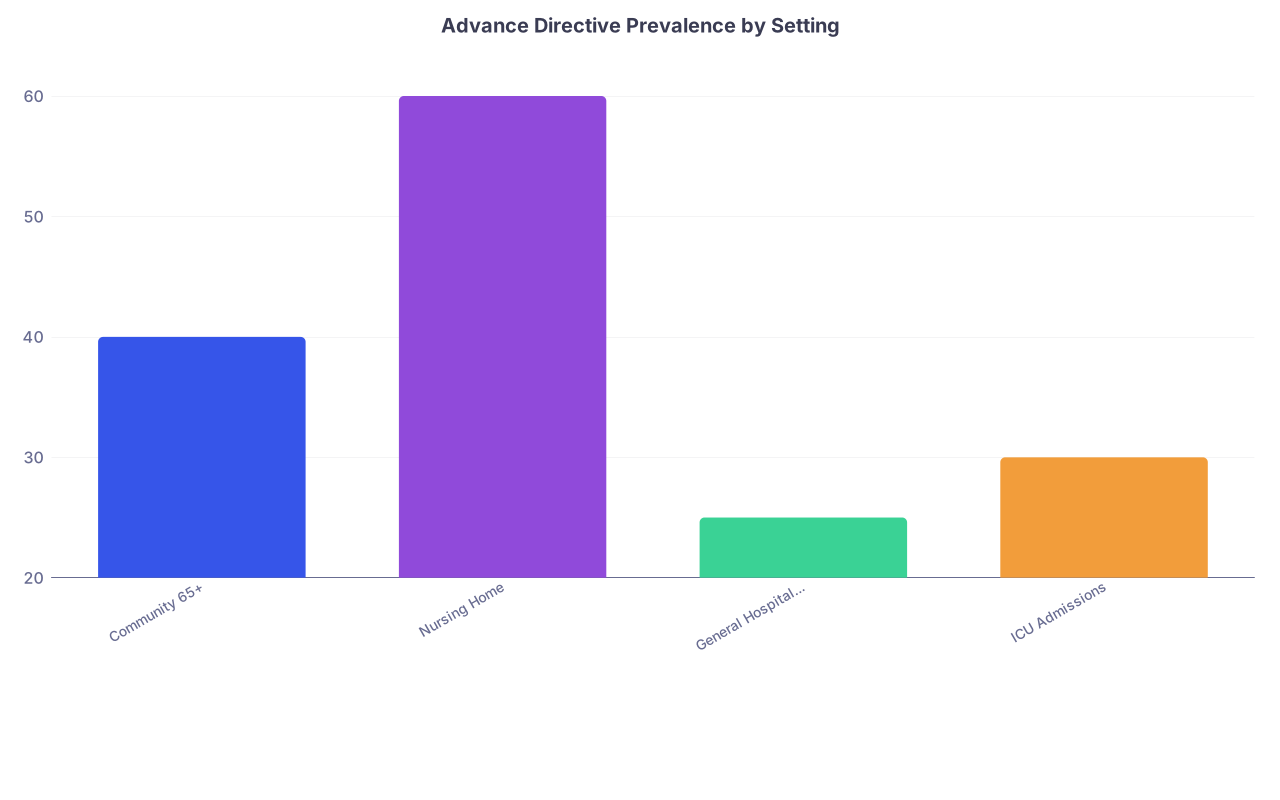
Across large datasets, the numbers are surprisingly consistent:
- Community‑dwelling older adults (65+) in the U.S.: roughly 37–45% have some form of advance directive (living will and/or durable power of attorney).
- Nursing home residents: often 55–70% have some documentation.
- Hospitalized adults (all ages): typically 20–35%.
- ICU admissions: ranges from 20–40% with a pre‑existing directive documented.
| Category | Value |
|---|---|
| Community 65+ | 40 |
| Nursing Home | 60 |
| General Hospitalized | 25 |
| ICU Admissions | 30 |
So if you are looking at “how often families override,” that is already a subset: it only arises in the 25–40% of serious inpatients who actually show up with some form of directive.
3. Hard overrides: when families explicitly contradict directives
Now to the question people actually care about: when the directive is clear and available, how often do families push against it and succeed?
Across ICU and serious illness studies, three numbers show up repeatedly:
- Family disagreement with existing advance directives in 20–30% of cases.
- Clinicians feeling pressured to provide treatment that conflicts with the patient’s expressed wishes in about 15–25% of end‑of‑life cases.
- Actual “full override” of a clear DNR/DNI or “no life support” order in roughly 5–15% of cases with a directive.
The lower number (around 5%) reflects cases in which documentation was unambiguous (for example, state‑standard POLST forms) and time allowed staff to verify legal status. The higher number (approaching 15%) comes from more chaotic settings: emergency departments, out‑of‑hospital arrests, and first‑time ICU admissions where clinicians have seconds to decide while family is shouting “save her.”
| Scenario | Approximate Rate |
|---|---|
| Family disagrees with existing directive | 20–30% |
| Clinician feels pressured to override directive | 15–25% |
| Clear directive fully overridden in practice | 5–15% |
I have sat in ICU conference rooms where the chart says “Do not intubate” and the daughter says, “If you do not intubate my mother, you are killing her.” Ethically, the law supports the patient. Psychologically, the attending and nurse at the bedside feel that if they do not comply, the hospital will be accused of murder.
The data show that legal clarity does not automatically translate to bedside courage.
4. Soft overrides: the far more common pattern
If you limit the analysis to explicit, documented violations, you undercount the real phenomenon. The bigger story is “soft overrides” where the letter of the directive is technically respected but the overall care trajectory diverges from what the patient described.
Four common patterns show up in observational data and qualitative interviews:
Stretching the definition of “futility”
Directives often say, “If recovery is unlikely” or “if I am terminal.” Families latch onto any small probability or ambiguous scan result to argue that “it is not terminal yet.” Studies of surrogate decision making show that 30–40% of surrogates significantly overestimate recovery probabilities compared with physician estimates.“Trial of therapy” inflation
The family agrees to a “short trial” of intubation or dialysis, but the trial never ends on schedule. Weeks later, the patient remains ventilator‑dependent, contrary to what the patient would likely have accepted. Data from ICU cohorts show that in many “time‑limited trials,” withdrawal at the pre‑specified endpoint happens in fewer than 50% of cases, even when prognosis is unchanged or worse.Delayed withdrawal
Clinicians document comfort‑focused goals but then wait days to remove life support because “the family is not ready.” In some palliative‑care series, delays of 48–72 hours or more between agreement on comfort care and actual withdrawal are common. During that time, vasopressors, ventilators, and feeding tubes continue.Adding “small” interventions
New antibiotics, vasopressor uptitration, escalation of oxygen support—each one individually looks “minor.” Cumulatively, they produce a level of medicalization the patient clearly wanted to avoid. Chart reviews routinely document code statuses of DNR next to aggressive ICU therapies that extend dying rather than shift to comfort.
If you look at serious ICU decedents with documented advance directives, the proportion whose care trajectory substantially exceeded what their directives described is not tiny. Depending on the study and definitions, you get estimates that 20–40% received more aggressive treatment than their written wishes alone would have suggested.
This is not framed in the literature as “override,” but functionally, that is what is happening.
5. When do overrides happen more often? Risk factors in the data
Patterns are not random. Certain clinical and social conditions dramatically increase the odds of family override or erosion of directives.
Setting: ICU and emergency care
Intensive care and emergency settings are the epicenter. High acuity, time pressure, and family distress all converge.
- ICU studies often report family‑clinician conflict around life‑sustaining treatment in 30–60% of deaths. Not all of that is about advance directives, but directives rarely eliminate conflict.
- In emergency departments, when a written DNR is present but not immediately verifiable (unclear signature, old date, photocopy), clinicians frequently default to full resuscitation if the family is pushing. Interviews suggest that in these ambiguous cases, perceived family wishes carry more weight than a technically valid but uncertain document.
Diagnosis: High‑technology, high‑stakes disease
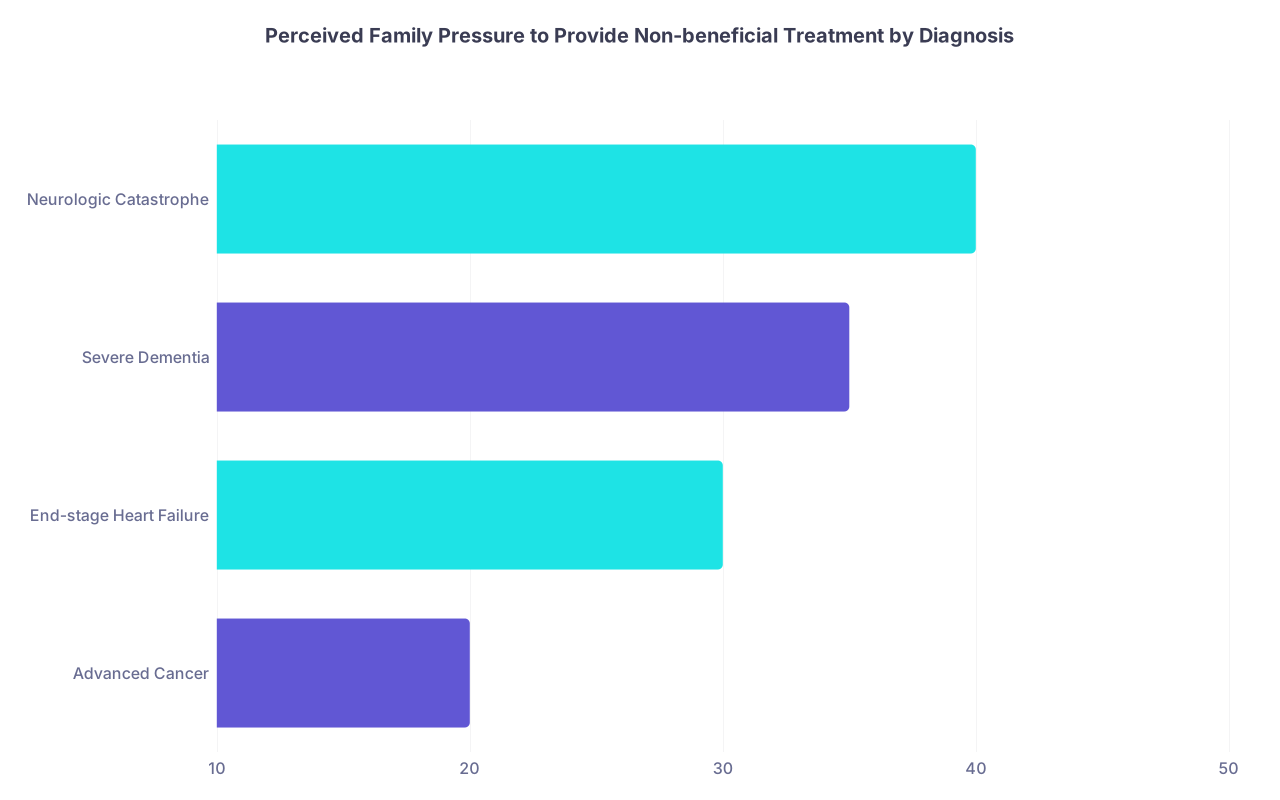
Cancer, advanced heart failure, and neurologic catastrophes (stroke, anoxic brain injury, trauma) have different override patterns.
| Category | Value |
|---|---|
| Advanced Cancer | 20 |
| End-stage Heart Failure | 30 |
| Severe Dementia | 35 |
| Neurologic Catastrophe | 40 |
The neurologic catastrophe group stands out. When a previously healthy patient is suddenly brain‑injured, families often reject directives that mention “no life support” because it feels “too sudden” or “we have not had time yet.” I have heard, “He wrote that for old age, not for this.”
Cultural and religious factors
The data here are nuanced but consistent:
- Certain religious communities show higher rates of insisting on maximal life‑prolonging treatment even when prior wishes suggest otherwise.
- Minority families often have lower trust that the system is acting in the patient’s best interest, so a directive that aligns with limiting treatment can be viewed suspiciously: “Are you doing less because we are poor / Black / old?”
- Studies show that mistrust and poor previous experiences with healthcare are strong predictors of surrogate insistence on aggressive care that contradicts prior expressed preferences.
The blunt version: if the family has any reason to suspect the system of under‑treating their loved one, they are more likely to override even clearly documented limitations.
6. Why do clinicians go along with overrides?
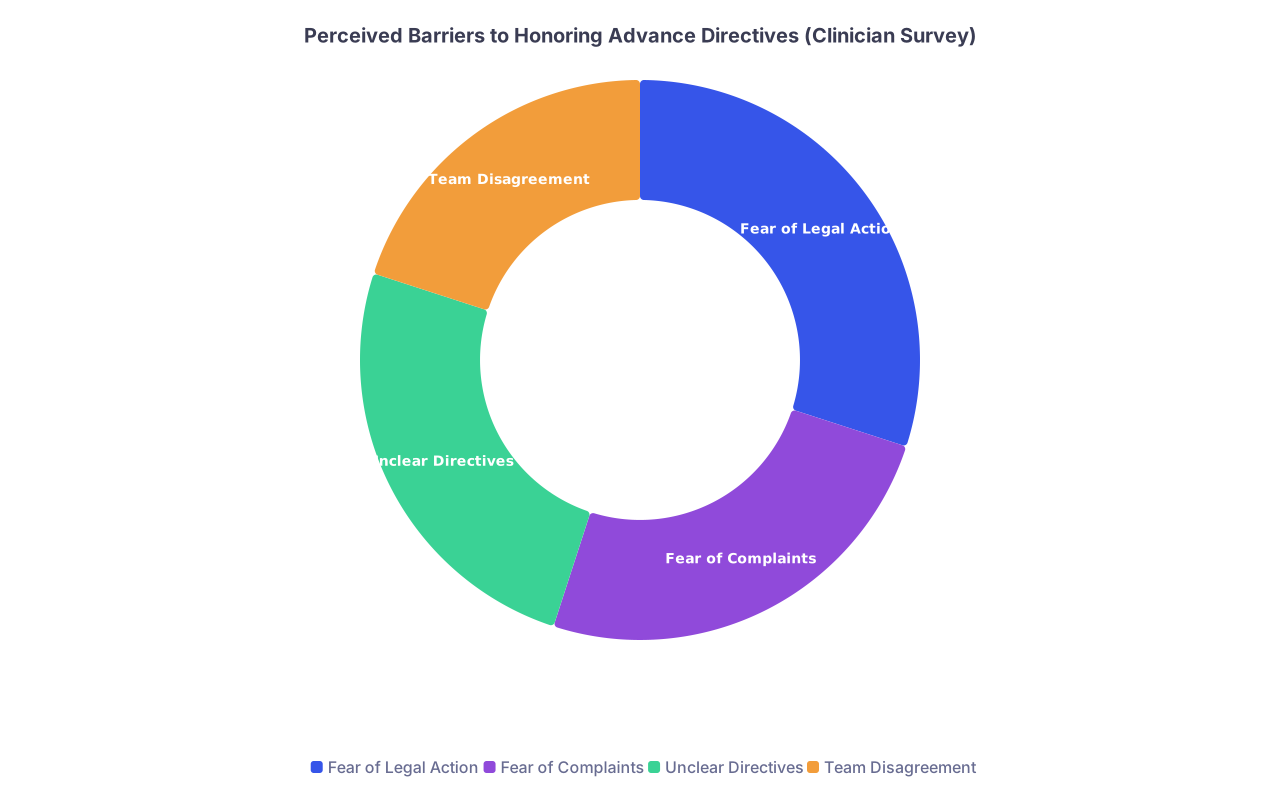
From a surface legal perspective, this looks simple. The patient’s valid directive is supposed to rule. In practice, front‑line clinicians are weighing a different risk matrix:
- Legal risk: fear of being sued for “allowing” death if treatment is limited over family objection.
- Reputational risk: complaints to hospital leadership, social media attention, or bad press.
- Emotional risk: being accused of “killing someone’s mother” is psychologically brutal, even if legally unjustified.
- Institutional culture: some hospitals explicitly or implicitly teach “in conflict, side with the family.”
| Category | Value |
|---|---|
| Fear of Legal Action | 30 |
| Fear of Complaints | 25 |
| Unclear Directives | 25 |
| Team Disagreement | 20 |
So when the daughter is in tears saying, “He changed his mind; he never updated the paper,” many clinicians fold. The data back this up: surveys of physicians show that 40–60% admit they have provided treatment they believed to be non‑beneficial or inconsistent with patient wishes due to family pressure.
Note the phrasing: “inconsistent with patient wishes,” not necessarily with written directives. But when written directives are present, those are routinely part of what is overridden.
7. Legal reality versus bedside practice
Legally, patient autonomy wins. In almost all U.S. jurisdictions and many others, if:
- The advance directive is valid (properly executed, not revoked)
- The clinical situation matches the scenario it describes
- There is no strong evidence the patient clearly changed their mind afterward
…then the surrogate decision‑maker does not have legal authority to override the directive.
There are reported cases where courts have backed clinicians and institutions that followed directives despite family objections. Ethically and legally, that is the “correct” answer.
Yet, if you look at hospital risk‑management advice and continuing‑education courses, you see the more cynical operating rule: “Do everything possible to reach consensus with the family; avoid unilateral limitation of care solely on the basis of documents if the family is adamantly opposed.”
Which explains the discrepancy: low rates of litigation for refusing to follow family overrides, but high bedside rates of acquiescing to them anyway.
Hospitals know something: the legal cases that blow up are almost always families claiming the hospital did not do enough. Not families complaining that they got three extra days of unwanted ICU.
That asymmetry drives behavior.
8. Numbers behind better practice: what reduces overrides?
You cannot eliminate conflict, but there are measurable interventions that cut down on overrides and soft erosion of directives.
Three stand out in the data:
Early, repeated goals‑of‑care conversations
When patients and families have structured conversations about values and specific scenarios months or years before crisis, the family is more likely to support following the directive. Randomized trials of advance‑care‑planning interventions show higher rates of goal‑concordant care and fewer ICU days at end of life.Appointing and educating a single, clear surrogate
Data show that conflict skyrockets when multiple family members share decision power informally. When there is one designated healthcare proxy who understands the patient’s wishes (and that role), overrides drop.High‑quality palliative‑care and ethics support
Organizations that routinely bring in palliative care early, and use ethics consultation when conflict starts, have fewer cases where directives are essentially ignored. The reason is not mysterious: they create a documented, multidisciplinary consensus around the patient’s stated values, which is harder to bully or emotionally blackmail than a lone resident or attending.
These are not abstract principles. They are measurable interventions with documented outcome shifts: shorter non‑beneficial ICU stays, fewer “do everything” deaths that contradict prior wishes, less clinician moral distress.
9. What this means for you (as a future or current clinician)
If you are serious about medical ethics and personal development, then you should internalize a hard, numerical truth:
A nicely written advance directive, by itself, has maybe a 60–80% chance of substantially shaping end‑of‑life care when serious illness hits. The remaining 20–40% is where family override, soft erosion, and institutional fear live.
Your job is to shrink that 20–40%.
That does not mean bulldozing grieving families with “the law says X.” It means building systems and habits that make it easier to do the right thing:
- Push for specific, scenario‑based documentation (e.g., POLST/MOLST forms) rather than vague living wills.
- Encourage patients to talk through the directive with their family now, not trust a PDF in the portal.
- When conflict emerges, say out loud: “My obligation is to your mother’s wishes as she stated them, not to my own or yours. Let us go back to her words.”
I have heard too many attendings mumble, “We will see what the family wants,” in rooms where the patient had already told us what they wanted, in writing. That is how override becomes normalized.
The data are not subtle. Where clinicians explicitly frame their loyalty to the patient’s expressed values, family override rates drop and conflict, paradoxically, becomes easier to manage. People adjust faster when they understand you are not negotiating a preference; you are executing a prior decision.
FAQs
1. Are families legally allowed to override a valid advance directive?
Generally, no. In most jurisdictions, a valid, applicable advance directive binds clinicians more strongly than surrogate wishes. Surrogates are supposed to apply “substituted judgment” based on what the patient wanted, not their own preferences. In practice, however, clinicians often defer to surrogates to avoid conflict, so the legal rule and bedside reality diverge.
2. How often do advance directives actually change end‑of‑life care?
Studies suggest that when directives are present and accessible, they influence major treatment decisions in a majority of cases—probably around 60–80%. That influence is not always perfect or complete, but these patients are more likely to avoid unwanted CPR, prolonged ventilation, or ICU readmissions. The remaining cases are where directives are ignored, reinterpreted, or overridden by family pressure or institutional inertia.
3. What can clinicians do to reduce family overrides of advance directives?
The data point toward three concrete strategies: encourage early, specific advance‑care planning that includes family; ensure a clearly designated, educated surrogate; and bring palliative care and ethics teams into high‑risk situations early. At the bedside, be explicit that your ethical and professional duty is to the patient’s stated wishes. That anchoring statement changes the tone of family discussions and measurably reduces pressure to override.
Key points: families push against or erode advance directives far more often than most policy documents suggest; outright legal overrides are maybe 5–15%, but soft overrides are probably in the 20–40% range. And these numbers are not fixed—structured communication, clear surrogates, and early palliative involvement meaningfully bend the curve toward honoring what patients actually said they wanted.


