

It’s 11:47 p.m. You’re on your couch after a brutal day. You open your phone, hop onto Reddit or a Facebook physician group or a WhatsApp chat, and you type out a “quick question” about a weird patient case. No name. No MRN. You’re careful…ish. You hit post.
And then your stomach drops.
“Wait. Did I just violate HIPAA? Could someone figure out who this is? Am I going to get reported? Am I going to lose my future career over a stupid vague case post?”
Yeah. That feeling. The cold-sweat, re-reading-your-own-post feeling. That’s what we’re talking about.
First: Did I Just Totally Ruin My Career?
Let me be blunt:
If you posted a vague case without names, MRN, room number, or obviously identifying stuff, the odds that you just destroyed your entire career are very, very low.
Does that mean it’s automatically fine? No. HIPAA’s not only about names and numbers. But the catastrophic, “they’ll find me and I’ll be kicked out of med school, lose my license I don’t even have yet, and get sued into oblivion” scenario you’re spiraling about? That’s usually not reality.
Here’s what you’re actually up against:
HIPAA looks at “protected health information” (PHI). PHI isn’t just:
- Name
- Date of birth
- Social Security number
- MRN
It’s anything that can reasonably identify a patient when tied to health information. So that includes combinations like:
- “34-year-old female with rare X condition at [small town hospital] last Friday…”
- “The only patient in the ICU on ECMO today with Y condition…”
So the real question isn’t “Did I use a name?” It’s “Could a reasonable person figure out who this is from what I posted?”
If what you posted is extremely generic—something like, “Adult with sepsis, on pressors, unclear source—would you cover for a colleague’s questionable order?”—that’s unlikely to be a HIPAA problem. It might still be unwise, but not classic PHI territory.
If you posted something like, “The only 21-year-old pregnant woman with cystic fibrosis at our 10-bed community hospital who just coded an hour ago…” That’s getting dangerously close to identifiable.
And yeah, I know—that realization usually comes after you already pressed “submit.”
What Actually Counts as a HIPAA Violation Online?
Let’s cut through the noise. I’ll tell you how I think about it when I’m spiraling over something I said or posted.
HIPAA = sharing identifiable health info about a real patient with someone who doesn’t have a legitimate reason to know it.
Online, that often looks like:
- Posting specific or unusual details that make the patient identifiable
- Combining demographic + timing + location + rare condition
- Sharing images (X-rays, rashes, CTs) with anything traceable or unique in them
People love to say “Just remove the name and you’re good.” That’s lazy and wrong. HIPAA has 18 identifiers (names, exact dates, phone, emails, photos of full face, small geography, etc.), but the bigger standard is this: could someone reasonably recognize the person?
Example:
“60-year-old man with diabetes and heart failure in the ICU.”
– Boring. Completely generic. Probably fine.“60-year-old former mayor of our town, in bed 4 of the ICU on ECMO, after a big MI yesterday, family at bedside asking about withdrawal of care.”
– That’s not vague. That’s a map.
Where most of us get into trouble is the gray zone:
- We think “no name = de-identified.”
- We underestimate how “unique” the situation is.
- We forget that someone reading might be from the same hospital or town.
If your post had rare disease + age + sex + small hospital + recent event (“today,” “yesterday,” “this morning”)—yeah, I’d be nervous too.
“But I Was Just Asking for Advice…” (Does That Matter?)
Here’s the part that annoys me but is true: your intent doesn’t erase the violation. HIPAA doesn’t care that you were just trying to learn or help the patient.
From a legal/ethical standpoint, asking:
“Is it okay if I post this detailed case online if I’m only doing it to learn?”
Answer: Not if the patient can be identified. Education doesn’t trump privacy.
Do I think boards and schools will burn down your life over one vague, overly cautious case question? No. But could a pattern of oversharing or one very specific, recognizable story get you in real trouble? Absolutely.
So your motive matters for how harshly people judge you. But it doesn’t magically make PHI disappear.
“How Do I Know If My Post Was Too Identifiable?”
Here’s how I’d stress-test it if I were panicking at 1 a.m.:
Ask yourself:
- Could the patient, their family, or your coworkers recognize this case if they saw it?
- Did you mention:
- Exact age (not just “elderly” or “young adult”)
- Exact dates or “today/this morning/yesterday”
- Small town or specific hospital
- Rare condition or one-in-a-million combo of things
- Social details that make them stand out (famous person, local news story, unusual trauma, etc.)
- If someone from your hospital group read it, could they say, “Oh, that’s clearly Mr. X in room 12”?
If you’re answering yes to any of those, it’s not really “vague,” even if you didn’t use a name.
If your post is more like:
“Middle-aged patient with acute kidney injury on multiple nephrotoxic meds, conflicting consultant recommendations—how do you approach this?”
That’s honestly very unlikely to be HIPAA territory. That’s an educational question, and the clinical scenario is common.
What Should I Do Now? Delete? Confess? Ignore?
This is the part where my own anxiety brain goes into overdrive:
“If I delete it, will that look suspicious? If I leave it up, what if someone screenshots it? Do I need to email the dean? Call risk management? Quit medicine and open a coffee shop?”
Take a breath.
Here’s how I’d approach it:
If you read it now and think, “Wow, this could clearly be recognized by people who know the patient,” then delete it. Right now. Don’t overthink “they’ll know I deleted it”—nobody is tracking your Reddit clicks.
If there’s a chance anyone at your institution, or the patient/family, could connect it back to them, and you’re part of a system that actually talks about social media and HIPAA, strongly consider quietly bringing it up with someone safe:
- A trusted attending who gets it
- Your clerkship director (if they’re known to be reasonable, not punitive)
- A GME or student affairs person who deals with this stuff
You’re not going to open with, “So I committed a massive HIPAA violation.” You say something like:
“I posted an anonymized case description online for advice, and now I’m worried I didn’t de-identify it enough. I’ve deleted it, but I wanted to ask what the right thing to do is going forward.”
That framing: you recognized the issue, you corrected it, you’re asking how to improve. That’s very different than someone else discovering it and you pretending it never happened.
- If your post was truly generic (no real identifiers beyond “adult with X issue”), I’d delete it if you’re spiraling, then move on. Learn from the scare. Don’t make a habit of it.
How Bad Could This Actually Get?
This is the nightmare scenario part my brain goes straight to: “What if they track my IP, the hospital finds it, I get reported to the board, and no residency ever ranks me?” Let’s be realistic.
Who gets serious consequences?
- People who repeatedly share identifiable patient info
- People who post photos, screenshots, labs, CTs with identifiers
- People who mock, shame, or demean patients publicly
- People who write about patients in a way that goes viral, gets to the media, or back to the patient
Punishments can hit:
- Employment (fired)
- School (professionalism violation, remediation, graduation delay)
- Fines (institution level more than individual, but still)
For a one-time, slightly-too-specific text description, anonymously posted, quickly deleted, where nobody complained? I’ve never seen someone’s entire career blown up over that alone. Have some people gotten talked to? Yes. Warned? Yes. Used as “the example” in a professionalism lecture? Yes.
Is it good? No. Is it automatically career-ending? No.
But here’s the uncomfortable truth: you don’t control how your institution reacts if they do find it. Some are measured. Some are draconian. That’s why the safest long-term strategy is: don’t post active patient cases online unless you’ve stripped them down to the point they could be about 10,000 people.
So How Do I Safely Ask About Cases Online?
Because honestly, we’re all stuck here: medicine is complex, attendings are busy, and online communities can be incredibly helpful. But they can also be a minefield.
Safer ways to approach it:
Change non-essential details that don’t affect the teaching point.
- Age: “elderly” vs “94-year-old”
- Exact timing: “recently” vs “yesterday at 3 p.m.”
- Setting: “small hospital” instead of “only community hospital in [small town]”
Focus on the clinical dilemma, not the patient story.
“How would you manage anticoagulation in someone with X and Y?” is different than “My patient who had a massive PE on [date] and just got transferred from [named hospital]…”Avoid rare combos that scream “this one person.” If it’s something that made rounds because it’s so wild, maybe don’t put it on the internet while it’s fresh.
Use educational platforms that are designed for cases and emphasize de-identification and permission. Even then, you’re not bulletproof, but it’s better than random social media.
And, harsh truth: if you can’t tell the story without specific, recognizable details, then you probably shouldn’t be posting it online at all unless it’s fully de-identified for formal teaching, or you have explicit permission and institutional guidance.
Will This Follow Me Forever?
This is what keeps a lot of us up:
“Residency programs Google people. What if this is the thing that pops up? What if they find my Reddit?”
Reality:
- If it was anonymous (no real name, no school, no location, no username tied to your identity), the odds anyone connects that to you personally later are tiny.
- Program directors are not combing through old, generic Reddit case posts hoping to catch a nervous MS3. They don’t have that kind of time.
- Your pattern matters more than one scared, now-deleted, too-detailed post.
But if you have a public Twitter/X, TikTok, or blog with your real name where you’ve been casually dropping semi-identifiable cases?
That absolutely can show up. And it does get discussed behind closed doors sometimes. I’ve heard: “Great applicant, but some of their social media posts about patients made people uncomfortable.” That’s not where you want to be.
If the thing you’re panicking about is more like: “Once, on an anonymous account, I posted a vague question that I now realize might’ve been borderline,” and you deleted it—no, that’s probably not going to stalk you into residency interviews.

Quick Reality Check: What I’d Do If I Were You
If I were sitting where you are, stomach tight, scrolling back to the post over and over, I’d do this:
- Read it like a stranger from your hospital. Could you identify the patient?
- If yes, delete it. Take a screenshot for yourself if you think you might need to discuss it later.
- If it feels truly borderline and you’re in a place where professionalism issues are taken seriously, talk to one reasonable person in authority and say, “I think I might’ve messed this up; I deleted it; I want to make sure I don’t repeat it.”
- Learn the lesson: from now on, either:
- Strip the case down to the core clinical question, or
- Don’t post active real-world cases online at all.
And then—this is the hard part—let it go. Don’t spend the next six months waiting for the professionalism police to crash through your door over a post nobody probably even screenshotted.
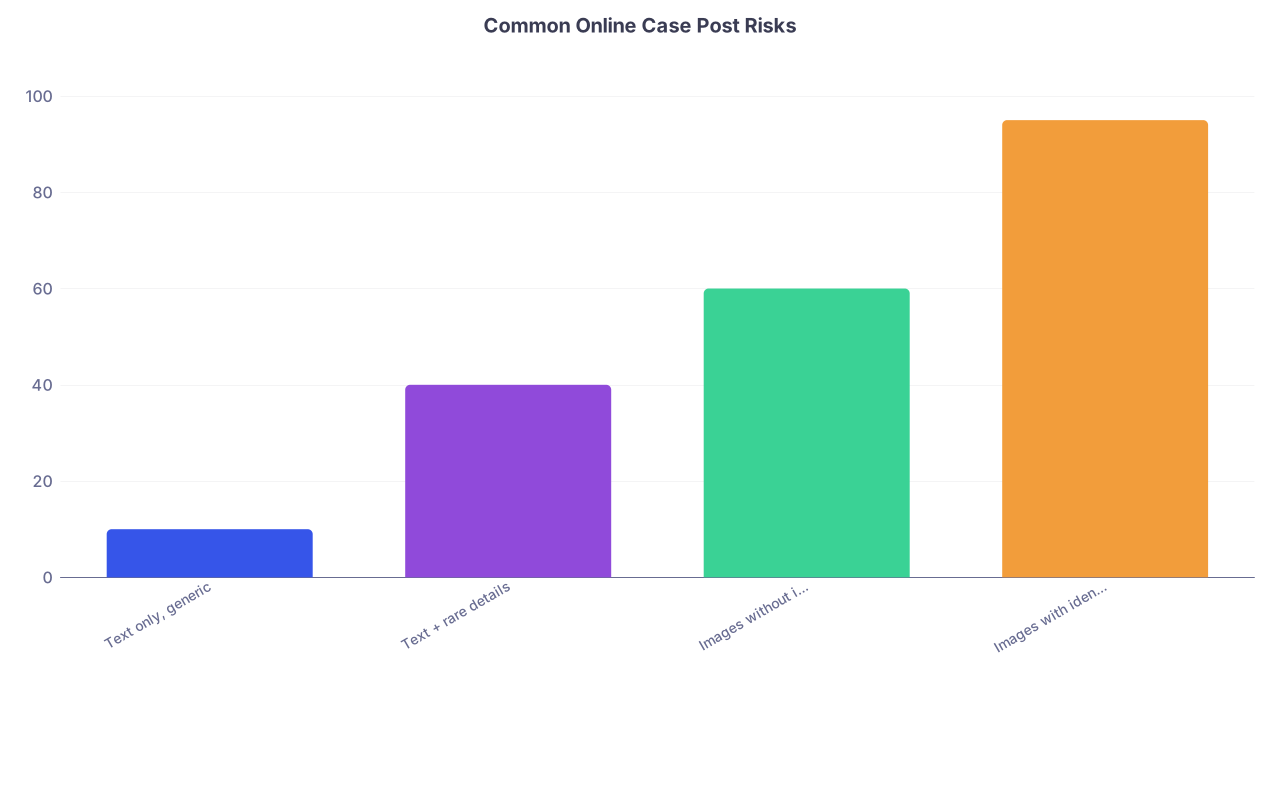
| Category | Value |
|---|---|
| Text only, generic | 10 |
| Text + rare details | 40 |
| Images without identifiers | 60 |
| Images with identifiers | 95 |
| Scenario | Relative Risk of HIPAA Issue |
|---|---|
| Generic text case, common condition | Low |
| Text case with rare disease + small hospital | Moderate to High |
| De-identified image (no unique features) | Moderate |
| Image with name/DOB or easily unique features | Very High |

| Step | Description |
|---|---|
| Step 1 | Want to post case online |
| Step 2 | Safer but still de identify |
| Step 3 | Do not post |
| Step 4 | Post minimal details or ask abstract question |
| Step 5 | Is it an active real patient? |
| Step 6 | Can it be made generic? |
| Step 7 | Could patient or coworkers recognize it? |
FAQ (4 Questions)
1. I posted a “vague” case on Reddit with age, sex, rare disease, and my hospital type (small rural). No name. Is that a HIPAA violation?
Maybe. If your combo of details makes it easy for someone in your community or hospital to know exactly who you’re talking about, then yes, it could qualify as a HIPAA issue even without a name. That’s the “reasonably identifiable” standard. I’d delete it and, if you’re really worried, quietly run it by a trusted faculty or student affairs person.
2. I already deleted the post. Can they still get me in trouble?
Technically, if someone screenshotted it and reported you, yes, it could still cause problems. Practically, if it was on an anonymous account, up for a short time, and not outrageous or mocking, the odds of major fallout are low. Deleting it was the right first step. Learn from it and tighten up your online behavior going forward.
3. Is it okay to post de-identified cases for education if I change some details?
Yes—if the changes make the patient non-identifiable. That means changing or omitting non-essential specifics (exact age, dates, small locations, unique social details) while preserving the core clinical question. If you can’t make it generic without ruining the point, it probably shouldn’t be online.
4. Do residency programs really care about this stuff?
Yes. Maybe not about one vague, anonymous case question from three years ago—but they care about patterns of poor judgment, disrespect for patients, or obvious HIPAA issues tied to your real identity. If your name is attached to an account that casually shares identifiable cases or mocks patients, that can absolutely hurt you. One anxious, now-deleted borderline post on an anonymous forum? That’s not usually what sinks someone.
Key Takeaways
- HIPAA isn’t just names—it’s anything that can reasonably identify a patient.
- If your post feels even remotely recognizable, delete it and don’t repeat the mistake.
- Long term, focus on asking about clinical dilemmas in a generic way, not telling detailed live patient stories online.


