

It is 2:15 a.m. on your ICU call night. You are at the bedside of a 64‑year‑old with sepsis, borderline pressures, and a lactate that will not settle. You upload the latest labs and vitals into the hospital’s new “AI diagnostic assistant.”
The screen spits out:
- Septic shock – 92%
- Adrenal crisis – 4%
- Cardiogenic shock – 3%
You are tired. The attending is at home. The nurse is asking, “So are we pushing more fluids or starting pressors?” And you are staring at this probability list thinking:
What exactly does “92%” mean here?
How much weight am I ethically allowed to put on this output?
If it is wrong and the patient crashes, who owns that mistake—me or the algorithm?
That is where we are now. Not theoretical. Not “someday.” AI decision support has already walked into the room with you.
Let me break down what actually matters at that bedside moment—legally, ethically, clinically—without the marketing gloss.
1. What “AI Decision Support in Diagnostics” Really Is
Strip away the buzzwords. Most “AI decision support” tools in diagnostics fall into a few concrete buckets.
| Category | Typical Use Case |
|---|---|
| Image interpretation | X‑ray, CT, MRI, pathology slides |
| Risk prediction | Sepsis, AKI, readmission risk |
| Triage & routing | ED prioritization, telederm sorting |
| Differential support | Symptom + labs → ranked diagnoses |
| Therapy suggestions | Antibiotic choice, dose adjustments |
Under the hood (simplified on purpose)
Most systems you will see clinically are some variant of:
- Supervised machine learning on large labeled datasets
- Deep learning for pattern recognition in images, waveforms, or EHR data
- Ensemble models combining structured data (labs, vitals) + unstructured data (notes, imaging)
They do not “understand” the patient. They map input patterns to outputs based on what they have seen before.
Key implications:
- Pattern ≠ causation. The AI detects associations, not reasons.
- Local context matters. A sepsis predictor trained in a U.S. tertiary ICU may misbehave in a rural hospital in India. Or in your under-resourced ward with missing data.
- Performance is probabilistic, not absolute. AUROC 0.92 means good discrimination overall, not “9/10 times it will be right for this exact patient.”
The sales pitch tends to blur these. You cannot afford to.
2. Core Ethical Principles Applied to AI at the Bedside
You have seen the four pillars a thousand times: beneficence, non‑maleficence, autonomy, justice. They do not disappear in front of a neural network. They get stress-tested.
2.1 Beneficence: Does AI actually help this patient?
Beneficence means acting in the patient’s best interest. With AI, the real ethical question is: “Is this tool clinically beneficial in this setting, for this patient, with my current level of understanding of it?”
Examples:
- AI chest X‑ray tool that flags early pneumothorax before the overworked overnight radiologist. Good.
- EHR‑integrated sepsis alert that fires so often everyone ignores it. Not beneficial. That is noise, not care.
Ethically, you should not:
- Blindly follow AI because “it is FDA‑cleared” or “the hospital paid for it.”
- Use an algorithm outside the population it was trained/validated on without skepticism (e.g., using a U.S.-trained dermatology model on dark skin types in a different region without good evidence).
You have a duty to ask:
- What is the sensitivity, specificity, PPV, NPV in my population?
- How does it perform compared with current standard of care?
- Is there evidence that outcomes (not just intermediate metrics) improve?
If you do not know those answers and still lean on the tool heavily, that is ethically lazy.
2.2 Non‑maleficence: Avoiding algorithmic harm
The “do no harm” part gets messy fast with AI.
Three big harm channels show up at the bedside:
False reassurance / missed diagnosis.
- The AI under‑calls early stroke on CT; you discharge with “migraine.”
- A low-risk PE prediction leads you to skip imaging. Patient returns in extremis.
Unwarranted escalation / overdiagnosis.
- Aggressive sepsis alert pushes broad‑spectrum antibiotics and ICU admissions for patients who might have done well on the ward.
- Overcalling incidental nodules → more scans, biopsies, complications.
Workflow distortion.
- Clinicians reorder their attention around what the algorithm flags.
- Patients who do not “fit the pattern” get ignored because the screen is quiet.
Clinically, harm will be subtle at first. Not a single catastrophic death, but dozens of small missteps shaped by AI nudges.
Ethically, if you do not track and question those nudges, you are letting an opaque process alter patient care without scrutiny.
2.3 Autonomy: Can patients meaningfully consent in an AI world?
Autonomy at the bedside has three moving parts now:
- Disclosure: Does the patient know that an AI system is involved in the diagnostic reasoning?
- Understanding: Do they have any grasp of what that means?
- Control: Can they meaningfully opt out?
Right now, many hospitals pretend this is solved by burying a sentence in a generic consent: “Your care may involve advanced computer systems to assist clinical staff.” That is ethically weak.
Reasonable approach at the bedside:
If an AI system is materially influencing your diagnostic thinking (e.g., you change plan due to the AI), you should be transparent:
“We are also using a computer‑based tool that looks at patterns in your tests to help us assess the likelihood of X. I will still be making the final decision, but I want you to know that this technology is part of the process.”Do not oversell it:
Not “this is cutting‑edge AI that is more accurate than doctors.”
Better: “It can sometimes see patterns faster than humans, but it also has limitations and can miss things or be wrong.”
True “opt‑out” at the bedside is complicated because many tools are deeply embedded. But ethically, if a patient explicitly says, “I do not want algorithms used in my care,” you have to take that seriously and negotiate what is realistically avoidable.
2.4 Justice: Who gets better care because of AI—and who is left behind?
This is not an abstract fairness debate. It shows up in very concrete ways.
Bias can appear because:
- Training data underrepresents certain groups (skin tone, ethnicity, age).
- Labels encode human bias (e.g., “noncompliant” notes, historically lower referral of certain groups for specialty care).
- Outcome measures ignore structural inequities (30‑day readmission risk that penalizes patients who cannot access outpatient care).
Bedside consequences:
- A dermatology AI may underperform on darker skin tones → more missed melanomas.
- A sepsis predictor might fire less often on groups who historically had less intensive monitoring → now the algorithm says they are “low risk” because the system treated them as low priority for years.
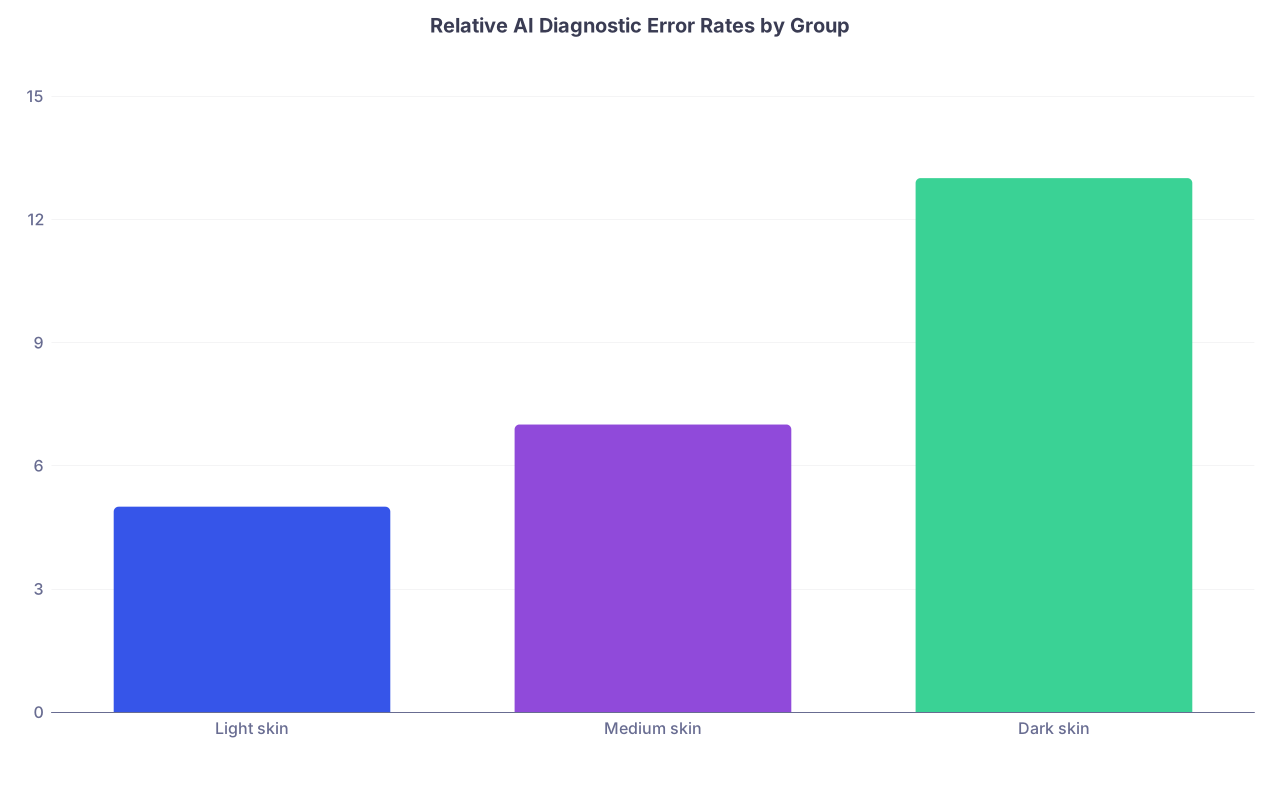
| Category | Value |
|---|---|
| Light skin | 5 |
| Medium skin | 7 |
| Dark skin | 13 |
The ethical problem is not just “the model is biased.” It is that you, as the clinician, may unknowingly amplify those biases:
- You trust the AI equally across all patients, even where its performance is weaker.
- You advocate less for certain patients because “the risk score is low.”
Justice demands that you:
- Ask for subgroup performance data before trusting the tool.
- Be extra cautious when using models in underrepresented groups.
- Be willing to override or discount the algorithm when your clinical read and contextual knowledge disagree—particularly in vulnerable populations.
3. Responsibility and Liability: When the Algorithm Is Wrong
Everyone loves to claim AI is “only a tool.” Until the lawsuit.
3.1 Clinician responsibility: You still own the decision
Right now, virtually every regulator and professional body lands on the same position: AI in diagnostics is assistive, not a replacement. That means:
- You cannot shift responsibility to “the system.”
- “The AI said so” is not a defense if you ignore clear clinical contradictions.
At the bedside, this translates to a simple rule:
If you would be uncomfortable defending a decision without mentioning the AI, you should not be comfortable making it because of the AI.
So:
- If the AI flags “low PE risk” but the patient looks like textbook PE, and you send them home anyway—you own that miss.
- If your discomfort is high, you are expected to override the AI, seek supervision, or do more workup.
3.2 Hospital and vendor liability: The invisible actors
Hospitals and vendors will try to distribute liability in contracts:
- Vendors: “We provide information, clinicians decide.”
- Hospitals: “Our staff are trained and licensed; they are responsible for clinical decisions.”
You will not see these contracts, but their existence affects how much the system is updated, how errors are reported, and whether there is any transparency when things go wrong.
From an ethics perspective:
- If a system is demonstrably unsafe or biased and the institution continues using it, the institution bears a moral (and likely legal) burden.
- If you know or suspect poor performance and continue blindly relying on it, you share that burden.
Some jurisdictions will slowly move toward shared liability models where:
- Developer responsibility: model design, training data quality, validation, post‑market surveillance.
- Healthcare organization responsibility: proper integration, governance, monitoring, and training.
- Clinician responsibility: individual use, critical judgment, informed use and override.
But for now, if you are standing by the bed, the legal crosshairs will be closer to you than to the server farm.
4. Explainability, Trust, and the Reality of Black Boxes
Ethicists love shouting “explainable AI.” Engineers roll their eyes. Clinicians are stuck in the middle.
4.1 What “explainable” often means in practice
Most bedside tools will offer some variety of:
- Highlighted regions on an image (“heat map” for pneumonia on CXR).
- Ranked feature importance (“lactate, HR, WBC contributed most to this risk score”).
- Short text justifications pre‑canned by the vendor.
Do not confuse these with genuine understanding. They are explanations for humans grafted onto systems that are fundamentally statistical.
You need enough transparency to:
- Know when the output is outside the training distribution (e.g., rare conditions, very young/old patients, pregnant patients).
- Identify obvious nonsense (e.g., heavily weighting race as a negative factor for a diagnosis in ways that do not make biological sense).
But you will not get a full causal story.
4.2 When lack of explanation is ethically unacceptable
There are settings where black‑box behavior is ethically intolerable:
- High‑stakes, irreversible decisions where the AI output is effectively determinative (e.g., denial of transplant candidacy, cessation of life‑sustaining therapy)
- Resource allocation affecting whole groups (e.g., ICU bed prioritization during a pandemic)
- Areas with strong historical discrimination (e.g., psychiatric risk prediction, criminal-justice-adjacent health decisions)
At the bedside, problem zones include:
- AI risk scores that determine who gets an echocardiogram or MRI when capacity is limited.
- Algorithms that gatekeep who is offered certain advanced therapies or referrals.
If the system is not transparent enough that you (and, in theory, a regulator or ethicist) can audit it, you should resist letting it be the final arbiter.
5. Practical Bedside Scenarios: How Ethics Actually Plays Out
Let me walk through a few situations you will actually face, and what ethically sane behavior looks like.
Scenario 1: The AI and the radiologist disagree
You are on ED call. CXR for a febrile patient with mild SOB.
- AI: “High probability left lower lobe pneumonia.”
- Night radiologist report: “No acute infiltrate. Mild basilar atelectasis.”
You look. Maybe you see something. Maybe you do not.
Ethically decent approach:
Acknowledge both sources:
“I have the AI suggesting pneumonia and the radiologist not seeing it. My read is X.”Consider clinical context:
If the patient has fever, productive cough, focal exam findings, you have more leeway to treat as pneumonia despite the radiologist.Document explicitly:
“AI CXR tool flagged possible LLL infiltrate; radiologist read clear. Given clinical context (fever, focal crackles), treating empirically for pneumonia with plan for reassessment.”
The point is not to bow to the AI. It is to integrate it as one input you can justify.
Scenario 2: The sepsis alert that everyone ignores
You are in a busy ward. The EHR sepsis alert fires constantly. Nurses are desensitized. Many patients flagged have no sepsis.
Non‑maleficence and justice are both in play here:
- Harm: dangerous alarm fatigue; real sepsis may get missed.
- Equity: some groups may be flagged more due to baseline lab/vital patterns, distorting attention.
Ethically reasonable stance:
- Do not pretend the alert is meaningless. If you are ignoring it, have a reasoned pattern: quick clinical scan, cross‑check vitals, and then consciously dismiss.
- Push your department to audit the system: flag rates vs true sepsis rates, subgroup analysis, outcome impact. If it is garbage, you have a duty to say so.
- Teach juniors how to respond to alerts without panic and without cynicism.
Scenario 3: The family asks, “Did the computer make this decision?”
ICU. Frail older adult with multi‑organ failure. You used a prognostic AI tool giving a grim mortality estimate. It nudged the team toward recommending limitation of aggressive interventions.
Son asks directly, “Did some computer decide my father is going to die?”
Bad answer:
“Sort of, yes, but we rely on it. It is quite accurate.”
Better answer:
“We use several tools that help estimate the chance of recovery, including one that looks at patterns in many previous cases with similar lab results and organ failures. It is not making decisions. We, as your father’s doctors, are. The tool is one piece of information, alongside our experience and what we know about him as a person. Ultimately, treatment decisions are guided by what he would have wanted.”
You are ethically obligated to own the recommendation as yours, not offload it to an algorithm.
6. Data, Privacy, and the Hidden Side of Diagnostic AI
You cannot talk ethics without acknowledging where these systems get their power: data. Mostly, patient data.
6.1 Secondary use of clinical data
Most AI diagnostic tools are trained on historical clinical data that patients did not explicitly consent to for AI development.
Depending on your jurisdiction, this may be legal if data are de‑identified. But “legal” is not always “ethical.”
Grey zones:
- Re‑identification risk when multiple datasets are combined.
- Commercialization: patient data used to build a proprietary model sold back to the hospital.
- Lack of transparency: patients have no idea this is happening.
At the bedside, you will not be asked about this. Yet you will be the visible face of a system built on their data.
It is reasonable, when asked, to say something like:
“Your medical records are sometimes used, usually in de‑identified form, to help create and improve tools that may benefit future patients. There are rules and oversight to reduce risk, but there is ongoing debate about how this should be done and how transparent we should be. If you have concerns, I can connect you with our data governance office.”
Anything less is just hand‑waving.
6.2 Data quality and garbage‑in, garbage‑out ethics
You know how messy clinical documentation is:
- Copy‑pasted notes.
- Wrong problem lists.
- Vitals documented late or inaccurately.
- Race and ethnicity coded crudely or incorrectly.
These are not just inconveniences. They are ethical vulnerabilities when fed into AI.
You cannot fix the entire EHR, but:
- Be precise when documenting key diagnostic data that you know feeds models (e.g., diagnosis codes, time of onset, critical events).
- Report obviously wrong model behavior; it is often a symptom of data quality issues upstream.
- Push back against being treated as free data-entry labor for algorithm optimization without adequate explanation or benefit.
7. Growing as a Clinician in an AI‑Rich Diagnostic World
Let us talk about you, not just the systems.
If you are in the “personal development and medical ethics” phase, your goal is not to become a machine learning engineer. Your goal is to be the kind of clinician who can practice well in this environment without being either naive or paralyzed.
7.1 Core competencies you actually need
I would argue you need competence in five domains:
| Domain | Concrete Skill Example |
|---|---|
| Basic AI literacy | Interpreting sensitivity/specificity |
| Critical appraisal | Questioning performance claims |
| Ethical reasoning | Applying principles to AI use |
| Communication | Explaining AI to patients/families |
| Governance awareness | Knowing local policies and escalation |
You should be able to:
- Read a performance table (AUROC, calibration, subgroup analysis) and ask, “Does this make sense for my population?”
- Spot marketing exaggeration immediately (“superhuman performance” is usually a red flag).
- Have a structured way to think, “Does using this here respect beneficence, non‑maleficence, autonomy, and justice?”
7.2 Building healthy skepticism without cynicism
Two bad attitudes are common among clinicians:
- Blind enthusiasm: “The AI is amazing. It catches stuff I would never see.”
- Reflexive rejection: “I do not trust computers. I am the doctor.”
Both are intellectually weak.
The middle path is:
- Treat AI as a second opinion that is fast, sometimes insightful, often shallow, occasionally dangerous.
- When it disagrees with you, be curious rather than submissive or dismissive. Why is it saying this? What data is it seeing that I am not—or vice versa?
- Collaborate with local ethics and data science teams to flag recurrent issues you see at the bedside.
7.3 Practical bedside checklist
When an AI diagnostic tool presents an output that could change management, ask yourself:
- Data fit: Does this patient resemble the population on which the model was trained and validated? (Age, comorbidities, setting, ethnicity.)
- Clinical coherence: Does the output fit with the story, exam, and my differential? Or is it wildly discordant?
- Stakes: If I follow this recommendation and it is wrong, what is the magnitude of harm? If I ignore it and it is right, what is the magnitude of harm?
- Alternatives: Could I get a human second opinion (radiologist, senior, specialist) in a reasonable timeframe?
- Communication: If I make this decision, can I explain it to the patient or family without hiding behind “the computer”?
If you cannot pass that checklist and still proceed purely because you feel pressured to “use the tool,” you are in ethically shaky territory.
8. Where This Is Going—and Your Role in Shaping It
We are early. Many of the current AI diagnostic tools are clunky, narrow, and poorly monitored post‑deployment. Yet the direction is clear: more integration, more automation, more subtle influence on bedside decisions.
You will see:
- AI‑first workflows: imaging pre‑read by AI, sorted, and routed before a radiologist sees them.
- Ambient AI “copilots” suggesting differentials and investigations as you click through the EHR.
- Outcome‑linked dashboards nudging you toward “high‑value pathways” that algorithms think reduce cost and length of stay.
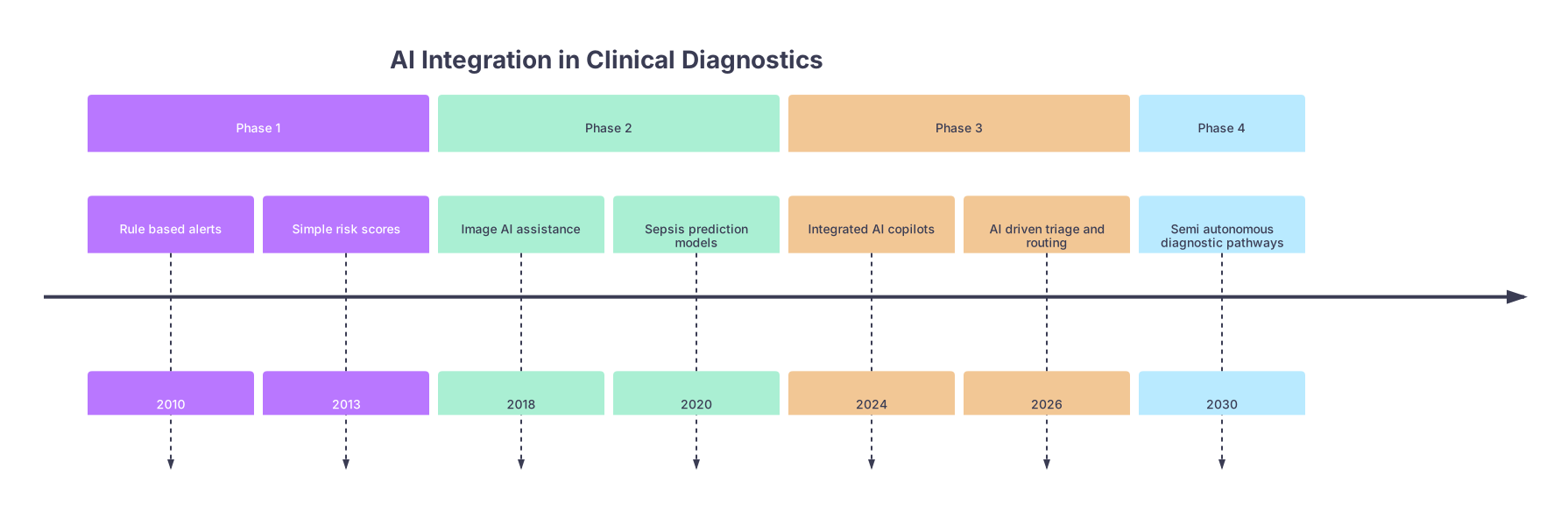
| Period | Event |
|---|---|
| Phase 1 - Rule based alerts | 2010 |
| Phase 1 - Simple risk scores | 2013 |
| Phase 2 - Image AI assistance | 2018 |
| Phase 2 - Sepsis prediction models | 2020 |
| Phase 3 - Integrated AI copilots | 2024 |
| Phase 3 - AI driven triage and routing | 2026 |
| Phase 4 - Semi autonomous diagnostic pathways | 2030 |
The ethical question is not “Will AI replace doctors?” It is: “What kind of doctors will we become in the presence of AI?”
You can drift into being a passive intermediary between the algorithm and the patient—explaining, apologizing, and signing orders.
Or you can deliberately develop into the clinician who:
- Understands where AI is strong and where it is brittle.
- Advocates for patients when the model is wrong, biased, or being misused.
- Pushes institutions toward transparent, just, and evidence‑based implementation.
- Teaches the next generation not just how to click, but how to think with and against AI.
The bedside is where this all gets real. The 2:15 a.m. sepsis call. The unclear CXR. The distressed family asking who, exactly, is making decisions.
If you build the habits and ethical reflexes now—questioning, explaining, documenting, sometimes resisting—you will not just survive that future. You will shape it.
With those foundations, the next step in your journey is learning how to bring these questions into your teams: morbidity and mortality conferences about AI‑influenced cases, curriculum proposals, quality improvement projects that actually measure algorithmic impact. That is where individual ethical awareness turns into collective change. And that is the work that is coming next.


