

What happens if a patient openly flirts with you… and you freeze, smile awkwardly, don’t shut it down perfectly, and then your attending or your school finds out?
Because that’s the nightmare, right? Not “a patient likes me.” It’s: “I handle this wrong and suddenly I’m the problem.”
Let’s go there. Because pretending this is rare or simple is how people get blindsided.
The fear you’re not saying out loud
You’re probably not actually asking, “What’s the ethical guideline on boundary crossings?”
You’re asking:
- What if I say the wrong thing and it looks like I encouraged it?
- What if the patient lies and says I flirted back?
- What if my school / residency believes them and I get written up, or worse?
- What if this goes on my record and follows me forever?
You’re imagining the worst version: patient starts flirting, you’re caught off guard, maybe you laugh nervously, maybe you don’t shut it down perfectly. Later, someone says, “The student seemed to like it,” and suddenly you’re in some professionalism meeting defending your facial expressions.
You’re not insane. That scenario actually happens. I’ve seen versions of it. Most of the time it doesn’t end in a career-ending disaster—but it can get messy, and the people who did best weren’t the ones who were perfect. They were the ones who documented and told someone early.
So let’s be blunt: you’re not going to handle every weird encounter like some perfectly scripted ethics video. You’re human. You’ll be surprised, embarrassed, maybe even flattered. The goal is not “never feel weird”; the goal is: protect yourself and your license-to-be.
Where the line actually is (and what’s non‑negotiable)
Strip away all the gray and here’s the bright red line:
You never start or entertain a romantic or sexual relationship with a current patient. Period.
If you remember nothing else, remember this: all the legal and ethical risk is stacked against the clinician, not the patient.
Even if:
- The patient is your age
- They’re “obviously joking”
- They say, “I know I shouldn’t, but you’re cute”
- You’re at a student-run free clinic, not a big hospital
- They “add you on Instagram” first
You’re the one in the position of power. The patient is the vulnerable party. Every ethics committee, every board, every lawyer will start from that assumption.
Here’s the part that makes people really anxious:
You can be completely innocent and still end up in trouble if it looks like you crossed the line or didn’t manage boundaries.
That’s why your strategy has to be less, “What’s morally pure?” and more, “What would this look like later, written in an incident report?”
Your internal question becomes:
“If a dean read a transcript of this encounter with zero context, how would it sound?”
Cold, but protective.
How to respond in the moment (even if you panic)
You probably won’t have a perfect scripted line. Your brain will be doing that “uhhhhhh” buffering thing. So you need a few phrases burned into your brain that you can pull out on autopilot.
Think of these as your emergency boundary scripts.
If a patient compliments your appearance in a normal way:
- “You look nice today.”
You: “Thank you. Let’s get back to how you’ve been feeling since last visit.”
That’s fine. Neutral, redirecting. Document nothing, move on.
If it’s more obviously flirty:
- “If all doctors looked like you, I’d come to clinic more often.”
You: “I appreciate the compliment, but it’s really important we keep this professional so I can take the best care of you. Let’s focus on your [symptom/concern].”
If they push further:
- “So you’re single? Maybe we should go out sometime.”
You: “I’m not able to have that kind of relationship with patients. My role here has to stay professional so I can be your doctor-in-training and part of your care team.”
Then you redirect back to medicine. The redirect is important. You’re showing: I recognized the boundary issue, I declined, I brought it back to care.
If they keep escalating or it starts to feel creepy or unsafe, you stop pretending it’s fine.
You can say:
- “I’m not comfortable with where this conversation is going. I’m going to step out and ask a member of the team to join us.”
Then you actually leave. You’re allowed to. You’re not required to sit and absorb boundary‑violating comments in silence because you’re “just a student.”
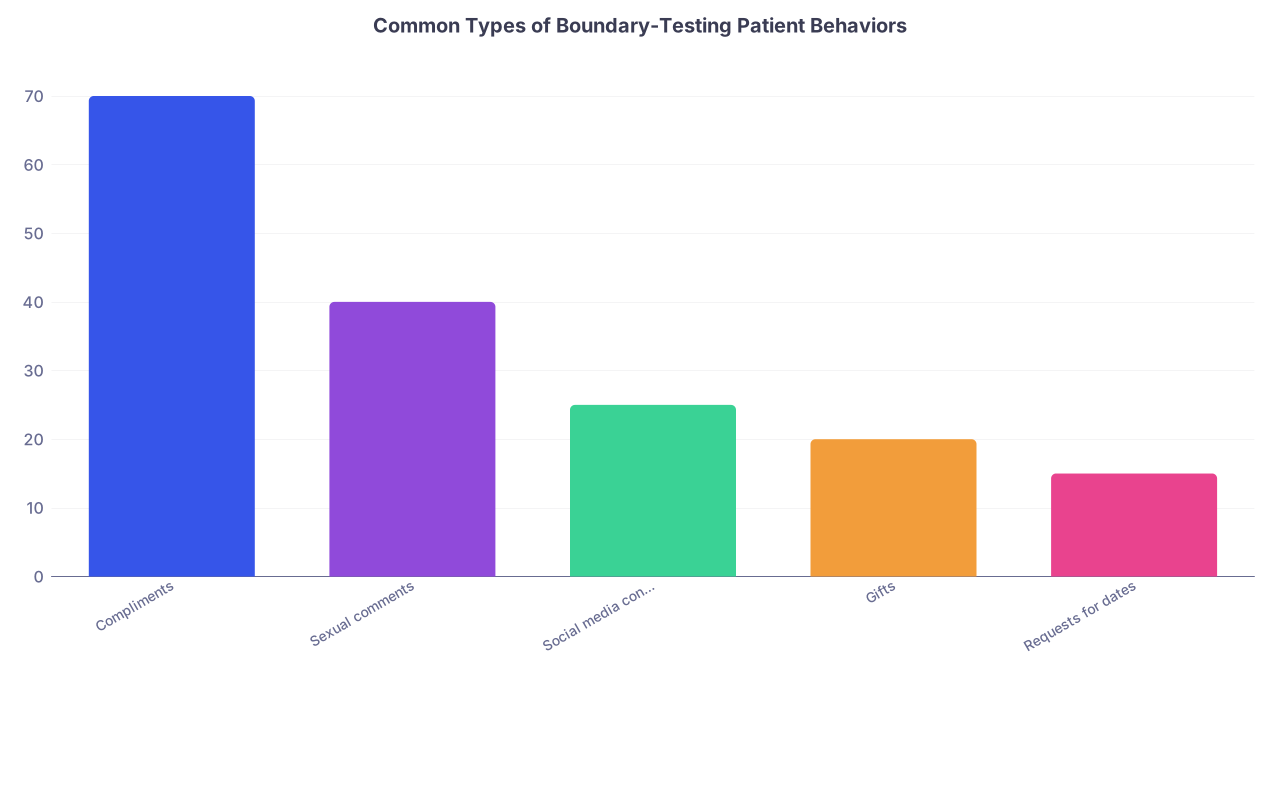
| Category | Value |
|---|---|
| Compliments | 70 |
| Sexual comments | 40 |
| Social media contact | 25 |
| Gifts | 20 |
| Requests for dates | 15 |
The part that actually protects you: what you do after
This is where anxious people either overreact (“I must report every awkward comment to the state board”) or underreact (“If I say anything, they’ll think I provoked it”).
Here’s the middle ground that actually protects you.
Step 1: Document the encounter for yourself
Right after the encounter, while it’s fresh, write down:
- Date, time, location
- Who was present
- What was said (actual phrases, not your feelings about them)
- What you said back
- That you redirected / set a boundary
- Whether you felt unsafe or just uncomfortable
This can be in a secure, private note (never on your phone’s Notes app with no lock; use something protected or hospital-approved if you’re charting). The point is: if anyone questions it later, you’re not relying on fuzzy memory.
If the comment was mild and you shut it down smoothly, you may not need to go further—but I still like having a note for any interaction that made my stomach drop.
Step 2: Tell someone with actual authority
This is where a lot of students sabotage themselves. They think, “If I say anything, I’ll look unprofessional or like I can’t handle patients.”
No. The exact opposite. The people who look the worst in hearings are the ones who kept it secret and only mentioned it once there’s a complaint.
You want a pattern like this:
- Patient flirts → You set boundary → You document → You quietly tell resident/attending/preceptor same day.
Something like:
“Hey, quick heads up about Mr. X in room 4—he made a couple of comments that were pretty flirtatious. I redirected and told him we have to keep it professional, but it made me uncomfortable. Just wanted you to know in case it happens again.”
Now if there’s ever a story later like, “The student encouraged me,” your supervising team can say, “Actually, the student told us at the time they were uncomfortable and that they had redirected the interaction.”
That’s gold. That’s how you don’t get hung out to dry.

| Step | Description |
|---|---|
| Step 1 | Patient makes flirty comment |
| Step 2 | Set boundary and redirect |
| Step 3 | Optional brief note for self |
| Step 4 | Monitor for repeat behavior |
| Step 5 | Set clear boundary and state discomfort |
| Step 6 | Step out if needed |
| Step 7 | Tell resident or attending |
| Step 8 | Document in chart if safety/professional risk |
| Step 9 | Consider chaperone or reassignment |
| Step 10 | Is it clearly inappropriate or repeated? |
But what if someone lies about me?
This is the worst-case scenario the anxious brain fixates on, so let’s hit it directly.
Yes, there are patients who misinterpret, project, or straight-up fabricate. It’s not common, but it happens. You cannot control that.
What you can control is whether they’re the only one with a story.
If you’ve:
- Used clear boundary language (“I can’t have that kind of relationship with patients”)
- Redirected to clinical care
- Documented your experience
- Told another member of the team
Then if something surfaces later, it looks like this:
- Patient: “The student flirted with me.”
- You: “Here’s my note from that day, here’s the language I used to set a boundary, and I informed Dr. X at the time.”
- Dr. X: “Yes, I remember them bringing that up and saying they were uncomfortable.”
Is it fun to be investigated? No. But with that pattern, you’re in infinitely better shape than “I never mentioned it and don’t remember exactly what they said, but I know I didn’t mean it like that.”
Ethics committees and professionalism panels are much kinder to “the person who brought up the issue early and tried to do the right thing” than to “the person who never said anything until they were cornered.”
You’re not trying to be perfect. You’re trying to be credible.
Legal and institutional realities (the part nobody spells out to students)
Here’s the uncomfortable truth: in almost every jurisdiction and every institution I’ve seen, the rules are written in a way that prioritizes:
- Patient safety
- Institutional liability
- Professional reputation of the hospital/school
Your feelings, comfort, and anxiety about being misunderstood are… way down the list. That’s not fair, but that’s how risk management thinks.
So you have to think like them if you want to be safe.
Translate your fear into their language:
- “I might get in trouble” → “This is a boundary issue that might put the institution at risk if it escalates.”
- “I’ll look weak if I ask for help” → “Bringing this forward early lets leadership intervene before there’s a complaint.”
- “Maybe I’m overreacting” → “If there’s any concern, it’s safer for everyone to add a chaperone or adjust staffing.”
Institutions love three things: documentation, early warning, and evidence that you tried to follow policy.
So when you:
- Ask for a chaperone with that patient next time
- Request to switch patients if you feel unsafe
- Mention patterns (“He’s made comments about my body three visits in a row”)
You’re not being dramatic. You’re doing exactly what legal and risk management would tell you to do if they were honest.
| Situation Example | Recommended Response Level |
|---|---|
| Single mild compliment, easily redirected | Internal note only, no escalation |
| Clear flirtation, you set boundary once | Tell resident/attending verbally |
| Repeated flirtation despite boundary setting | Tell team + document in chart |
| Sexualized comments / feeling unsafe | Leave room + report formally |
| Any allegation you flirted back | Immediate detailed documentation + formal report |
What about social media, gifts, and “small” stuff?
Your anxious brain might be spinning on all the side scenarios:
- “What if a patient finds my Instagram and DMs me?”
- “What if they bring me a small gift?”
- “What if they say they’re not really my patient, just here with family?”
Here’s the simple framework: would it look weird if someone read it in a disciplinary file?
- Patient: “I followed the student on Instagram and we DMed a lot.”
- Committee: “Why didn’t you shut that down and tell someone?”
So you:
If they DM you:
- Do not reply normally.
- You can ignore or, if you respond, keep it formal: “I use this account for personal use only and can’t communicate with patients here. Please contact the clinic if you need medical help.” Then block.
- Screenshot and tell your supervisor.
If they offer gifts:
- Check your institution’s policy. Many places allow small tokens (like a card or candy for the team) but not personal gifts.
- Safest default as a trainee: “Thank you, that’s very kind, but I’m not allowed to accept personal gifts. I can see if the team can accept this for the unit.”
If they say things like, “You can’t get in trouble, I’m technically not your patient”:
Huge red flag. Anyone pre‑lawyering your relationship is dangerous for you. Treat them as if they’re absolutely your patient. Which, functionally, they are.

Protecting future-you, not just present-you
Here’s the part you’ll only really feel years later: your future self will not care if you “overreacted” to a boundary violation. They will care deeply if you underreacted and it became a professionalism case.
Future-you, applying for residency/fellowship/privileges, wants to answer on forms:
- “Have you ever been subject to disciplinary action?” → No.
- “Have you ever been investigated for boundary violations?” → No.
Every weird encounter with a flirty or inappropriate patient is ultimately about protecting that future checkbox.
So if you’re sitting there thinking, “I don’t want to make it a big deal,” ask:
Will I still think it’s “not a big deal” if this is the patient who later says I did something inappropriate?
If the answer is no, then yeah, you escalate. You document. You tell someone.
You don’t need to be fearless. You just need to be a little more afraid of hidden, unspoken risk than of awkward conversations with your senior.
Years from now, you won’t remember which patient called you cute or who joked about marrying their doctor. You’ll remember whether you built a habit of quietly protecting yourself when things felt off.
FAQ (exactly 5 questions)
1. What if I laughed or smiled when the patient flirted—does that mean I already messed up?
No. You’re human. People nervously laugh when they’re uncomfortable; everyone in medicine knows that. One awkward reaction doesn’t doom you. What matters is what you did after that moment. If you redirected, set a boundary, and especially if you told someone later, you’re fine. If it’s still bothering you, you can even bring it up to your attending as, “I think I handled that awkwardly; here’s what happened,” which actually makes you look more professional, not less.
2. Should I document flirtatious behavior in the actual medical chart or just my private notes?
If it’s a one-time, mild comment that you easily shut down, private notes are usually enough. But if the behavior is repeated, clearly sexual, or makes you feel unsafe, it’s reasonable—and often wise—to document in the chart in neutral language, e.g., “Patient made personal comments toward student; boundary was set and visit continued with attending present.” Do not editorialize. Keep it factual. Always let your attending know you’re considering chart documentation and ask how they want it handled.
3. Can I get in trouble for asking to be reassigned from a patient who keeps flirting or making sexual comments?
You might worry people will think you’re “too sensitive,” but no, you shouldn’t get in trouble for protecting your boundaries and safety. What’s more likely is you’ll be quietly respected for recognizing a problematic dynamic. Frame it as, “Given the repeated boundary issues, I’m concerned this relationship isn’t therapeutic anymore. I think it might be better for the patient and for me if someone else takes over.” That language is defensible and focused on care, not your personal discomfort (even though that matters too).
4. What if my attending dismisses it and says, ‘That’s just how some patients are; ignore it’?
That happens. Some older clinicians normalize behavior they absolutely shouldn’t. You don’t have to accept that as the final word. You can escalate sideways or up: talk to a chief resident, clerkship director, program director, or student affairs. You can say, “I mentioned this to Dr. X, but I still feel uncomfortable and unsafe, and I’m not sure the current plan addresses it.” Once the words “unsafe” and “boundary concern” are in the air, most sane institutions take it more seriously.
5. Could a single patient complaint about me and ‘flirting’ ruin my career?
It’s vanishingly rare for one unsupported complaint—especially against someone who documented, set boundaries, and reported early—to destroy a career. What ruins people are patterns and cover-ups: repeated problems, clear evidence of unprofessional behavior, or hiding things until the institution discovers them from the patient instead. If you’re anxious, use that anxiety productively: document, tell someone quickly, and make your behavior so clean and consistent that, if anyone ever reads it back, it tells a story of a trainee doing their best to stay professional in a messy situation. That’s how you protect future-you, not just survive today.


