

The hype around “breakthrough” cancer drugs is out of control—and if you do not manage it deliberately, it will manage you.
Oncologists are getting crushed between industry marketing, social media miracles, sensational headlines, and families who arrive convinced that one specific drug will save everything. You know the data. They know the tagline. Guess who they trust more when they are terrified and desperate.
You need a system. Not more empathy platitudes. A repeatable way to handle the “miracle drug” conversation so you protect:
- Your patient’s hope
- Their autonomy
- Your integrity
Here is how to fix it.
1. Recognize the Forces Driving Unrealistic Expectations
Before you try to “educate,” you had better understand what you are up against. This is not just confusion. It is a full ecosystem pushing magical thinking.
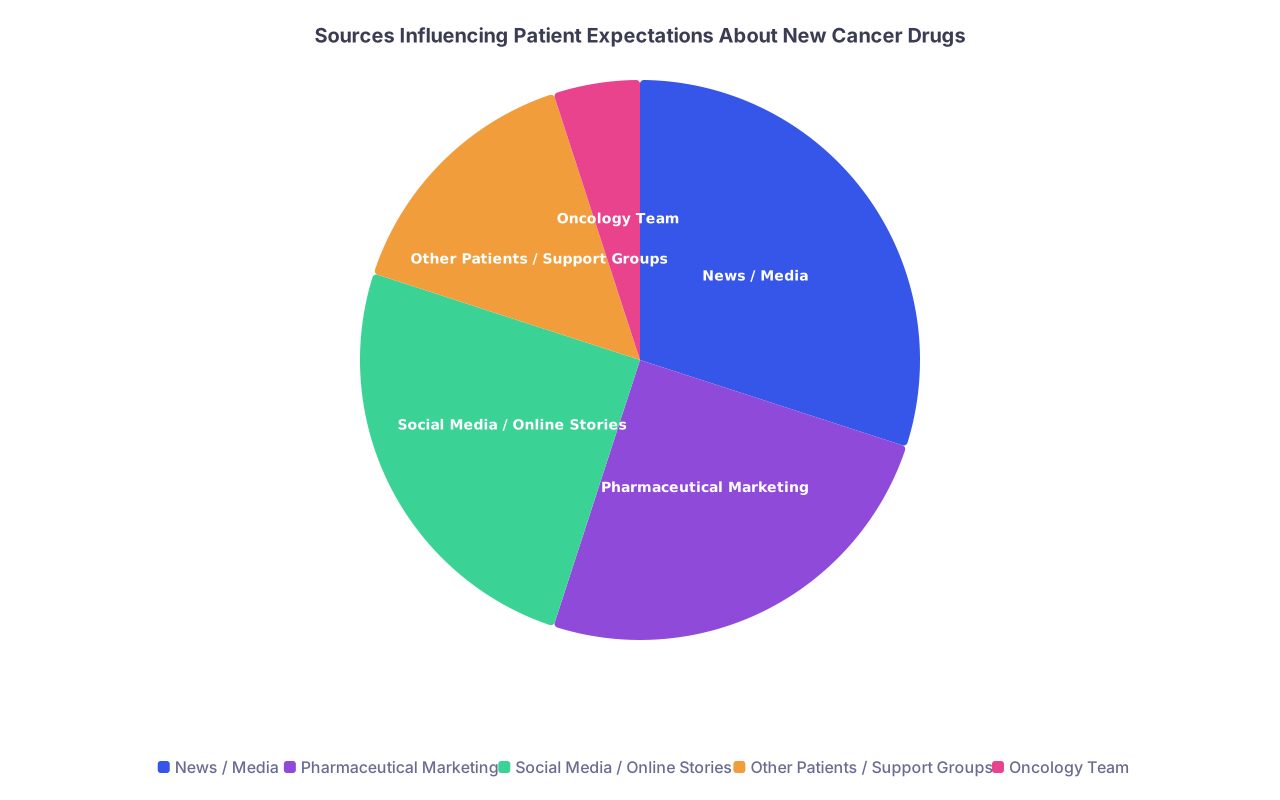
| Category | Value |
|---|---|
| News / Media | 30 |
| Pharmaceutical Marketing | 25 |
| Social Media / Online Stories | 25 |
| Other Patients / Support Groups | 15 |
| Oncology Team | 5 |
Here is the core problem: by the time patients reach you, their mental model of a “breakthrough” drug is usually this:
- Works dramatically
- Works fast
- Works for almost everyone
- Fixes the cancer without major toxicity
Reality, of course, looks more like:
- Small absolute survival benefit
- Specific niche indication
- Modest response rates
- Non-trivial side effects and financial toxicity
Three common distortion channels you need to assume are active in almost every new-therapy encounter:
Headlines and health journalism
- “Game-changing pill doubles survival”
- Based on: relative risk reduction, cherry-picked subgroup, or secondary endpoint.
- Patients do not parse hazard ratios. They hear “double survival = I will live twice as long.”
Anecdote inflation (especially online)
- Facebook group: “My uncle had Stage IV and is NED after Drug X!!”
- Patients over-weight single miracle stories and under-weight base rates. That is just how human cognition works.
Hopeful framing by industry
- Direct-to-consumer ads, glossy patient brochures, “Ask your doctor about…”
- Formal language about risks, but emotionally dominant images of people hiking, hugging grandkids, “getting their life back.”
Do not waste time being annoyed by this. Assume it. Build your communication approach to counterbalance it.
2. Use a Structured Conversation Framework (So You Do Not Wing It)
If you handle every “new drug” conversation ad hoc, you will burn out and miss key pieces. You need a consistent script skeleton that you adjust per patient.
Here is a simple 6-step framework that works in oncology clinics, tumor boards, and even rushed inpatient consults.

| Step | Description |
|---|---|
| Step 1 | Patient asks about new drug |
| Step 2 | Explore understanding and goals |
| Step 3 | Briefly explain what drug is and who it helps |
| Step 4 | Give clear numbers on benefits and limits |
| Step 5 | Discuss side effects, logistics, and costs |
| Step 6 | Align with patient values and propose recommendation |
| Step 7 | Summarize, check understanding, plan next steps |
Step 1: Start with what they think and what they want
Do not open with a lecture. You will be talking past them.
Use questions like:
- “Tell me what you have heard about this drug.”
- “What are you hoping this treatment could do for you?”
- “What worries you most if we do not use this drug?”
Then listen. Not politely-waiting-to-speak. Actually listen.
You are trying to identify:
- Misconceptions (e.g., “I heard it cures this type of cancer”)
- Hidden goals (“I just need to make it to my daughter’s wedding in six months”)
- Non-medical drivers (family pressure, religious beliefs, past trauma with chemo)
Summarize back in one or two lines:
- “So you have read that this drug is a new option that might shrink the cancer, and your hope is that it could give you more good-quality time with your family. Is that right?”
Step 2: Define the drug in one plain-language sentence
If you start with pathways and targets, you lose them.
Use a formula:
“This is a newer type of cancer treatment that works by [very short mechanism], and it is mainly helpful for people with [specific biomarker / stage / prior treatment history].”
Examples:
- “This drug is an immunotherapy that helps your own immune system recognize and attack cancer cells, and it tends to help a subset of people whose tumors express a certain marker.”
- “This is a targeted pill that blocks a specific mutation inside the cancer cells. It only works when the tumor has that mutation.”
Then immediately connect to them:
- “In your case, we have / have not found that marker yet.”
- “Your cancer does / does not have the mutation that this drug attacks.”
Step 3: Put the benefit into concrete, honest numbers
This is where most clinicians fail. They say “improves survival” or “reasonable chance of response.” That is not enough. Patients will fill in the gap with fantasy.
You want:
- Absolute benefits
- Time frames
- Best-case, worst-case, and typical expectations
Keep it simple:
“In studies, out of 100 people like you who took this drug:
• About 30 had their tumors shrink
• About 40 had the cancer stay about the same for a while
• The rest did not have a meaningful benefit”“On average, this drug added about 3–4 extra months of life for people in your situation. Some had more, some had less.”
Avoid:
- Raw hazard ratios without translation
- Vague words like “significant” or “robust”
You are not defending a grant. You are aligning expectations.
3. Side Effects, Logistics, and Money: Say the Quiet Parts Out Loud
Patients do not only overestimate benefit. They underestimate everything else.
Toxicity: avoid both sugar-coating and horror stories
Patients have usually been primed to think “breakthrough = fewer side effects.” Sometimes true. Often not.
Use a layered approach:
Start high level:
- “Most people notice side effects. For some it is mild and manageable; for others it is rough enough that we have to stop or adjust the dose.”
List the 3–4 most common or serious issues for that person:
- “For you, the big ones I worry about are fatigue, diarrhea, and inflammation in the lungs.”
Give a realistic probability sense:
- “Roughly 1 out of 10 people on this drug can have a lung inflammation that is serious enough to need steroids or even hospitalization.”
Always flag “early call” symptoms:
- “If you notice new shortness of breath, new cough, or fever, that is not a ‘wait and see’ thing. That is call-us-the-same-day.”
Family members forget 80 percent of what you say once the word “cancer” hits. Write the red-flag symptoms on paper or in the AVS. Circle them.
Logistics: explain the work involved
Breakthrough drug ≠ magic pill. It often means:
- Frequent labs and scans
- Infusion days
- Monitoring for immune or targeted toxicities
- Co-ordination across disciplines
Spell it out:
- “If we start this, the first two months involve a visit every two weeks for bloodwork and to see how you are tolerating it. After that, if things are stable, we usually stretch to monthly. CT scans about every 2–3 months.”
Some patients will say yes to anything in the abstract and then crumble when infusion days collide with work, childcare, or a 90-minute drive each way. Better to surface that early.
Financial toxicity: if you avoid it, you are abandoning them
I have watched patients sign up for a “breakthrough” oral therapy, appear relieved, then quietly stop after two months because the copay was wrecking their finances. Nobody had the stomach to talk numbers up front.
You do not need to be a billing expert. But you must:
Name the issue:
“This drug can be very expensive. Insurance coverage and copays vary a lot, so we always check before starting.”Normalize financial questions:
“If the cost turns out to be too high, that is not a failure on your part. It is a reality we deal with together. There are assistance programs and sometimes good alternatives.”
Then link them proactively:
- To a financial counselor / social worker
- To manufacturer assistance programs
- To foundation-based grants where applicable
| Domain | Minimum You Must Address |
|---|---|
| Mechanism | Simple one-line explanation |
| Eligibility | Why it may or may not fit this patient |
| Benefit | Absolute numbers, not just “better” |
| Toxicity | Most likely and most serious side effects |
| Logistics | Visit frequency, labs, scans, duration |
| Financial | Potential cost and support resources |
4. Protect Hope Without Lying: How to Talk About Prognosis and Uncertainty
Here is the ethical tightrope:
- Over-promise, and you steal informed consent.
- Crush hope, and you steal meaning from the time they have.
You have to get comfortable in the middle.
Use “hope for X, prepare for Y” framing
Patients can hold two truths at once if you help them.
Example:
- “My hope is that this drug will shrink the cancer and give you more good-quality time. At the same time, I would be doing you a disservice if I did not tell you that sometimes it does not work, or it works only for a short time. So we plan for both possibilities.”
This explicitly licenses them to:
- Feel hopeful
- Make practical plans (wills, family discussions, bucket list items)
Translate statistics into personal terms without pretending certainty
You do not know exactly how long they will live. They know you do not know. What they want is a range and a sense of where they probably fall.
Try:
- “For people in your situation who take this drug, many live in the range of [X to Y] months.
A smaller group lives longer.
A smaller group, unfortunately, has a more aggressive course and lives less.”
Then ask:
- “Do you want more detail about numbers or prefer to keep this more general?”
Respect the answer. Not everybody wants the same level of granularity. But everybody deserves the offer.
5. When the Patient Demands a Drug You Do Not Recommend
This is where ethics and practical reality collide. You will get:
- “I saw on YouTube that Keytruda cures Stage IV. I want that.”
- “My cousin in another state is on Drug X. Why are you refusing me the same chance?”
- “If you do not give it to me, we will find someone who will.”
You cannot simply cave. But you also cannot just say “No, not indicated” and walk out. Here is a protocol that works.
Step 1: Name the conflict explicitly, respectfully
- “I can see how strongly you feel about trying this drug. My concern is that, given what we know about your cancer, it is very unlikely to help and has real risks.”
Step 2: Make your reasoning transparent in plain language
- “This particular immunotherapy works best when the cancer has a marker called PD-L1 at a certain level, or a feature called MSI-high. We have checked your tumor, and it does not have those features. In all the studies we have, people without those markers had very little benefit and still had the side effects.”
If possible, compare with an option you do recommend:
- “Right now, the treatment that actually gives you the highest chance of living longer and feeling better is [recommended regimen]. I am recommending that because of [reason: response rate, survival, symptom relief].”
Step 3: Offer a conditional “if–then” path when ethical
Sometimes you can channel the demand into a measured plan:
- “If we start with the standard treatment that we know has benefit, and later the disease grows, then at that time we can reconsider clinical trials or immunotherapy options, depending on your performance status.”
Or:
- “If you are very committed to trying a PD-1 inhibitor despite the low chance of help, we can explore clinical trial options where it is studied in your situation. I would feel more comfortable doing this in a research setting than as off-label monotherapy.”
Step 4: Maintain relational respect even if you decline
There are times you should say no. Wrong indication, clear harm, or gross misalignment with any standard of care.
When that happens:
- “I am not willing to prescribe this drug for you because I believe it would expose you to harm with almost no chance of benefit. That would go against my responsibility to you as your doctor.”
Then immediately pivot:
- “However, I respect your right to seek another opinion. If you would like, I can provide your records and suggest another center where you can talk with someone else.”
This does two things:
- Preserves your integrity
- Treats them as an autonomous adult, not a disobedient child
6. Use Visual and Written Tools So the Conversation Actually Sticks
Spoken words vanish. Anxiety and chemo brain accelerate forgetfulness. You need artifacts—things that stay after they leave the room.
Simple visual aids beat dense handouts
You do not need glossy pharma brochures. In fact, avoid them as your main educational tool; they are marketing, not neutral education.
Use low-tech visuals:
- Draw a quick bar chart of “100 people like you” on a blank sheet and block out those who benefit vs do not.
- Sketch a timeline with “today,” “scan in 3 months,” “re-evaluation,” and possible paths.
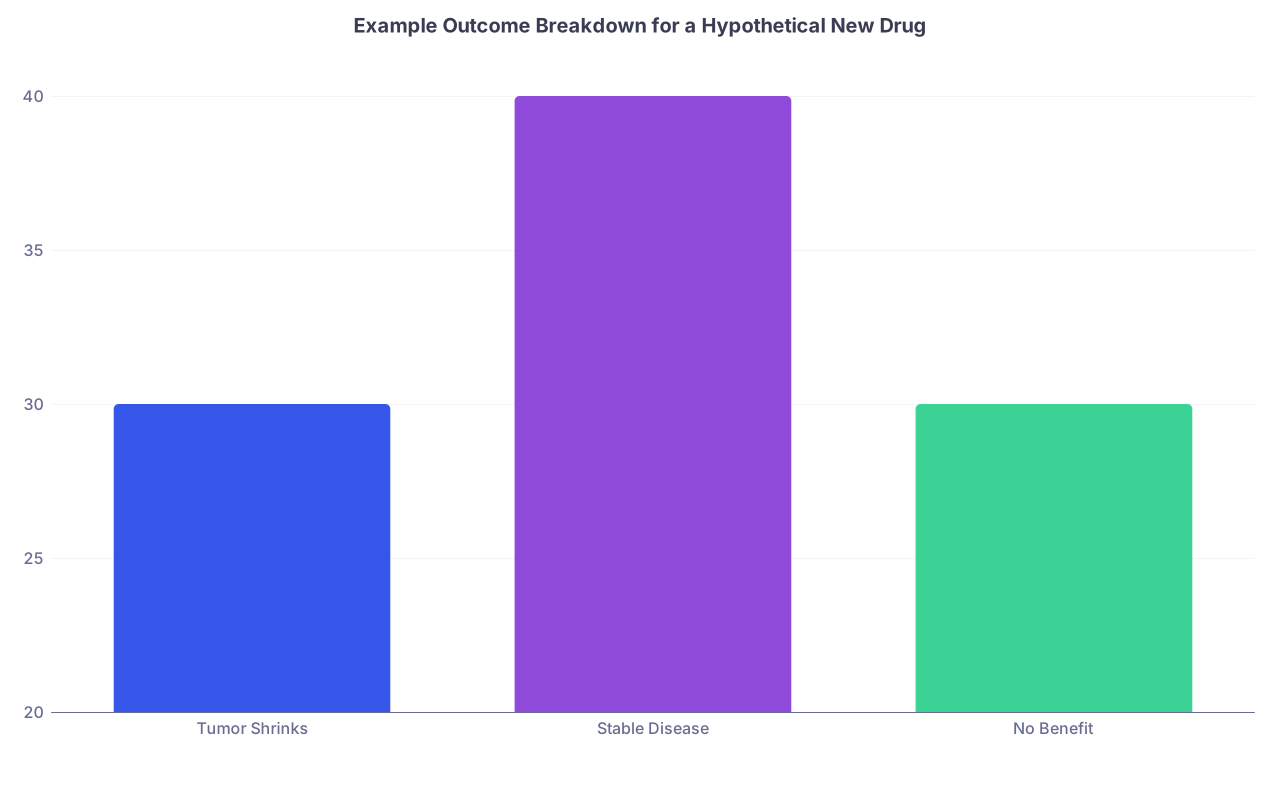
| Category | Value |
|---|---|
| Tumor Shrinks | 30 |
| Stable Disease | 40 |
| No Benefit | 30 |
Patients remember shapes and proportions more than phrases like “modest benefit.”
Personalized one-page summary
Create a standard template in your EMR or as a clinic handout. Something like:
Treatment Option: [Drug name]
- Why it might help you:
- Why it might not work:
- Likely benefits (numbers if available):
- Main side effects to watch for:
- Plan for monitoring (visits, scans):
- What we will do if it is not working:
Then fill it out with the patient during the visit. Hand them a copy. Scan it into the chart.
That document becomes:
- A reality check for family members who were not present
- A reference when anxiety distorts memory at 2 a.m.
7. Protect Yourself: Emotional Boundaries and Ethical Clarity
You are not a robot. Being the person who repeatedly says, “This drug will not save you” is corrosive if you do not build internal structure around it.
Separate responsibility for disease from responsibility for honesty
You did not cause their cancer. You did not design the drug. Your job is to:
- Present realistic options
- Align them with the patient’s values
- Avoid interventions that are all burden and no benefit
When a family accuses you of “giving up” because you will not offer a sexy new therapy, mentally repeat:
- “Offering treatments supported by evidence and aligned with your goals is my duty. Saying no to harmful fantasy is part of that duty.”
Use team support deliberately
Cases with huge expectation gaps can wear you down. Do not carry them alone.
- Discuss in tumor board: get group consensus on what is reasonable.
- Loop in palliative care early: not as “end-of-life,” but as co-managers of complex decisions and hope realism.
- Debrief with colleagues: the 5-minute “I just had to tell a 42-year-old that…” conversation is not gossip, it is psychological PPE.

8. Turn This Into a Habit: A Practical Implementation Checklist
If you want this to stick, you need more than good intentions. You need habits and systems.
Here is a practical 8-point checklist you can run mentally (or build into your note template) for any “breakthrough” drug conversation:
- Did I ask what the patient has heard and what they hope for?
- Did I explain in one sentence what the drug is and who it helps?
- Did I give absolute numbers for likely benefit?
- Did I name the 3–4 most relevant side effects and give a sense of how often they occur?
- Did I describe the treatment logistics (visits, labs, scans, duration)?
- Did I acknowledge financial issues and offer resources if needed?
- Did I align the plan with the patient’s stated goals (more time, fewer hospital days, symptom relief, legacy planning)?
- Did I provide something written or visual for them to take home?
Run this for a month. Your conversations will shift from chaotic one-offs to a consistent, ethical practice that patients and families start to trust.

FAQs
1. What if a patient refuses standard therapy and wants only an experimental or “breakthrough” drug?
First, clarify their reasoning. Sometimes “I only want the new drug” really means “I am terrified of chemo” or “My father died on chemo and I will not go through that.” Name that:
- “It sounds like a lot of your reluctance about standard treatment comes from what you saw your father go through. Let us talk specifically about how your situation is similar and how it is different.”
Then lay out options transparently:
- Standard therapy with known benefit
- Clinical trial options, if appropriate
- What “no active treatment” looks like, including palliative care support
Use a values-based frame:
- “Given that your top priorities are [avoiding hospitalization / staying clear-headed / maximizing time], here is how each option lines up with those goals.”
If after fully informed discussion they still decline standard therapy, document the conversation clearly, respect their autonomy, and continue to offer supportive and palliative care. Declining chemo does not mean they lose access to you or to symptom management.
2. How do I handle family members who push aggressively for every new drug when the patient is exhausted or ambivalent?
Your job is to center the patient, not the loudest relative. Start by checking in directly with the patient, even if family is present:
- “I hear your family is very eager to try more treatments. Before we get into details, I want to ask you: how do you feel about continuing treatment versus focusing more on comfort right now?”
If the patient seems hesitant to speak honestly in front of family, ask for a brief one-on-one conversation:
- “Would it be alright if I spent a few minutes talking with you alone, and then we bring your family back in to discuss together?”
Then, with family:
- Validate their fear: “I can see how much you care about her and how hard it is to think of not doing everything possible.”
- Reframe “everything”: “Sometimes doing everything includes protecting her from treatments that are very unlikely to help and very likely to make her feel worse.”
Anchor to the patient’s stated goals:
- “She has told me that being at home and avoiding hospital stays is her top priority. That goal means some of these very aggressive treatments are actually the opposite of what she wants.”
Stay calm, repeat the core message, and do not let emotional pressure from family push you into offering a drug that is more burden than benefit. Your ethical duty is to the patient’s interests, even when that conflicts with family demands.
Key takeaways:
- Do not wing the “breakthrough drug” conversation; use a structured, repeatable framework that covers mechanism, eligibility, benefit, harm, logistics, and cost.
- Protect both hope and honesty by using concrete numbers, values-based recommendations, and clear boundaries when a requested therapy is inappropriate.
- Turn this into a clinic habit—visual aids, one-page summaries, and a simple checklist will keep expectations grounded without killing the hope your patients need to keep going.


