

Conflict on a mission team is not a sign that your team is broken; it is a sign that your work actually matters. High-stakes, cross-cultural medicine without conflict? That is fantasy.
The real question is whether your team has a framework for handling disputes or just survives each blow‑up and moves on, a little more fractured every time.
Let me give you the framework.
The Reality of Conflict on Mission Teams
Mission teams are conflict machines. You combine:
- Different cultures
- Different sending organizations
- Power gradients (surgeon vs nurse, foreign vs local, long‑term vs short‑term)
- Vague authority lines
- Exhaustion and moral pressure (“we’re here for Jesus / for the poor, why are you complaining?”)
You end up with predictable patterns:
- The visiting anesthesiologist furious that the OR nurse “ignored sterile technique”
- The local clinical officer offended that a visiting resident overrode his plan in front of patients
- The team lead blindsided because two team members did not speak for three days and then both emailed the board afterward
- The “hero doctor” doing unsafe volume while others quietly resent and enable it
If you do not handle this deliberately, you drift into one of two bad models:
- Peace‑faking – Smiling, spiritual language, while resentment calcifies.
- Peace‑breaking – Passive‑aggressive comments, gossip, or open blow‑ups that damage witness and patient care.
You need a third way: peace‑making. That is an active, structured approach.
A Simple, Non‑Negotiable Framework: 4 Levels of Conflict
Use this as your backbone. Every dispute on a mission team should be handled at the lowest level that is safe and effective.
| Level | Who Is Involved | When To Use |
|---|---|---|
| 1 | Person-to-person | Minor issues, misunderstandings |
| 2 | Add a trusted third | Repeated or unresolved tensions |
| 3 | Formal leadership step | Safety, ethics, power issues |
| 4 | Organizational process | Serious harm, legal/ethical breaches |
If your team does not already have this written down, print it and stick it on the wall of the team house. I am not joking.
Let us walk through each level, with exact scripts and steps you can use tomorrow.
Level 1: Direct Conversation – The 24‑Hour Rule
Most disputes on mission teams should die at Level 1. That means:
- No triangulating
- No “pray requests” that are really gossip
- No storing anger for the flight home and writing a 6‑page report
Protocol: The 24‑Hour Rule
If something bothers you enough that you are replaying it in your head, you address it within 24 hours, unless immediate patient care or sleep makes that impossible.
Step 1: Check yourself first (10–15 minutes)
You do this before you open your mouth.
Ask three blunt questions:
Is this about patient safety / ethics, or about my ego / preferences?
- Safety/ethics → Non‑negotiable to address.
- Ego/preferences → Still may need addressing, but with more humility.
What exactly happened, in one sentence, without adjectives?
- Bad: “She was so disrespectful and careless.”
- Better: “During the C‑section, she leaned over the sterile field with a non‑sterile phone.”
What do I actually want to change?
- Specific behavior?
- Communication pattern?
- Clarification of roles?
If you cannot answer question 3, you are not ready for the conversation. You are venting.
Step 2: Use a clear starter script
Mission teams are usually tired, cross‑cultural, and pressed for time. You do not have the luxury of a perfect conversation. You need something short and workable.
Use a simple three‑part script:
- “When you did/said X…”
- “I felt/was concerned about Y…”
- “Could we talk about how to handle Z going forward?”
Concrete example:
“When we were in the ward round and you corrected my treatment plan in front of the family, I felt undermined and worried it confused them about who is responsible for the patient. Could we talk about how to handle disagreements about plans in the future?”
Another:
“When you photographed the patient in the dressing change without asking her directly, I was concerned about consent and dignity. Could we talk about how we want to handle patient photography on this trip?”
That structure keeps you grounded in behavior, impact, and future.
Step 3: Choose time and place that do not sabotage you
- Not in front of patients
- Not in a crowded team van
- Not at midnight when you are both post‑call zombies
Aim for:
- Short, private, neutral location (clinic courtyard bench, quiet corner of guesthouse dining area)
- Clear time boundary: “Do you have 10 minutes after lunch to talk about something from this morning?”
Step 4: Listen like you might be wrong
If you go into this to “win,” you will lose the team.
When they respond:
- Do not interrupt their first 2–3 minutes. Let them get the story out.
- Clarify facts: “So from your side, it felt like I was ignoring the local protocol?”
- Look for misaligned assumptions, especially cross‑culturally:
- Different hospital norms
- Different understanding of who “owns” the patient
- Different expectations of hierarchy
Often, Level 1 conflict is 95% misunderstanding, 5% real disagreement. Sort those two piles.
Step 5: End with a concrete micro‑agreement
You are not drafting a treaty. You are locking in one small, forward‑looking change.
Examples:
- “Next time we disagree during ward round, let us step aside after and settle it there.”
- “For photos, we both ask patients directly through the interpreter and never assume family consent is enough.”
- “If either of us is worried about the other’s technique, we ask first: ‘Can I share an observation from my training?’”
If you walk away with no change, you will be right back here next week.
Level 2: Add a Third Person – Before It Gets Toxic
When Level 1 is not enough, you escalate carefully, not dramatically.
When do you move to Level 2?
- You have had one or two direct conversations and the pattern continues
- The other person refuses to meet or dismisses your concern entirely
- You sense the conflict is starting to affect other team members or patients
Note: You are not going behind their back. You invite them into a three‑way conversation.
Step 1: Pick the right third person
Criteria:
- Respected by both of you (or at least neutral)
- Understands the mission context and local culture
- Has enough authority to influence, but not so much that everyone goes silent
Possible candidates:
- Long‑term missionary physician
- Local senior nurse or matron
- Team lead who is not directly involved in the incident
Avoid:
- Your close friend on the team (they will look biased)
- Someone who already dislikes the other person
- Someone who treats all conflict as “sin” and just says “forgive each other” without engaging facts
Step 2: How to invite them in
You say to the other person something like:
“We have gone back and forth about the OR protocols a couple of times and I do not think we are landing well. Would you be open to sitting down with [Name], since they know the local system and our sending organization? I would like a fresh set of eyes.”
If they say no and the issue is about patient safety or ethics, you still move forward. You inform them:
“I respect your view. Because I am still worried about safety here, I am going to ask [Name] to help us think it through. You are welcome to join that conversation.”
Step 3: Structure the three‑way conversation
Keep it tight:
Brief facts from each side, without interruption (3–5 minutes each).
Third person reflects back: “Here is what I am hearing from both of you…”
Identify:
- What is factual?
- What is cultural / expectation mismatch?
- What is ethical / safety?
Agree on:
- Clear behavioral changes
- How and when to review if it is working
Use questions like:
- “What can each of you change this week that is realistic?”
- “What would ‘good’ look like on the next ward round?”
- “Is there a written protocol we should actually follow instead of reinventing this?”
Level 3: Leadership Intervention – For Serious or Stubborn Problems
This is where many mission teams fall apart because there is no defined process. Leadership either ignores the conflict or comes down randomly and severely.
You need a pre‑agreed structure for when leadership steps in.
Typical triggers:
- Repeated disregard for safety protocols (e.g., reusing single‑use equipment dangerously)
- Ethical violations (e.g., performing procedures beyond scope and hiding it)
- Systematic disrespect of local staff or cultural arrogance
- Harassment, bullying, or abusive behavior
- Refusal to follow clearly explained team policies (e.g., photo policy, medication distribution)
At this point, it is not “a disagreement.” It is a performance / conduct issue.
Step 1: Separate urgent safety from process
If a behavior is immediately unsafe:
- You intervene in real time: “Stop. This is not safe. We will talk after.”
- You stabilize the clinical situation.
- Then you move deliberately into a leadership conversation the same day if possible.
Do not hide behind conflict‑avoidance when patients are at risk.
Step 2: Leadership conversation format
Two leaders in the room if possible:
- One with direct authority (team leader, medical director)
- One observer / support (HR, senior local staff, elder from sending organization)
Outline:
- State the purpose: “We are meeting because there are ongoing concerns about X behavior and its impact on patient care / the team.”
- Describe specific incidents, not vague impressions:
- Dates, locations, what was done/said, who was present
- State why it matters:
- Link to patient safety, ethics, witness, local relationships
- Invite response (but keep it focused)
- “What is your perspective on these events?”
- Clarify expectations going forward:
- Concrete, observable, time‑bound
- Explain consequences if behavior continues
- Up to removal from certain duties or early return home
Write it down. Both parties sign an acknowledgment of the discussion and expectations. This is not bureaucratic. It is protection for patients, the team, and the person being corrected.
Level 4: Organizational Process – When Things Are Seriously Wrong
Sometimes you hit issues that go beyond “team conflict”:
- Sexual misconduct
- Financial misconduct
- Falsifying credentials
- Systematic abuse of local staff or patients
- Serious clinical negligence with harm
At this point, you are in formal investigation territory. It is not a Matthew 18 coffee chat.
You need to trigger:
- Your sending organization’s safeguarding / HR / ethics process
- The local hospital or ministry of health reporting mechanisms, if relevant
- Documentation that would stand up to external review
If your mission or NGO has no written process for:
- Whistleblowing
- Sexual abuse / harassment
- Clinical negligence
…then you have a governance problem, not just a conflict problem. Raise this with the board when you get home.
Clinical vs Personal vs Cultural Conflicts: Diagnose Before You Treat
Different problems need different tools. Treat every conflict as “spiritual immaturity” and you will cause harm.
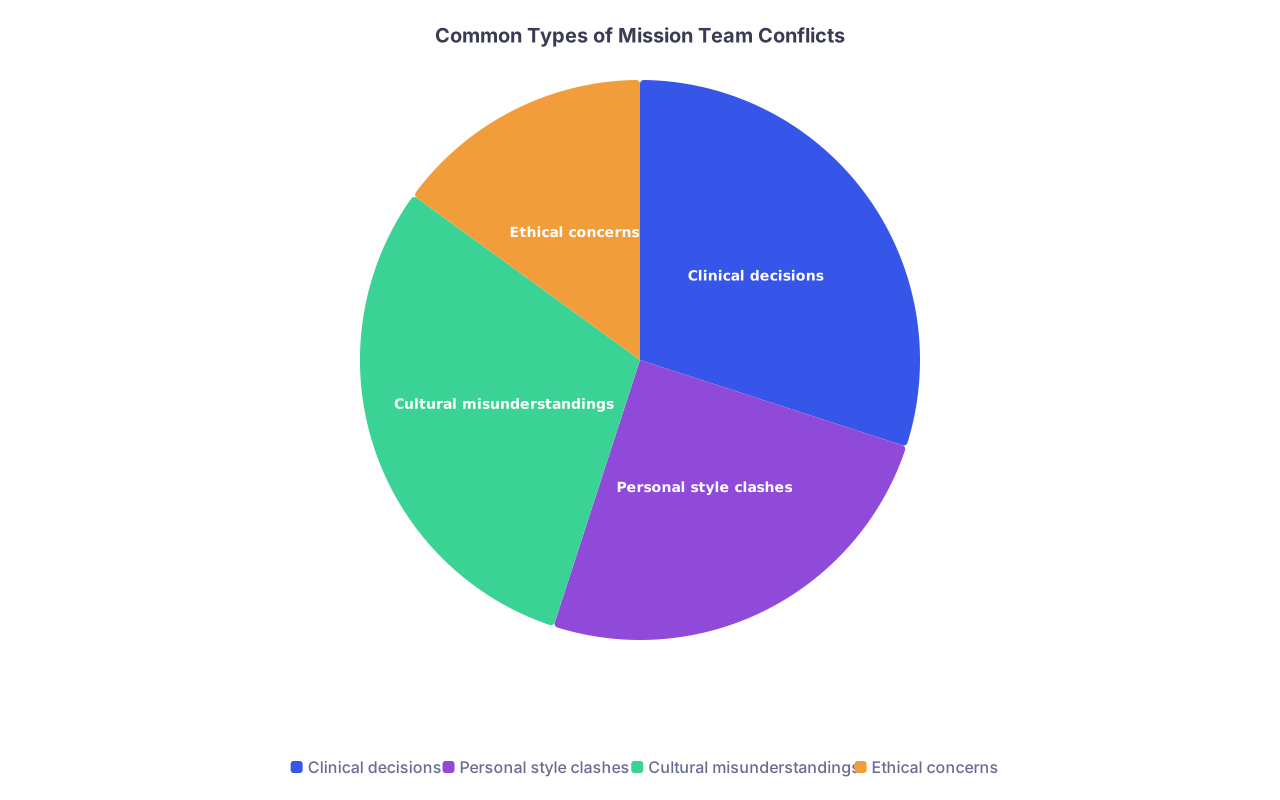
| Category | Value |
|---|---|
| Clinical decisions | 30 |
| Personal style clashes | 25 |
| Cultural misunderstandings | 30 |
| Ethical concerns | 15 |
1. Clinical Conflicts
Examples:
- Disagreement about when to transfuse
- Different antibiotic choices
- Debates about when to operate vs refer
Fix with:
- Clear clinical authority hierarchies (who has final say in each domain)
- Written local protocols pinned in the ward / OR
- Pre‑trip or first‑day alignment meetings:
- “In this hospital, we do not have CT. Our threshold for laparotomy is different. Let us agree how we decide these cases.”
Good practice:
- If you are the visitor, assume the local standard is default unless it is clearly unsafe.
- If you are local, explain constraints explicitly: “We do not have ICU; that changes what is realistic post‑op.”
2. Personal Style Clashes
Examples:
- Fast, blunt surgeon with a slow, process‑oriented nurse
- Extroverted “let us debrief everything” doc and introverted “let me process alone” resident
This is where self‑awareness tools actually help.
Use a short “who I am on a team” form on day 1:
Each person writes:
- How I prefer to receive feedback (direct / with time / in writing)
- What I look like under stress (quiet / sarcastic / controlling)
- How to challenge me without putting me on the defensive
Then in conflict, you can say:
“You wrote that when stressed you get very task‑focused. I think that is what is happening. Can we slow this conversation down 2 notches?”
3. Cultural Conflicts
This is huge on mission teams and regularly ignored.
Classic problems:
- Westerners expect flat hierarchy and open disagreement; local staff expect deference to seniority.
- Different concepts of time, urgency, and planning.
- Different comfort with saying “no” directly.
You will not fix this in one trip, but you can do three smart things:
- Ask explicitly: “In this hospital, how is disagreement usually handled?”
- Learn taboo zones:
- Can juniors correct seniors in front of patients? Usually no.
- How is feedback given? Public? Private? Via intermediaries?
- Use cultural brokers – local leaders who can translate not just language but norms.
When a conflict happens, add one question:
“How much of this is about the actual decision, and how much is about how we expressed it in this culture?”
That question alone has defused countless spirals I have seen.
Pre‑Trip Damage Control: Build the Framework Before the Fire
If you are leading or planning a mission team, you have one job: do not improvise your conflict system mid‑crisis.
Minimum kit you need before you land:
Two‑page team covenant that includes:
- How we handle disagreements (24‑hour rule, four levels)
- How we talk about each other (no gossip, no “prayer request” slander)
- Who has clinical authority in each area
Clear photo, consent, and social media policy (you would be shocked how many conflicts start here)
Named conflict contacts:
- One on the sending side
- One on the local side
Daily 10–15 minute debrief built into the schedule:
- “Wins, worries, tensions” format
- Leader explicitly asks: “Any brewing conflicts we should address at Level 1 today?”

| Step | Description |
|---|---|
| Step 1 | Incident or Tension |
| Step 2 | Immediate real time intervention |
| Step 3 | Wait for appropriate moment |
| Step 4 | Level 1 direct talk within 24 hours |
| Step 5 | Document mentally and move on |
| Step 6 | Level 2 add third person |
| Step 7 | Adjust behavior and review |
| Step 8 | Level 3 leadership meeting |
| Step 9 | Performance plan |
| Step 10 | Level 4 organizational process |
| Step 11 | Patient safety at risk? |
| Step 12 | Resolved? |
| Step 13 | Serious pattern or ethics? |
| Step 14 | Major misconduct? |
This is not bureaucratic overhead. This is what keeps a short‑term trip from scarring the long‑term work.
Scripts for the Tough Moments
You will freeze if you have to invent every sentence in the moment. Here are a few ready‑made lines.
When you see something unsafe
- “I am not comfortable with this. Can we pause and talk through the plan?”
- “I may be missing a constraint here, but where I trained this would be considered unsafe because of X.”
When someone is dismissive or demeaning
- “When you laughed after my question in front of the students, I felt dismissed. Could we talk about how we give each other feedback?”
- “I know tensions are high, but I do not accept being spoken to like that. Let us take five minutes and try again.”
When you need to escalate
- “We have tried to work this out between the two of us. I still think we are stuck and it is affecting the team. I am going to ask [Name] to help us think this through.”
- “Because this involves patient safety, I have a responsibility to bring this to leadership.”
When you realize you were wrong
- “I acted too fast and did not respect the local way of doing things. I am sorry. Next time I will ask before changing the plan.”
- “I spoke about you to others instead of to you directly. That was wrong. I have gone back to them to correct that, and I would like to rebuild trust if we can.”
Guardrails: What You Must Not Do
A few patterns destroy mission teams fast:
- Gossip as processing – If you talk to three people about them before you talk to them, you are the problem.
- Spiritual gaslighting – Using verses or “God told me” language to shut down legitimate concerns.
- Weaponizing culture – Dismissing all feedback as “that is just your Western perspective” or “that is just how they are here.”
- Silence as virtue – Calling your avoidance of conflict “servanthood” while quietly withdrawing.
You will not avoid all of these perfectly. Just be honest when you catch yourself doing them and repair quickly.
Measuring Whether Your Framework Works
Do not guess. Look for specific indicators that your conflict framework is healthy.
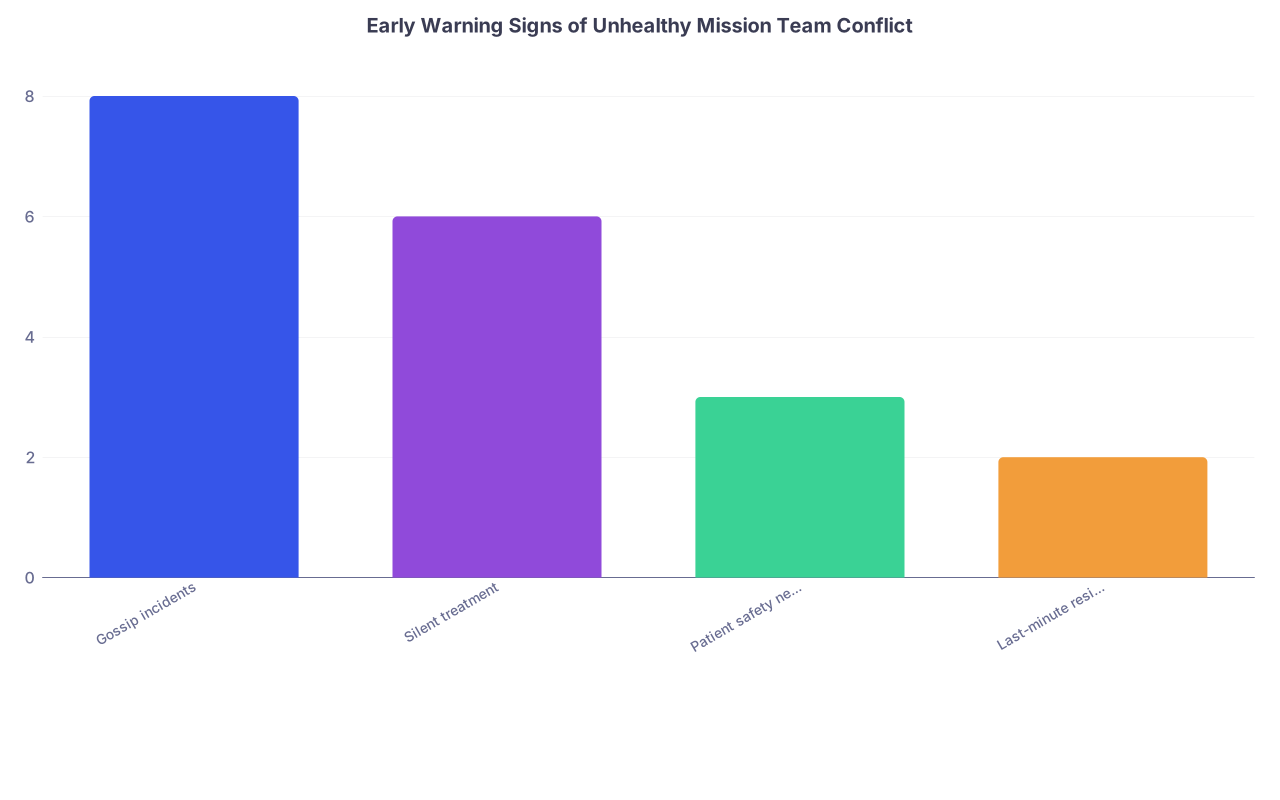
| Category | Value |
|---|---|
| Gossip incidents | 8 |
| Silent treatment | 6 |
| Patient safety near misses | 3 |
| Last-minute resignations | 2 |
Track informally:
- Number of unresolved tensions raised in daily debriefs
- Frequency of anonymous complaints to leadership
- Instances where local partners express disappointment or confusion about your internal dynamics
- How many times you need Level 3 or 4 interventions in a given season
If everything is surfacing only at Level 3 and 4, your Level 1 culture is weak.
One More Layer: The Ethics Behind the Framework
This is not just about team harmony. It is about medical ethics in a mission context.
Every conflict you mishandle has ethical spillover:
- Shaky teamwork leads to missed handovers and med errors
- Disrespect of local staff erodes trust and capacity‑building, which harms future patients
- Covering up misconduct undermines justice and safeguarding for vulnerable people
Ethically sound mission work demands:
- Transparency within appropriate bounds
- Accountability that does not depend on personal charisma
- Respect for local systems and authority, not colonial work‑arounds
Conflict is where those values are either lived or betrayed.
Your Next Step Today
Do not wait for the next crisis.
If you are on a mission team now, or planning one:
Write down a one‑page conflict protocol today. Include:
- The four levels (direct, third person, leadership, organization)
- The 24‑hour rule for Level 1
- Named people for Level 2 and Level 3
Then send it to your current or future team with one line:
“This is how we will handle conflict on our mission team. Please read it and tell me what is unclear.”
Open the draft. Write the first three sentences. That is where healthy mission teams actually begin.


