

The obsession with international medical missions is completely out of control.
You see it everywhere: Instagram photos with kids in matching school uniforms, a stethoscope photo in front of some rural clinic, a line in people’s personal statements about “transformative experiences in Guatemala.” And if you’re sitting there thinking, “Cool, I can’t afford a $3,000 voluntourism trip… so I’m screwed,” I know exactly how that panic feels.
Let me say this plainly before your brain spirals any further:
Not going on an international mission does not automatically put you at a disadvantage.
But how you handle that fact in your application? That absolutely can.
Let’s unpack this like two people sitting in a library at 11:30 pm spiraling together.
The Ugly Truth About International Missions
Here’s the part nobody likes to say out loud: a lot of “international medical missions” are more about the applicant than the patients.
You already know this. That’s why it bothers you. Your brain is going:
- Are they actually helping?
- Is this just poverty tourism in scrubs?
- And also… I literally cannot afford this. Am I ethically better but strategically doomed?
I’ve read and heard so many versions of the same thing from admissions people:
“If I see one more essay about a week in Honduras changing someone’s entire view of medicine, I’m going to scream.”
They’re not impressed just because you got on a plane.
Programs are getting increasingly wary of short-term, fly-in-fly-out “help” that doesn’t understand local systems, uses limited resources, or lets undertrained students act way above their actual skill level. Many faculty now actively question the ethics of students doing anything clinical abroad that they wouldn’t be allowed to do at home.
So no, there isn’t some secret checkbox that says:
“International mission: Yes = serious candidate. No = rejects pile.”
What they’re actually trying to read is:
- Do you understand health disparities?
- Do you care about underserved populations?
- Can you reflect ethically on power, privilege, and limits of what you can/should do as a trainee?
- Do you commit to service in a way that isn’t performative?
You can show all of that without ever leaving your city.
The Money Thing: Yes, It’s Unfair. No, It’s Not Fatal.
You’re not imagining it. There is a built-in bias toward students who can pay for “meaningful” experiences.
Let’s be honest: an international trip can easily run you:
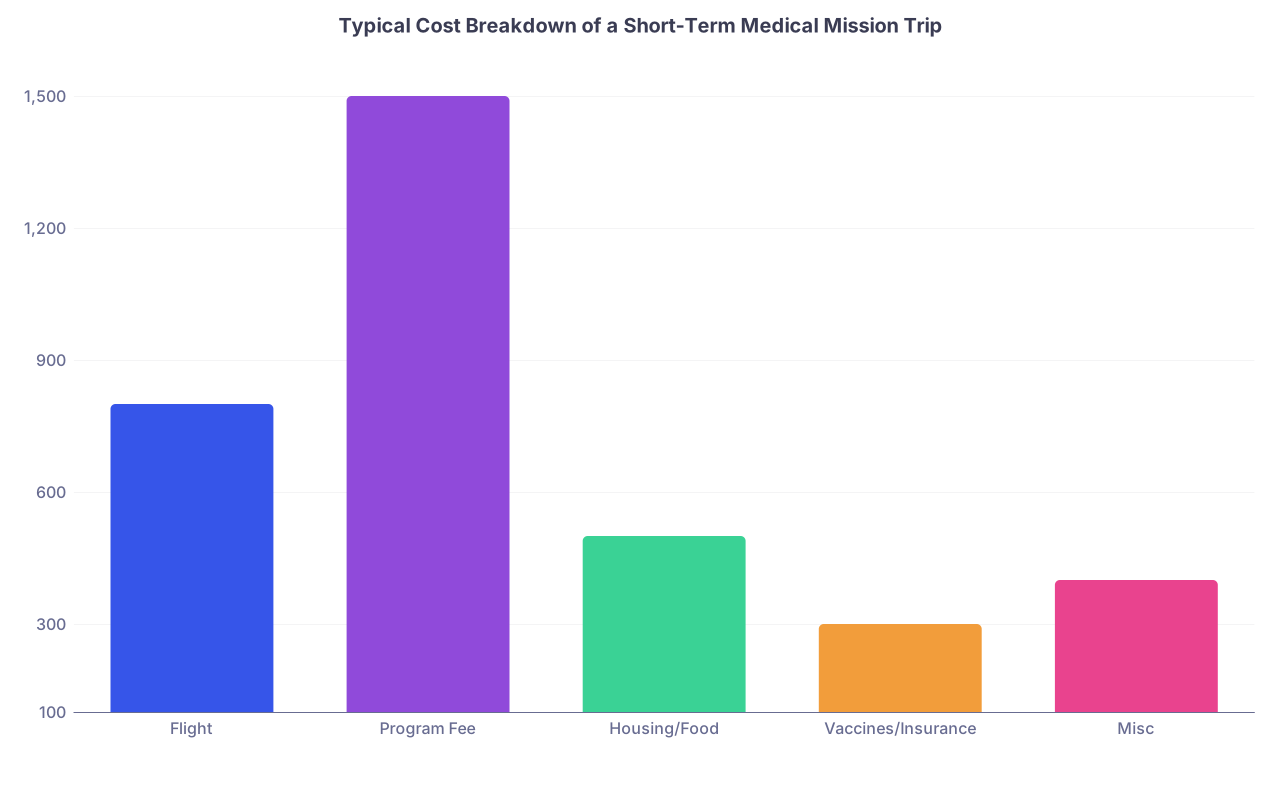
| Category | Value |
|---|---|
| Flight | 800 |
| Program Fee | 1500 |
| Housing/Food | 500 |
| Vaccines/Insurance | 300 |
| Misc | 400 |
If you’re working 20–30 hours a week just to keep your own lights on, that’s not happening. And it feels like the system is saying: “Congrats, you’re ethical and broke. Too bad.”
Here’s the part you need to hold onto:
Med schools are not blind to this. The more serious the school, the more likely they are to understand that certain experiences are basically pay-to-play.
They know:
- Not everyone can just not work for a summer.
- Not everyone has family who can drop $2–4k on a plane ticket and program fee.
- Not everyone even has a passport.
What matters is what you did with what you did have.
If your reality looked like:
- Working at a grocery store 25 hours/week,
- Volunteering at a free clinic on Saturdays,
- Helping care for younger siblings or grandparents,
That’s not “less than” the student who did two weeks in Peru. It’s often more impressive because it shows long-term commitment and sacrifice, not a one-time photo op.
Where people get into trouble is when:
- They don’t explain their choices.
- They don’t connect their real circumstances to their values and application story.
You can’t assume adcoms will automatically understand why you didn’t do certain things. You can absolutely frame it.
What Adcoms Actually Want From “Mission” Experiences
They don’t care about your boarding pass.
They care about growth and ethics.
Most mission-trip essays are boring. I’m just going to say it. They follow the same formula:
- “I went to [country].”
- “I saw so much poverty.”
- “It made me realize how lucky I am.”
- “Now I want to help people.”
There’s nothing special there. That same arc could be written by 100 people who barely remember the names of anyone they met.
What stands out is depth, not distance.
They’re looking for things like:
- Do you talk about systems (access, policy, social determinants), or just “helping poor people”?
- Do you understand your limits as a pre-med? That you’re not the hero?
- Do you show sustained engagement with underserved communities, not just one glamorous week?
- Do you reflect on power, your role, and the risk of causing harm?
You can do that from:
- A community clinic in your own city.
- A mobile health unit in rural areas of your own state.
- Working with refugees or immigrants in your community.
- Hospice volunteering.
- Street medicine teams in local urban settings.
International is one flavor of underserved. It’s not the only one.
How to Turn “I Couldn’t Afford It” Into Something That Actually Helps You
Let’s turn your fear into strategy.
Instead of thinking:
“I don’t have an international mission, I’m behind,”
shift to:
“I have sustained, grounded, ethical service in my own community, and I understand why that matters.”
This isn’t spin. This is you telling the truth well.
1. Build a clear through-line of service
If you haven’t already, start creating a pattern. Not random one-offs, but a consistent story that says: “I care about underserved populations, and I prove it with my time.”
That might look like:
- 2+ years at a free clinic in your city.
- Working as a medical assistant/EMT in a safety-net hospital.
- Volunteering with a needle-exchange program or homeless outreach.
- Tutoring or mentoring kids in under-resourced schools.
Length and consistency matter more than a passport stamp.
2. Explicitly name your constraints without sounding like you’re making excuses
You don’t need a dramatic “financial hardship essay” unless asked, but you can briefly explain context when relevant.
Something like:
“During college, I worked 20–25 hours per week to support myself and my family, which limited my ability to participate in travel-based programs. I focused my service locally at [X place], where I developed long-term relationships with patients and staff and gained a deeper understanding of barriers to care in my own community.”
That’s not whining. That’s context. It simultaneously says:
I had limits. I made grounded, ethical choices anyway.
3. Lean into ethics, not exoticism
You’re in the “personal development and medical ethics” phase. Use that.
Adcoms are tired of the “I went somewhere poor, now I want to save the world” narrative.
Talk instead about things like:
- How you wrestled with your role as a pre-med in an underserved setting.
- Times you didn’t act, because it would have been beyond your scope.
- Situations where you realized good intentions aren’t enough without systems and follow-up.
- What you’ve learned about listening before “helping.”
This is where you can quietly rise above the superficial mission-trip flexes.
If someone else says: “I pulled teeth in a village!”
And you say: “I spent 2 years listening to patients navigate our broken Medicaid system and realized how little is actually under their control,”
adcoms know who’s thinking like a future physician.
Alternatives That Are Just as Strong (Or Stronger) Than International Missions
Here’s the part that should calm you down a bit: many of the most respected physicians in global and underserved health started local.
| Experience Type | What It Shows |
|---|---|
| Free clinic volunteering | Long-term service, continuity, humility |
| Street medicine outreach | Comfort with vulnerability, resilience |
| Refugee/immigrant support | Cross-cultural care, communication |
| Rural health or FQHC work | Understanding systemic access issues |
| Hospice or palliative care | Emotional maturity, depth, presence |
| Long-term community org | Commitment beyond resume-building |
None of those require a plane ticket. All of them let you talk about:
- Suffering and structural inequality.
- Your evolving role as a learner.
- The tension between wanting to fix everything and accepting limitations.
- Real relationships, not just snapshots.
And quietly, a lot of faculty will respect those more than a one-week “mission” where an organization parachutes into a town they barely know.
The Ethics Piece You’re Probably Worried About But Haven’t Said Out Loud
Let’s name the thing hanging in the air:
You’re not just worried about being behind. You’re also thinking:
“Is it even… right… to want to go on a mission for my application?”
You’re asking the right question. That’s your conscience doing its job.
Short answer: motive matters, but impact matters more.
If your gut is already squirming about:
- Students acting like junior doctors abroad.
- Taking photos of patients you’d never take in a US hospital.
- Using limited local resources for the benefit of visiting trainees.
Then your decision not to go may actually be the more ethically grounded one.
And that’s something you can talk about, carefully, in interviews or secondaries about ethics or global health. Not in a smug “I’m better than them” way. In a “I’ve thought seriously about how trainees can unintentionally cause harm” way.
For example:
“I’ve been drawn to global health, but I’ve also struggled with concerns about short-term mission trips where trainees may function beyond their scope and local systems may not be meaningfully strengthened. Given my financial limitations and these ethical concerns, I’ve focused on long-term local service with underserved populations while continuing to learn about sustainable, partnership-based global health models that I hope to pursue later in training.”
That answer says:
- I’m thoughtful.
- I’m not naive.
- I didn’t chase the shiny option just because everyone else did.
That is not a disadvantage.
What You Should Actually Be Afraid Of (Not What Instagram Tells You)
The real red flags for an application aren’t:
- “No international mission.”
They’re more like:
- No sustained service anywhere.
- A vibe that you only volunteer when someone’s going to write it down.
- Essays with savior complex energy.
- A total lack of reflection about power, privilege, and inequity.
- Zero exposure to people who aren’t just like you.
If instead your application says:
- I had constraints.
- I made intentional, grounded choices.
- I showed up, again and again, for people in my own community.
- I think deeply about the ethics of what I do.
You’re in a much better place than you feel right now.

| Step | Description |
|---|---|
| Step 1 | No money for travel |
| Step 2 | Focus on other app areas |
| Step 3 | Identify local needs |
| Step 4 | Free clinic or FQHC |
| Step 5 | Homeless or street medicine |
| Step 6 | Refugee or immigrant support |
| Step 7 | Long term commitment |
| Step 8 | Reflect on ethics and growth |
| Step 9 | Strong application narrative |
| Step 10 | Want to serve underserved? |
Quick Reality Check: Will Some People Still Flex Their Trips? Yes.
You will absolutely meet people who talk like:
- “Yeah on my Tanzania trip when I was assisting with surgeries…”
- “When I was doing global health work in undergrad…”
- “During my mission in Haiti…”
Some of them had genuinely meaningful, well-structured experiences. Some of them did unskilled tasks and embellished the rest. You have no way of knowing which is which from the outside.
But adcoms are not naïve. They’ve read thousands of these. They can smell:
- Overreach (“I realized I can really handle high responsibility in critical settings” …you handed out vitamins.)
- Savior narratives.
- Ethical blind spots.
You’re not behind because your story is different. You’re behind if your story is empty.
FAQs
1. Will not having an international medical mission hurt my chances at top schools?
No, not by itself. Top schools care about depth, reflection, and sustained commitment. A 2-year role at a local free clinic can easily be more powerful than a 10-day trip abroad. You will not be rejected because you didn’t go to another country; you’ll be rejected if your experiences don’t show maturity, service, and insight. Those can all be built locally.
2. Should I mention that I couldn’t afford to go on a mission trip?
You don’t need to highlight it as a tragic centerpiece, but yes, you can briefly provide context. One or two sentences explaining that you worked significant hours or had family obligations, so you focused your service locally, is completely appropriate. Frame it as a thoughtful choice, not an apology. Don’t overdo it; state it once, clearly, and move on to what you did do.
3. Are adcoms suspicious of short-term international trips?
More and more, yes. They’re not automatically cynical, but they’re cautious. A one-week or two-week trip with vague clinical descriptions can raise eyebrows, especially if you imply you did things above your training. They’re looking for humility, proper scope, and partnership with local systems. If your story sounds like a hero movie, they’re not impressed.
4. How can I show interest in global health without traveling?
You can: work with refugee or immigrant populations locally, volunteer with organizations that focus on global health education or policy, take classes in global/public health, join research projects on infectious disease or health disparities, or attend global health seminars at your institution. Reflect on how global issues show up in your own community—language barriers, access to care, cultural differences—and talk about that.
5. What if I genuinely want to do a mission trip later in med school or residency?
That’s totally fine—and honestly, often better. As a med student or resident, you’ll have more skills, access to better-structured programs, and mentors who know which projects are ethical and sustainable. You can absolutely say in applications that you’re interested in future global health work but are currently focusing on long-term, local service and learning about ethical global models first.
6. Is it okay to feel resentful that others can afford these trips?
Yes. It’s human. The system is unequal. Some people can essentially buy experiences that photograph well and sound impressive. You’re allowed to feel bitter about that. Just don’t let that bitterness bleed into your application tone. In your actual materials, stay grounded: explain your reality, show what you did with it, and let your consistency and reflection speak louder than your passport stamps.
Bottom line:
You’re not at a disadvantage because you didn’t get on a plane. You’re at a disadvantage only if you let that fear paralyze you instead of doubling down on real, consistent, local service—and framing it thoughtfully, ethically, and honestly.


