
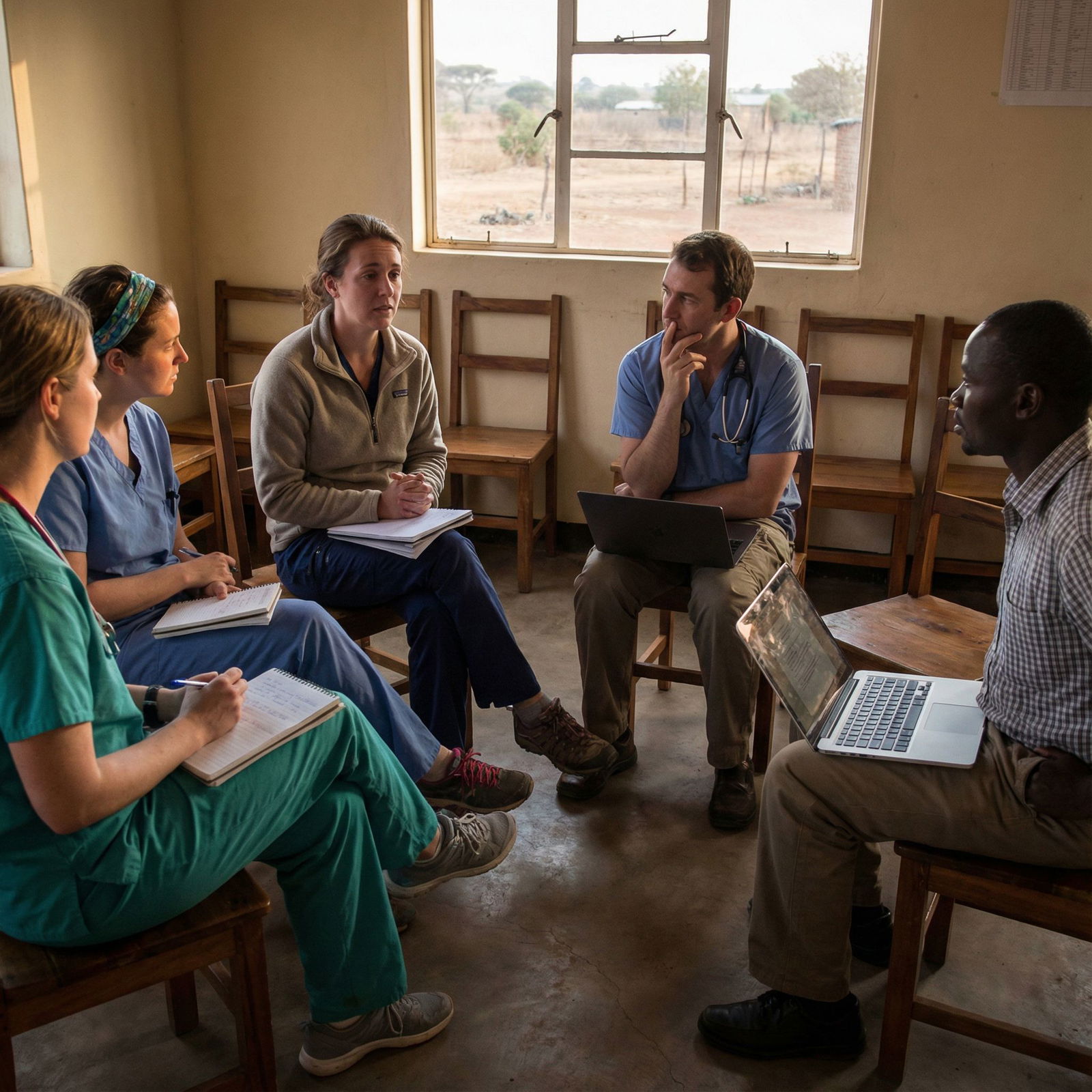
No overseas experience. No mission trips. Nothing “global” on your CV. Are program directors secretly reading that as: “This person doesn’t care about global health”?
Let’s talk about that knot-in-your-stomach feeling head-on.
The Fear Behind “No Global Health Experience”
You’ve probably seen it on other people’s CVs:
- “Medical mission to Honduras”
- “Global health elective in Malawi”
- “NGO work in India”
And your brain goes straight to: great, I’m the selfish one who never left my city. PDs are going to think I don’t care about underserved populations or global health or “bigger than myself” medicine.
Here’s the uncomfortable truth: some applicants absolutely do use overseas trips as shiny CV ornaments. One week abroad. Cute pictures with kids. Zero sustained follow-up. And yes, a lot of programs know this.
So no, the absence of that line item doesn’t automatically scream “doesn’t care.”
What PDs actually see when they look at your application is much simpler and also more frustrating: they see what’s written. They don’t see motives. They don’t see bank accounts. They don’t see visas. They see: “No formal global health experience listed.”
That’s it.
Your anxiety is taking that neutral fact and expanding it into a personality judgment that isn’t on the page.
The real question isn’t: “Will they think I don’t care about global health?”
It’s: “If I care about global health, how do I show that without having boarded a plane?”
That’s fixable.
What Program Directors Actually Care About (Global Health Edition)
Program directors are not sitting around saying, “Reject anyone who hasn’t been to rural Kenya.”
Most of them care about a few core things:
- Do you have a track record of service to underserved populations?
- Do you understand health disparities in a thoughtful, non-savior way?
- Can you work effectively in low-resource or unpredictable environments?
- Are you actually committed, or are you chasing buzzwords?
Overseas work is one way to show those things. It is absolutely not the only way—and for a lot of PDs, not even the most convincing way.
I’ve heard versions of this in PD meetings:
- “I’d rather see 3 years at a local free clinic than one week of selfies abroad.”
- “Mission trips are fine, but show me longitudinal service.”
- “Everyone ‘cares’ about global health on paper. I want to know who will show up for our patient population.”
So if your brain is telling you, “No mission trip = they’ll think I don’t care,” that’s your anxiety talking, not reality.
Here’s roughly how this plays out in their heads:
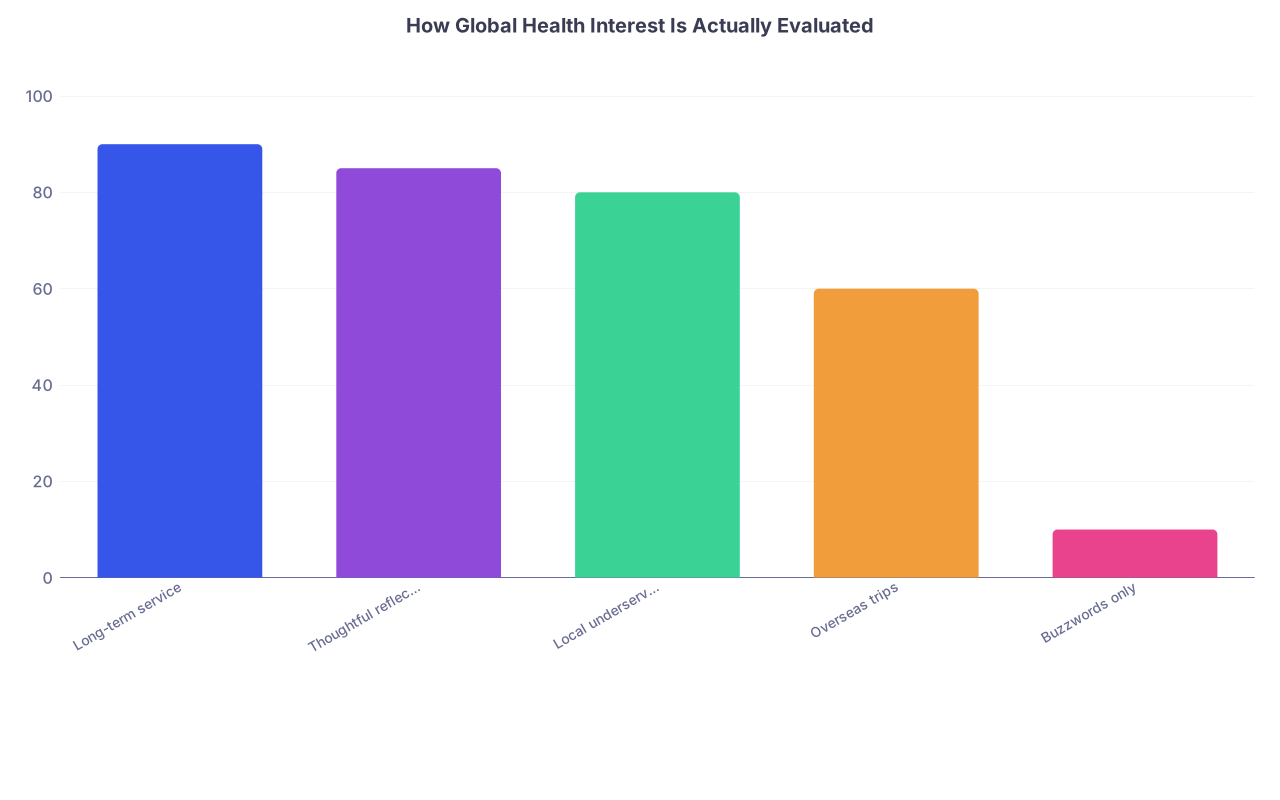
| Category | Value |
|---|---|
| Long-term service | 90 |
| Thoughtful reflection | 85 |
| Local underserved work | 80 |
| Overseas trips | 60 |
| Buzzwords only | 10 |
Is this exact data from a paper? No. But it’s basically how PDs I’ve listened to talk about this stuff.
Mission trip alone is not the trump card you think it is. And not having one doesn’t make you look indifferent.
Why You Might Not Have Overseas Experience (And Why PDs Don’t Hate That)
Let’s say the quiet part out loud: not everyone can hop on a plane to “go help.”
Money. Family responsibilities. Immigration status. Chronic illness. Pandemic travel restrictions. Pure bad timing. Some combination of those.
The idea that “caring about global health” must equal “did a trip abroad” is not just unrealistic—it’s actually classist and a little gross.
A lot of thoughtful PDs know that.
Maybe this is you:
- You worked every summer to pay tuition instead of paying $3,000 for a two-week trip.
- You’re a caregiver for a parent or sibling and literally can’t leave for weeks.
- You’re on a visa and international trips are a bureaucratic nightmare.
- You were at a med school without a strong global health department, and it just… never lined up.
None of that says anything about whether you care about global health or health equity. It says more about your circumstances than your values.
You don’t need to over-explain all of that on your application. But you also don’t need to apologize for it like you’ve committed some character flaw.
If it comes up in an interview—something like, “Have you had any global health experiences?”—you can be straightforward:
“I haven’t had the chance to do overseas work yet. For financial/family/visa reasons, travel wasn’t realistic during training. I focused on underserved work locally instead: [insert specific examples]. Long-term, I’d love to build into global health in a sustainable way.”
Reasonable. Mature. Not defensive. That lands a lot better than panicking about how to fake global interest.
How To Show You Care About Global Health Without Leaving The Country
Here’s the part you actually have control over.
If you care about global health, you can show that through your choices, your reflections, and your long-term consistency. None of that requires a passport stamp.
Think of “global health” less as “going somewhere far away” and more as:
- Understanding structural determinants of health
- Caring about inequities wherever they show up
- Being thoughtful about power, culture, and sustainability
You can absolutely demonstrate those things with local work.
Some concrete things that actually impress PDs more than a random trip:
- Longitudinal work at a free clinic serving immigrants or refugees
- Interpreting/advocacy for non-English-speaking patients
- Research or QI on health disparities, access to care, or policy
- Community health outreach in low-resource neighborhoods
- Work with asylum seekers, migrant workers, or houseless populations
If you’ve done any of that, you’re already closer to “global health person” than someone who flew to another country for a week and never thought about global anything again.
And if you’re worried you have “nothing,” look more carefully at what you have done. A lot of applicants dismiss experiences because they weren’t labeled “global health elective.”
For example:
You volunteered at a student-run clinic that mostly sees uninsured Latinx patients, many of them recent immigrants. You used your Spanish. You learned to work around limited access to meds and imaging. You saw how legal status and policy decisions affect health.
That is global health. Honestly more real-world global health than some highly curated trips.
How To Talk About Global Health Ethically (Without Sounding Like A Savior)
If you don’t have overseas work, your instinct might be to overcompensate. To pour global buzzwords all over your personal statement or ERAS experiences and hope that makes up for it.
PDs can smell this from space.
They are absolutely sick of:
- “I realized how privileged I am…”
- “Seeing how happy they were despite having so little…”
- “It made me want to help the less fortunate…”
You know the vibe.
If you do care about global or underserved work, and you want to express that, keep it grounded and specific:
Talk about systems, not just feelings. Instead of, “I realized how unfair the world is,” say what you actually learned: insurance barriers, legal challenges, cultural differences, language issues, supply constraints.
Talk about your role without centering yourself as the hero. You’re a learner, a collaborator, not “the one who came to save people.”
Focus on what you did after the realization. PDs care less about your epiphany moment and more about the actions that followed. Did you keep showing up to that clinic? Did you join a QI project? Advocate for interpreter services?
Here’s the pattern that spooks PDs: generic statements + no track record.
“I’m deeply passionate about global health”
…but then zero clinical or community engagement with underserved patients, local or abroad.
That’s when they think, “Checkbox. This person is just parroting what they think we want to hear.”
If you’re anxious that your application reads like that, fix the mismatch: either tone down the huge claims, or build up the evidence with specific, concrete examples—even if they’re local.
If You’re Early: Building A Real Global Health Foundation Now
If you’re still in med school or early enough in training and all of this is making your stomach clench, there’s actually time to build something real.
Two important points though:
- Don’t rush into a random mission trip just to plug a hole.
- Don’t wait for the “perfect” overseas opportunity to start acting like you care.
You can do a lot from where you are:
- Join (or create) a project focused on refugees, migrants, or international patients at your hospital.
- Get involved in research on global or cross-border health issues—TB, HIV, maternal mortality, climate health, whatever intersects with your interests.
- Take electives in public health, ethics, or health policy that touch on global topics.
- Work seriously on language skills and actually use them in clinical contexts.
- Read—like really read—about global health ethics, “voluntourism,” and power imbalances, and let that shape how you talk about this stuff.
And if an overseas opportunity arises that’s structured, supervised, ethical, and longer than a long weekend? Great. Do it for the right reasons, not as damage control for your CV.
What To Say In Interviews When You Have No Overseas Experience
This is the part that usually causes the late-night spiral. You picture an interviewer who single-handedly built a clinic in rural Uganda, looking unimpressed as you say, “I… worked at my city clinic?”
Here’s a script-ish answer you can adapt if they ask:
“Have you had any global health experiences?”
“I haven’t done an overseas rotation yet. For me, travel just wasn’t feasible during medical school because of [work/financial/family/visa reasons, briefly]. But I’ve been very focused on underserved care in my local community. At [clinic/hospital], most of our patients are [immigrant/refugee/migrant/unhoused] and face major barriers with language, insurance, and legal status. That’s where I’ve learned to work in resource-limited settings, coordinate with community partners, and think about the broader systems affecting health. Long-term, I’d like to build on that foundation and eventually work in a more formal global health setting, but in a sustainable, partnership-driven way.”
That answer:
- Doesn’t apologize for not having flown somewhere.
- Shows insight into what global health actually is.
- Emphasizes longitudinal commitment, not a stunt.
- Signals maturity and ethics.
That’s the opposite of “PDs will think I don’t care.”
Quick Reality Check: How Big A Deal Is This Really?
Let me be blunt: unless you’re applying to a program that explicitly brands itself as “Global Health Residency” with built-in international tracks, the lack of an overseas experience is not a core selection criterion.
Even at “global health focused” places, they aren’t only looking for people with passport stamps. They’re looking for serious people who understand inequity and can handle challenging clinical environments.
Here’s roughly how “no overseas experience” compares to other things PDs care about:
| Factor | Relative Importance |
|---|---|
| Clinical performance | Very High |
| Letters of recommendation | Very High |
| Professionalism | Very High |
| Commitment to underserved | High |
| Research (program dependent) | Medium |
| Prior overseas missions | Low–Medium |
So no, you are not getting auto-screened out because you never stood in front of a village in scrubs for Instagram.
If they care about health equity and you show real, grounded commitment to that—locally or otherwise—you’re fine.
FAQ (Exactly 4 Questions)
1. Will top “global health” residencies reject me if I’ve never done overseas work?
Not automatically. What they’ll reject is a mismatch: someone loudly claiming to be “passionate about global health” with no sustained work with underserved populations, no reflection, and no clear plan. If you’ve done real local work and you talk about it thoughtfully, you’re still a viable candidate. Sure, some applicants will have flashy overseas experiences, but many programs actually prefer longitudinal, grounded service over one-off travel.
2. Should I try to squeeze in a short mission trip before I apply just to have something?
Honestly? If the main reason is “I’m panicking about my application,” I’d say no. A rushed, two-week trip right before apps can actually read as performative if it’s disconnected from your prior work. Admissions folks have been reading these CVs for years—they can tell when something was slapped on at the last second. You’re better off deepening current commitments, writing about them well, and, if you do travel, making sure it’s structured, supervised, ethical, and part of a longer-term pattern.
3. How do I avoid sounding like a global health “savior” if I’ve only done local work?
Focus on systems and humility. Talk about learning from patients and community partners, not “fixing” them. Emphasize barriers—policy, language, access—rather than your personal heroism. If you use “global health” language, tie it explicitly to what you’ve seen in your own city: immigration law, housing instability, food insecurity, structural racism. That actually signals deeper understanding than someone bragging about a week abroad.
4. Should I even mention global health interest if I have no overseas experience, or will that look fake?
You can absolutely mention it—as long as you back it up. Frame it as a future direction grounded in what you’ve already done. For example: “Working with immigrant patients at our free clinic sparked my interest in global and cross-border health. I hope to build on that in residency through structured global health electives or projects.” That’s honest, realistic, and credible. The red flag isn’t lack of travel; it’s grand, dramatic claims with nothing underneath.
Key takeaway 1: No overseas experience does not equal “doesn’t care about global health” in PDs’ minds. Your anxiety is adding that judgment, not them.
Key takeaway 2: Long-term, local work with underserved patients plus thoughtful reflection is more convincing than a rushed, one-off trip abroad.
Key takeaway 3: If you care about global health, you can show it—right now—through what you do and how you talk about it, even if you’ve never left your city.


