

What do you do when your toddler has a fever, your senior is texting you about an extra night shift, and your missions team lead just emailed asking if you can extend your trip by three days?
If that sounds close to your real life, this is for you.
You’re trying to be a decent parent, a competent resident, and a committed medical missions person. All at once. The Instagram version of that life is cute backpacks and airport photos. The real version is childcare spreadsheets, program director meetings, guilt from three directions, and wondering if you’re being selfish or sacrificial.
Let’s be blunt: you cannot “do it all.” But you can do meaningful work in all three areas without destroying your marriage, your kids, or your career. You just have to stop operating on vibes and start operating on systems.
Below is what actually works in real life, based on what I’ve seen residents and young attendings pull off (and what’s blown up).
Step 1: Decide What You Are Actually Optimizing For
Most people in your situation are running on default:
- Please the program
- Please the missions org
- Patch your family in around the edges
That’s backwards.
You need a priority stack. Not a vague “family first” slogan. A real, operational order that you use when decisions hurt somebody.
For most sane setups, it looks like:
- Family (spouse/partner, kids, your own basic health)
- Training (residency requirements / board eligibility)
- Missions work (short-term trips, long-term planning, fundraising, etc.)
If your order is different, fine. But decide it consciously, write it down, and share it with your spouse/partner and one trusted mentor. Then, when conflicts hit, you’re not re-deciding your entire life philosophy at midnight. You’re just applying the rule.
Example:
Child gets hospitalized the same week you’re supposed to leave for a 7‑day trip.
If family > missions, you cancel or defer the trip. That’s it. Guilt will scream. Your hierarchy wins.Program says you can’t take a second week off for a mission this year or it will risk your graduation timeline.
If training > missions, you scale back the trip or move it to vacation after graduation.
This hierarchy also shuts down a lot of ethical anxiety. If your missions work is regularly harming your kids or your training, you’re not being “sacrificial.” You’re being reckless.
Step 2: Build a Realistic Time and Energy Map
You cannot shove missions into the cracks of residency plus parenting. There are no cracks. You must deliberately carve space.
Do this on paper. One week of your “average” life. Yes, even in residency.
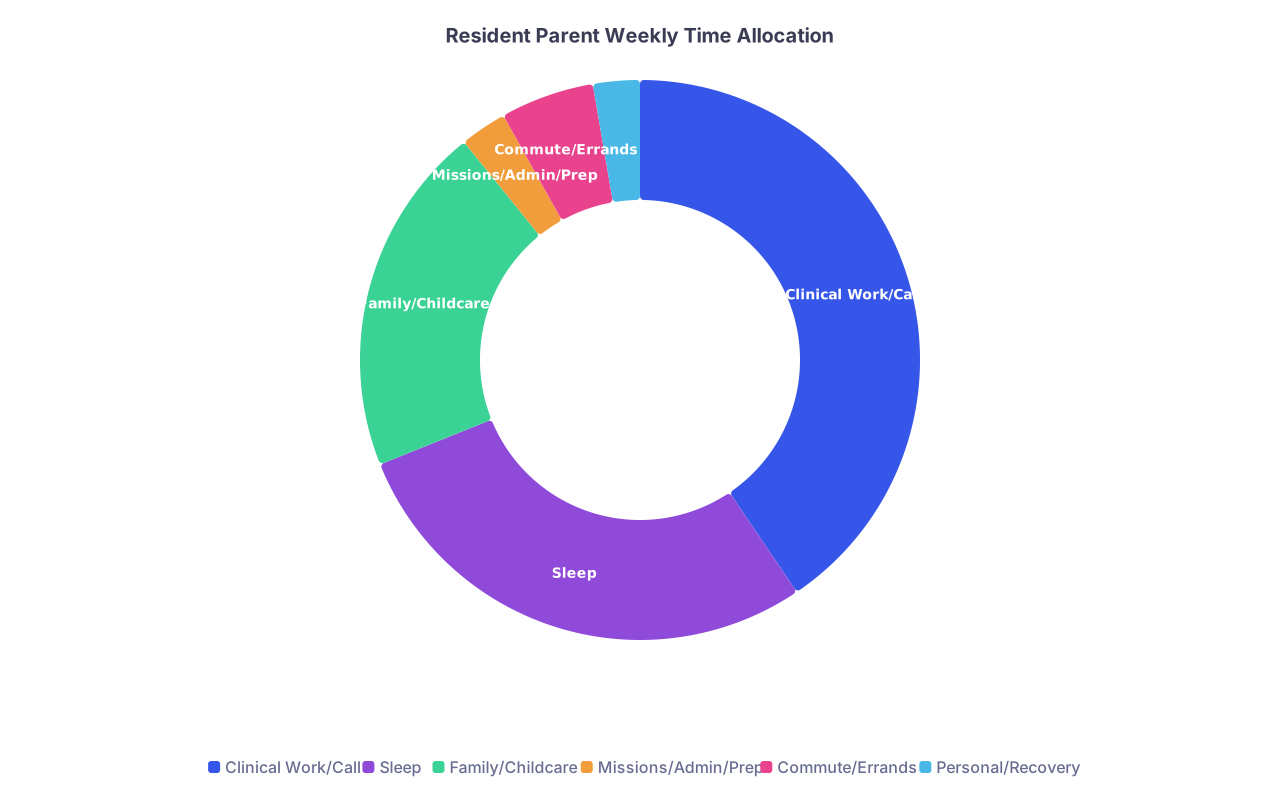
| Category | Value |
|---|---|
| Clinical Work/Call | 60 |
| Sleep | 42 |
| Family/Childcare | 30 |
| Missions/Admin/Prep | 4 |
| Commute/Errands | 8 |
| Personal/Recovery | 4 |
Now look at that and answer:
- Where could 2–4 hours a week for missions realistically live?
- Where is it absolutely not coming from? (Hint: not from sleep to a dangerous level.)
- What can be outsourced, automated, or just dropped?
Typical pattern that actually works:
- One 90‑minute block early morning on your “lighter” day off for missions work (prep, language study, fundraising emails)
- One 60‑minute evening block after kid bedtime 1x per week for long-range planning or team calls
- A 30‑minute weekly check‑in with your spouse/partner where missions is on the agenda (not a surprise)
If you cannot find 2–3 hours on paper, you sure will not find it in reality. Then your decision is: delay active missions until a less insane season, or drop another commitment.
Step 3: Get Your Program Director On Board (Without Torching Goodwill)
The worst move: emailing your PD, “Hey, I’ll be gone for two weeks in March for a mission trip, hope that’s okay.” You’ll get the policy PDF slapped back in your face.
You want a professional, planned approach.
Do this 9–12 months ahead if possible
Ask for a meeting (in person if you can).
“I’d like to talk about long-term planning and how to incorporate some supervised international work into my training without compromising requirements.”Walk in prepared:
- Specific dates or rough timeframe
- Which rotation you’d like to be away from (or avoid)
- How you’ll meet ACGME/college/board requirements
- Whether any part of the mission can count as elective or global health rotation
Use language that signals you understand training comes first:
- “I want to do this without affecting my progression or burdening my co-residents.”
- “I’m willing to stack call before/after to make this workable.”
- “I’ve checked the policy; I know we’re limited to X weeks away per year.”
Offer options, not demands:
- “I’d be open to a shorter trip this year if two weeks is not realistic with current staffing.”
- “If March is bad for the service, we could look at June after boards.”
If your program already has a global health track, this gets easier. If they don’t, you may be the guinea pig—which means you need to be extra-organized and low-drama.
Step 4: Design Childcare That Can Survive Chaos
Here’s the real stress test: you’re on night float, your partner works days, and you’re trying to leave the country for 10–14 days. Childcare is not a footnote. It’s the central question.
You basically need a redundancy system. Not “my mom said she can help.” A system.
For a 7–14 day trip, your options are usually:
- Partner as primary + backup adult(s) on call
- Grandparent or relative moves in temporarily
- Trusted friend from community/faith group staying over
- Paid caregiver (nanny, au pair, or sitter) filling gaps
Make it concrete. I like it on one page:
| Time Block | Primary Caregiver | Backup Caregiver | Notes |
|---|---|---|---|
| Weekdays daytime | Partner | Grandparent | School drop/pickup |
| Weekdays evenings | Grandparent | Neighbor friend | Dinner, bedtime |
| Overnight emergencies | Neighbor friend | On-call sitter | Hospital runs |
| Weekends | Partner | Church friend | Activities, church |
Every person on that list needs:
- Exact dates
- Clear expectations (school, meals, bedtime, meds)
- Signed consent forms for medical care and travel if needed
- Your kid’s pediatrician info, insurance card copies, schedule
If your backup plan is “we’ll figure it out if something happens,” you’re dumping risk on your spouse/partner and kids. That’s not “stepping out in faith.” That’s just inconsiderate.
Step 5: Tackle the Money Question Like an Adult
Money is a moral issue here. Because if you’re quietly pulling mission funds from your rent, your kids’ daycare, or your partner’s sanity, that has ethical weight too.
Look at three buckets:
- Family baseline: rent/mortgage, daycare, food, transportation, debt payments, basic savings
- Residency/professional: board exams, licensing, conferences
- Missions: trip fees, flights, vaccines, travel insurance, giving
Your missions funding cannot regularly cannibalize bucket 1. Once, in a crisis? Maybe. As a pattern? No.
Many residents I’ve seen do this well:
- Cap personal financial contribution per year (e.g., “We’ll give or spend up to $X from personal funds; beyond that, we raise support or we don’t go.”)
- Build a tiny “missions” sub-savings (even $50–$100/month) during less busy years
- Use tax refunds/bonus money intentionally, not impulsively
- Get serious about fundraising rather than feeling guilty and paying everything themselves
And yes, you should be transparent with your partner: “This trip will cost us about $Y out of pocket, and I’ve raised $Z. Are we both okay with that this year?”
Step 6: Choose Missions Work That Actually Fits a Resident-Parent Life
The wrong move is signing up for the most dramatic, farthest, longest trip because it feels the most meaningful.
You want alignment with your current life stage, not with your Instagram imagination.
As a resident parent, better fits usually are:
- 7–10 day trips, not 3–6 weeks
- Sites with decent communication and clear agendas, not constant last-minute chaos
- Work that uses your actual training level (not pretending to be an attending)
- Organizations that understand you have kids and a residency schedule, and don’t guilt-trip you
Early on, project types that work:
- Focused surgical camps (if your program can count some cases)
- Primary care/urgent care style clinics where you can function within your training
- Education-focused trips (training local providers, lectures, protocols)
- Repeat visits to the same site annually or biannually for continuity
If the missions org constantly pushes: “Just trust God and come, we’ll figure it out,” but has no structure for supervision, continuity, or local partnership, that’s a red flag. Especially when you have young kids depending on you coming back in one piece.
Step 7: Ethical Guardrails So You Can Sleep at Night
You’re not just juggling logistics. You’re juggling moral obligations:
- To your kids and partner
- To your patients at home
- To the patients and local clinicians abroad
- To your own long-term sustainability
A few hard lines I’d keep as a resident parent doing missions:
No practicing beyond your competence just because you’re “over there.”
If you wouldn’t do it unsupervised in your US/UK/Canadian hospital, don’t suddenly do it in a rural clinic with no backup because it feels heroic. Your kids need you alive and not traumatized by a preventable bad outcome.No bait-and-switch “mission tourism.”
If most of the trip is selfies, vague “helping,” and parachuting into communities without local partnership, ask yourself whether time away from your kids is really justified.No systematic overburdening of your co-residents.
Trading call is fine. Leveraging goodwill once in a while is fine. But if your missions habit means others are constantly picking up the slack, that’s an ethical cost too.No repeated deep disruption of your kid’s attachment if they’re very young, unless your partner and therapist both say the child is handling it well.
Not all time away is equal. Leaving a 9‑month-old and leaving a 9‑year-old are different things psychologically. Pretending they’re the same is self-justification.
Step 8: Protect Your Spouse/Partner From Becoming “Collateral Damage”
Reality: When one parent goes on a trip, the other goes on a mission too. At home. With dishes, tantrums, laundry, and probably their own job.
Your ethical questions are not just about you and “the poor.” They’re also about the person sitting next to you on the couch.
Do this before you commit to a trip:
Ask, don’t announce.
“I’ve been invited to this 10‑day trip in July. Do you feel like we can handle that this year, or would it be too much?”Spell out the load.
How many overnights alone? What support will they get? What’s happening with their job? Are there exams, deadlines, or health issues on their side?Offer to say no. For real.
If your partner feels like you never genuinely offer to step back, they’ll stop being honest and just quietly resent you.Plan recovery on the back end.
No, you cannot come back from a red-eye, hug the kids, and go straight to a 28‑hour call. Or expect your spouse/partner to keep functioning at single-parent level indefinitely. Build in one “re-entry” day if at all possible.
Step 9: Use Missions to Shape Your Kids, Not Compete With Them
Parents in your shoes often feel torn: “Am I neglecting my kids for someone else’s kids?” That tension is real.
There’s a healthier framing: your missions work can be part of their formation—if you’re thoughtful.
Some practical tactics:
Age-appropriate transparency:
“Mom is going to help take care of sick people in another country. Other doctors and nurses there are working very hard too. I’ll come back on this day.”Rituals:
A countdown calendar, special “mission trip” bedtime book, or a map with a pin where you are. It makes your absence more concrete and less scary.Involvement:
Let older kids help pack simple supplies, write cards to local kids, or choose one small toy to donate. Not as props, but as participants.Debrief honestly:
When you’re back, share one or two stories of resilience and joy—not just poverty and suffering. Your kids do not need emotional trauma dumped on them, but they also shouldn’t get the “savior” narrative.
If your missions work consistently makes you emotionally unavailable or chronically exhausted at home, your kids aren’t “sharing you with the world.” They’re losing you to burnout. That’s a different thing.
Step 10: Set a 3–5 Year Mission Plan (Not a 3–Week Fantasy)
Residency is a season. Your kids’ early years are a season. Your mission calling is (probably) longer than both.
You need a medium-range plan, not just disconnected trips.
Sketch something like this:
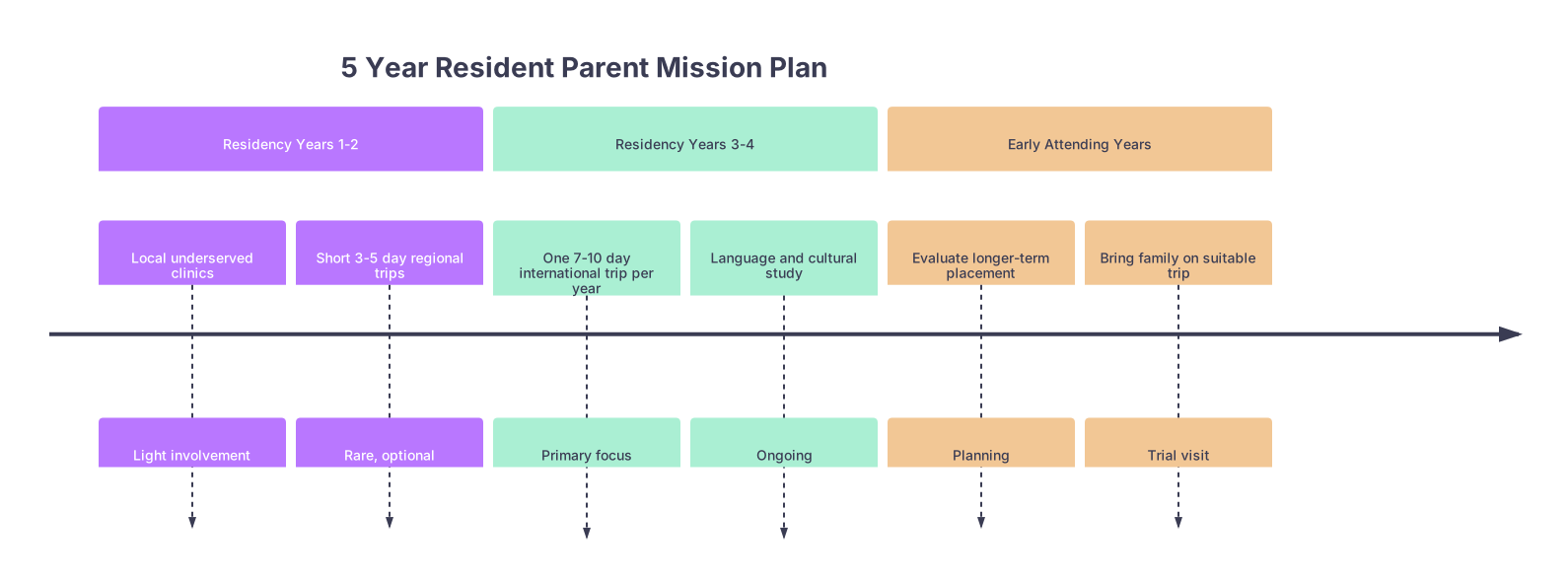
| Period | Event |
|---|---|
| Residency Years 1-2 - Local underserved clinics | Light involvement |
| Residency Years 1-2 - Short 3-5 day regional trips | Rare, optional |
| Residency Years 3-4 - One 7-10 day international trip per year | Primary focus |
| Residency Years 3-4 - Language and cultural study | Ongoing |
| Early Attending Years - Evaluate longer-term placement | Planning |
| Early Attending Years - Bring family on suitable trip | Trial visit |
That level of planning does a few things:
- Keeps you from overcommitting in intern year when you’re drowning
- Gives your partner and kids predictability (“Probably one bigger trip per year, not constant”)
- Lines up with training milestones (boards, senior rotations, fellowship decisions)
- Helps you say no to opportunities that would wreck your current season
Step 11: Create Systems, Not Heroics
If you want to do this long term without imploding, you can’t run on adrenaline and last-minute scrambling. Build systems.
Examples that I’ve seen work:
A shared “missions binder” (physical or digital) with:
- Copies of passports, vaccines, licenses
- Childcare plans
- Emergency contacts and insurance details
- Packing lists you refine after every trip
Annual family “missions meeting”:
- What worked last year?
- What was too much?
- What’s realistic this year?
Pre-trip checklist for your partner:
- Car maintenance done
- Bills on autopay
- School forms signed
- Food prep or grocery plan in place
Sounds overkill until you come back from a trip to a car with expired registration and three urgent notices from daycare. Systems are how you protect everyone from your good intentions.
Quick Comparison: Healthy vs Risky Patterns
| Area | Healthier Pattern | Risky Pattern |
|---|---|---|
| Time | 1 trip/year, 7–10 days | Multiple trips/year, 2–3 weeks each |
| Childcare | Redundant, written plans | Vague promises from friends/family |
| Training | PD involved, rotations preplanned | Last-minute requests, frequent disruptions |
| Finances | Capped personal spend + fundraising | Recurrent debt or bill delays |
| Partner | Clear consent and debrief | “They’ll adapt” attitude, simmering resentment |
Visual: Stress Spikes in Your Year
You can’t run at maximum intensity all year. So you want to see your “spikes”: boards, big rotations, mission trips, family events.
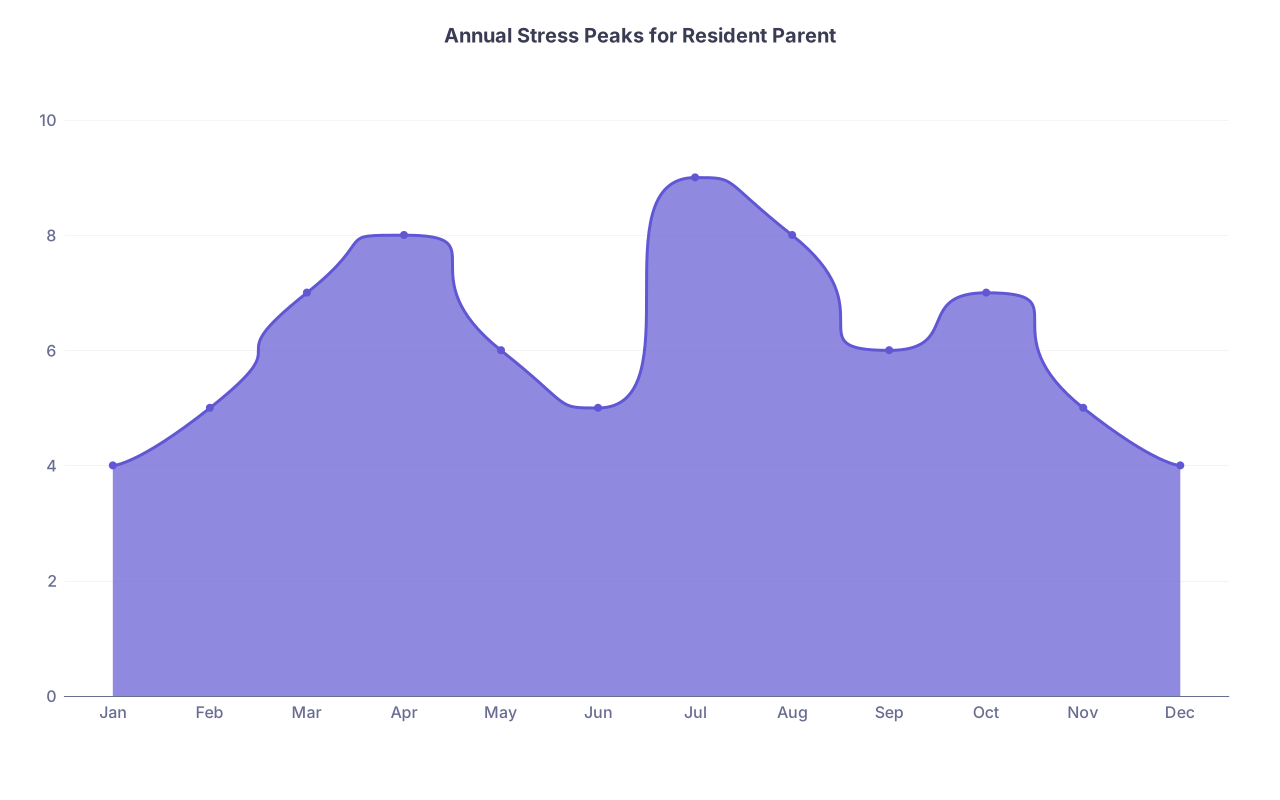
| Category | Value |
|---|---|
| Jan | 4 |
| Feb | 5 |
| Mar | 7 |
| Apr | 8 |
| May | 6 |
| Jun | 5 |
| Jul | 9 |
| Aug | 8 |
| Sep | 6 |
| Oct | 7 |
| Nov | 5 |
| Dec | 4 |
If your proposed mission trip lands on top of boards + an ICU month + your second baby’s due date… you already know the answer.
Emotional Reality: Guilt From Every Direction
One last thing people don’t say out loud: you will feel guilty no matter what you choose.
- Stay home for family → guilt about “abandoning the poor”
- Go on the trip → guilt about leaving your kids
- Focus on training → guilt that you’re “delaying obedience”
You’re not going to logic your way out of that completely. What you can do is:
- Anchor your decisions to a clear hierarchy you’ve already agreed on
- Ask two or three wise people who know you and your family, not random internet voices
- Accept that some guilt is just the tax of caring about more than one good thing
Over time, the question shifts from “How do I stop feeling guilty?” to: “Am I making sustainable, honest choices that align with my values and protect the people entrusted to me?”
That’s adult faith. And adult ethics.


| Step | Description |
|---|---|
| Step 1 | Trip Opportunity |
| Step 2 | Do not go this year |
| Step 3 | Proceed with trip and debrief |
| Step 4 | Family stable and supported |
| Step 5 | PD approves schedule |
| Step 6 | Childcare plan redundant |
| Step 7 | Financially viable |
FAQ (Exactly 5)
1. Is it selfish to go on international missions while my kids are still very young?
Not automatically. It becomes selfish when you consistently ignore the impact on your partner, your children, or your training just to satisfy your own sense of purpose or adventure. One well-planned, supported trip every year or two can be workable even with young kids, especially if your partner is fully on board, childcare is solid, and you’re not financially imploding. If every year feels like survival mode at home, that’s a season where the most ethical “mission” might be local service and preparation rather than international travel.
2. How do I handle a program director who’s skeptical or unsupportive about missions?
Treat their skepticism as a data point, not an enemy attack. Some PDs have legitimate concerns: coverage, accreditation, optics. Come in with specifics: timing, how you’ll meet requirements, how coverage will work. If they still say no, you have two choices: accept that for this training phase, formal international trips are off the table, or consider whether a different residency with a built-in global health track is worth the upheaval. What you do not do is go anyway and burn trust—the cost will be higher than one missed trip.
3. What if my spouse/partner says they’re “fine” with me going, but I can tell they’re not?
You slow down. Probe gently, and give them permission to say no without being cast as the “unspiritual” one. Try: “I would love to go, but not at the cost of you drowning. If you honestly feel like this year is too much, I’d rather hear that now than feel it through resentment later.” If they still won’t be direct, look at their behavior. Are they already exhausted? Has there been conflict about time away in the past? In ambiguous situations, lean conservative—one delayed trip is better than a cracked marriage.
4. Is it better to bring my kids on shorter mission trips or leave them at home?
It depends on age, destination, risk, and the purpose of the trip. Dragging a toddler to a high-risk, high-intensity setting where you’re clinically needed is usually a bad idea. Taking a 10‑ or 12‑year‑old on a well-structured, lower-risk, relationship-focused trip where you’re not constantly on call can be fantastic. Under about age 6–7, I’d lean toward leaving them home with strong support and building family rituals around your going and returning. As they get older, selectively involving them can be part of their formation, but not as props for your narrative.
5. How do I process the emotional whiplash of going from a mission field back to residency and parenting?
You need intentional decompression. That means at least three things: one debrief with someone who understands missions (mentor, counselor, team leader); one honest conversation with your partner about what you saw, without dumping trauma on them; and one clear transition ritual back into “home mode” with your kids. Also, do not schedule your hardest rotation immediately after you return if you can help it—you’ll be more irritable, more sleep-deprived, and more vulnerable to compassion fatigue. Use that post-trip window to integrate what you learned into your everyday life, not to prove how tough you are.
Key Takeaways
- You need a real hierarchy—family, training, missions—and you have to actually use it when decisions hurt.
- Systems beat heroics: childcare plans, PD agreements, financial caps, and yearly family check-ins keep you out of crisis mode.
- Your calling to missions does not compete with your obligations to your kids and spouse; it has to be expressed in a way that protects them, respects your training, and serves others without turning you into a martyr.


