

It’s day three of your medical mission. You’re in a hot, crowded clinic in rural Honduras. The line outside wraps around the building. Inside, a local nurse brings in a young woman with a large breast mass. The senior local physician looks at you and says, almost casually:
“You’re from the US, right? You can do a biopsy. Or excise. Yes? Please. We do not have time to send her to the city.”
Everyone turns and looks at you.
You’ve done a couple of punch biopsies in residency. You’ve never done a full excisional biopsy alone. You have limited supplies, one aging cautery unit, no reliable pathology system, and no clear follow-up plan.
But this woman is staring at you with hope and desperation. And your own team is expecting you to “step up.”
Here’s what you do next.
1. Get Clear on One Thing: Doing More Than You’re Trained For Is Not Heroic
Medical missions breed pressure to be a hero. You see huge needs, minimal resources, and hear subtle (or explicit) lines like:
- “This might be their only chance.”
- “We have to do what we can.”
- “In the US this would be easy for you.”
Let me be blunt: being on a mission does not expand your scope of practice. Your skillset does not magically level up because you flew over an ocean and put on a matching t-shirt.
If you would not do it, unsupervised, in your home hospital with your license, your malpractice, and your name on the chart, you do not suddenly get to do it in another country just because no one’s watching.
That’s not cultural humility. That is using poorer, less-protected patients as practice material. It’s unethical. And it will haunt you if a bad outcome happens.
So the frame is simple:
- Your real training and competence
- The actual resources and follow-up available
- The patient’s best interest, not your ego or your team’s expectations
Once you accept that, the rest of the decisions get clearer.
2. Immediate Triage: Ask Yourself These Three Questions Before Saying Yes
Before you touch a scalpel, run this quick internal checklist. Out loud in your head. No hedging.

Question 1: Am I independently competent in this procedure at home?
Not “I once saw it.”
Not “I did one under supervision.”
Not “I watched a YouTube video.”
Independent competence means:
- You’ve done enough of these alone to manage the usual and some unusual complications.
- You know when to abort or modify the procedure.
- You can handle the immediate complications (bleeding, airway issues, local anesthetic toxicity, etc.) with what’s available.
If the honest answer is no, that’s a hard stop. You should not do it.
Question 2: If a major complication happens, can this setting handle it?
Pretend worst-case:
- Severe bleeding you can’t stop
- Anaphylaxis to lidocaine
- Post-op infection requiring IV antibiotics
- Peritonitis after an “easy” abdominal procedure
Look around. Do you have:
- Resuscitation supplies?
- A way to transfer to higher-level care within a reasonable window?
- Antibiotics, oxygen, basic monitoring?
If the system cannot respond to the complications that procedure can reasonably cause, you are increasing risk exponentially. That’s not “better than nothing.” That’s gambling with someone else’s body.
Question 3: Is there a realistic plan for follow-up?
Without follow-up, you’re not doing a procedure. You’re doing a one-time event and hoping.
Follow-up questions:
- Is there a local clinician who will see this patient next week if there’s a problem?
- Will they recognize and manage complications?
- Do they know what you did and why you did it?
- Is there any documentation in a form they can actually access and understand?
If follow-up is zero or near-zero, the threshold to intervene should be incredibly high.
If any of these three questions come back as “no,” your default answer should be: do not perform the procedure as requested. You then move to safer alternatives and escalation.
3. How to Say “No” Without Burning Bridges (Or Looking Like the Arrogant Outsider)
Sometimes the hardest part isn’t the clinical judgment. It’s saying no in front of the local doc, your mission leader, and a room full of patients.
You need language that is:
- Clear
- Respectful
- Non-defensive
- Focused on patient safety
Here’s workable phrasing you can adapt.
To the local clinician
“I want to help, but I have not been trained to safely perform this procedure alone. I would not do this independently in my home hospital, and I’m not comfortable doing something here that I wouldn’t do there. Let’s see what safer options we have for her.”
If they push back with, “But you are from the US, you can do it,” you can add:
“In the US, this would be done with different equipment, monitoring and surgical backup. Without those, the risk of hurting her is higher than the chance of helping. I don’t want to cause a complication that this clinic can’t manage.”
To your mission team leader (if they’re pressuring)
“I’m not independently competent in that procedure. Doing it here would be below the standard I practice at home. I’m not willing to put the patient at that kind of risk.”
If they say “that’s how missions work,” my translation: they’re used to people overstepping their training. That doesn’t make it right.
To the patient (through interpreter if needed)
This is the important part.
“Where I work, this procedure is done by someone with more training than I have, with more equipment and support than we have today. If I did it here, it could be unsafe for you. I don’t want to do something that might hurt you. Let’s talk about what we can safely do and what options might exist for you.”
You are not saying, “I won’t help.” You’re saying, “I won’t harm you in the name of helping.”
4. What To Do Instead: Safer, Ethical Alternatives
Saying no does not mean walking away. It means pivoting to something that is actually in the patient’s best interest.
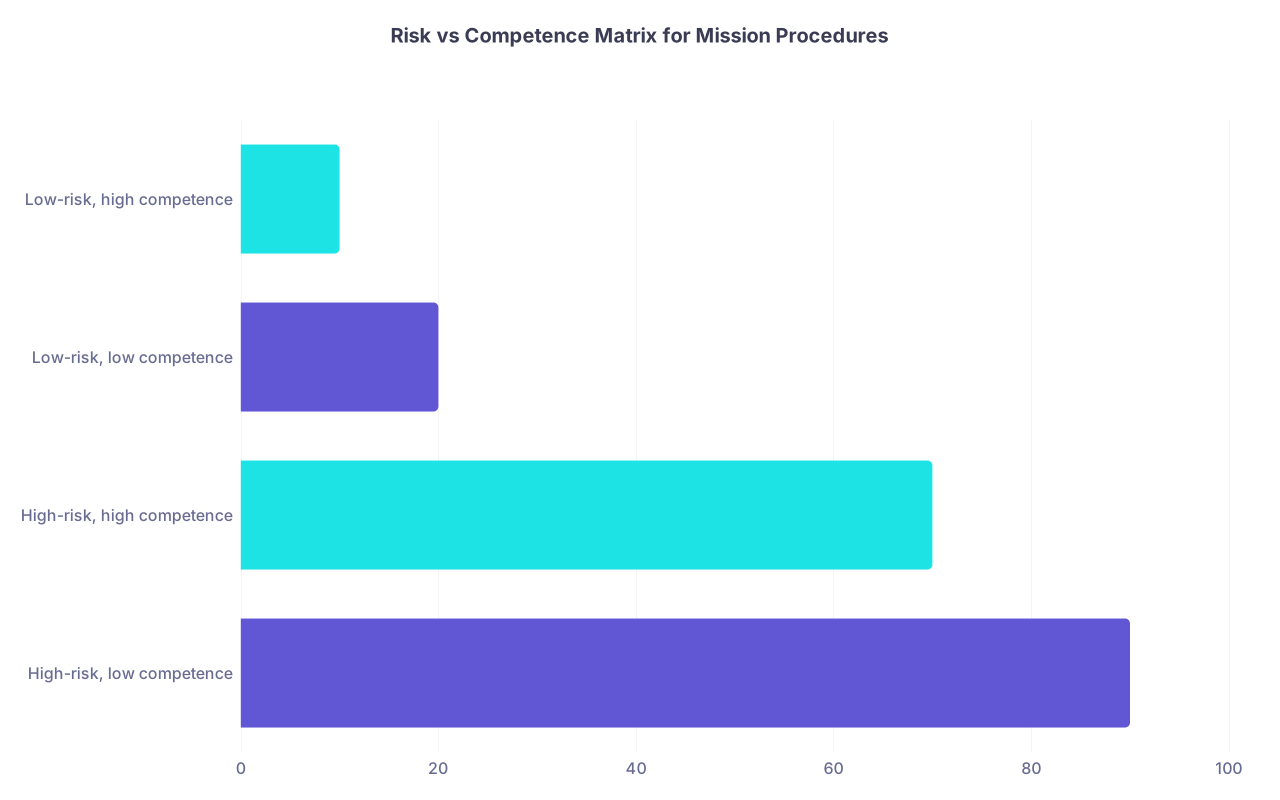
| Category | Value |
|---|---|
| High-risk, low competence | 90 |
| High-risk, high competence | 70 |
| Low-risk, low competence | 20 |
| Low-risk, high competence | 10 |
Think in tiers.
Tier 1: Non-procedural care you can do well
Sometimes the most ethical move is to stay in your lane, even if it feels underwhelming.
Examples:
- Thorough exam and documentation of the mass or condition
- Optimizing pain control, infection control, chronic disease management
- Counseling on red flag symptoms that should trigger urgent local care
- Writing a detailed summary (in simple language) for the local clinician
You may not be removing the tumor. But you can be the first person who actually explains what might be going on, what to watch for, and what steps might still be possible.
Tier 2: Simplified or partial procedures within your clear competence
Sometimes there is a modified, safer step you are actually trained for.
Examples:
- You’re asked to do a complex laceration repair with tendon involvement that you’re not trained for. You can:
- Perform irrigation and simple closure for the skin only if appropriate
- Or just irrigate, loosely approximate, and explicitly document the need for surgical follow-up, rather than trying to reconstruct anatomy you don’t understand.
- You’re asked to do a joint injection you’re shaky on.
- Instead, you explain you’re not confident in the specific injection, but you can provide oral meds, bracing, and ROM exercises, and clearly document for someone locally to consider injection later.
The key: your “yes” stays inside procedures you’d be allowed to do alone at home.
Tier 3: Escalation and advocacy
You won’t fix the structural problems in one trip. But for that patient in front of you, you can still advocate.
Concrete moves:
- Ask the local clinician: “Is there any government program, charity hospital, or NGO that can take her for surgery or specialty care?”
- Document the case well (without identifiers when you take notes home) and bring it to your mission organization afterwards:
- “We saw multiple late-stage breast cancers. Is there a way to partner with a regional hospital for subsidized diagnostic workup?”
- If there’s a patient fund or emergency aid program: help her apply or talk with whoever manages it.
None of this is dramatic. It’s slow, systematic, and less personally satisfying than “saving” someone with your own hands. But it’s real care.
5. Handling Pressure From Your Own Team
Sometimes the ugliest pressure comes from your colleagues—even the “ethical” ones at home turn into cowboys abroad.
You’ll hear:
- “This is mission medicine, not residency clinic.”
- “If you don’t do it, no one will.”
- “You’re overthinking it.”
No. You’re not overthinking. You’re actually thinking.
Here’s how to push back without turning it into a brawl.
Strategy 1: Invoke your home standard explicitly
“I would not be permitted to do that independently at my US program. My competence hasn’t changed just because we flew here. I’m not putting this patient at higher risk just because they’re poor and far away.”
Hard to argue with that without sounding explicitly unethical.
Strategy 2: Make risk visible
Spell out the worst-case scenario.
“If we do this and she hemorrhages, we have no blood, no ICU, no OR. We’ll watch her die on this table. If we do nothing procedural, she at least has a chance to seek care elsewhere.”
You’re not threatening. You’re clarifying reality.
Strategy 3: Name the ethical line
“I came here to help, not to practice procedures I’m not trained for on people who can’t consent to that risk meaningfully. I’m not crossing that line.”
Sometimes saying the thing out loud snaps people out of mission-drunk thinking.
If your team keeps pushing, that’s data. That tells you something about whether you ever want to work with this organization again.
6. Consent on Missions: Why “They Agreed” Isn’t Enough
On paper, the patient “consented.” On the ground, consent is distorted by:
- Power differentials (you’re the foreign doctor, they’re desperate)
- Language and cultural gaps
- Limited alternatives (“agree or get nothing” isn’t really a choice)
- Misunderstanding what “rare complication” actually means
Ethical consent for a higher-risk procedure where your own skills or resources are borderline means you must be extra clear, not less.
Elements you cannot skip:
- Who you are and your level (student, resident, attending, NP, PA, etc.)
- How many times you’ve done this alone before
- The specific risks that are more dangerous here due to limited resources
- What happens if this goes badly—what help is or isn’t available
- The real alternative: not doing it now and seeking care later, even if that’s logistically hard
If you cannot say all that plainly (via a good interpreter, not your broken Spanish or French), then consent is weak at best.
And if you feel like being honest about your level of training would make them say no—then they’re not truly consenting to what you’re actually offering. That’s your answer.
7. Before the Next Trip: How to Prevent This Situation From Ambushing You Again
This won’t be the last time someone tries to hand you a procedure beyond your training. You can prepare so you’re not improvising ethics under pressure.

| Step | Description |
|---|---|
| Step 1 | Decide to join mission |
| Step 2 | Clarify your scope |
| Step 3 | Ask org about expectations |
| Step 4 | State limits in writing |
| Step 5 | Review procedures you are competent in |
| Step 6 | Plan referral and follow up pathways |
| Step 7 | Rehearse how to say no |
Step 1: Clarify your scope with yourself
Sit down and write two lists before you go:
- Procedures I can do independently at home, safely, with known complication management
- Procedures I absolutely will not do, here or there, without supervision or proper setup
Bring this with you. Literally. When the heat is on, having it in writing helps anchor you.
Step 2: Ask the organization specific questions
Do this before you commit fully:
- “What procedures are typically done on these trips?”
- “Who decides what’s within scope?”
- “What local systems exist for handling complications or referrals?”
- “How is consent handled and documented?”
If they respond with vague hand-waving—“Oh, we just see what shows up”—be cautious. That’s code for “we let people wing it.”
Step 3: State your limits in advance
Email the trip lead:
“I want to be clear ahead of time about my scope. I’m comfortable with X, Y, Z independently. I’m not trained for A, B, C and will not perform those unsupervised. I’m sharing this so there’s no confusion on the ground.”
Now your “no” on site is backed by a documented boundary.
Step 4: Learn to say no out loud before you leave
Actually practice phrases in the mirror or with a colleague. Out loud. So they come out of your mouth smoothly when you’re tired and stressed.
For example:
- “I’m not trained for that and I won’t do it unsupervised.”
- “This clinic doesn’t have the resources to safely manage the complications of that procedure.”
- “I don’t do anything here that I wouldn’t do at home.”
This is muscle memory. Build it.
8. When You Already Crossed the Line: Guilt, Debrief, and Repair
If you’re reading this after a mission, thinking, “I already did things I shouldn’t have,” you’re not alone. I’ve seen residents come back from trips anxious, ashamed, or rationalizing what they did because the alternative is admitting they harmed someone.
Here’s how you handle that.
Be honest with yourself.
“I did procedures beyond my real training, in a low-resource setting, and I’m not sure it was right.” That sentence is brutal. And necessary.Debrief with someone who understands.
Not your friend who thinks every mission is wonderful. Someone with global health ethics experience, your residency PD, or a trusted attending who’s blunt and thoughtful.Analyze the cases.
For each “borderline” or wrong procedure:- Were you truly the last/only option?
- What were the real alternatives?
- What went well, what didn’t, and where did you get lucky?
Change future behavior explicitly.
“In the future, I will not do X without Y.” Put it in writing. Treat it like a QI project on your own ethics.If harm was clear and traceable, talk to your organization.
This is tough, but silence keeps bad patterns alive.
“On this trip, I was asked to do X, which I’m not trained for. I went along and now I’m concerned about the safety of this model. We need to re-examine our scope and protocols.”
If the organization brushes it off? Seriously consider never working with them again. And tell your peers why.
9. Bottom Line: Your Ethics Should Travel With You
Mission work exposes the cracks in your training, your judgment, and your courage to say no. You will feel pulled to be braver, looser, more “creative.” People will praise you for it if you go along.
But long term, your reputation—externally and internally—is built on the times you refused to abandon your standards when no one was watching.
If a procedure would be unacceptable, unsafe, or outside your competence at home, then doing it abroad on a vulnerable patient is not service. It’s exploitation dressed up as altruism.
Your job on a mission isn’t to be a hero. It’s to be the same clinician you are at home: bound by training, honesty, and the duty to first, do no harm.
Do This Today
Open a blank document and write two lists:
- “Procedures I am truly competent to do independently.”
- “Procedures I will not do unsupervised, at home or abroad.”
Be brutally honest. Save it. Before your next mission—or your next “opportunity” abroad—pull that list up and make one concrete promise to yourself: you won’t let geography change which side of that line you stand on.


