
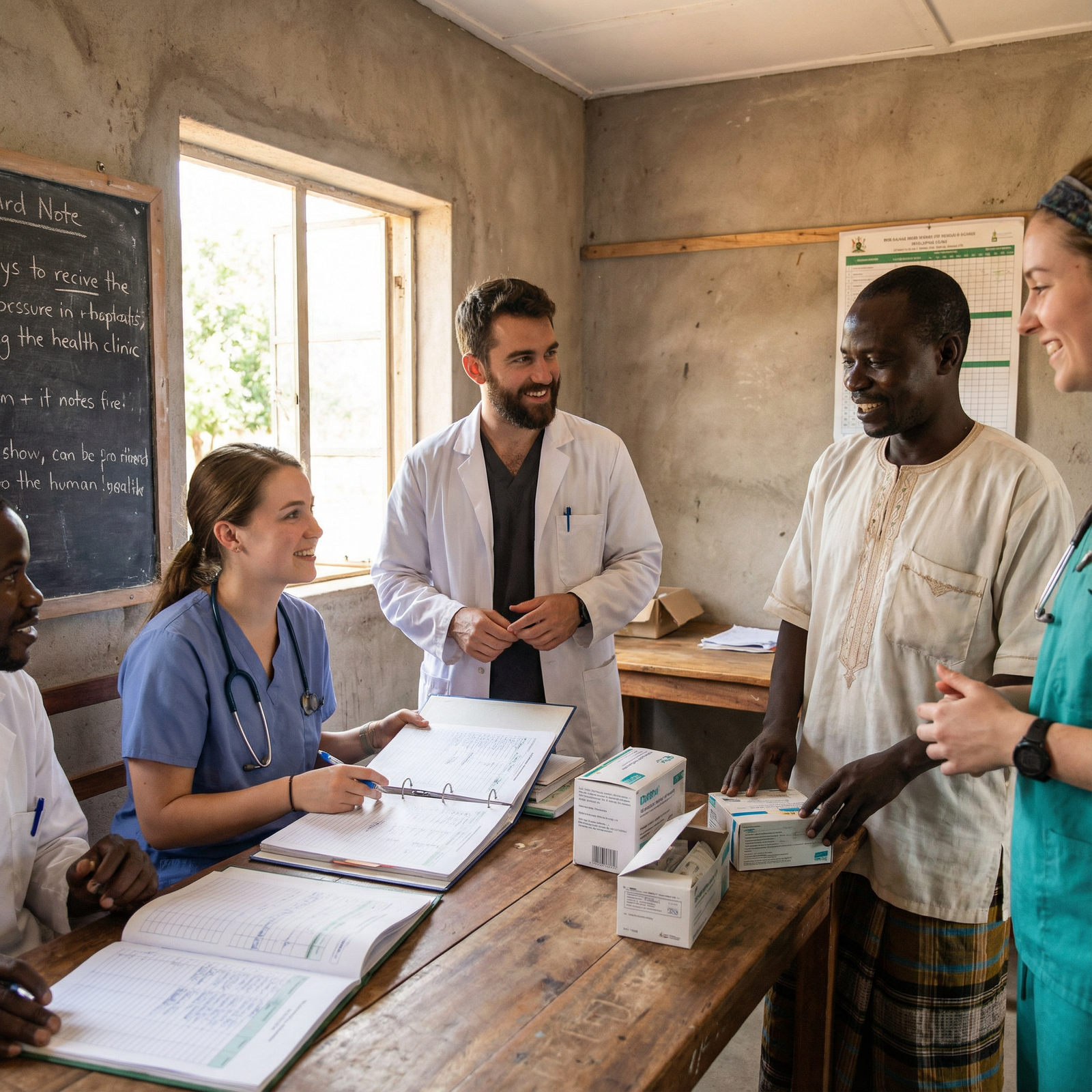
The worst time to realize your medical mission might be unethical is after you’ve already paid the deposit. But that’s exactly when most people finally start asking the right questions.
If you’re already signed up for a sketchy-sounding medical mission, you’re not doomed. You just have to stop coasting and start making active choices. There are ways to course-correct—some before you go, some during, and some after—but they all require you to drop the “it’ll probably be fine” mindset.
This is the playbook I’d give a student sitting in my office, panicking with a printed itinerary for a “surgery-focused global health experience” in a low-resource country where they’ve never touched a scalpel.
Step 1: Get Honest About Why This Mission Feels Dubious
You cannot fix what you will not name. Start by diagnosing the problem like you would a patient.
Common red flags I keep seeing:
- You’re a premed or early med student and the mission promises you’ll “perform” or “assist with” procedures far beyond your training—delivering babies, suturing, pulling teeth, administering anesthesia, “participating in surgeries.”
- There’s no credible local partner. The website is all glossy photos of Western students; local physicians and institutions are barely mentioned.
- No clear scope of practice. Nobody has spelled out exactly what you will and will not be allowed to do.
- No meaningful pre-departure training. Maybe a one-hour Zoom about “culture” and “packing lists,” but nothing on local health systems, ethics, or supervision.
- They brag about “impact numbers” (X surgeries done, Y patients seen) while being vague about follow-up care or continuity.
- It’s run by a travel company or generic NGO, not a legitimate medical or academic institution.
Do a 10–15 minute focused review:
- Re-read the mission website and emails. Highlight anything involving:
- “Hands-on clinical experience”
- “Performing procedures”
- “Operate under the guidance of local staff” (often code for “we’ll loosely watch you do unsafe things”)
- Check who’s actually accountable:
- Is there a named physician leader?
- Are they licensed in the host country?
- Are local health authorities or hospitals clearly partnered?
- Ask yourself bluntly: “If this exact thing were done by untrained foreigners in my own country, would I think it was acceptable?”
If you’d be outraged, there’s your answer.
Once you’ve articulated the specific ethical issues, you can decide: cancel, renegotiate your role, or go with strict boundaries.
Step 2: Decide Whether You Should Cancel—And How to Do It
Yes, canceling is embarrassing. Yes, you might lose money. No, that doesn’t make an unethical trip suddenly okay.
Let’s be clinical. You’re balancing:
- Harm to patients
- Harm to your reputation
- Financial loss
- Relationship/political fallout at your school or with the organization
Use a simple decision frame
Ask three questions:
- Will this mission expect or encourage me to provide care I am not trained or licensed to give?
- Is there credible, accountable local leadership and follow-up care for patients?
- Have my direct questions about scope, supervision, and ethics been answered clearly and in writing?
If you get:
- “Yes” to #1, or
- “No” to #2, or
- Vague/deflecting answers to #3,
Then the default recommendation: cancel if at all possible.
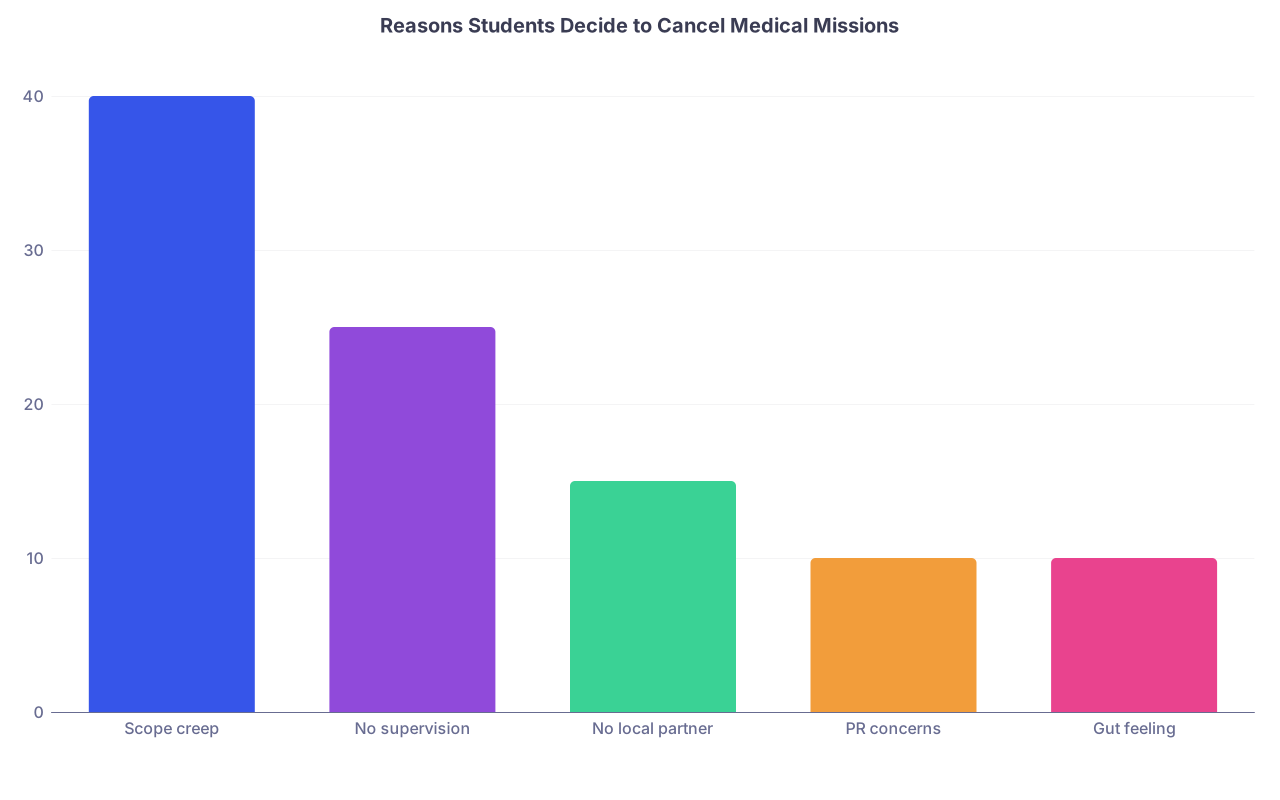
| Category | Value |
|---|---|
| Scope creep | 40 |
| No supervision | 25 |
| No local partner | 15 |
| PR concerns | 10 |
| Gut feeling | 10 |
Numbers here are illustrative, but the pattern is real—scope creep and lack of supervision are the most common deal-breakers.
How to cancel with minimal drama
Script it. Do not over-explain. You’re not on trial.
Email template to the organization:
Dear [Name/Organization],
After reviewing the details of the [location] trip and reflecting on my current training level and professional responsibilities, I’ve decided I am not the right fit for this program at this time.
I appreciate the opportunity and the work your team is doing. Could you please confirm the cancellation process and clarify whether any portion of my payment can be refunded or credited?
Best regards,
[Your Name]
That’s it. You don’t need to debate them about ethics. You’re withdrawing your participation, not trying to reform their model.
If they push back: “We really need you,” “We’ve always done it this way,” “You’ll be supervised,” etc.—stay neutral but firm:
I understand and respect your experience with these trips. After consulting with mentors and considering my professional responsibilities, my decision stands. Please proceed with the cancellation.
Then talk money:
- Read the fine print you already signed.
- Ask politely if they’d consider partial refund, future credit, or transfer to a non-clinical placement.
- Accept that you might lose the deposit or full cost. Better that than compromising patient safety or your career.
If your school is tangentially involved (faculty “recommending” this program), talk to someone you trust—global health faculty, dean of students, or an ethics office. Be factual: “I’m concerned that this program expects students at my level to [insert concrete concern]. I’ve chosen not to participate.”
You’re not being dramatic. You’re acting like a professional.
Step 3: If You’re Going Anyway, Lock Down Your Ethical Boundaries Now
Sometimes you can’t or won’t cancel. Maybe the money is nonrefundable. Maybe this is tied to a course. Maybe you genuinely believe parts of the experience could be ethical and valuable.
Fine. Then your job is to aggressively define and defend your scope of practice.
Step 3A: Get explicit answers before you go
Send a concise, direct email to the trip organizer or supervising physician:
Dear [Name],
I am looking forward to the upcoming [location] trip. To prepare appropriately and ensure I stay within my training level, could you please clarify:
- What clinical tasks are students at my level explicitly expected and allowed to perform?
- What tasks are we explicitly not allowed to perform?
- Who will be directly supervising me on-site, and will they be physically present when I’m interacting with patients?
- How is patient follow-up and continuity of care handled after our team leaves?
Having this in writing will help me prepare and make sure I contribute safely and appropriately.
Best,
[Your Name]
If they give you vague answers like “You’ll learn as you go” or “It depends on the situation,” that’s not acceptable. You can reply once, more pointedly:
To avoid any misunderstanding, could you give a few concrete examples of what students like me did on the last trip? For example, did students take histories only, or also perform physical exams and procedures?
No hard answers = huge red flag.
Step 3B: Decide your personal “no” list in advance
You’ll be tired, jet-lagged, and social-pressured on site. Do not trust yourself to improvise clear boundaries under that kind of pressure. Write them now.
Examples, depending on your level:
If you’re a premed:
- No diagnosing or prescribing.
- No independent physical exams that affect management.
- No injections, suturing, or procedures, period.
- No implied authority—don’t introduce yourself as “doctor,” ever.
If you’re a first- or second-year med student:
- History-taking and vitals? Fine, if supervised.
- Physical exam? Only as practice, with explicit patient consent and oversight, not as sole exam.
- No independent decision-making about treatment.
- No procedures beyond very basic tasks you’ve been trained in and routinely performed under supervision at home (and even then, be cautious).
If you’re a clinical student:
- Do only what you are already allowed to do in your home hospital, and only with comparable or tighter supervision.
- No stepping up two levels just because you’re in a rural clinic.
Write it down:
“I will not:
– Prescribe or choose medications independently.
– Perform procedures I have not already performed competently under supervision at home.
– Act without a supervising licensed clinician present when I’m touching patients.”
That becomes your internal contract with yourself.
Step 4: On the Ground – How to Handle Pressure and Scope Creep
This is where people crack. You’re there, there’s a line of 80 patients outside, the local nurse says “You suture, we are busy,” and the US trip leader says, “This is why you came.”
You need rehearsed lines. Ready to use. Short, respectful, firm.
Phrases that work in real life
When asked to do something beyond your training:
- “I’m not trained to do that safely. I can assist or observe, but I can’t perform it.”
- “In my home institution I’m not allowed to do this yet, so I’ll need to stay within that same level here.”
- “For patient safety, I’m not comfortable taking that on. Can I help in another way?”
If someone insists:
- “I understand the need, but my responsibility is to not do anything beyond my abilities. Let me help with triage, paperwork, or translating instead.”
Say it calmly. Don’t argue. Don’t launch into an ethics lecture. Just repeat variations of that line.
Protecting patients from “group momentum”
Watch for these high-risk patterns:
- Mass tooth extractions by students with a weekend course.
- Students doing pelvic exams, cervical checks, or delivering babies.
- Students independently running triage and deciding who gets what medication.
- “Teaching labs” on real patients (e.g., everyone tries an injection on the same afternoon).
If things go bad:
- Quietly step back. Stop participating in the problematic activity.
- If there’s a senior clinician you trust, debrief privately: “I’m concerned that we’re doing X without adequate training. Is there a way to change this?”
- If no one is receptive, at minimum, do not add your own unsafe actions to the pile. Observing a problematic system isn’t the same as actively harming patients.
And if someone tries the guilt line—“If you don’t help, these patients won’t get any care”—remember: harm is not better than no care. Would you justify unsafe spinal taps on kids in your home hospital because “otherwise they’d go undiagnosed”? No. Same standard applies.
Step 5: Document and Debrief – For Your Sake and Theirs
You’re not done when the flight lands back home. This is the part almost no one does well, and it’s where you can actually turn a bad situation into ethical growth.
Keep a private, factual log
Not for Instagram. For you.
Each day, jot down:
- What you actually did clinically (tasks, level of supervision).
- Any moments you felt ethically uneasy or directly uncomfortable.
- Quotes or attitudes that bothered you (“They’re lucky to get anything” is a classic).
- How patients were followed up—or not.
No need for dramatics. Just facts and your reactions.
This becomes:
- Evidence if anyone later questions your role.
- Raw material for reflection in future personal statements, if you’re honest about what went wrong.
- A mirror that keeps you from rewriting history as “overall it was fine” just because it’s over.
When you get back: debrief with the right people
Do not process this only with the same peers who were on the trip. Groupthink is strong, and nobody wants to admit, “We messed up.”
Find:
- A global health faculty with real experience (not just someone who “likes travel”).
- An ethics professor or clinician.
- A mentor who will tell you the truth even if it stings.
Bring specifics, not vibes:
“I was asked to [example]. I declined, but other students did it. Supervision was [describe]. Patients had [or did not have] access to follow-up. Here’s what I did and didn’t do. How should I think about this?”
If your school endorsed or promoted the program, consider a brief, calm report up the chain. One page, focusing on:
- Structure (who led, who supervised, what training happened).
- Concrete examples of unsafe or unethical expectations.
- Suggestions: “If the school continues this relationship, I’d strongly recommend limiting roles to observation and structured teaching, with clear scope and training.”
You’re not whistleblowing to blow things up; you’re trying to prevent the next cohort from walking into the same mess.
Step 6: Salvage the Experience Ethically in Your Narrative
You will eventually face the question in interviews or essays: “Tell me about your global health/medical mission experience.”
Do not spin. Admissions committees and PDs have read enough “I saved the poor villagers” essays to last ten lifetimes. They notice who’s honest about power, harm, and learning.
The smart way to talk about a dubious mission:
Acknowledge the concern up front.
“I joined a short-term medical mission to [country] as a [premed/MS1]. I later realized the model had serious ethical problems.”Name specifics.
“Students were encouraged to [give injections/prescribe/perform procedures] beyond our training, and supervision was limited.”Take responsibility for your role.
“Once I recognized that, I decided I would only [take histories/observe/help with logistics] and refused to perform tasks I wasn’t trained for.”Show what you changed because of it.
“When I got back, I debriefed with faculty, reported my concerns, and now I only participate in programs with established local partnerships and defined student roles.”
That’s what maturity looks like. Not pretending it was a “life-changing” unqualified good. But showing that when confronted with a messy situation, you course-corrected and raised your standards.
Step 7: Build Yourself a Better Alternative Path
If you canceled, or if you now realize that kind of mission is off the table for you, good. You haven’t ruined your career. You’ve protected it.
What to do instead that’s actually ethical and impressive:
Work with immigrant/refugee clinics at home.
Same cross-cultural skills, far better continuity, and you’re under your home system’s ethical standards.Join a university-affiliated global health project with real partnerships.
Not a “safari clinic.” A bilateral exchange, research collaboration, or long-term twinning program. If the local institution leads, that’s usually a good sign.Focus on language proficiency.
Being truly fluent in Spanish, French, Arabic, etc. will do more for your future patients (at home and abroad) than one week of “doing sutures” as a premed.Develop nonclinical skills low-resource health systems actually need:
Quality improvement, data management, logistics, supply chain work. Not sexy. Very useful.
| Option | Key Benefit |
|---|---|
| Local immigrant clinic | Continuity + supervision |
| University global health team | Real partnerships, sustained work |
| Language immersion program | Direct patient communication skill |
| QI project in home hospital | Systems thinking, scalable impact |
| Remote research collaboration | Skills without clinical overreach |
None of these require you to pretend to be a doctor in a place that can least afford your mistakes.
Step 8: If You’re Truly Stuck and Leave Soon
Sometimes you’re reading this 5 days before departure. Ticket bought. Nonrefundable. Pressure sky-high.
Here’s the “bare minimum” rescue plan:
- Get your role in writing (even if vague).
- Write your personal “no” list and actually carry it on a card in your pocket.
- Decide now that you’d rather be “the annoying cautious one” than the reckless hero.
- Find at least one ally on the trip (another student who shares your concerns) and agree to back each other up when pressured.
- Plan a formal debrief for when you return and block time for it in your calendar now. Treat it like part of the trip, not an optional afterthought.

| Step | Description |
|---|---|
| Step 1 | Realize trip is dubious |
| Step 2 | Clarify role in writing |
| Step 3 | Set personal no list |
| Step 4 | Identify ally on team |
| Step 5 | Commit to saying no when needed |
| Step 6 | Schedule post trip debrief |
This will not magically transform a bad model into a good one. But it will keep you from becoming an active participant in the worst parts.
The Bottom Line
If you’re already signed up for a dubious medical mission, you still have real choices:
- You can walk away and eat the cost rather than eat the guilt.
- If you go, you can strictly limit your role, say no to unsafe tasks, and refuse to let someone else’s broken model dictate your ethics.
- You can use the whole mess as a turning point—to raise your standards, demand real partnerships, and seek out work that respects patients as more than training material.
That’s how you course-correct. Not by pretending it’s fine. By acting like the clinician you’re trying to become, before anyone hands you the title.


