

The worst behavior on mission trips usually isn’t from “bad people.” It’s from decent people acting blindly.
If your mission team is being culturally insensitive, you’re not imagining it, and you’re not overreacting. You’re watching power, stress, and ignorance mix into something that can genuinely harm patients and communities. Your job is to decide how to intervene without blowing yourself up in the process.
Let’s walk through what to do, step‑by‑step, while you’re actually there — not in some ideal ethics seminar.
Step 1: Name What You’re Seeing — To Yourself First
You can’t intervene well if everything just feels like a vague “this feels off.”
Sit down and label the behavior clearly in your own head. Concrete, not emotional.
Common patterns I’ve seen on medical missions:
- Mocking or stereotyping local patients or culture (“These people are so uneducated,” “That’s such a primitive belief”).
- Ignoring local clinical norms or decisions (“We’ll just do it our way; it’s evidence-based.”).
- Taking photos of patients without real consent, or posting “poverty porn” to social media.
- Forcing religious conversations on patients in clinical contexts.
- Dismissing local staff input (“They don’t understand modern medicine.”).
- Doing procedures you’re not trained/credentialed to do because “they need help.”
Write down—literally if you can—what you saw or heard:
- Who did it?
- What exactly was said or done?
- Who was affected (patients, families, local staff)?
- When/where did it happen?
- Was anyone physically or emotionally harmed?
This isn’t to “build a case” like a prosecutor. It’s so you don’t gaslight yourself or get dismissed later when someone says, “I’m sure they didn’t mean it like that.”
Step 2: Quickly Triage: Annoying vs. Harmful vs. Dangerous
Not every insensitive comment deserves a full-scale intervention. Some things are annoying. Some are harmful. Some are dangerous.
Use a simple internal triage:
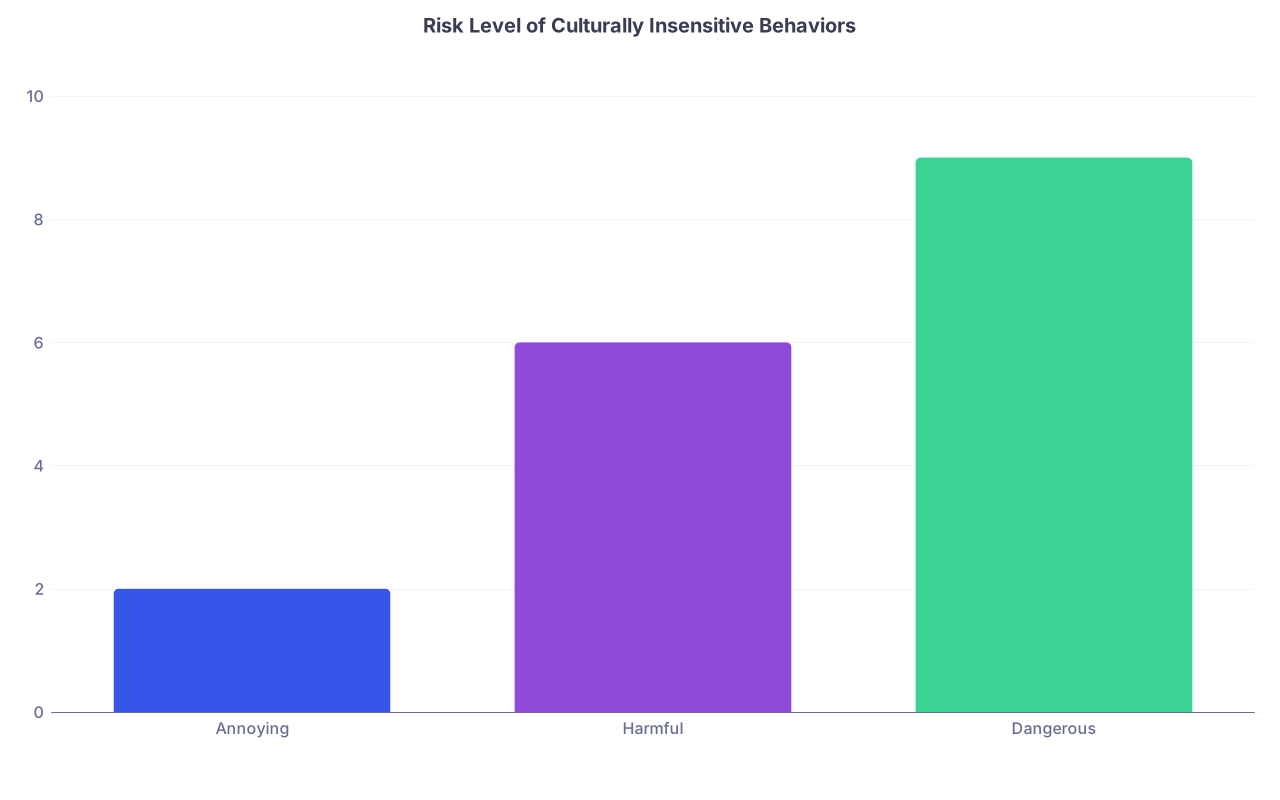
| Category | Value |
|---|---|
| Annoying | 2 |
| Harmful | 6 |
| Dangerous | 9 |
Annoying:
- Eye-rolling about local delays.
- Clumsy jokes that land badly but don’t target anyone specifically.
- Mildly patronizing comments that don’t change care.
Harmful:
- Making fun of beliefs in front of patients.
- Ignoring local language interpreters and talking over them.
- Shaming patients for “non-compliance” without understanding context.
- Posting identifiable patient photos on social media.
Dangerous:
- Violating consent (e.g., touching, examining, or photographing without permission).
- Overriding local clinicians in ways that risk patient safety.
- Performing beyond your training because “no one else will.”
- Aggressive proselytizing that conditions care on belief or participation.
Your response should match the risk level:
- Annoying → brief, low‑key correction or private conversation.
- Harmful → more intentional 1:1 intervention, possibly involving local partners.
- Dangerous → consider immediate interruption, and if needed, escalation to leadership or local authority.
The higher the risk to patients or the community, the more you accept some personal discomfort to intervene.
Step 3: Decide Your Safety and Power Level
This is the part ethics lectures skip: sometimes it’s not safe to confront someone head‑on.
Ask yourself honestly:
- What’s my role? Student, nurse, attending, non‑medical volunteer?
- Who’s doing it? Peer, team leader, sponsoring physician, pastor, trip organizer?
- How dependent am I on them (grades, letters, employment, church politics)?
- Would this person retaliate? Have they done it to others?
You’re not obligated to be a martyr. You are obligated not to be complicit when someone is being harmed and you see it.
Think of your options as a spectrum:
Low risk to you → subtle redirect, questions, modeling better behavior.
Medium risk → private, respectful confrontation.
High risk (they control your career or you’re in a fragile situation) → involve allies, local partners, or document for post‑trip reporting.
Step 4: Real-Time Micro-Interventions You Can Use Immediately
Sometimes you only have 10 seconds to act before the moment passes. Here are scripts that actually work on the ground.
Scenario A: Team member mocks a patient’s belief
Example: “She thinks it’s evil spirits causing her pain. Wow.”
You can jump in right there without shaming them publicly:
- “Different belief systems have their own logic. Let’s ask her more about what this means to her.”
- Or, slightly firmer: “Hey, let’s be careful about joking where patients can see us. They pick up more than we think.”
You’ve redirected, named the problem (joking), and brought it back to patient-centered care.
Scenario B: Someone starts taking photos without consent
Classic move: volunteers snapping photos of kids in the waiting area.
You step in physically and verbally if it’s safe:
- Move between camera and patient slightly.
- “Let’s pause photos for a second — can we check if there’s a consent process here?”
- If a local partner is nearby: “Dr. [Name], what’s the usual rule about photos here?”
Now it’s not just “your opinion”—you’ve brought in the local standard.
Scenario C: Overriding local staff
Example: An American physician tells a local nurse, “No, we’ll just give this med now; it’s fine,” ignoring the nurse’s concern.
You can support the local nurse without grandstanding:
- To the local nurse: “Can you tell me more about the usual practice here?”
- To the physician: “Could we double‑check the local protocol? They might be seeing different resistance patterns here than we’re used to.”
You’re not saying “you’re wrong and imperialistic,” but you’re raising the need to respect local knowledge.
Scenario D: Forced religious conversations in clinical spaces
If someone begins, “Before we treat you, can we talk about Jesus?” in an exam context, that’s a problem.
You can soften and redirect:
- “We can absolutely talk about spiritual questions if you’d like, but let’s make sure your medical care isn’t dependent on that.”
- Or to your teammate later: “We need to separate proselytizing from clinical care. Patients might feel they can’t say no.”
Step 5: Use the 1:1 Conversation — The Workhorse Tool
Most behavior change will happen in private, not in front of the group.
Pick a moment after clinic. No big audience, no adrenaline. Then:
Lead with observation, not accusation.
“Hey, I noticed earlier when we were in triage, you said X about the patients from that village…”Name the impact, not just the intent.
“I know you probably meant it as a joke, but it can really come across as demeaning.”Link to shared values.
“We’re all here to serve with humility and respect; stuff like that can undercut trust.”Offer an alternative.
“Maybe next time, if we’re frustrated or surprised, we talk about it in debrief instead of in front of patients.”
If they get defensive (“I didn’t mean anything by it!”), stay calm:
- “I’m not questioning your intent. I’m talking about how it lands here, in this context, with the power differences we’ve got going on.”
You do not need to win the argument that day. You’re planting a stake in the ground: this isn’t invisible.
Step 6: Use Local Partners as a Compass (And a Shield)
Good rule: if local physicians, nurses, community health workers, or church leaders look uncomfortable, you should be uncomfortable too.
Actively ask them:
- “How does our team’s behavior feel to you?”
- “Are we doing anything that feels disrespectful or out of place here?”
- “If someone on our team crosses a line, who would you want us to tell?”
This does three things:
- Gives you external confirmation you’re not overreacting.
- May give you a local ally who can set boundaries more safely than you.
- Signals that not everyone on the foreign team is blind to power imbalance.
Sometimes the most effective intervention isn’t you confronting your attending; it’s the local medical director saying, “That is not how we treat our patients here.”
Step 7: Use Structured Debriefs to Surface Problems
If your team has any kind of nightly debrief, that’s prime territory to raise cultural issues without targeting individuals by name.
You might say:
- “Today I felt uneasy when I heard some comments about patients being ‘ignorant.’ It made me wonder how we talk about people when they’re not in the room.”
- “I’m struggling with how we’re handling photography here. Are we okay with posting images of patients who may not fully understand social media?”
If your leader is decent, they’ll pick up the thread.
If they shut it down (“Let’s stay positive; we’re doing great work here”), that tells you a lot. You may need another route.
Step 8: Know When It’s Time to Escalate
Sometimes quiet nudges and nice conversations don’t cut it.
Escalate when:
- There’s ongoing disrespect or racism despite feedback.
- Patient safety is at risk.
- Local staff have complained or look distressed but are being overrun.
- You’re seeing repeated consent violations or clear exploitation (photos, stories, fundraising on people’s suffering without community input).
Your options:
- Talk to the trip leader or medical director.
- If they’re the problem, go to the sponsoring organization (hospital, university, NGO, church) while still on the trip if harm is active.
- If your institution has a global health office, they often actually want to know about this.
When you escalate, be specific and factual:
- “On three occasions I witnessed [person] perform [procedure] that they are not trained in, without discussing risks or obtaining clear consent.”
- “Local nurses have expressed discomfort to me about [behavior].”
Not: “They feel racist.”
Instead: “They said, ‘These people are so backwards,’ in front of patients in the waiting area.”
Step 9: Protect Yourself: Documentation and Boundaries
If you’re concerned about retaliation or you’re dealing with a powerful person, you need receipts.
No drama. Just notes.
- Keep a secure file or notebook with dates, times, what was said/done, who was present.
- Save any relevant emails or group messages (screenshots if needed).
- Jot down how local staff reacted or what they told you privately.
This matters if:
- You report to your school/hospital later.
- Someone tries to frame you as “disruptive” or “not a team player” for raising ethical concerns.
Also set personal boundaries:
- You can refuse to participate directly in unethical acts. Example: “I’m not comfortable performing that procedure beyond my training; can we get someone qualified?”
- You can opt out of photos, testimonials, or fundraising materials that feel exploitative.
You might take some heat. Better that than being complicit in harm you knew was wrong.
Step 10: Plan the Post‑Trip Follow‑Through
The trip ends. You get home. The temptation is to move on. Don’t.
This is where real change can happen.

| Step | Description |
|---|---|
| Step 1 | Return Home |
| Step 2 | Write detailed report |
| Step 3 | Reflect and document |
| Step 4 | Send to sponsoring org |
| Step 5 | Share feedback anonymously |
| Step 6 | Follow up for response |
| Step 7 | Was there serious harm? |
What to do after:
Write a clear narrative report.
One or two pages. Events, dates, behaviors, impact, your attempts to address it, who else witnessed it.Send it to the right people.
- Global health director.
- Program director or dean (if it’s an educational trip).
- NGO or mission organization leadership.
- Hospital or church leadership that sponsors the trip.
Offer concrete suggestions.
- Mandatory pre‑departure cultural humility training.
- Clear photography and social media policies.
- Defined scope‑of‑practice rules and enforcement.
- Mechanisms for local partners to give honest feedback without fear of funding cuts.
Ask for accountability, not just “thanks for sharing.”
“Can you share how this feedback will be used and what changes you’re considering? I’d like to see us do better for future trips.”
You can also debrief with peers who care about ethics. What you learn from one bad trip can shape how you choose future organizations. Some groups are simply not safe or ethical, and you’re allowed to say, “I won’t go back.”
Quick Comparison: Response Options and Tradeoffs
| Option | Risk To You | Impact Potential | Best For |
|---|---|---|---|
| Subtle redirect | Low | Low–Medium | Annoying or mild issues |
| 1:1 conversation | Low–Medium | Medium–High | Patterns, harmful behavior |
| Group debrief comment | Medium | Medium | Norm-setting, awareness |
| Escalate to leader | Medium–High | High | Harmful/dangerous issues |
| Report post-trip | Low–Medium | High (long-term) | Structural change |
Build Your Personal “Ethical Red Lines” Before You Go
You handle this whole mess better if you already know your non‑negotiables. Do this even if you’re already on the trip — better late than never.
Examples of reasonable red lines:
- “I will not participate in or be silent about non-consensual photography.”
- “I will not perform procedures beyond my verified training.”
- “I will not allow my presence to be used for deceptive fundraising or storytelling.”
- “I will not join or support explicit shaming or mocking of patients, beliefs, or cultures.”
If your mission team repeatedly crosses your red lines and leadership doesn’t care, the problem isn’t you. You’re in a dysfunctional or unethical program. Your job then is to protect patients, protect yourself, and, if possible, expose the dysfunction to people who can shut it down or fix it.
Don’t Forget This: Cultural Humility Cuts Both Ways
Yes, your team might be culturally insensitive. But be careful not to become the arrogant “ethics police” from your own culture.
Good antidotes:
- Ask more questions than you make statements.
- Involve local partners whenever possible.
- Check your own assumptions: what feels “obviously wrong” to you might be more complicated in context.
(Note: this does not apply to clear abuse or exploitation. Those are wrong everywhere.)
You’re not there to win moral points. You’re there to reduce harm and increase respect. That’s it.
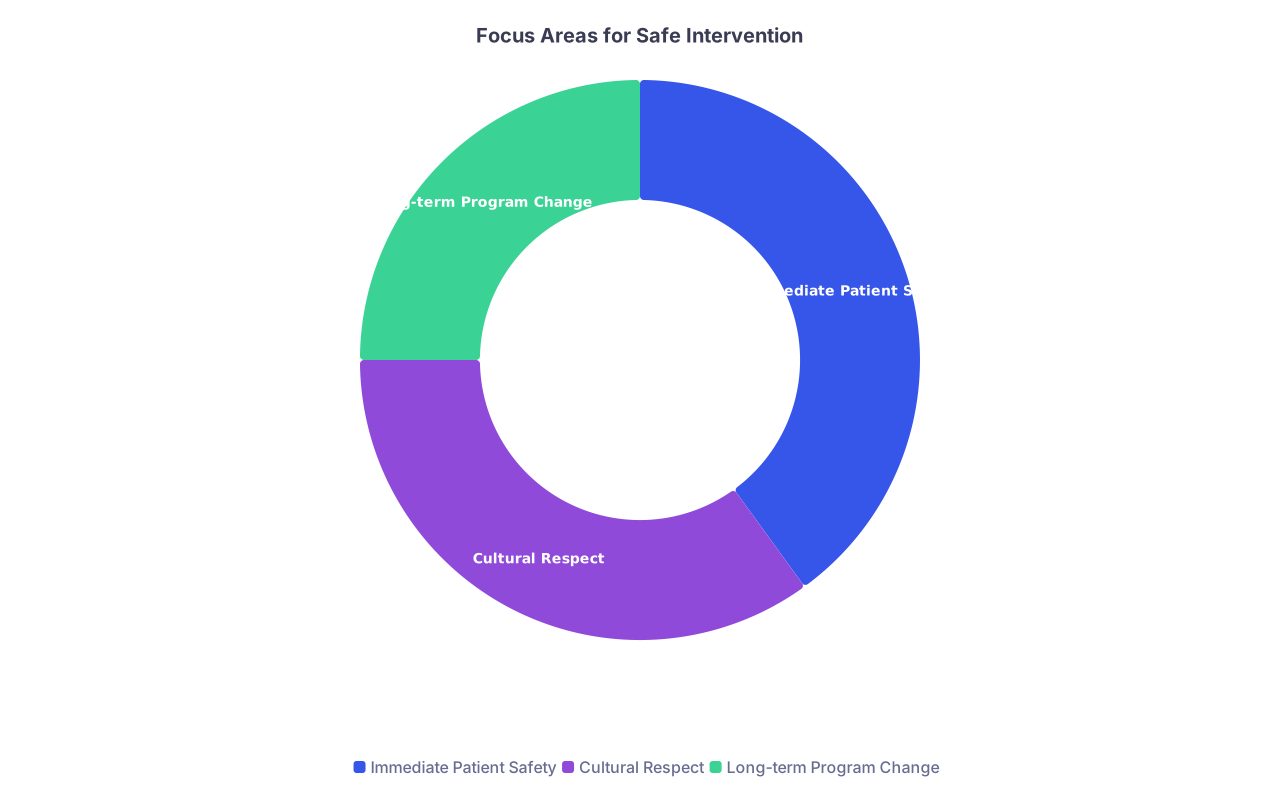
| Category | Value |
|---|---|
| Immediate Patient Safety | 40 |
| Cultural Respect | 35 |
| Long-term Program Change | 25 |
FAQs
1. What if I’m the only one who seems bothered by the team’s behavior?
That happens more than you think. Do three things:
(1) Reality-check with a local partner (“Does anything about how our team behaves feel off to you?”).
(2) Document what you’re seeing.
(3) Use at least one small intervention (a 1:1 conversation, a debrief comment). If you’ve done that and still feel isolated, you may be the canary in the coal mine — not the problem. Follow through with post-trip reporting.
2. How do I balance respecting local culture with not tolerating harmful practices?
You respect culture by listening, asking, and deferring on neutral differences (diet, clothing, family roles, communication styles). You do not have to respect harm: child abuse, physical coercion, outright fraud, or clear breaches of basic human rights. When local norms and human rights collide, you lean toward protecting the vulnerable. But you still do it with humility — involve local allies whenever possible.
3. Could speaking up ruin my career or future mission opportunities?
It could affect a letter, a relationship, or a particular organization. That’s true. But silent complicity also shapes your career — it pushes you toward environments that normalize unethical behavior. Protect yourself smartly: document, seek allies, avoid impulsive public confrontations that become personal battles. Still, if an organization punishes you for raising good-faith concerns about patient respect and safety, that’s a sign you should not tie your future to them anyway.
Key takeaways:
- Name what you’re seeing and triage it: annoying, harmful, or dangerous. Match your response to the level of risk.
- Use concrete tools — subtle redirects, 1:1 conversations, local allies, and structured debriefs — before and alongside escalation.
- Protect patients and your integrity, then follow through after the trip; ethical red lines and honest reporting do more good than one more “feel-good” mission photo ever will.


