

The glowing brochures about hospital-sponsored medical missions are only telling you half the story. The other half lives in budget meetings, marketing decks, and closed-door conversations you’ll never be invited to.
Let me walk you through what actually drives these trips, how they’re evaluated behind the scenes, and what it means for you ethically and professionally if you participate.
What Hospital Leaders Really Say When You’re Not in the Room
I’ve sat in those conference rooms. The PowerPoint slide never says “PR stunt,” but everyone understands that’s part of the game.
Here’s the first truth: your hospital does not sponsor medical missions primarily because of altruism. Altruism is the wrapping paper. The real package is branding, recruitment, staff morale, tax benefits, and sometimes academic currency.
You’ll hear phrases like:
- “This will be great for our community reputation.”
- “We can highlight this in our residency recruitment materials.”
- “Corporate is looking for more ESG content this year.”
(ESG = environmental, social, governance — code for “we need to look good in reports.”)
Nobody is villainous-twirling their mustache. Most of these people genuinely like the idea of “helping.” But do not mistake that for pure, agenda-free service. Hospitals are businesses, even the “non-profit” ones. They invest in medical missions like they invest in new scanners: they expect a return.
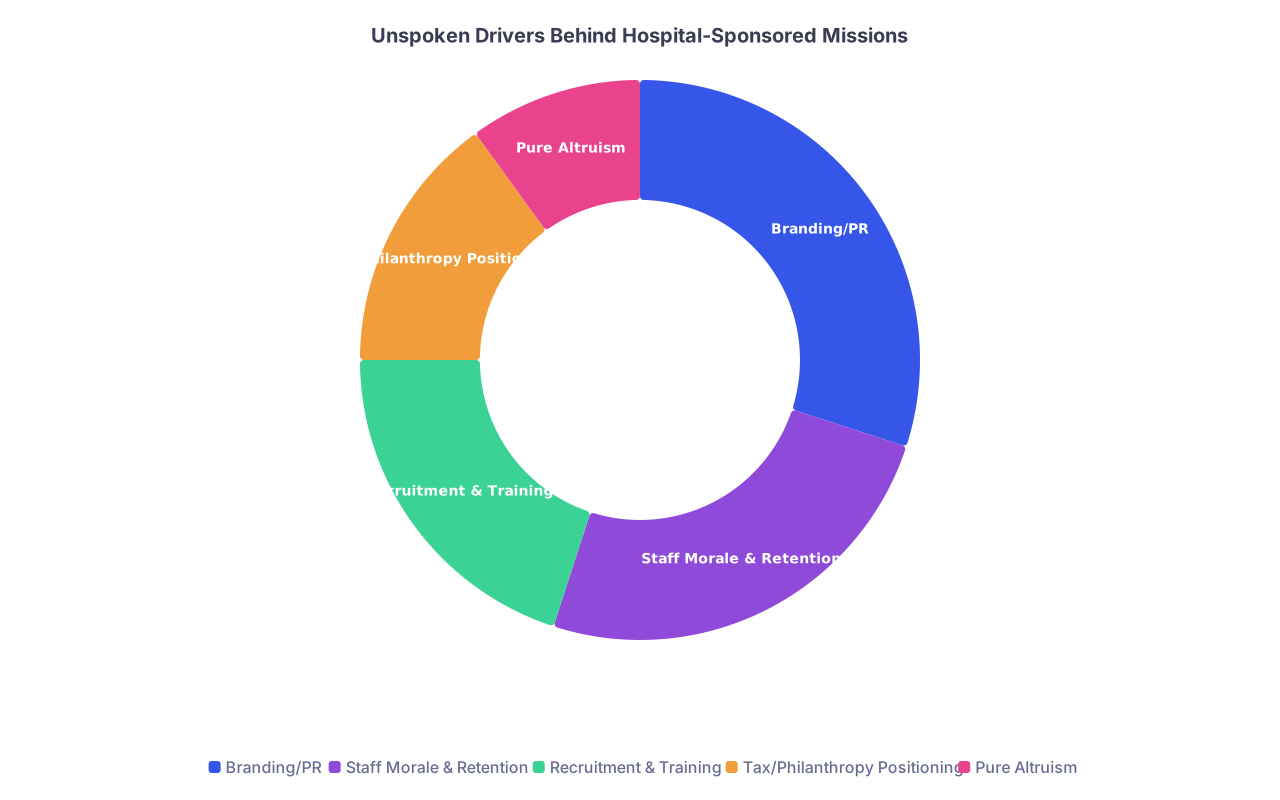
| Category | Value |
|---|---|
| Branding/PR | 30 |
| Staff Morale & Retention | 25 |
| Recruitment & Training | 20 |
| Tax/Philanthropy Positioning | 15 |
| Pure Altruism | 10 |
So when you’re deciding whether to go, stop asking only, “Will I help people?” and start asking, “Whose interests are being served, and how am I being used?”
Because you are being used. The question is whether you’re okay with the trade.
Branding, Optics, and the Quiet PR Agenda
If you want to understand hospital missions, follow the cameras.
If there’s a communications person embedded on the trip “to tell our story,” that mission is partially a content factory. The drone shots of the village. The close-up of the smiling kid with the stethoscope. The obligatory group photo in matching shirts with the hospital logo prominently centered.
All of that is deliberate.
I’ve watched marketing directors review mission footage like a commercial shoot. Comments like:
- “Can we get more images with our logo visible?”
- “We need at least one heroic surgeon shot for the annual report.”
- “Let’s avoid anything that makes the local hospital look too chaotic.”
They’re not thinking global health. They’re thinking brand identity.
Here’s what this means for you:
If you’re a med student, resident, or junior attending, your presence on these trips doubles as casting. You become part of the hospital’s narrative about itself. “At [Hospital X], we care deeply about global health and the underserved.” Your brown scrub top in the background of a photo will be in recruitment brochures, philanthropy campaigns, maybe even your hospital’s homepage.
Is that inherently bad? Not necessarily. But it’s political.
If leadership sees that global health messaging resonates with donors and applicants, they’ll keep funding missions. If it doesn’t move the needle on fundraising or brand image, they’ll quietly sunset the program, no matter how meaningful it felt to you or to local partners.
I’ve literally heard: “The last trip was great, but we didn’t get much media traction out of it. Do we really need to send another team this year?”
Those are the conversations you never see.
The Money Trail: Who Pays, Who Profits, Who Pretends Not To
Let’s talk dollars, because that’s where the hypocrisy often hides.
Hospital-sponsored missions usually draw from a mix of:
- Philanthropy / foundation money
- Line items in “Community Benefit” budgets (for non-profit status)
- Corporate donations (pharma, device companies, logistics)
- Sometimes staff paying part of their own way
On paper, this is “charity.” In practice, it’s usually strategic spending.
Non-profit hospitals need to justify their tax-exempt status. “International service” looks very impressive in community benefit reports, even if the same hospital is closing clinics in poor local neighborhoods. I’ve seen flagship systems boast about sending teams to Central America while ignoring their own city’s uninsured.
There’s another layer: industry.
If a device company “donates” supplies and equipment for the trip, there are strings. At minimum, it’s marketing data and goodwill. In some cases, you’ll see gentle nudges:
“Let’s use our partner’s implant system if possible.”
“Can we get photos of their equipment in use for their corporate report?”
They’ll phrase it as partnership. But it’s product placement with an ethical halo.
| Driver | How It Shows Up |
|---|---|
| Brand/Image Building | Press releases, social media campaigns |
| Tax/Non-profit Justification | Community benefit reports |
| Donor Appeasement | Gala speeches, name-branded missions |
| Industry Relationships | Sponsored supplies/equipment |
| Staff Retention & Burnout Fix | Missions framed as “renewal” trips |
If you’re on the trip, you become part of this ecosystem. You’re the labor that turns money into photos, stories, and outcomes that justify the spend.
Your ethical task is not to pretend this layer doesn’t exist. Your task is to decide whether the benefits to patients and local partners are real and proportionate enough to justify the politics.
Power, Prestige, and the Academic Game
Here’s the part almost no one tells students: hospital missions often double as career currency for people above you.
Department chairs and senior attendings aren’t just going because they “love to help.” Some do. Many also see:
- A chance to build a “global health” line on their CV
- A pipeline for research publications
- A hook for promotion dossiers: “international leadership” sounds impressive
I’ve seen this play out the same way at multiple institutions:
A senior surgeon spearheads a mission to an overseas site. They come once a year for a week. They brand it as a “center of excellence partnership.” They put their name on the initiative. They bring a rotating cast of residents and fellows.
Five years later? They’re giving grand rounds titled “Building Sustainable Surgical Capacity in Low-Resource Settings” and using cases from that site. They’re now “the global health person” in their specialty. They get invited to speak, to write book chapters, to sit on committees.
Meanwhile, the local hospital is still struggling with broken autoclaves and stockouts of basic meds.
I’m not saying these senior people are faking it. Many genuinely care. But the asymmetry of benefit is real. You get a month of “amazing experience.” They get a platform and often academic credit. The local clinician who keeps things running 51 weeks a year? Often gets a fleeting “thank you” slide at a conference.
And yes, I’ve watched program directors subtly pressure residents to join missions:
“It would look good on your fellowship applications.”
“Programs love to see global engagement.”
This is the politics: the mission is leveraged as a signaling tool in a totally different arena — the residency/fellowship job market.
You’re not just helping patients. You’re helping build someone’s brand.
Residents and Students: Who Gets Picked and Why
You think slots on these trips are allocated by pure interest and passion? Not quite.
Here’s the informal selection algorithm I’ve seen used:
- Residents who are already “favorites” or high-potential recruits for academic careers get first dibs. It’s a reward and a development tool.
- Residents perceived as responsible, low-drama, and non-complaining are prioritized. No one wants to troubleshoot behavioral problems in another country.
- People with specific skills that make the trip look good (language ability, photography, prior global health work) get bonus points.
- If there’s a political need, one or two “squeaky wheels” are included to keep them happy.
I’ve heard conversations like:
“Let’s definitely take Sarah; she’ll get some great photos for our website.”
“James is applying cards; this mission will really help his story.”
“I don’t want to take X. Great clinically, but complains too much. Not worth it.”
Rarely: “Who will be best for our local partners?”
Almost never: “Who will do the least harm clinically given the resource constraints?”
In other words, the mission becomes a currency of favor and opportunity. If you want in, it helps to be strategically visible, politically safe, and aligned with the narrative leadership wants to tell.
You’re not crazy if you sense that. It’s real.
The Ethics No One Walks You Through Before the Flight
Let’s talk about the ethical messiness that hospitals prefer to gloss over in their glossy videos.
The big silent issues:
Scope of practice creep
Residents and even students doing things they’d never be allowed to do at home. Because “there’s no one else.” Because “it’s good learning.” Because “they need us.”Short-term care with long-term consequences
Surgery or interventions performed during a one-week mission with no robust plan for complication management after the team leaves.Local system undermining
Free foreign teams that unintentionally undercut local clinicians, pull patients away from local hospitals, or normalize dependence.Patient consent with power imbalances
Patients saying yes to procedures, photos, or “teaching cases” because they feel they can’t say no to the visiting team that brings resources.
None of these are theoretical. I’ve watched a resident in orthopedics do a procedure overseas that they were explicitly not credentialed to do at home. The justification? “The attending was scrubbed in, so it’s fine.” It wasn’t fine. The local team was left to deal with a complication after the US team flew home.
Your hospital’s official framing will be something like: “We partner with local providers to enhance capacity.” That phrase is doing a lot of hiding. Sometimes it’s true. Sometimes it’s theater.
Before you go on a mission, you should be asking:
- Who decided what services we’re offering — us or the local site?
- Who will manage complications after we leave?
- How are we ensuring we’re not displacing local clinicians?
- What is my exact scope of practice there, and who enforces it?
Most hospitals don’t put these questions on the pre-trip orientation slides. They talk more about vaccines and packing lists than power and harm.
The “Burnout Cure” Myth and Emotional Manipulation
Hospitals have discovered that “send burned-out clinicians on a mission” is cheaper than fixing toxic staffing and workload at home.
The line you’ll hear: “These trips remind our staff why they went into medicine.”
I have watched C-suite executives actually say that with a straight face. Meanwhile, they refuse to fund basic support for their own underserved patients locally.
Missions become emotional pressure valves. You feel useful and appreciated for a week. You see dramatic pathology. You’re thanked profusely. You come home with renewed energy — for a while.
Your hospital gets to say, “We support physician wellness and global engagement.”
What they’re not saying is: “We’d rather pay for a handful of mission trips than fix the everyday moral injury baked into our systems.”
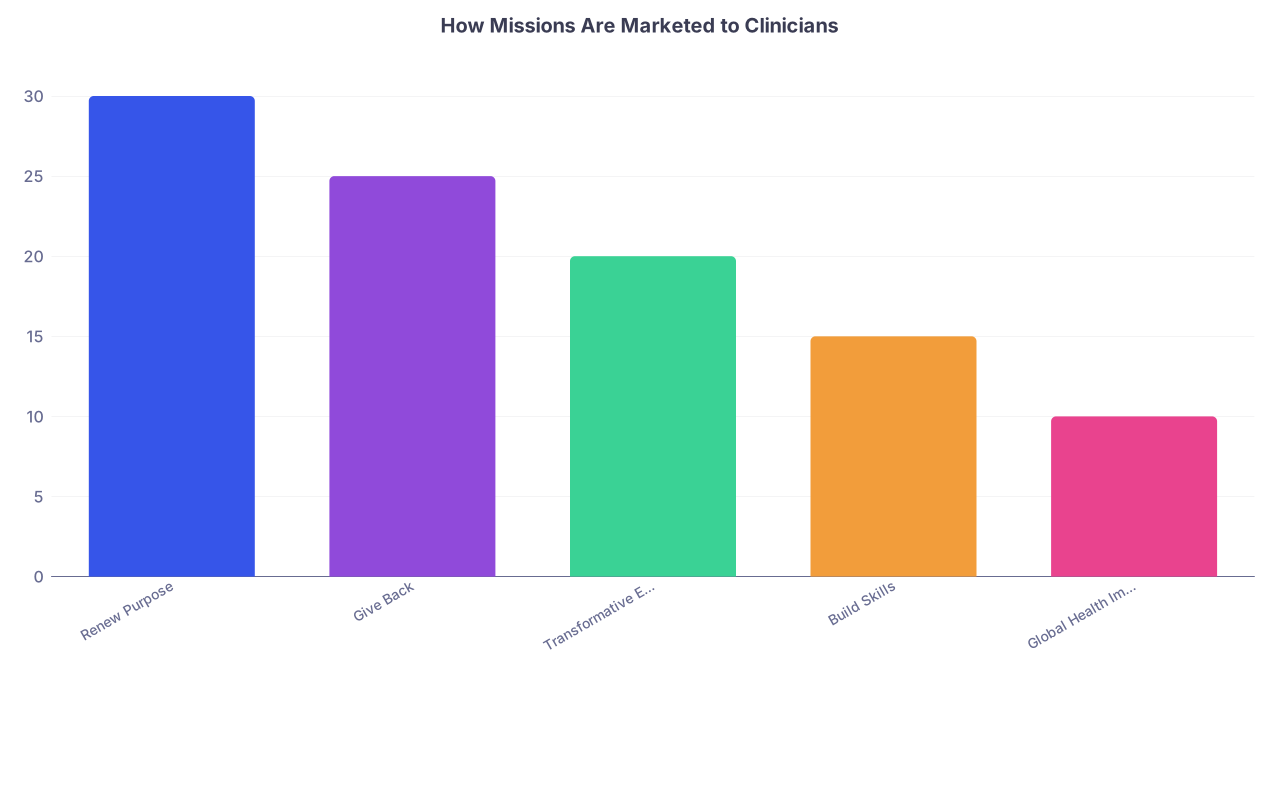
| Category | Value |
|---|---|
| Renew Purpose | 30 |
| Give Back | 25 |
| Transformative Experience | 20 |
| Build Skills | 15 |
| Global Health Impact | 10 |
If you’re feeling burned out, be honest with yourself: a mission might help you personally. It might also distract you from the structural problems you should still be fighting at home. Those two truths can coexist.
Just don’t swallow the hospital’s narrative that this is primarily about your growth. It’s also about their retention metrics.
How to Participate Without Lying to Yourself
Here’s the tension: missions can do real good. They can also be ethically messy, politically charged, and self-serving for the institutions that sponsor them.
You do not have to choose between “missions are pure” and “missions are evil.” You have to learn to work inside the gray.
If you decide to go, here’s how to keep your integrity intact.
First, vet the partnership — not just the trip.
Ask:
- How long has this relationship existed?
- Who initiated it — the local site or us?
- Did the local partners define the priorities, or did we?
- What support exists year-round when teams aren’t on the ground?
If your hospital can’t answer those cleanly, that’s a red flag. A trip built on a weak or one-sided partnership is much more likely to be extractive.
Second, define your ethical red lines before you get there.
Examples I’ve heard from residents who’ve thought this through:
- “I won’t perform procedures I’m not credentialed to do at home, even if I’m pressured.”
- “I won’t participate in taking identifiable photos of patients without clear, voluntary consent.”
- “I won’t present a ‘hero’ narrative in talks or on social media that erases local staff.”
If you don’t set those boundaries ahead of time, you’ll get swept along by the group culture and the pressure to be a “team player.”

Third, be honest in how you tell the story when you return.
The easy version is: “It was life-changing. We helped so many people. I learned so much.”
The harder, more honest version includes:
- What the local clinicians taught you
- The limitations and complications you saw
- The structural problems that a one-week mission will never fix
When you apply for residency, fellowship, or jobs, committees are starting to sniff out the difference. They’ve seen the generic “I care about global health” statement a thousand times. They pay attention when someone speaks clearly about power, sustainability, and humility.
When You Should Probably Say No
There are missions I would tell you outright to avoid.
Patterns that should make you walk away:
- The trip is primarily led by marketing, not by a global health or clinical team.
- There is no clear local institutional partner, just a vague “community” or “village.”
- The team brags about “how much we got done in just a week” with no mention of continuity.
- You’re explicitly told, “You’ll get to do procedures you can’t do at home.”
- There is heavy emphasis on social media, photos, and “impact stories” and very little on logistics of follow-up.

| Step | Description |
|---|---|
| Step 1 | Offered Mission Spot |
| Step 2 | High risk - likely short term stunt |
| Step 3 | Question agenda and design |
| Step 4 | Patients may be harmed after you leave |
| Step 5 | More ethically defensible |
| Step 6 | Long term local partner? |
| Step 7 | Local defined priorities? |
| Step 8 | Clear follow up plan? |
If this flow feels abstract, translate it to one simple test:
“If this trip ended tomorrow and never resumed, would the local system be better off, worse off, or basically unchanged?”
If the answer isn’t clearly “better off,” you’re walking into politics disguised as generosity.
Your Responsibility Going Forward
You’re not going to fix the global ethics of medical missions by yourself. But you can choose not to be naïve.
Understand that:
- Hospital-sponsored missions are always political — they intersect with branding, money, career advancement, and institutional image.
- Your presence is used to tell a story about the hospital. Decide whether you’re okay with the story and whether it’s honest.
- Real ethical global health work is slow, unglamorous, and long-term. If your hospital’s approach doesn’t reflect that, call it what it is: short-term relief with heavy PR.
If you remember nothing else, keep these three points:
- There is always a second agenda behind hospital-sponsored missions; learn to see it clearly instead of pretending it’s not there.
- You’re not just a volunteer — you’re also a character in your institution’s narrative; decide how you’re willing to be used.
- The only defensible missions are those where local partners set the priorities and benefit when you leave, not just while the cameras are rolling.


