
The romantic fantasy of “I’ll just study on the mission and take Step when I get back” is how people blow both the exam and the mission.
If your mission schedule now collides with Step/COMLEX/boards, you’re not dealing with a scheduling hiccup. You’re in an ethical, professional, and personal decision fork: patient care, your host partners, your exam, and your future residency all have skin in this game.
Let’s walk through what to do if you’re already committed, tickets bought, people counting on you—and your exam date or prep window just got smashed.
Step 1: Get Completely Honest About Your Situation
Start with a clear-eyed inventory. No optimism, no guilt-spin. Just facts.
Ask yourself, in writing, not in your head:
- What exam and when?
- Step 1? Step 2 CK? COMLEX? Specialty boards?
- Exact date and score target.
- What mission details?
- Dates door-to-door.
- Time zone difference.
- Daily schedule (clinic, call, teaching).
- Degree of chaos vs structure.
- What’s your current exam status?
- Hours studied so far.
- Recent practice scores (NBME/UWorld self-assessment, COMSAE, etc).
- Realistic remaining study hours needed.
If you can’t answer these concretely, that’s your first problem—you’re trying to “feel” your way instead of running real numbers.
Use this rough guide:
| Situation | Risk Level | Immediate Action |
|---|---|---|
| ≤4 weeks to Step, no dedicated yet | Critical | Postpone mission or exam |
| 6–8 weeks to Step, 4–6 hrs/day mission work | High | Adjust mission role or move exam |
| 8–12 weeks to Step, mission ≤6–8 days | Moderate | Keep both, tighten schedule |
| >12 weeks to Step, solid baseline prep | Manageable | Plan structured study on mission |
If you’re in the “Critical” or “High” boxes, you’re not going to brute-force this with coffee and vibes.
Step 2: Decide What Cannot Move (Ethically and Logistically)
You’ve got four movable (or not-so-movable) pieces:
- The exam date
- The mission dates
- Your role on the mission
- Your exam score target/timeline for residency goals
Be very clear: “I don’t want to move it” is not the same as “It cannot be moved.”
A. Exam: How movable is it really?
Look up—not guess:
- Your school’s required latest Step 1/2 date
- Residency timeline for your specialty (e.g., Step 2 CK before ERAS submission)
- Test center availability in your region
Then call or email:
- Your dean’s office / academic affairs
- The testing body if needed (NBME, NBOME, specialty board)
Ask specific questions like:
- “If I move Step 2 CK from June to August, does that jeopardize graduation or ERAS timing for internal medicine?”
- “What’s the latest date I can take this board and still be certified for the upcoming renewal/credentialing deadline?”
Document the answers. No “they said it should be fine.” You want names and clear statements.
If you’re staring at:
- A once-per-year board exam
- Or a drop-dead date for graduation/residency
…then the exam is likely less movable than the mission.
B. Mission: How fixed is your presence?
Strip the emotional drama and answer:
- Are you the only physician or the only person with a critical skill?
- Are plane tickets refundable/transferable/insured?
- Is this a one-off trip or part of a recurring partnership where you could join later?
Red flags where you should not casually pull out:
- You’re one of only 1–2 licensed clinicians staffing clinic days.
- You’re leading surgical cases or anesthesia.
- You’re functioning as a bridge with local partners (language, relationships, MOH approvals).
On the other hand:
- If you’re a med student mostly shadowing or doing health education that others can cover…
- Or a junior resident on a large, well-staffed team…
…then you’re important, but not irreplaceable. Ethically, that matters.
Step 3: Pick a Path—There Are Only Four That Make Sense
You’re really choosing between four scenarios.
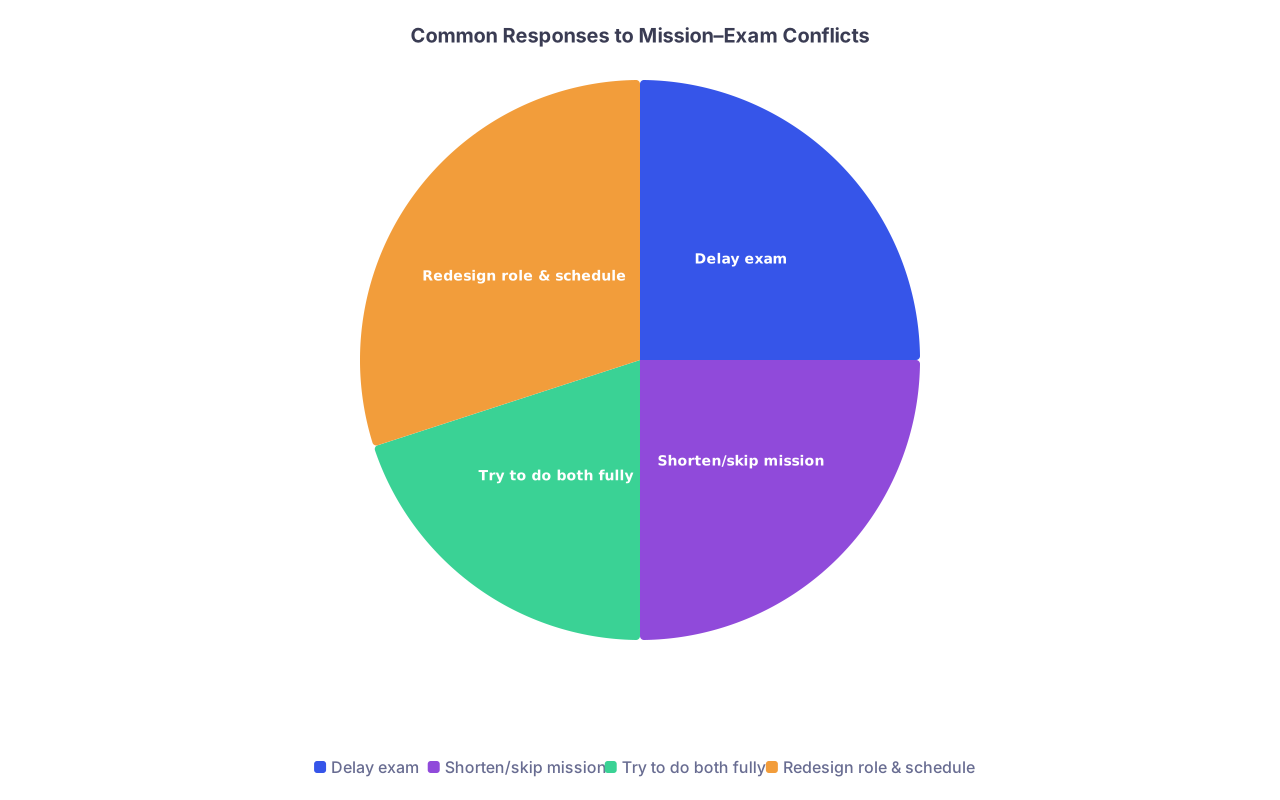
| Category | Value |
|---|---|
| Delay exam | 25 |
| Shorten/skip mission | 25 |
| Try to do both fully | 20 |
| Redesign role & schedule | 30 |
Let me be blunt: the “try to do both fully” group is where burnout and mediocrity live.
Option 1: Move or Delay the Exam
Best when:
- Mission is high-stakes or ethically central.
- Exam can be legally and logistically moved without blowing up graduation/residency.
- You haven’t started serious dedicated time anyway.
What to do concretely:
- Confirm new feasible dates (testing center + school approvals).
- Draft an email to your dean/advisor:
- “I’m scheduled for Step 1 on [date], but I’m committed to a mission trip from [dates] where I have [specific responsibilities]. I’d like to move the exam to [new date]. Can you confirm this will keep me on track for [graduation/residency timeline]?”
- Rebuild your study schedule backward from the new date:
- New dedicated start
- Number of UWorld blocks/day
- NBME practice exam dates
Ethically, this is clean: you respect the mission commitment and protect your future. The cost: longer anxiety window and possibly more months living in exam limbo.
Option 2: Shorten, Shift, or Skip the Mission
Best when:
- Exam is tightly tied to graduation/residency goals (e.g., Step 2 CK score for a competitive specialty).
- Your role on the mission is important but not uniquely irreplaceable.
- Your recent practice scores are far below goal and you need real, concentrated time.
This is where people start over-moralizing. “If I don’t go, I’m abandoning patients.” No—you’re avoiding becoming a marginal, exhausted clinician and still showing some respect for future patients who need you competent and licensed.
Concrete moves:
- Ask the mission organizer:
- “Can I join just for the first 5 days instead of the full 2 weeks?”
- “Is there a later trip this year I can join instead?”
- “Can my role be shifted more to teaching/non-clinical if I come for fewer days?”
You’re not bailing with a text the week before. You’re offering adjusted participation with clear reasons, well in advance. That is ethically defensible.
Option 3: Redesign Your Role and Schedule to Protect the Exam
This is the middle path that actually works when done intentionally.
You stay on the mission but:
- Narrow your clinical duties
- Protect set study blocks
- Cut out non-essential social/tourist stuff
Example setup that I’ve seen work:
- Two-week mission, fairly intense clinic days.
- You ask to:
- Work 4 full clinical days + 2 half-days each week.
- Have 2 protected evenings for 3-hour study blocks (no call those nights).
- Take one weekend day mostly off for long-study.
That gives you:
- 4–5 serious study sessions per week (2–3 hours each)
- Enough clinical work to not feel like dead weight
- Some sleep to avoid disintegrating by week 2
You must communicate this before the trip:
“Given my Step 2 CK date on [X], I can safely commit to [these specific clinic blocks] and [these specific teaching or admin tasks]. I’ll need [two evenings and one weekend day] protected for exam prep. If that’s not realistic, I should likely change my participation this year.”
If the leader flinches at that and basically wants free 24/7 labor, that’s your sign.
Option 4: Try to Do Everything, Hope It Works Out
This is not a strategy. It’s denial.
Patterns that predict failure:
- Clinical 8–10 hours/day
- Call or evening debrief most nights
- You “plan” to study from 10 p.m.–1 a.m.
- Unreliable internet, jet lag, poor sleep, emotional exhaustion from witnessing poverty/trauma
You come home:
- Fried
- Behind
- Full of guilt about both the exam and the mission experience
Do not choose Option 4 on purpose. Either redesign or reschedule.
Step 4: Build a Realistic Exam Plan If You Go
Let’s say you’re going and the exam can’t move much. Then you treat the mission like a rotation during dedicated.
Construct a specific schedule. Not this: “I’ll study when I can.”
Use a weekly template:
| Day | Mission Duty | Study Plan |
|---|---|---|
| Mon | Full clinic | 2 hrs Qbank 7–9 p.m. |
| Tue | Half-day clinic | 3 hrs AM, 1 hr evening review |
| Wed | Full clinic + call | 0–1 hr flashcards only |
| Thu | Teaching/education | 2 hrs UWorld, 1 hr Anki |
| Fri | Full clinic | 2 hrs blocks + review |
| Sat | Light clinic/outreach | 3–4 hrs mixed review |
| Sun | Rest + 2-hr light | Only if not exhausted |
Non-negotiables:
- One true rest block per week (half or full day). Your brain needs it.
- Ceiling of 3–4 intense study hours on heavy clinical days.
- Pre-downloaded content (Qbanks, videos, PDFs) because Wi-Fi will betray you.
Also assume:
- At least 2 days go sideways (transport, illness, team emergency)
- Jet lag costs you 2–3 decent days of cognitive power
So don’t overpack the schedule like you’re in a library at home.
Step 5: Handle the Ethics Like an Adult, Not a Martyr
This isn’t just logistics. You’re balancing obligations:
- To current patients (mission site and at home)
- To future patients (who need you licensed and competent)
- To your team and host partners
- To yourself (burnout is not noble)
Some people weaponize “service” to pressure you into terrible decisions. Watch out for:
- “God will provide, just trust and come.”
- “If your heart is in the right place, the exam will work out.”
- “We really need you, there’s no one else.” (Said 3 weeks before departure.)
You’re allowed to say:
“I cannot safely commit to that schedule and still meet my exam obligations. To be a responsible clinician long-term, I need to adjust or defer.”
You serve people best by being sustainable and competent, not by being emotionally blackmailed into overextension.
Step 6: Communicate Clearly With Everyone Who Matters
There are at least three conversations you need to have.
1. With the Mission Leader
Do this early, over phone/Zoom if possible.
Script it something like:
“I’m fully committed to the partnership and want to contribute. I’m also scheduled for Step/boards on [date], and I need [X] hours per week of protected study time to stay on track. That means I can offer [specific clinical blocks/roles], but I can’t safely do 24/7 duty or late-night debriefs every day. Is that compatible with what the team needs? If not, it’s better I adjust my involvement now rather than underperform there.”
You’re not asking permission to take your exam seriously. You’re stating constraints.
2. With Your Academic/Program Leadership
Tell them the truth. Not the Instagram version.
- “I’m planning to be in rural Guatemala from [dates], with 8–10 hour clinic days.”
- “I’m currently scoring [XX] on practice tests, targeting [YY] for [specialty].”
- “My concern is whether I can safely maintain that trajectory if I go.”
Ask directly: “If you were me, with this data, what would you do?”
If they’re competent, they’ll give you an opinion. Listen.
3. With Yourself
Sounds corny, but this is where most people lie.
You need to answer:
- Am I willing to accept a lower score to keep this mission commitment exactly as planned?
- Is this particular mission foundational to my values, or is it partially about résumé optics and social media?
If you’re truthfully okay with a slightly lower Step 1 because this long-term partnership matters more to you—fine. Own that choice. But don’t pretend you can maximize everything simultaneously.
Step 7: After the Mission – Immediate Recovery and Damage Control
You land back home. You’re tired. You probably got sick once. Your sleep is chaos.
If your exam is within 4–6 weeks after return, do this in the first 72 hours:
- Sleep. Like actually.
- Take one day with no mission debrief, no exam guilt. You’re not a machine.
- On day 2–3, run:
- One shorter Qbank block at normal intensity
- Or a scaled-back practice exam (or half an NBME)
You’re checking: did your knowledge base erode or just stall?
Then adjust:
- If your scores held steady: ramp back into your original plan.
- If they dropped meaningfully: push the exam if you still can, or aggressively re-prioritize topics.
This is where you also integrate the mission experience without letting it hijack the next month:
- Journal for one evening about what you saw/learned.
- Note maybe 2–3 clinical cases you want to follow up on academically later.
- Then park it. Back to Step.
You can process the big ethical and emotional stuff more fully after the exam. That’s not avoidance; that’s triage.
A Quick Visual: Decision Flow When Mission and Exam Collide

| Step | Description |
|---|---|
| Step 1 | Mission and exam dates collide |
| Step 2 | Assess exam flexibility |
| Step 3 | Check school and residency impact |
| Step 4 | Assess mission role criticality |
| Step 5 | Move exam, keep mission |
| Step 6 | Consider shortening or deferring mission |
| Step 7 | Redesign mission role and study schedule |
| Step 8 | Set protected study blocks |
| Step 9 | Adjust commitment or skip this trip |
| Step 10 | Rebuild study schedule |
| Step 11 | Exam movable? |
| Step 12 | Minimal impact? |
| Step 13 | You are critical on site? |
What People Get Wrong About Missions and Exams
Three persistent myths:
“Studying on mission is just like studying on a busy rotation.”
Wrong. You’re in an unfamiliar environment, emotionally loaded cases, possibly language barriers, physical discomfort. It drains you in a different way.“If you really care, you’ll find the time.”
Care does not create cognition at 1 a.m. after 12 hours in a hot, crowded clinic. Brains have limits.“Skipping this trip means you don’t value global health.”
No. It might mean you respect global health enough not to show up half-present and compromised. Long-term engagement beats one heroic, badly timed trip every time.
Integrating This Into Your Long-Term Development
Look beyond this one exam, this one mission.
Good physicians who do global or underserved work long-term:
- Guard their professional milestones (licensure, boards, training) fiercely.
- Choose service commitments that are sustainable and integrated into their lives, not performative add-ons.
- Learn to say “not this time, but I’m in for the long run.”
Use this clash as a stress test:
- How do you handle conflicting goods?
- Do you martyr yourself, or do you make sober decisions?
- Can you disappoint people now to avoid disappointing many more patients later?
If you handle this collision thoughtfully—whether that means going, staying, delaying, or reshaping—it’s not a failure. It’s rehearsal for the rest of your career, where competing obligations never stop.
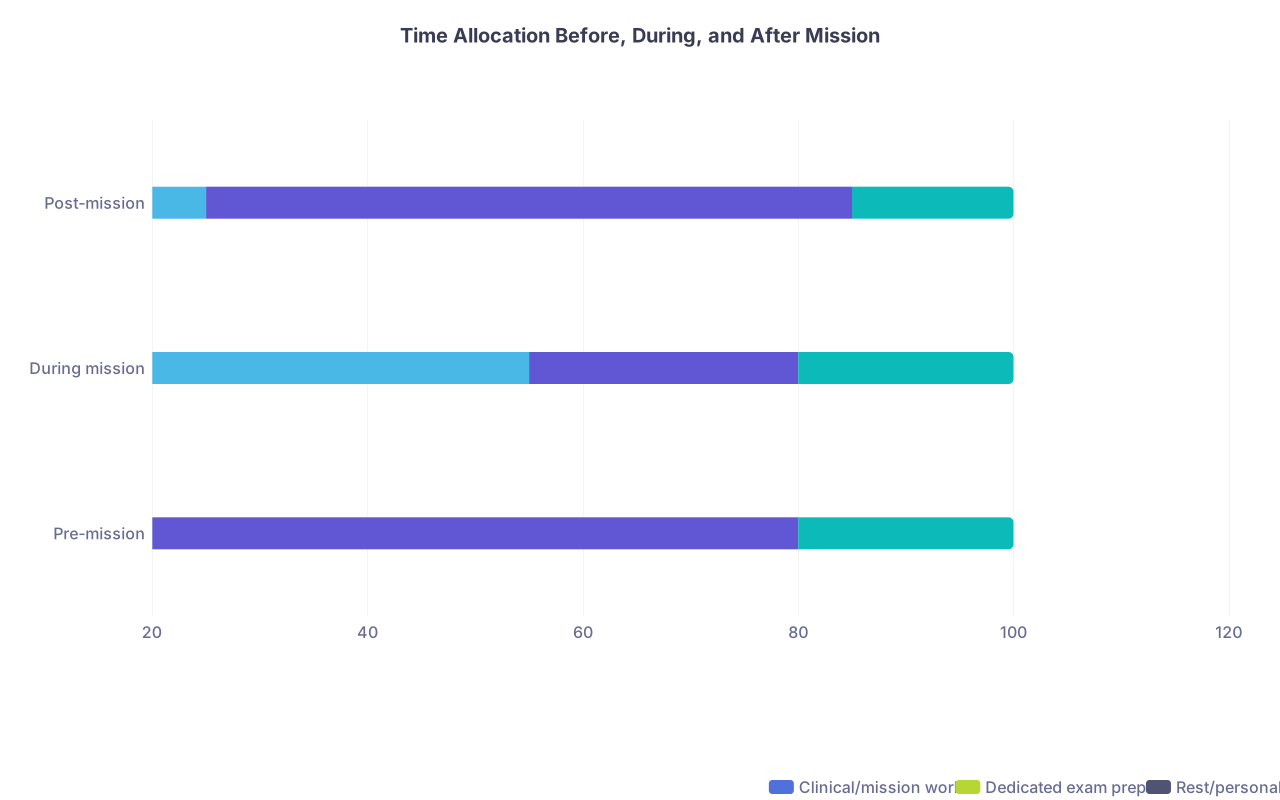
| Category | Clinical/mission work | Dedicated exam prep | Rest/personal |
|---|---|---|---|
| Pre-mission | 20 | 60 | 20 |
| During mission | 55 | 25 | 20 |
| Post-mission | 25 | 60 | 15 |

FAQs
1. I already committed to the mission and just realized my Step/board date is too close. Is it unethical to back out?
No, it’s not automatically unethical. What’s unethical is ghosting or canceling last minute without giving the team a chance to adjust. If you genuinely cannot fulfill the role you promised and protect a critical exam, the ethical move is to tell them early, clearly, and help them find alternatives. You’re allowed to recalibrate when new information (exam constraints, your prep status) appears.
2. Can I just move my exam to take it during the mission in another country?
Technically, sometimes yes. Practically, this is usually a bad idea. You’re dealing with:
- Time zone shifts
- Unpredictable internet
- Unfamiliar test center logistics
- Travel fatigue or illness
If everything goes perfectly, you save time. If anything goes wrong, you’re stuck thousands of miles from your home support systems with a high-stakes exam on the line. I’ve seen more horror stories than success stories with this plan.
3. How many hours per day do I realistically need to maintain Step/COMLEX prep while on mission?
To maintain (not significantly improve) your level, most people need around 2–3 focused hours on most days, plus a slightly longer block once or twice a week. That’s assuming you already have a solid content base and you’re in the refinement phase with Qbanks and practice tests. If you’re early in prep, trying to learn foundational material on mission is not realistic—you’ll need closer to 4–6 hours/day, which most mission schedules won’t allow without severely compromising your presence.
4. Will residency programs judge me for delaying a mission or not going because of Step/boards?
Not if you handle it like an adult. Programs care far more about your exam performance, your clinical competence, and your long-term commitment than about any single short-term mission. You can honestly say in interviews: “I chose to prioritize my Step 2 CK preparation that year so I could be fully trained and effective for future global health work. I’ve since engaged in [X, Y] more sustainable partnerships.” That sounds thoughtful, not flaky.
5. I’m already on the mission and realizing I overestimated my study capacity. What do I do now?
You have three real options:
- Immediately scale back your role—talk to the team lead, reduce clinic hours or call, and carve out real study blocks.
- Accept that your exam performance may be lower and own that trade-off—stop pretending you’ll somehow get a 260 with 30-minute nightly reviews.
- If the exam is still movable, contact your school/program and the testing body from the field and see if you can push the date as soon as you realize the mismatch.
Do not just “see how it goes” for two weeks and then panic three days before the exam. Make a decision as soon as you see the reality.
Bottom line:
Protect your exam like your future patients depend on it—because they do. Treat your mission commitments as real obligations, not resume ornaments, and adjust them early if your capacity changes. And stop pretending you can operate at 110% in two worlds at once; pick your priorities deliberately, communicate clearly, and you’ll come out of this collision stronger, not scorched.


