

The way most of us deal with test anxiety is broken.
We cram harder, add another Anki deck, cut sleep, pound caffeine, scroll Reddit r/Step2 in a panic… and then we’re shocked when our brain freezes the second we sit for a shelf or board exam. It’s not a mystery. We’ve basically trained our nervous system to go into full alarm mode around tests.
So here’s the thing I wish someone had told me earlier: mindfulness isn’t some cute wellness extra. It’s basically nervous system training. And for shelf and board anxiety, your nervous system is the whole game.
I know that sounds a little dramatic. But you’re the one lying awake at 2 a.m. reciting “NBME percentiles” in your head, so let’s not pretend this is just “mild stress.”
You asked: can mindfulness actually help your test anxiety before shelf and board exams?
Yes. If you do it right, and if you stop treating it like a last‑minute hack and start treating it like reps in the gym for your brain.
Let me walk through this like someone who’s spent way too many nights convinced one exam would ruin their entire career. Because same.
What Your Test Anxiety Is Really Doing To You
Let’s strip the motivational poster stuff and call it what it is.
On exam days (and honestly the weeks before), your brain is doing three things:
Predicting catastrophe:
“If I fail this shelf, PDs will hate my application. I’ll match nowhere. I’ll be that person reapplying three times.”Replaying past failures on loop:
“Remember that one NBME where you got 57%? Yeah, that’s the real you.”Body going full fight‑or‑flight:
Heart racing, sweaty palms, shallow breathing, random GI issues, that weird chest tightness you google at 3 a.m. but are “definitely sure” is not ACS.
The worst part? None of this actually helps you remember the clinical presentation of DKA vs HHS.
And on shelf/boards, it hits in specific, awful ways:
- You read a stem three times and still can’t process it.
- You second‑guess every answer you pick.
- You blow time on one question because your brain locks up.
- After the exam, you ruminate every missed question like it’s evidence you’re a fraud.
So the real problem isn’t just “I’m stressed.” It’s: your nervous system and attention system are hijacked during the exact block of time where you need full access to your memory and reasoning.
That’s the thing mindfulness goes after directly.
What Mindfulness Actually Is (And What It’s Not)
(Related: What Seasoned Attendings Really Do to Stay Mindful on 28‑Hour Call)
People hear “mindfulness” and immediately picture a monk sitting by a waterfall meditating for six hours. That’s not what we’re talking about.
Forget the Instagram version. For you, as a medical student dealing with shelves and boards, mindfulness basically means:
The practiced skill of noticing what your brain is doing in real time…
without automatically believing it…
and then bringing your attention back to what actually matters in that moment.
That’s it. Not mystical. Very unsexy. Very trainable.
It’s not:
(See also: How Elite ICU Teams Use Micro‑Mindfulness Between Codes and Rounds for more details.)
- Silencing thoughts
- Forcing yourself to “think positive”
- Emptying your mind
- Being calm and zen 24/7
If you sit down to do a 3-minute breathing exercise and your brain screams, “You’re going to fail Step 2 and never be a real doctor,” guess what? That doesn’t mean you’re “bad at mindfulness.” That’s literally the reason you need it.
The value isn’t in having no anxiety. It’s in being able to say:
“Oh, that’s the ‘I’m going to fail and ruin my life’ narrative again,”
notice the anxiety spike in your body,
and still answer the damn question in front of you.
Why Mindfulness Actually Helps on Test Day (The Boring Brain Science You Sort of Already Know)
Let’s tie this to something your med‑school brain respects: neuro stuff.
Chronic anxiety + constant future catastrophizing → your amygdala and limbic system are on overdrive.
Mindfulness practice (over time, not one YouTube video) → strengthens prefrontal control and reduces reactivity.
Translated out of textbook language: you get slightly better at:
- Not reacting instantly to every anxious thought
- Not spiraling when you feel your heart race
- Catching yourself sooner when your mind leaves the question and jumps into “what if I fail” fantasies
There’s actual research on mindfulness and test anxiety, academic performance, and attention regulation. It doesn’t make you a genius. It doesn’t take a 210 to a 270. But it gives you a real edge in the part everyone underestimates: being able to access what you already studied under pressure.
You know that thing where you review a UWorld explanation later and think, “I knew this, why didn’t I see it?”
Yeah. That gap between “I knew this” and “I could retrieve it under stress” is where mindfulness lives.
How Mindfulness Fits Into Shelf and Board Prep (Without Taking Over Your Life)
Here’s the biggest fear: “If I spend time doing mindfulness, that’s time I’m not doing questions, and I’m already behind.”
I get it. You measure days in blocks of UWorld questions and Anki reviews.
The truth: we’re not talking about 45‑minute meditations twice a day. You don’t need to become a different person. You just need small, consistent reps.
Think of it like:
- 5–10 minutes per day of formal practice (yes, literally set a timer)
- 10–30 seconds at strategic points during the day (before starting a block, mid‑exam, before bed)
If you’re willing to sacrifice 10 minutes of doom‑scrolling or watching yet another “Step 2 score reveal” video on YouTube, you have the time.
Concrete Practices That Actually Help (Not Vague “Be More Present” Advice)
Let’s get specific. Here are practices I’ve seen actually move the needle for students freaking out before shelves/boards.
1. Two-Minute “Name the Panic” Drill (For the Pre-Study Spiral)
You know that thing where you sit down, open your QBank, and instead of starting, your brain starts narrating your demise?
Do this:
- Sit. Close your eyes or look down.
- Notice what thoughts are screaming the loudest.
- In your head, label them very simply: “planning,” “catastrophizing,” “self‑doubt,” “comparison,” etc.
- Notice where in your body you feel the anxiety (chest, stomach, throat). Just label it: “tightness,” “pressure,” “heat.”
- No fixing. No arguing. Just label, feel, breathe slowly for 5–10 breaths.
- Then open your QBank and start. First question, no debate.
The point isn’t to feel great. It’s to create 2 millimeters of distance between “I’m having a thought” and “this thought is the truth about my future.”
2. 5-3-1 Grounding Before Timed Blocks
Right before you hit “Start” on UWorld timed, do this:
- 5 slow breaths, exhale slightly longer than inhale
- 3 things you can feel physically (chair under you, feet on floor, hands on keyboard)
- 1 clear intention: “For the next 40 questions, I just focus on the next stem. Not my score. Not my future. Just the next stem.”
Total time: under 60 seconds.
Total effect: you start the block actually inside your body, not already halfway into your imagined failure email.
3. Micro Mindfulness Mid-Exam (When Your Brain Starts to Melt)
This is the part no one prepares you for: somewhere around question 32 or 168 or whatever, your brain just… fuzzes. You feel behind on time, you’re stuck on a question, anxiety spikes.
You cannot do a 10‑minute body scan here. But you can do this in under 20 seconds:
- Put your feet flat on the floor.
- Take one slow inhale, one slow exhale.
- In your head: “This is anxiety. Not danger.”
- Look at the question number. Name it: “Question 47.”
- Say (internally), “What is this question actually asking?” And go to the last line of the stem first.
It sounds dumb. It isn’t. You’re interrupting automatic panic and giving your prefrontal cortex a tiny shot at coming back online.
4. 3-Minute “After-Block Reset” (Instead of Immediate Self-Hate)
After a bad block (you know the ones), your instinct is to go straight to self‑destruction:
“I’m never going to be ready. Why am I even in med school?”
Try this instead:
- Close your eyes or soften your gaze.
- Notice the urge to check your percentage or go to the score breakdown. Don’t. Not yet.
- For 3 minutes, feel the physical sensations of “I did badly” without adding the story. Butterflies? Nausea? Tight throat? Just feel it.
- Add one sentence: “This is what disappointment feels like in my body. It sucks. But it’s not fatal.”
Then, yes, go review your performance. But you’ve cut the intensity down from a 9/10 to maybe a 6/10. That’s the difference between “I can analyze mistakes” and “I’m paralyzed and now scrolling for an hour.”
5. A Bare-Minimum Daily Practice (So Exam Day Isn’t Your First Rep)
If all you can manage is this, it’s still worth doing:
- Set a 5‑minute timer once a day.
- Sit anywhere.
- Focus on your breath or the feeling of your feet.
- Every time your mind goes to Step, shelves, ranking, or self‑hate, just silently say “thinking” and bring it back to breath/feet.
- Over and over and over.
You’ll feel like you’re failing at it. You’re not. The reps are in the coming back. That’s literally the same muscle you use when, in the middle of a shelf question, your brain jumps to “I’m bombing this exam” and you choose to come back to the stem.
What About the Big Ethical Question: Is Mindfulness Just Making You Tolerate a Broken System?
You’re in medicine. You’re not dumb. There’s probably a small, angry part of you thinking:
“Cool, so instead of fixing toxic exam culture and absurd expectations, we’re just teaching students to breathe through their panic and keep grinding? That feels… gross.”
You’re not wrong.
The system is messed up. Boards are high stakes. Shelf exams sometimes get treated as a measure of your worth as a future physician instead of one (flawed) metric. You’re asked to perform clinically all day and then go home and do 80 UWorld questions. It’s not exactly humane.
Mindfulness does not fix that.
What it can do is stop the system from eating you alive from the inside.
There’s a weird, almost rebellious angle here: by training your mind, you’re refusing to let an NBME form dictate your entire sense of identity. You start to see:
- “I’m anxious” ≠ “I’m unfit to be a doctor.”
- “I had a bad exam” ≠ “I’m fundamentally incompetent.”
- “I’m scared” ≠ “I need to punish myself into working harder.”
Ethically, I’d rather see you use mindfulness to survive this stage with some intact self‑respect, so that one day, when you’re on the other side, you have the bandwidth to advocate for better systems. Burned‑out, self‑hating doctors rarely fix institutions. They just perpetuate them.
What Mindfulness Won’t Do (So You Don’t Get Blindsided)
Let me be brutally honest about the limits, because this is where people get disappointed and quit:
Mindfulness will not:
- Replace actual studying. If your UWorld percent is 35% and you’ve done 12% of the QBank, no amount of breathing will salvage that.
- Erase anxiety. You will still feel nervous. You may still get GI issues on exam day.
- Guarantee performance. Some days your brain just misfires. Sleep, nutrition, timing, luck on question pool—it all matters.
What mindfulness does is change the quality of the anxiety.
Instead of being a full‑body hijack that destroys your access to knowledge, it becomes background noise you can work with.
You go from “I can’t function” to “I’m scared and I can still do this question.”
That’s not magical. It’s just… better.
A Quick Reality Check on Time and Payoff
You’re probably calculating in your head: “If I start this now, will it even matter before my next exam?”
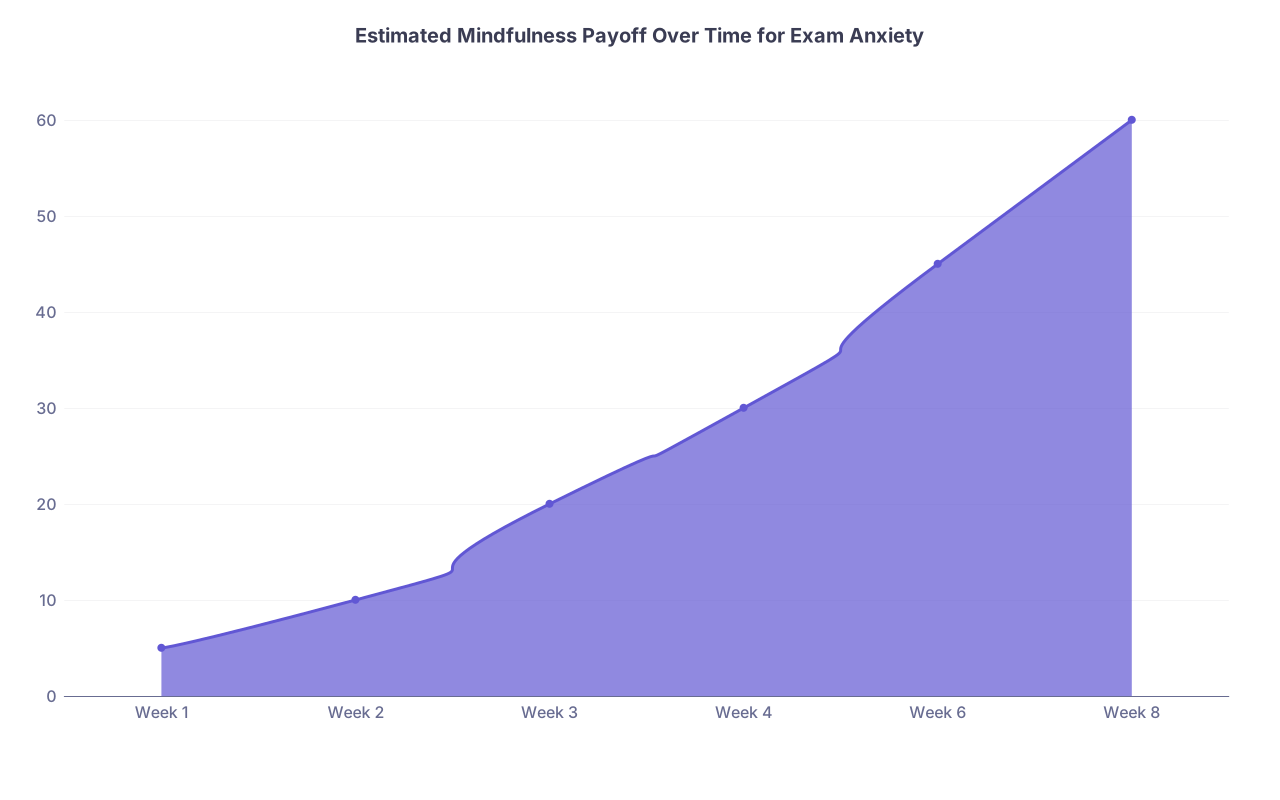
Rough timeline reality:
| Category | Value |
|---|---|
| Week 1 | 5 |
| Week 2 | 10 |
| Week 3 | 20 |
| Week 4 | 30 |
| Week 6 | 45 |
| Week 8 | 60 |
Think of that “value” axis as “percent improvement in how hijacked you feel,” not score points. Week 1? You mostly just notice how insane your brain is. By Week 4–6, a lot of people start saying things like:
- “I still got anxious, but I didn’t spiral as hard.”
- “I could bring myself back to the question faster.”
- “I only lost like 5 minutes instead of 25 to panic.”
That’s enough to be worth 5–10 minutes a day, especially in the last month before a big exam.
How This Fits Alongside Actual Study Schedules
Let’s say you’re in a 6‑week dedicated block for Step 2 or studying during a rotation for a shelf. Here’s how mindfulness can sit next to everything else without blowing your schedule:

| Step | Description |
|---|---|
| Step 1 | Wake Up |
| Step 2 | 5 min mindfulness |
| Step 3 | Morning QBank block |
| Step 4 | 1 min grounding before block 2 |
| Step 5 | Second QBank block |
| Step 6 | 3 min reset after review |
| Step 7 | Content review |
| Step 8 | Evening walk or break |
| Step 9 | 2-3 min pre-sleep breathing |
We’re talking maybe 15 total minutes of “formal” stuff scattered through 12+ hours of studying. It’s not a spa day.
The Hardest Part: Doing This When You Feel You Don’t Deserve a Break
Here’s the psychological trap I see over and over:
“I’ll do mindfulness after I get my life together. After I’m on track. After I deserve it.”
No. That’s backwards.
You don’t earn the right to take care of your nervous system by scoring high. You take care of your nervous system so you can even access your ceiling in the first place.
If you only practice when you’re “calm enough,” you’ll barely practice. You have to be willing to sit with yourself even when the inner voice is screaming, “You’re lazy, you’re falling behind, you should be doing questions right now.”
That moment—choosing 5 minutes of training your mind instead of 5 extra minutes of frantic, low‑quality cramming—is the rep that actually counts.
One Last Thing, From One Anxious Brain to Another
The system you’re in is harsh. You’re judged on numbers that reduce years of effort into a three‑digit score. You’re told (implicitly or explicitly) that a few exams might determine whether you get to do the specialty you love.
Of course you’re anxious.
Mindfulness isn’t about pretending this isn’t high‑stakes. It’s about giving yourself a fighting chance to bring your actual abilities to the table, instead of letting raw panic drive the car.
You don’t need to be a different person. You don’t need to suddenly become “chill.” You just need to be 10–20% less hijacked by your own thoughts when it matters.
That’s realistic. That’s doable. And that’s often enough.
Do one specific thing today:
Before your very next QBank block, set a 2‑minute timer. Sit, feel your feet on the floor, notice every catastrophic thought that shows up, label it “thinking,” and bring your attention back to your breath until the timer ends. Then start the block.
Not tomorrow. Not “after I watch another video.” Do it on the very next block you were already planning to do, and see—honestly—if those questions feel even slightly different.


