

You’re sitting in M&M. The case is ugly. Outcomes were bad, tempers are worse, and you can feel your shoulders creeping up toward your ears. Someone is clearly on the defensive. Someone else is on the attack. The word “mindfulness” feels about as far away as a beach vacation.
Yet this is exactly the room that needs it.
You’re not trying to turn M&M into group therapy. You want it to be what it’s supposed to be: honest, rigorous, system-focused, and safe enough that people tell the truth. And you’re realizing that without some intentional mindfulness, it keeps slipping into blame, shame, or checked‑out box‑ticking.
Here’s how to actually bring mindfulness into morbidity and mortality conferences without making it fluffy, fake, or useless.
First, What Does “Mindfulness” Even Mean In An M&M?
Strip away the buzzwords. In this context, mindfulness means three things:
- Attention: Staying present with the case instead of mentally escaping or ruminating about your own mistakes.
- Emotional awareness: Noticing the anger, shame, fear, or grief in the room without letting it drive the conversation.
- Intentional response: Choosing how you speak and listen, rather than reacting on autopilot (deflecting, attacking, shutting down).
You’re not teaching everyone to meditate on cushions. You’re trying to create a culture where:
- People can hear criticism without being destroyed by it.
- Real contributing factors get named honestly.
- Learning beats blame.
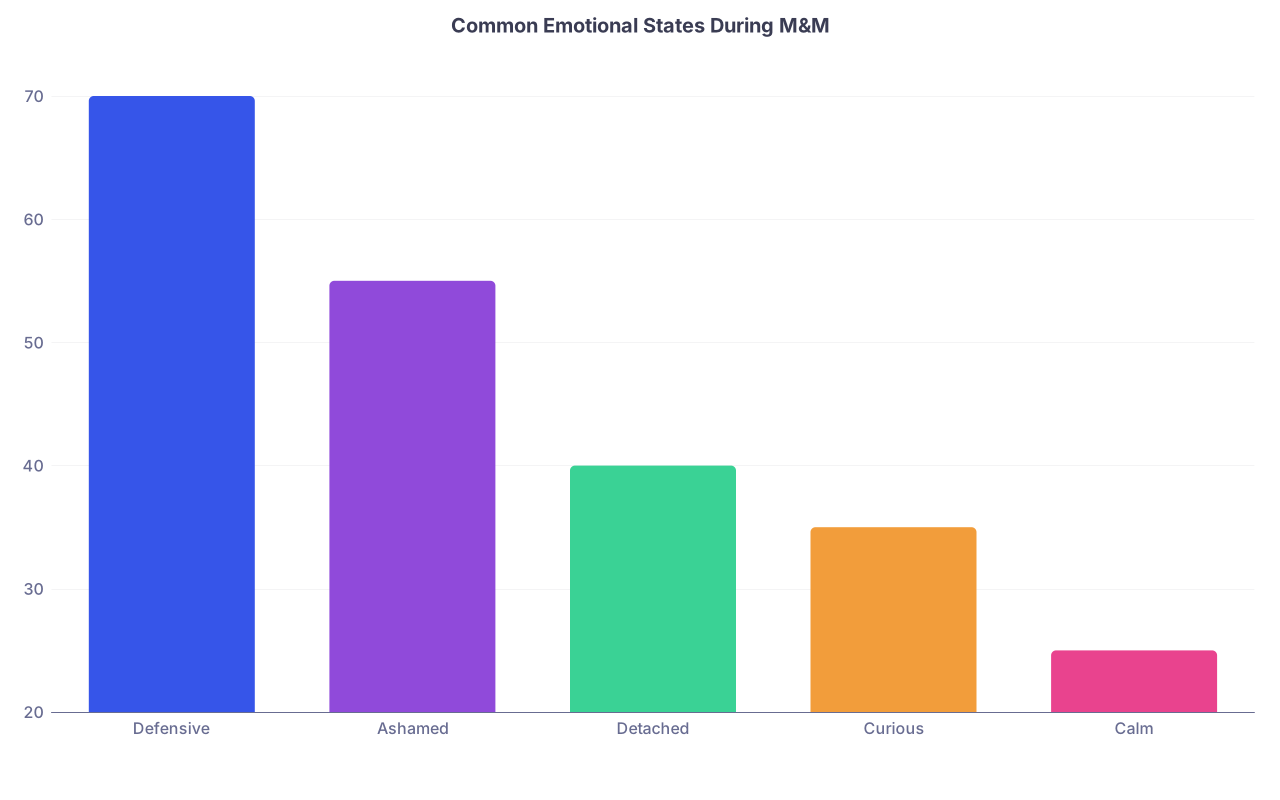
| Category | Value |
|---|---|
| Defensive | 70 |
| Ashamed | 55 |
| Detached | 40 |
| Curious | 35 |
| Calm | 25 |
That’s what mindfulness is for here: protecting learning and ethics in a high-stakes, emotionally loaded setting.
Start With Yourself: Mindfulness Before And During M&M
If you can’t regulate yourself, you’re not going to influence the room. So start small and concrete.
Before the conference: a 60-second reset
Arrive 2 minutes early. Literally.
Do this before you walk in, or before you unmute on Zoom:
- Feel your feet on the ground or your body in the chair.
- Take 3 slow breaths, longer exhale than inhale.
- Name your internal weather in one short phrase:
“Tired and annoyed.”
“Anxious and braced.”
“Sad and worried.”
You’re not trying to change it. You’re acknowledging it so it stops running the show unconsciously.
If you’re directly involved in the case, add one step:
“I’m allowed to feel X, and I’m still committed to learning from this.”
That one line keeps you from slipping into pure self-defense mode.
During the conference: micro-skill #1 – pause before you speak
Simple rule: add a half-second pause between impulse and speech.
Someone says, “Why did you discharge that patient? That was clearly unsafe.”
Your nervous system spikes. You want to fire back or collapse.
In that half-second pause, ask yourself one quick question:
“Am I about to protect my ego or protect the patient/system?”
If it is purely ego defense (“Because nobody told me!” “You weren’t there!”), swallow it. If it actually helps learning (“Here’s what information I had, and where my thinking went wrong…”), say it.
That’s mindfulness in action. Not magical. Just disciplined.
During the conference: micro-skill #2 – feel your body
Watch your own tells:
- Jaw clenched
- Shoulders tight
- Hands gripping pen or arms crossed hard
- Breath shallow
Those are early warning signs you’re dropping into fight/flight/freeze. When you notice one, relax that single muscle group and take one slower breath while still listening.
No one sees it. But it stops you from spiraling.
Bringing Mindfulness To The Structure Of M&M
If you have any influence on how M&M is run (chief, faculty, quality officer, even a respected senior resident), you can hardwire mindfulness into the format without using the word “mindfulness” at all.
1. Add a 1-minute grounding at the start
Don’t call it meditation. Call it “orientation” or “framing.”
Example script (30–45 seconds, spoken by the moderator):
“Today we’re reviewing a serious outcome. Our goals are:
- to understand what happened as accurately as we can,
- to focus on systems and decision processes, not blame, and
- to leave with at least one concrete change.
Many of us may feel defensive, guilty, or upset. That’s normal. Let’s try to stay curious and respectful as we hear the story.”
No incense. No mantras. But that’s mindfulness: naming the emotional reality and setting intention.
If your group is open to it, you can add 10–15 seconds of silence:
“Let’s just take a quiet moment to settle before we begin.”
And then actually be quiet. People adapt quickly.
2. Use a standard, non-accusatory case template
Mindfulness loves structure. Chaos feeds reactivity.
Push for a case presentation format that moves away from “Who messed up?” to “What happened and why?”
| Section | Purpose |
|---|---|
| Brief clinical summary | Shared understanding |
| Timeline of key events | Reduces hindsight bias |
| Decision points | Where real choices were made |
| Contributing factors | Systems, communication, bias |
| Emotional impact | Human cost, clinician impact |
When the moderator explicitly calls out “decision points” and “contributing factors” (including cognitive bias, system pressures, handoff quality), it pulls attention away from simple character attacks.
3. Build in explicit “learning goals”
At the start or just after the case presentation, name 1–3 learning goals:
- “How we assess fitness for discharge in X scenario”
- “How we handle conflicting recommendations from consultants”
- “How we recognize anchoring bias in our own thinking”
This shifts the tone from trial to seminar. Again, that’s mindfulness: directing attention intentionally.
How To Respond Mindfully When You’re On The Hot Seat
At some point, the case will be yours. Maybe you were the resident, maybe the attending, maybe the consultant who said, “Looks fine to me.”
You will feel exposed. The question is: do you let shame run it, or do you show up with grounded honesty?
Here’s a simple framework you can use (and even write down beforehand).
Step 1: Own your role accurately
Not more, not less.
Bad extremes:
- Over-owning: “This whole thing is entirely my fault.” (usually not true, and shuts down systems analysis)
- Under-owning: “I did nothing wrong, this was just bad luck.” (also usually not true)
More mindful middle ground:
- “I was the night resident. I made the decision not to call the attending after X happened.”
- “I was the surgeon on call. I accepted the patient based on the report, which was missing Y detail, and I didn’t clarify it.”
You’re staying factual, not self-flagellating.
Step 2: Name your actual thought process
This is where most people hide, because it feels vulnerable. But it’s where the educational gold is.
Example:
- “I thought her tachycardia was from pain and anemia, not sepsis, because her blood pressure had improved. I anchored on the early improvement and downplayed the new signs.”
- “I assumed the ED team had already checked for X, because I saw the note saying ‘labs sent’ and I didn’t confirm what was actually drawn.”
You are modeling cognitive humility. That is more powerful than any “pearls and pitfalls” slide.
Step 3: Acknowledge emotions without making them the story
Short and clean is best.
- “I felt embarrassed about calling again because I’d already called twice that night.”
- “I was afraid of delaying the OR and being seen as overcautious.”
You’re not doing therapy in front of the room. You’re illuminating how real human feelings distort clinical decisions.
Step 4: Commit to a concrete change
Not “I’ll be more careful.” Worthless sentence.
Instead:
- “In similar cases, I’ll now always confirm X data point myself.”
- “If my gut concern is high, I’ll call the attending regardless of how many times I already called.”
- “I’m adding a discharge checklist item for Y for patients like this.”
That is the ethical side of mindfulness: awareness plus action.
If You’re Moderating: How To Keep The Room Mindful
Moderators make or break M&M. I’ve seen brilliant ones turn a potentially vicious session into serious, respectful learning. They use a few key behaviors consistently.
1. Call out blame language and redirect
You hear: “Why didn’t you just admit the patient?”
A non-mindful moderator lets that hang.
A mindful moderator says:
- “Let’s rephrase that. At that moment, with the info you had, what options did you consider, and why did admission not feel necessary?”
- “Instead of ‘why didn’t you just,’ let’s walk slowly through what you were seeing in real time.”
You are not protecting feelings at the expense of truth. You’re protecting clarity at the expense of lazy judgment.
2. Normalize discomfort
One line from the moderator can drop the temperature in the room:
- “Cases like this are hard to listen to. Many of us have made similar decisions with incomplete information.”
- “It’s easy to see the right move in hindsight. Let’s stay disciplined about separating hindsight from what was actually known.”
This doesn’t excuse errors. It keeps people from mentally retreating into “Glad that wasn’t me,” which kills learning.
3. Equalize hierarchy when possible
Residents and nurses shut down the moment they feel they’re being publicly prosecuted while attendings skate.
A mindful moderator:
- Asks attendings directly: “Looking back, would you have done anything differently with the same information?”
- Invites other roles: “Nursing, from your vantage point, what felt like the biggest challenge in this case?”
You’re quietly signaling: everyone in the system is part of the reflection, not just the lowest person on the totem pole.
Ethical Core: Why Mindfulness Actually Matters In M&M
This is not window dressing. Mindfulness in M&M is an ethical practice.
It prevents three common ethical failures:
Scapegoating
Blaming the most junior or most visible person, letting systemic problems persist. Mindfulness forces you to see the whole context.Moral injury
When clinicians are publicly shamed for system-caused outcomes, they carry that wound. Over time, that breeds cynicism, burnout, or quiet disengagement. Mindful framing protects truth and dignity.Willful blindness
When the room is too uncomfortable, people disconnect. They check their phones, their email, their mental to-do list. Mindful practices (even tiny ones) keep people present enough to absorb the lesson.
If you care about patient safety, professionalism, and your own integrity, then mindfulness in M&M is not optional. It’s part of doing this work without destroying people.
Practical Ways To Start This Month
You don’t need a committee. Pick one or two of these and just start.
If you’re a resident:
Before your next M&M, write out your thought process and one concrete change. Commit to describing both out loud, calmly, even if no one asks perfectly.If you’re faculty:
Open your next M&M with a 30‑second framing about goals, systems focus, and normalizing discomfort. Then actually model it yourself when your decisions come up.If you’re chief or QI lead:
Propose a simple standard template for cases (timeline, decision points, contributing factors, changes). Make “contributing factors” explicitly include cognitive and emotional elements, not just lab turnaround times.For everyone:
Use that half-second pause rule before you speak. Ask yourself: “Am I defending myself, or serving the case?”
Those small acts are how culture changes. Not slogans. Not posters. Repeated behaviors in the room where it happens.

| Step | Description |
|---|---|
| Step 1 | Pre-M&M Personal Check-in |
| Step 2 | Opening Framing by Moderator |
| Step 3 | Structured Case Presentation |
| Step 4 | Explore Decision Points |
| Step 5 | Name Contributing Factors |
| Step 6 | Identify Concrete Changes |
| Step 7 | Brief Closing Reflection |
FAQ: Mindfulness In M&M Conferences
1. Won’t people roll their eyes if I mention “mindfulness” in M&M?
Probably. So do not lead with the word. Lead with behaviors: a clear opening frame, a brief pause, explicit focus on systems and thought processes instead of blame. You can practice mindfulness without ever using the label. Over time, people respect what actually improves the quality of discussion, even if they never call it “mindful.”
2. How do I stay calm when the case is about my mistake?
You won’t be fully calm. That’s fine. Aim for grounded enough. Prep beforehand: write down what you knew, what you thought, what emotions influenced you, and what you’d change. Breathe slowly before you speak. When you feel defensive, silently name it (“I’m feeling attacked”) and then answer from your earlier written reflection, not from the spike of emotion.
3. What if my institution’s M&M culture is extremely blame-heavy?
Then you start smaller. Focus on your own reactions first. Use neutral, factual language about your thought process. When you’re in the audience, ask curiosity-based questions instead of accusatory ones. If you have any leadership influence, start by formalizing a case template that includes systems factors. You may not fix the culture, but you can refuse to fuel its worst habits.
4. How do I integrate emotional impact without turning M&M into group therapy?
Keep it brief and bounded. One or two sentences about emotional impact are enough: “This case was very distressing for the team,” or “The residents involved have struggled with guilt about this outcome.” That honors the human cost without derailing into processing. If people clearly need more support, that’s for debriefs or wellness resources, not the main M&M hour.
5. Is there any evidence that mindfulness actually improves M&M or patient safety?
Direct RCTs of “mindful M&M” are rare, but we do have strong evidence that mindfulness reduces clinician burnout, improves emotional regulation, and enhances communication. We also know psychologically safe environments produce more error reporting and better team learning. What you’re doing is borrowing those well-established mechanisms and applying them to one of the most emotionally charged, learning-critical meetings in medicine. The logic is solid, and the downside is minimal.
Key points: You bring mindfulness into M&M by changing how you show up and how the room is structured, not by preaching meditation. Stay present with discomfort, be explicit about thought processes and systems, and protect learning over blame. That’s it.


