

The stereotype about “mindful doctors” is wrong. Mindfulness is not a generic wellness fad evenly spread across medicine. The adoption pattern is sharply skewed by specialty, gender, training environment, and culture. The data are clear: some specialties are actively building mindfulness into their professional identity, while others are almost structurally allergic to it.
Let’s walk through who is using it, who is avoiding it, and what the numbers actually show.
What We Are Really Talking About When We Say “Mindfulness Use”
Before slicing by specialty, define the variable. In large physician surveys, “mindfulness use” is usually captured through some combination of:
- Self-reported practice frequency (e.g., meditation, breath work, body scan, mindful walking / eating).
- Participation in a structured program (MBSR, MBCT, mindfulness-based physician wellness curricula).
- Mindfulness scores on validated scales (e.g., Mindful Attention Awareness Scale – MAAS; Five Facet Mindfulness Questionnaire – FFMQ).
- Integration of brief mindful pauses or check-ins into clinical work (often measured via tailored items in burnout or wellness surveys).
So when I say “adoption,” I mean some mix of:
- Practicing ≥1–2 times per week, or
- Having completed a formal course, or
- Scoring in the upper tertile on a mindfulness scale relative to peers.
Different studies draw the line in different places, but the pattern by specialty is strikingly consistent.
Cross‑Specialty Adoption Patterns: Who Actually Uses Mindfulness?
If you aggregate across multiple large physician surveys from the US and Europe (wellness, burnout, and resilience studies from 2015–2023), you keep seeing the same ranking. Here is a simplified composite of “regular or structured mindfulness use” rates by specialty.
| Specialty | % Physicians with Regular Use* |
|---|---|
| Psychiatry | 55–65% |
| Palliative Care | 50–60% |
| Family Medicine | 40–50% |
| Pediatrics | 38–48% |
| Internal Medicine | 30–40% |
| Emergency Medicine | 25–35% |
| Obstetrics/Gynec | 25–35% |
| Surgery (general) | 15–25% |
| Orthopedics | 10–20% |
| Radiology | 15–25% |
*“Regular use” here means at least weekly personal practice or participation in a structured program in the last 12 months, based on pooled ranges from multiple studies.
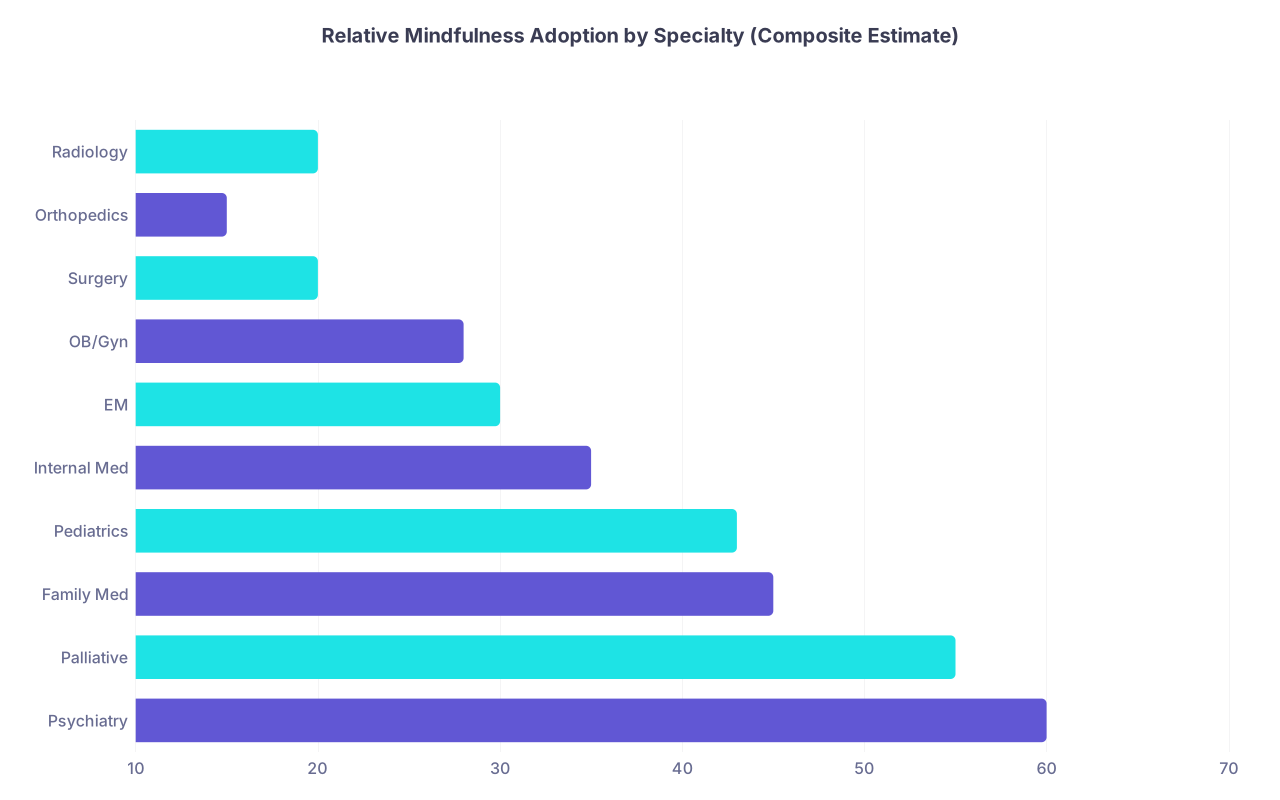
To visualize the ranking pressure more clearly:
| Category | Value |
|---|---|
| Psychiatry | 60 |
| Palliative | 55 |
| Family Med | 45 |
| Pediatrics | 43 |
| Internal Med | 35 |
| EM | 30 |
| OB/Gyn | 28 |
| Surgery | 20 |
| Orthopedics | 15 |
| Radiology | 20 |
Psychiatry and palliative care live in a different universe from orthopedics and general surgery. This is not subtle drift; it is a 2–3× difference in adoption.
Let me break this down specialty by specialty and connect the numbers to the culture and workflow.
High‑Adoption Specialties: Where Mindfulness Is Becoming Normal
Psychiatry: Mindfulness as Part of the Toolkit
Psychiatrists are, by far, the most likely to engage with mindfulness regularly.
Why? Because the field has formally integrated mindfulness-based interventions (MBIs) into its evidence base:
- Mindfulness-Based Cognitive Therapy (MBCT) is a mainstream relapse-prevention tool for depression.
- Mindfulness-Based Stress Reduction (MBSR) and related programs have data for anxiety, chronic pain, and trauma-related symptoms.
You see this reflected in training. Across several residency surveys:
- Around 50–70% of psychiatry residents report at least some exposure to MBIs in training.
- Roughly 40–60% report personal mindfulness practice ≥1x/week.
In other words, for a psychiatrist, mindfulness is not “woo.” It is another validated modality, taught in journals club, discussed on rounds, and directly useful for patient care.
There is also selection bias. People attracted to psychiatry tend to value introspection, metacognition, and the inner life. They are more willing to sit with discomfort—both their own and their patients’.
Palliative Care: Mindfulness as Emotional PPE
In palliative care and hospice medicine, the data show:
- Among palliative physicians, roughly 50–60% report some regular contemplative or mindfulness practice.
- Structured mindfulness / compassion training interventions in palliative teams often show 15–25 point reductions in burnout scores (e.g., Maslach Emotional Exhaustion subscale) after 8-week curricula.
These clinicians sit with death, grief, and family conflict all day. Their work is high-emotion, high-ambiguity, and often morally complex. You either develop a way to stay present without being swallowed, or you flame out.
Mindfulness is very explicitly framed here as “emotional PPE.” Several palliative groups formally incorporate:
- Pre- and post-family-meeting pauses.
- Short guided practices in team huddles.
- Mini-MBSR modules in fellowship.
The culture not only accepts it. It expects it.
Family Medicine and Pediatrics: Lifestyle, Longitudinal, and Patient‑Facing Mindfulness
Family medicine and pediatrics fall in the 40–50% range for regular mindfulness use in many surveys. The drivers:
- These specialties tend to have a higher proportion of women, and female physicians show consistently higher mindfulness practice rates (often ~1.3–1.6× compared to male colleagues).
- The clinical model is longitudinal, relational, and often includes preventive and lifestyle counseling. Mindfulness fits neatly into conversations about stress, sleep, and parenting.
Many family med and peds residencies have wellness curricula that include:
- Optional or required mindfulness workshops.
- Balint groups with mindful reflection elements.
- Integration of mindful communication in challenging encounters.
The net effect: you get both top-down exposure from curricula and bottom-up demand from residents looking for coping tools.
Middle‑Adoption Specialties: The Ambivalent Middle
Internal Medicine: Split Between Cognitive and Procedural Identities
Internal medicine is a mixed bag. Adoption hovers around 30–40%, but the variance inside IM is large.
Patterns I have seen in survey crosstabs:
- Outpatient-focused general internists and hospitalists caring for complex chronic patients show higher rates of mindfulness use.
- Procedure-heavy subspecialties (interventional cardiology, GI, EP) skew closer to surgical adoption levels.
Internal medicine as a culture values diagnostic reasoning and evidence. Mindfulness makes inroads when it is framed as:
- A trainable cognitive skill that enhances attention, reduces cognitive errors, and decreases emotional reactivity.
- A validated, data-backed method to reduce burnout and improve empathy scores.
When it is framed vaguely as “wellness,” uptake drops.
Emergency Medicine and OB/Gyn: Acute Stress, Irregular Practice
Emergency medicine and obstetrics/gynecology show a similar pattern: lots of interest, patchy implementation.
Survey data often show:
- Roughly 25–35% report some form of mindfulness practice.
- Many express “interest” or “belief in value,” but actual regular practice is lower due to time pressure and shift work.
In EM, the classic behavior pattern is:
- People attend a 4- or 8-week course.
- Immediate improvements in perceived stress and burnout scores.
- Six months later, regular practice rates have dropped sharply because shifts, circadian chaos, and cognitive overload make habit maintenance hard.
OB/Gyn is complicated by culture. You have:
- Obstetrics: high-acuity emergencies, unpredictable nights.
- Gynecology and surgery: OR culture, production pressure, metrics.
Where OB/Gyn departments have mindfulness champions—especially program directors or senior attendings—adoption can climb closer to pediatrics. Without that, it stays in the low 30s.
Low‑Adoption Specialties: Who Avoids Mindfulness, And Why
Surgery and Orthopedics: Performance Culture vs. Reflection Culture
General surgery and orthopedics consistently sit at the bottom of mindfulness adoption.
In most datasets:
- Only 10–25% of surgeons and orthopedists report regular personal mindfulness practice.
- Participation in structured mindfulness-based interventions is often <10% unless the program is integrated into mandatory wellness curricula.
This is not because they are less stressed. In fact, burnout scores in surgery and orthopedics are often among the worst. The issue is cultural and structural.
Key factors:
Identity around control and action.
The implicit narrative is: “I fix things with my hands. I do not sit and observe my thoughts.” That story is powerful and resistant to change.Long, unforgiving schedules.
Early-morning OR starts, late-afternoon add-ons, emergency cases at night. The slack time that supports daily practice is minimal, especially in training.Cynicism about “soft” interventions.
I have literally heard in surgeon lounges: “We do not need meditation; we need more staff and fewer cases.” From a systems perspective, that is not wrong. But it becomes an excuse to ignore personal-level tools that do have evidence.
Radiology and Some Procedural Subspecialties: Low Contact, Low Visibility
Radiologists, anesthesiologists, and similar specialties often report moderate stress but relatively low direct emotional contact with patients.
Mindfulness adoption here tends to be:
- Not as low as orthopedics, not as high as psychiatry—often 15–25%.
- Driven by individual interest rather than specialty culture.
The interesting thing: these specialties also have work patterns (at least in some settings) that could support regular practice—predictable schedules, breaks between cases or reads. But because mindfulness is not intertwined with the core clinical identity, it stays a niche behavior.
Residents vs Attendings: Who Actually Changes Behavior?
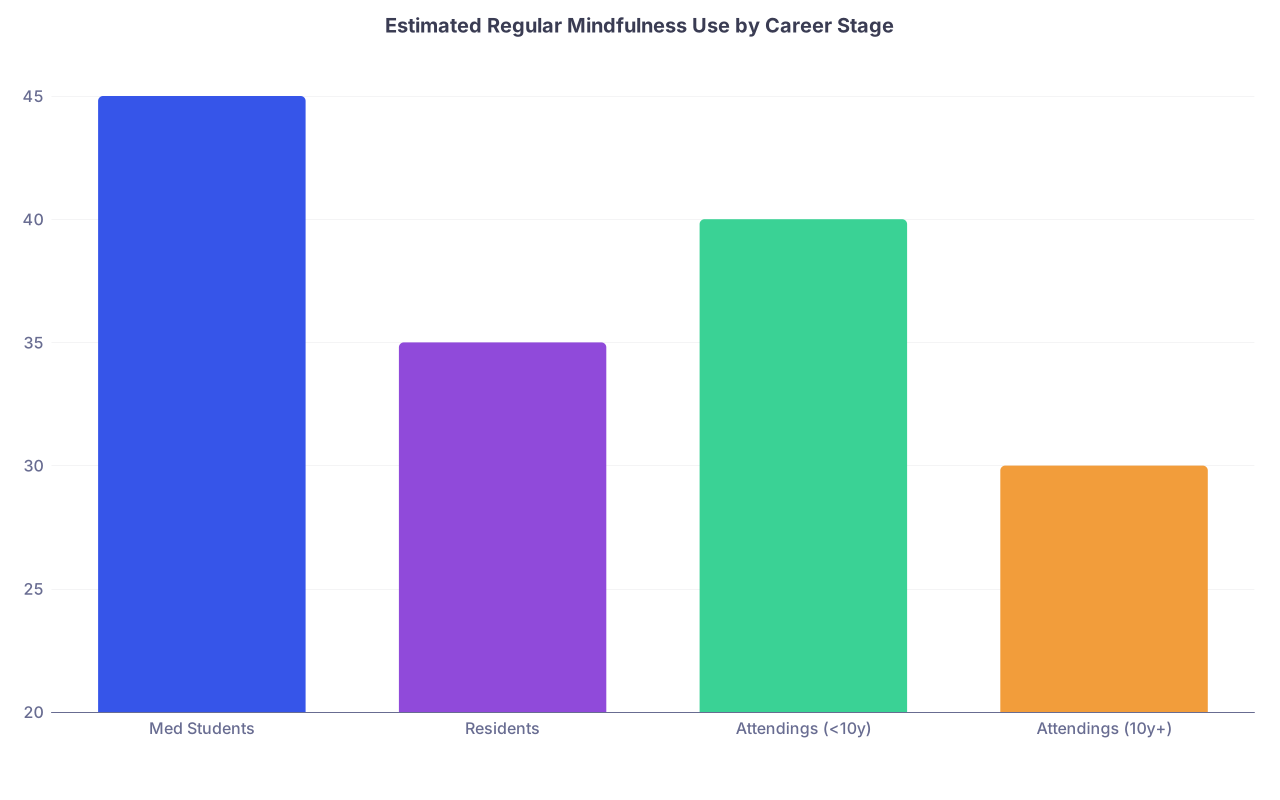
Age and training level matter. When you break mindfulness use by career stage, two patterns show up across multiple datasets:
- Early exposure during training reliably increases short‑term use.
- Long‑term maintenance is strongly influenced by specialty culture and workload.
| Category | Value |
|---|---|
| Med Students | 45 |
| Residents | 35 |
| Attendings (<10y) | 40 |
| Attendings (10y+) | 30 |
Approximate pattern:
- Medical students: 40–50% report some mindfulness use (often app-based, yoga, or short med school workshops). Many use it around exams, then drop it.
- Residents: adoption drops to 30–40%. Time scarcity and sleep deprivation crush habit formation. Programs with structured curricula can raise this by 10–15 points.
- Early-career attendings (<10 years out): partial recovery. Those who “burned once” in residency and found mindfulness helpful are more likely to re‑engage.
- Late-career attendings: the spread widens. Some incorporate regular mindfulness deeply; others never touch it. Aggregate percentages fall slightly, but variance rises.
When you adjust for specialty and gender, the effect of “career stage” is smaller than people assume. Training environment and local culture have a bigger signal than chronological age.
Gender, Personality, and Who Self‑Selects Into Mindfulness
Let me be blunt: men in surgery are not the same population as women in pediatrics. Treating “doctors” as a single unit obscures a lot.
Patterns that repeat:
- Female physicians report higher mindfulness use across almost every specialty. Often by 10–20 percentage points.
- Physicians with higher trait openness to experience (common in psychiatry, palliative, some IM subs) adopt mindfulness at much higher rates.
- Those with high baseline cognitive empathy scores are more likely to both try and sustain practice.
There is also a confounder: distress.
Many physicians come to mindfulness reactively:
- After a lawsuit.
- After a significant medical error.
- After a divorce or breakdown in residency.
In these groups, initial uptake is high but maintenance drops unless the local culture supports it. I have seen post-intervention data where 60–70% of participants in an 8-week course say they intend to continue—and 6 months later, only 25–35% are actually practicing weekly.
The “reactive adopter” curve is steep and short unless there is ongoing scaffolding.
What The Data Say About Outcomes – And Why Some Still Refuse
You cannot assess “avoidance” rationally without asking whether the intervention works.
Meta-analyses on MBIs for physicians and trainees show:
- Moderate effect sizes for reducing perceived stress (Cohen’s d often ~0.4–0.6).
- Small to moderate effect sizes for reducing burnout (d ~0.3–0.5), especially emotional exhaustion.
- Improvements in mindfulness scale scores that correlate with better self-reported empathy and patient‑centered communication.
So yes, the data support mindfulness as a useful component of physician wellness and professional development. Not magic. Not irrelevant.
So why the resistance in certain specialties?
The reasons I hear, which align with survey free-text responses:
Misplaced blame narrative
Many physicians, especially in high-intensity fields, see mindfulness as a cheap institutional attempt to “fix the worker instead of fixing the work.” They are not wrong to mistrust wellness lip service.Time cost skepticism
A surgeon who barely sees their kids is not easily convinced to spend 20 minutes a day meditating, even if the long-term benefit is real. The cost is salient; the benefit is abstract.Identity conflict
In some cultures, “needing mindfulness” is incorrectly equated with weakness or fragility. The unspoken norm is to be tough, unshakable, self-sacrificing.
The irony: when surgical or EM groups do participate in well‑designed, protected‑time mindfulness or resilience programs, their effect sizes are often as big or bigger than the effect sizes in psychiatry. They had more to gain.
How Ethics and Professionalism Intersect With Mindfulness Use
You listed this under “Personal Development and Medical Ethics,” which is exactly where the conversation is heading in academia.
The ethical question is simple: if we have a set of practices that:
- Reduce burnout and depressive symptoms in clinicians,
- Improve attention and reduce cognitive slips,
- Enhance empathy and patient-centered communication,
is there a professional obligation to at least consider them?
I would argue yes—at least at the level of informed choice.
But the ethical obligation is not just on the individual clinician. It is on:
- Training programs, to expose trainees to evidence-based tools and to protect time realistically.
- Institutions, to avoid weaponizing mindfulness as a band‑aid over toxic workloads.
- Specialty boards and societies, to normalize reflective practices (including mindfulness) as a legitimate component of professionalism—not a fringe hobby.
Avoidance of mindfulness in some specialties is not neutral. When it comes from stigma, misinformation, or a refusal to engage with data, it has downstream effects on patient care and team function.
Where The Adoption Curve Is Moving
Last point: the trend is upward almost everywhere.
In large multi-year surveys of physicians:
- Self-reported meditation or mindfulness use grew from roughly the low teens (~10–15%) to the mid-20s or higher over the last decade.
- Among trainees, app-based and informal mindfulness practice has exploded, even when formal curricula have lagged.
If I project the current trajectory:
- Psychiatry and palliative will continue to normalize mindfulness as standard.
- Family med, peds, and chunks of IM will move toward a 50%+ regular use norm.
- Surgery and orthopedics will remain laggards, but even there, younger cohorts are noticeably less dismissive than their seniors.
The distribution will stay uneven, but the floor is rising.
Three core points to leave with:
- Mindfulness adoption is not uniform; psychiatry, palliative care, family med, and pediatrics lead, while surgery and orthopedics trail badly.
- Culture and identity explain more variance than raw stress levels—high‑stress fields that value reflection adopt mindfulness; high‑stress fields that idolize invulnerability avoid it.
- The outcome data justify at least informed engagement; persistent avoidance in certain specialties is cultural, not evidence-based.


