Health insurance for physicians is not “basically the same everywhere.” That belief costs residents, fellows, and moonlighters thousands of dollars a year and exposes them to catastrophic gaps they do not see until they get sick, pregnant, or injured.
You’re told some version of: “The hospital gives you good insurance, you’ll be fine.” That’s lazy, and it is often flat-out wrong.
Let me walk through what actually changes between plans, why moonlighting and multi-site work make this worse, and where the real landmines hide.
The Myth: “Employer Health Insurance Is Basically Standardized”
This is the story people like because it’s simple. HR gives you a glossy PDF, some colleague shrugs and says, “We’re on the PPO; it’s fine,” and you click enroll.
Reality: even within the same hospital system, two plans can mean a five‑figure difference in your out-of-pocket expenses in a bad year.
For physicians, there are three layers of variation you need to care about:
- The core plan design (deductibles, coinsurance, out-of-pocket maximums)
- The network structure (who is actually considered “in-network,” especially for moonlighting sites)
- The carve-outs and exclusions that hit healthcare workers disproportionately (mental health, reproductive care, disability overlays, work-related injuries)
Most residents only ever look at the premium difference. That’s like choosing a home based on the property tax line and ignoring the fact that one has black mold and no roof.
What Actually Varies Between Plans (That You Feel in Your Wallet)
Let’s get specific. Here’s how two “good” employer plans can quietly differ.
| Feature | Plan A (Traditional PPO) | Plan B (High Deductible HSA) |
|---|---|---|
| Monthly premium (employee) | $220 | $90 |
| Deductible (individual) | $500 | $2,000 |
| Out-of-pocket max (indiv.) | $3,000 | $6,000 |
| Primary care visit | $20 copay | 20% after deductible |
| ER visit | $150 copay | 20% after deductible |
| Employer HSA contribution | N/A | $1,000 |
Both of these will get described in orientation as “solid coverage.” They are not remotely the same.
If you’re healthy, the HSA plan might win easily. If you have a complicated pregnancy, chronic disease, or one bad accident on the way home from an overnight shift, the PPO could save you thousands—even with higher premiums.
Here’s what actually matters, more than the premium, once you’re past intern year and especially if you’re moonlighting:
- The deductible and out-of-pocket maximum: what is the absolute worst-case scenario in a year?
- Whether those numbers apply per person or per family
- What counts toward the out-of-pocket maximum (spoiler: not everything)
- How out-of-network emergencies are treated
Most physicians never read those lines. I’ve watched a PGY-3 with twins in the NICU hit an out-of-pocket maximum she didn’t realize reset separately for each baby. That’s not a “minor difference.” That’s real money.
Network Games: Why Moonlighting Blows Up Your Assumptions
If you only work at one academic center, you might get away with ignoring networks. Start moonlighting at an outside hospital, urgent care, or telemedicine group, and the cracks appear.
You assume: “If I’m working there, surely they’re in my network.” That’s not how contracting works.
Common traps:
- The moonlighting hospital is out-of-network under your primary academic employer’s plan, even though your ID badge on the wall looks identical
- The ED is in-network but the radiologist, anesthesiologist, or pathologist group is not
- Telehealth platforms hire you as an IC, and your own plan treats them as out-of-area or out-of-network
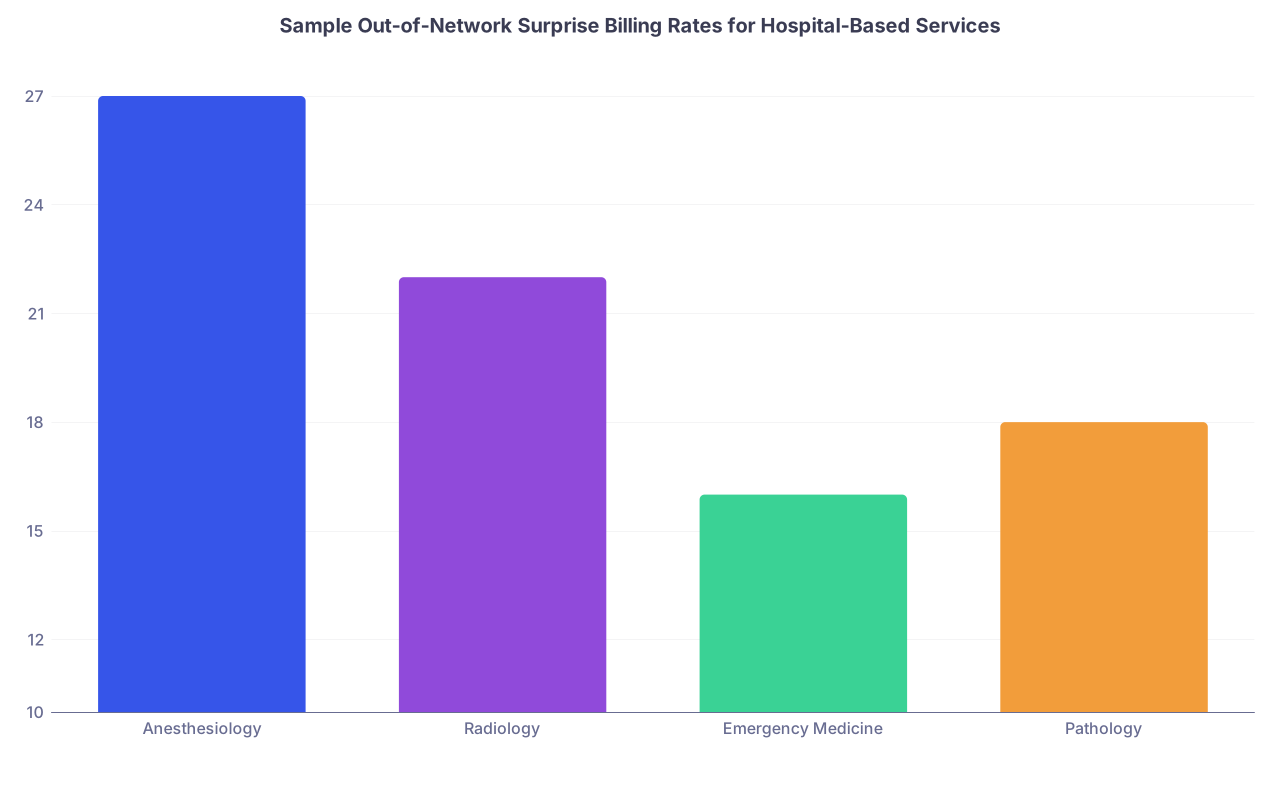
| Category | Value |
|---|---|
| Anesthesiology | 27 |
| Radiology | 22 |
| Emergency Medicine | 16 |
| Pathology | 18 |
These numbers are pre–No Surprises Act data, but even post‑legislation, there are loopholes, and not everything is covered (ground ambulances, some specialist follow-ups, certain telehealth situations).
I’ve seen a moonlighting resident get a $4,000 bill from an imaging center she literally worked at—because the group was out-of-network under her main hospital’s plan.
- Pull the provider directory and search every site where you work or might get care (home, moonlighting facility, main hospital).
- Do not trust the branding. Shared logos do not mean shared contracts.
- Check urgent cares and freestanding ERs near your home. Night float plus sudden appendicitis does not wait for you to drive back to the academic medical center.
Hidden Gaps That Hit Physicians Especially Hard
The real differences among plans are not always in bold text. They’re buried in exclusions, prior auth requirements, and carve-outs that disproportionately affect healthcare workers.
Mental health and burnout care
Everyone loves to talk about “wellness.” Your plan booklet may tell a different story.
Things to look for:
- Session limits per year for therapy or psychiatry
- Requirement to see only “behavioral health network” providers through a separate vendor
- Higher copays for mental health visits than for primary care
- Out-of-network reimbursement for therapists who don’t take insurance (which is a lot of them, especially in big cities)
I’ve watched residents pay $200/session out-of-pocket because their plan’s mental health panel was months out and full of providers who “weren’t taking new patients.”
Plans are not “all the same” when one treats mental health as a core medical need and another treats it like an optional add-on.
Reproductive and fertility coverage
Here’s where benefits diverge dramatically even within medicine-friendly employers.
Look for:
- Coverage of IVF or ICSI
- Limits on fertility benefits (lifetime max: often ridiculously low)
- Coverage for fertility preservation (egg/sperm banking) before chemo or gender-affirming care
- Maternity coverage differences between plans, including facility charges and NICU costs
Residents often delay having kids assuming “once I’m an attending, I’ll have good insurance.” Then they join a private group with a bare‑bones small-group plan that covers almost nothing for fertility.
I’ve seen OB/GYN residents with better fertility coverage than the REI staff they joined after fellowship.
Work-related injuries and the workers’ compillusion
Many physicians do not understand where their health insurance simply walks away.
If you get hurt “in the course of employment” (needle stick, back injury lifting patients, assault in the ED), your regular health plan often refuses to pay because it’s workers’ comp territory. That’s a different insurer, different system, different fight.
Moonlighting muddies this further. Get injured driving between sites? Fight #2. Telehealth on your couch and you develop a DVT after a 16-hour marathon? Gray zone.
Plans are not the same in how aggressively they offload these cases to comp or in how well their internal teams help you navigate it. Academic centers with unionized housestaff often have better support. Community hospitals and locums groups often leave you to figure it out.
Multi-Employer Chaos: When You Have More Than One Plan
Moonlighting and per-diem work create another mess: coordination of benefits.
You think: “Cool, two plans. Double coverage.” Reality: overlapping coverage often creates:
- Claim denials while the plans argue who’s primary
- Delays that push bills into collections while you’re on nights
- Out-of-network care getting misassigned to the “wrong” plan first

| Step | Description |
|---|---|
| Step 1 | Two Active Health Plans |
| Step 2 | Plan 1 primary |
| Step 3 | Plan 2 secondary |
| Step 4 | Claim submitted |
| Step 5 | Plan 2 reviews leftover |
| Step 6 | Denial or delay |
| Step 7 | Billing confusion and patient balance |
| Step 8 | Which is primary |
| Step 9 | Plan 1 pays? |
It’s not just annoying; it can change your actual out-of-pocket costs if the secondary plan has worse out-of-network rules or a higher deductible.
If you marry someone during residency, switch programs, or pick up W‑2 shifts with benefits through a separate employer, you should actually talk to HR and figure out which plan should be primary. Not guess. Not assume “it’ll sort out.”
HDHPs, HSAs, and the “Doctor Should Understand This” Trap
Many health systems are pushing high-deductible health plans (HDHPs) with Health Savings Accounts (HSAs) onto residents and faculty because they’re cheaper to offer.
On paper, HSAs are great: triple tax advantage, portable, can be invested. On the ground, for a PGY-2 with unpredictable expenses and no savings buffer, the deductible alone can be financially destabilizing.
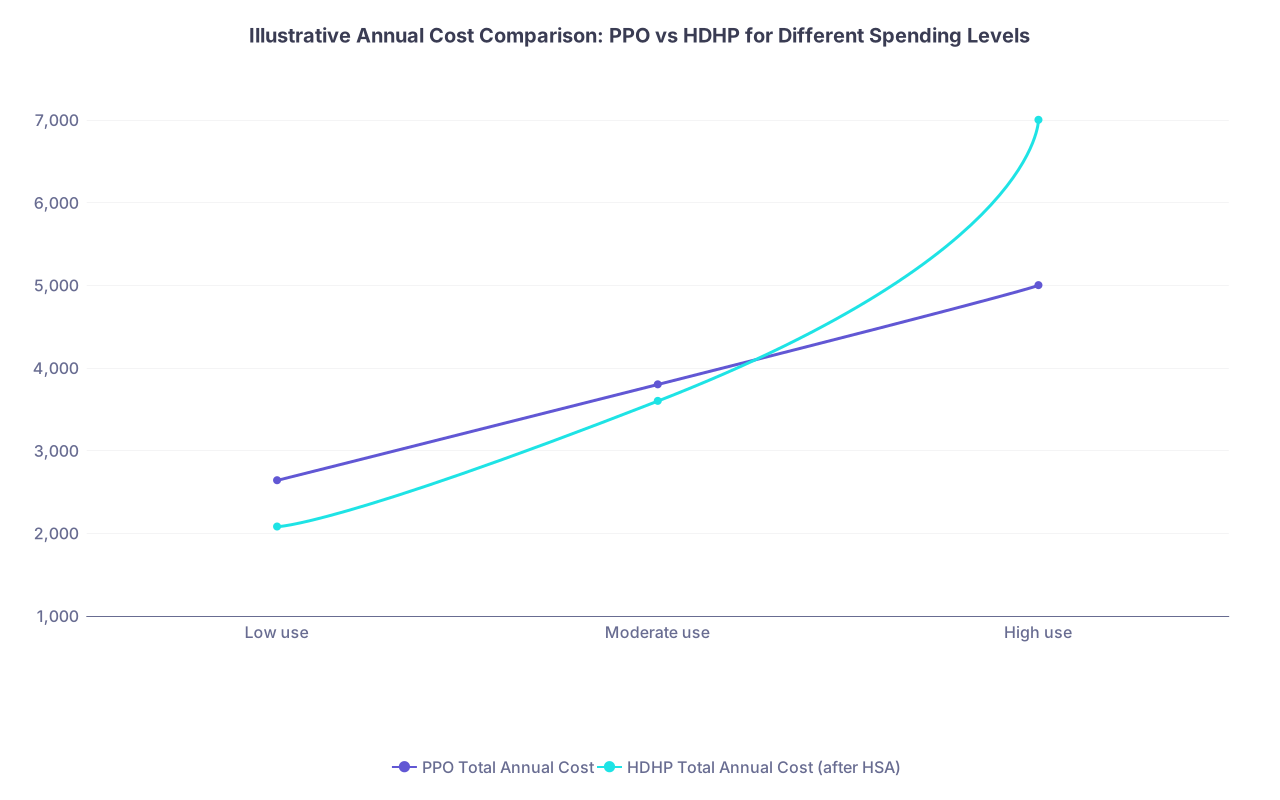
| Category | PPO Total Annual Cost | HDHP Total Annual Cost (after HSA) |
|---|---|---|
| Low use | 2640 | 2080 |
| Moderate use | 3800 | 3600 |
| High use | 5000 | 7000 |
The rough picture:
- If you rarely use care, HDHP+HSA wins.
- If you have a moderate year, they’re similar.
- If you have a really bad year (pregnancy + complications, major surgery, cancer), HDHP can hurt more, especially if you never built up the HSA balance.
Academic HR slides will say, “If you’re young and healthy, this is the best choice.” That completely ignores differential risk: residents doing procedures, working nights, driving sleep-deprived, caring for infectious patients, and delaying care because they’re broke.
Physicians are not standard white-collar employees. The risk profile is different, but benefit design doesn’t reflect that.
Telehealth, Crossing State Lines, and Network Weirdness
Future of medicine? Sure. But your 1990s-shaped health insurance is still trying to pretend you only get care in one state, during business hours, from brick-and-mortar offices.
What I’m seeing more of:
- Residents doing telehealth moonlighting licensed in multiple states while their health plan’s network is essentially local
- Plans that “cover telehealth” but only if you use their proprietary platform, not external telemedicine groups
- Behavioral telehealth covered differently from in-person visits, with separate copays or vendor networks

If your life is increasingly cross-state—rotations, away electives, remote work, conferences—you cannot assume “national PPO” equals “actually usable everywhere.” You need to verify:
- How emergency care is handled out of area
- Whether follow-up care post-emergency (e.g., orthopedist after a ski accident) is covered out-of-state
- Whether their telehealth coverage lets you see a doctor outside your home state
I’ve seen people fully insured who still got burned on a fall while traveling because post‑ER follow-up was treated as out-of-network specialty care.
Where the Real Money Difference Hides
To hammer this home, here’s roughly how your true annual cost varies, which almost nobody explains clearly:
| Component | Shows Up As | Often Overlooked? |
|---|---|---|
| Premiums | Monthly paycheck deduction | No |
| Deductible | First chunk of annual spending | Yes |
| Coinsurance | % you pay after deductible | Yes |
| Copays | Flat per-visit charges | Sometimes |
| Out-of-pocket maximum | Worst-case annual ceiling | Very often |
| Out-of-network costs | Balance bills, denied claims | Constantly |
Physicians are notorious for doing the following:
- Choosing the cheapest-premium plan by $50/month
- Ignoring the fact that the out-of-pocket maximum is $3,000 higher
- Being “shocked” when a single hospitalization wipes out their savings
If you look at nothing else, look at the out-of-pocket maximum for in-network and out-of-network separately. Then ask yourself: “Could I handle this number tomorrow if I had to?” If the answer is no, your “cheap” plan is lying to you.
How to Actually Compare Plans Like an Adult (Not a Tired Intern)
You don’t need to become a benefits lawyer. You do need to stop pretending plans are interchangeable.
When you’re deciding between options—even if you only get 10 minutes between cases—do this:
Flip to the summary of benefits and find:
- Deductible (individual/family)
- Out-of-pocket maximum (individual/family)
- In-network vs out-of-network structure
Check the provider directory for:
- Your main hospital and clinic
- Every moonlighting site
- Major hospitals near where you actually live and your family lives
Identify deal-breakers based on your life:
- Ongoing mental health care? Look at behavioral coverage details.
- Planning a pregnancy or IVF? Look at maternity/fertility language.
- Chronic condition? Check specialty copays and med formulary.
Run two scenarios in your head:
- “Nothing major happens this year.”
- “I get pregnant / need surgery / end up in the hospital once.”
If the bad-year math is absolutely brutal, but you know your risk profile is higher than average, ignoring that because “the monthly premium is cheaper” is not rational. It’s denial.
The Bottom Line
Health insurance is absolutely not “the same everywhere,” and for physicians—especially those moonlighting or planning nontraditional careers—the differences are amplified, not smoothed out.
Three points to leave with:
- Plans that look similar on the surface can differ by thousands of dollars in a bad year; the real levers are deductibles, out-of-pocket maximums, and network boundaries, not just the premium.
- Moonlighting, telehealth, and multi-site work make network details and coordination of benefits far more important than most residents realize until they get burned.
- Mental health, reproductive care, and work-related injuries sit in the gray zones and carve-outs where benefits quietly diverge; that’s where you should be reading the fine print first, not last.
Stop assuming “the hospital’s coverage is good.” Start treating health insurance as part of your actual compensation and risk profile, because that’s exactly what it is.