
Most residents should not moonlight in their first year. Many should in their last. The tricky part is everything in between.
Here’s the answer you’re actually looking for: moonlighting can absolutely change your financial life as a resident, but it can also quietly wreck your training, your marriage, and your board scores if you get it wrong. You need a structured way to decide, not “my senior said it’s fine.”
This is that framework—by training year, with clear yes/no decision points and specific red flags.
The Core Risk‑Benefit Equation
Strip away the noise. Moonlighting is a trade between four things:
- Money
- Time
- Fatigue / burnout
- Training quality and safety (for you and patients)
Most residents only stare at #1. Programs only talk about #4. You have to weigh all four for your specific situation, not some generic “residents should/shouldn’t moonlight.”
Think of it as a running calculation:
Benefit score:
- Extra income (debt relief, childcare, helping family, saving for a house)
- Additional clinical exposure (only true in some fields and sites)
- Autonomy and confidence (working as “the doctor” without the safety net)
Risk score:
- Fatigue and error risk
- Impact on rotation performance and evaluations
- Board score impact (Step 3, in‑training, written/oral boards)
- Relationship and personal life strain
- Legal/credentialing exposure if you skimp on malpractice, supervision, or documentation
You should only moonlight when the total benefit clearly beats the total risk for your current year of training.
Let’s break that down year by year.
PGY‑1: Almost Always No
If you’re an intern asking “should I moonlight?” the answer is nearly always: not yet.
Here’s why:
- You’re still learning to be safe on your primary job.
- Your efficiency is terrible (and that’s normal).
- Every extra shift multiplies your errors, not your income.
- You don’t even know what a “light” week truly is yet.
I’ve seen this play out repeatedly: the PGY‑1 who picks up urgent care or cross‑coverage nights in October ends up with:
- Documentation constantly late
- Evaluations quietly mentioning “fatigued” or “disorganized”
- A Step 3 score that’s fine but not what it could’ve been
- A PD who “knows” they’re moonlighting because their performance swings depending on the week
Bottom line by PGY‑1:
- If your program explicitly allows it: still usually no.
- If your program prohibits it: that’s the end of the conversation.
- If you’re in dire financial crisis (actual crisis, not “I want more lifestyle”): talk to your PD about institutional work that might be safer (e.g., extra in‑house shifts under supervision, tutoring, research overtime).
PGY‑1 is for survival, systems learning, and building clinical judgment. Sell that year for moonlighting money and you’re trading long‑term earning power for short‑term cash. Bad trade.
PGY‑2: Conditional, And Only With Guardrails
PGY‑2 is where the question gets real. You’re slightly faster, you understand your EMR, and suddenly you hear numbers like “$120/hour” from seniors.
Here’s the framework I use with PGY‑2s who ask about moonlighting.
You need “yes” to all of these before you even consider it:
- Program explicitly allows moonlighting at your PGY level
- You’re above average in performance (evaluations, in‑training exam)
- You have passed Step 3 (or are solidly scheduled and actively preparing)
- You’re not on a string of high‑intensity rotations (ICU, nights, heavy wards block)
- Your financial need is legitimate and specific (e.g., childcare, high‑interest debt, not just “extra spending”)
If any of those is no → do not moonlight yet. Reassess in 6–12 months.
If all are yes, then you layer in the next filter: structure.
| Guardrail Type | Recommended Limit |
|---|---|
| Max extra hours per month | 24–32 hours |
| Max shifts per week | 1 extra shift |
| Never after | 24h call or night float |
| Rest period before moonlighting | 8+ hours off |
| Rest period after moonlighting | 8+ hours before residency work |
If the opportunity cannot fit those boundaries, it’s not appropriate for a PGY‑2. Walk away.
Good PGY‑2 moonlighting (if allowed) looks like:
- Low‑acuity urgent care with clear protocols
- Supervised telemedicine with good backup
- In‑house coverage roles your hospital already uses residents for
Bad PGY‑2 moonlighting:
- Solo ED coverage in a critical access hospital
- Hospitalist roles where you’re the only physician in house
- Long overnight shifts on your “golden” weekend
If it feels like it could end up on a lawsuit slide deck, it’s not for PGY‑2.
PGY‑3 and Beyond: Now It Can Make Sense
Senior residents are where moonlighting often becomes rational—if your foundation is solid.
By this point:
- Your clinical judgment is sharper
- Your speed has improved
- You’re trusted to run codes and triage sick patients
- You (ideally) have Step 3 and a decent in‑training track record
For PGY‑3+ (and especially PGY‑4/5 in longer programs like surgery, anesthesia, EM, psych), the main questions become:
- Will this compromise my board prep?
- Will this compromise my performance on key “audition” rotations?
- Will this meaningfully change my financial picture?
That last point matters more than people admit. An extra $600 a month may not be worth chronic fatigue. An extra $2,000–$3,000 a month funnelled into 7%+ loans? That can actually move the needle.
Reasonable limits for senior residents
For a solid PGY‑3+ performing well:
- 3–4 shifts / month is usually the upper bound for sustainability
- 24–36 extra hours / month is where many start to feel it on tough rotations
- Zero moonlighting on:
- ICU months
- Heavy wards / trauma blocks
- Critical exam prep periods (3 months before written/oral boards)
Don’t be the person who tanks their boards because they “had to” keep a moonlighting contract. You didn’t. And programs remember.
How Training Year Changes the Risk Profile
By year, the risk‑benefit balance roughly shifts like this:
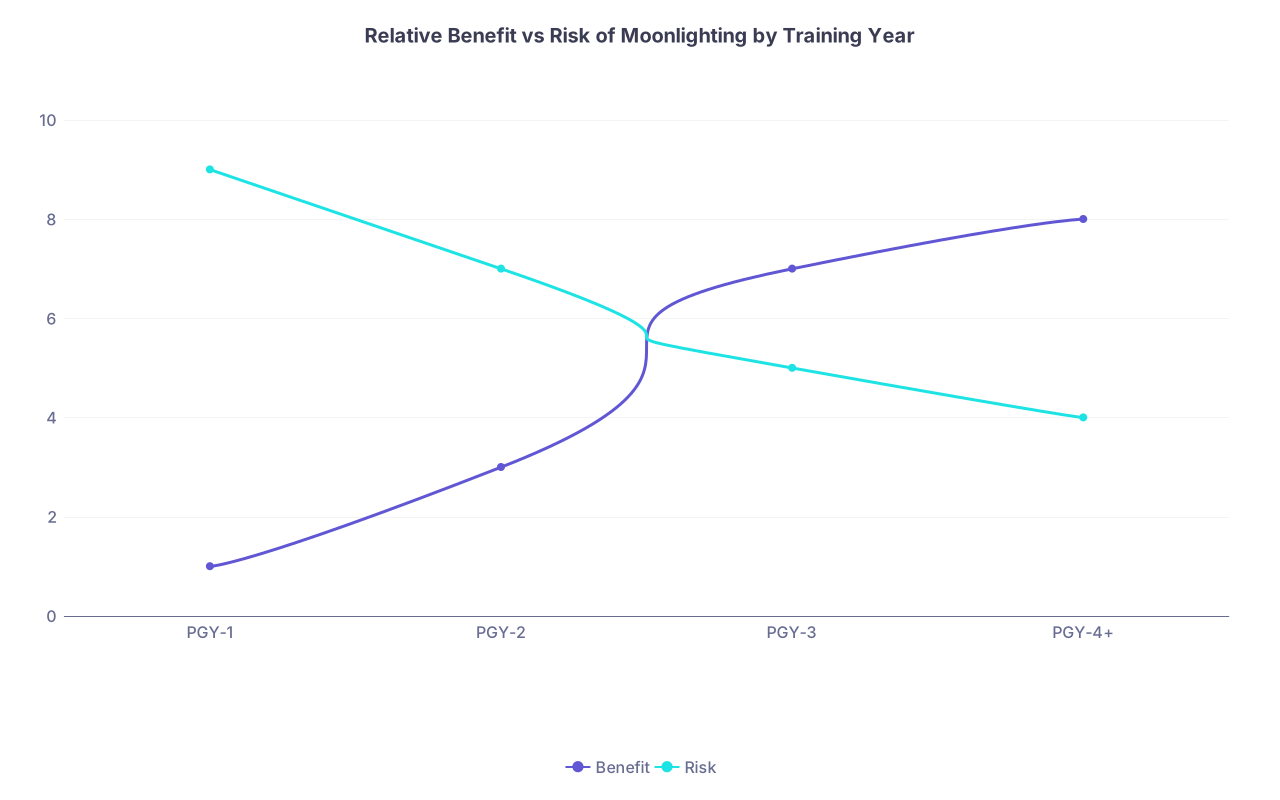
| Category | Benefit | Risk |
|---|---|---|
| PGY-1 | 1 | 9 |
| PGY-2 | 3 | 7 |
| PGY-3 | 7 | 5 |
| PGY-4+ | 8 | 4 |
Interpretation (rough, but directionally right):
- PGY‑1: nearly all risk, minimal benefit
- PGY‑2: starting to balance, still risk‑heavy
- PGY‑3: often worthwhile for the right person, with controls
- PGY‑4/5: can be very beneficial, especially in fields where moonlighting mirrors your attending job
But there’s another layer you can’t ignore: specialty.
Specialty‑Specific Realities (Brief but Honest)
Some specialities lend themselves to safer, more educational moonlighting. Others don’t.
Examples:
Internal Medicine / Family Medicine / Hospitalist‑bound
Moonlighting in low‑acuity hospitalist or SNF settings during senior years can actually sharpen your bread‑and‑butter skills. Still need tight guardrails early.Emergency Medicine
Common to moonlight PGY‑3+. The risk is overextending in small, under‑resourced EDs “for the money” and normalizing unsafe staffing. Be picky.Psychiatry
Outpatient or C/L moonlighting can be nice experience. But on‑call psych moonlighting can be overwhelming and expose you to high liability. Choose carefully and only when you’re solid clinically.Surgery / OB‑GYN
Time and fatigue are the big killers. Many surgical residents simply don’t have the bandwidth until late PGY‑4/5, and even then, should prioritize case volume and boards over money.Anesthesia
Senior residents sometimes take on supervised extra OR days that look like moonlighting. Formal external moonlighting is more fraught because of high‑stakes cases and liability.
If your potential moonlighting work looks nothing like your future practice, the “training benefit” column is almost empty. Then it has to be purely about money vs exhaustion. Often not worth it.
Legal, Credentialing, and Policy Landmines
Here’s where people get burned.
You can’t just decide “I’ll go pick up shifts somewhere.” There are mandatory checks you cannot skip:
Program approval
- ACGME requires programs to know and track your total hours.
- Many require a formal approval form and contract copies.
- If you hide it and something bad happens, you’re exposed and your PD is furious. Both matter.
Duty hour compliance
- All work counts, even if offsite.
- If moonlighting pushes you over 80 hrs/week averaged over 4 weeks, you’re out of compliance.
- “But nobody checks” is not a defense when a sentinel event hits the news.
Malpractice coverage
- Your residency malpractice does not automatically cover moonlighting.
- The site should provide coverage, and you should see it in writing (policy limits, tail coverage, scope).
- Working without clear coverage is insane. Do not do it.
Licensure requirements
- Many states need a full unrestricted license to moonlight. A training license is often not enough.
- Getting that license can take months and several hundred dollars. Factor that in.
Scope and backup
- You should have clear written expectations: patient load, backup attending availability, transfer policies.
- If the pitch is “you’ll be fine, we never have problems,” that’s a red flag.
Financial Reality: When the Money Actually Matters
Let’s be blunt. Moonlighting is only worth it if it substantially changes something important:
Good reasons:
- Paying off 15–25% interest credit cards or personal loans
- Covering childcare or eldercare that allows your partner to work or your family to function
- Building a true emergency fund so one car breakdown doesn’t wreck your life
- Boosting retirement match (if your institution offers one) or attacking high‑interest med school loans
Bad reasons (by themselves):
- Upgrading vacations
- Buying luxury items
- Keeping up with co‑residents with richer families or no debt
If you’re going to moonlight, treat it like a targeted project:
- “I will moonlight for 12 months to eliminate $20,000 of 18% debt”
- “I will moonlight 2 shifts/month for 6 months to build a $10,000 emergency fund”
And then you stop or scale back. Permanent maximum‑throttle moonlighting through all of senior residency is how people show up to fellowship or attending jobs already burned out.
A Simple Decision Flow You Can Actually Use
Here’s the logic tree I’d walk you through if you were sitting in my office.

| Step | Description |
|---|---|
| Step 1 | Want to Moonlight |
| Step 2 | Do not moonlight |
| Step 3 | Start with low hours and reassess monthly |
| Step 4 | Program allows at PGY level |
| Step 5 | Passed Step 3 and solid evals |
| Step 6 | High intensity rotation block? |
| Step 7 | Clear financial or training benefit? |
| Step 8 | Within duty hours and rest rules |
| Step 9 | Malpractice and license confirmed |
If at any node the answer is no, your answer right now is no. Maybe not forever, but for this season.
Quick Specialty/Year Snapshot Table
To give you a sense of the general pattern:
| Specialty | Common Earliest Year | Typical Safe Window | Notes |
|---|---|---|---|
| Internal Med | Late PGY-2 | PGY-3 | Hospitalist-style best as senior |
| Family Med | PGY-2 (limited) | PGY-3 | Outpatient/urgent care common |
| EM | PGY-3 | PGY-3+ | Be selective with site resources |
| Psych | PGY-3 | PGY-3–4 | Watch on-call load and risk |
| Surgery | PGY-4+ | Late senior years | Time and fatigue major limit |
This isn’t a rulebook. It’s the pattern that shows up over and over in real programs.
FAQs
1. Is it ever okay for an intern to moonlight?
Technically yes, in a tiny minority of situations: programs that explicitly permit it, low‑risk in‑house supervised work, and an intern who’s already crushing it clinically and has a very specific financial crisis. In practice, for almost everyone, PGY‑1 moonlighting is a bad idea. The opportunity cost on your learning and sleep is massive.
2. How much money can residents realistically make from moonlighting?
Very broad ranges, but ballpark:
- Low‑acuity outpatient or nursing home work: $70–120/hr
- Hospitalist or ED shifts: $110–180/hr depending on region and desperation level
Most residents who moonlight sustainably make an extra $1,000–$3,000 per month. More than that usually means they’re overdoing it and something else (sleep, performance, relationships) is paying the price.
3. Does moonlighting help or hurt fellowship applications?
Depends how you use it. If moonlighting causes mediocre in‑training scores, thin research, or lukewarm letters, it hurts you. If you maintain strong performance and can describe moonlighting as added responsibility that sharpened your skills in your future field (e.g., hospitalist shifts for a cards hopeful), it can be a neutral or small positive. The bar is: did your core residency performance stay excellent?
4. What’s the biggest hidden risk residents underestimate?
Two things tie for first: chronic fatigue that slowly degrades your decision‑making, and the legal risk of unclear malpractice coverage or unsafe staffing. People picture dramatic errors; what actually happens more often is quiet under‑performance, missed opportunities, and being stuck with a bad contract because “I need the money now.”
5. If I decide to moonlight, what’s the smartest first step?
Before you touch a contract: sit down with your program director or associate PD and be transparent. “Here’s the opportunity, here’s why I’m considering it, here’s how I’ll protect my training and duty hours.” If they’re strongly hesitant, take that seriously. Then, verify malpractice coverage in writing, confirm you meet licensure requirements, start with the lowest reasonable number of shifts, and commit to reassessing monthly with your own fatigue and performance as hard criteria.
In the end, the key points are simple:
- Early training years almost never justify moonlighting; senior years sometimes do, with structure.
- Money is only a good reason if it meaningfully changes your financial trajectory, not your lifestyle.
- Transparency, clear limits, and ruthless self‑assessment are what keep “extra income” from turning into “extra problems.”