
What actually happens to your take‑home pay and risk when you say yes to that “$300/hr 1099” gig instead of a W‑2 job with benefits?
Let’s cut straight through the noise. The W‑2 vs 1099 decision isn’t just about tax forms. It determines:
- How predictable your life is
- How exposed you are to audits, malpractice gaps, and schedule swings
- How much hidden work you do for free
And yeah, how much cash ends up in your pocket.
Quick Definitions: W‑2 vs 1099 in Physician Language
Forget IRS jargon. Here’s what these actually mean in your world.
| Feature | W‑2 Employee | 1099 Independent Contractor |
|---|---|---|
| Taxes Withheld | Yes (payroll) | No (you pay quarterly) |
| Benefits | Often included | Usually none |
| Payroll Taxes Split | With employer | You pay both halves |
| Schedule Control | Less | More (usually) |
| Legal Protections | More | Less |
W‑2 (Employee)
You’re on payroll. Hospital or group withholds taxes, may give:
- Health, dental, vision
- Retirement match (401k/403b)
- Malpractice (often tail)
- CME money, PTO
You’re under their policies and schedule. Less control, more safety net.
1099 (Independent Contractor)
You’re a separate business. You:
- Get paid gross
- Handle your own taxes and benefits
- Often buy your own malpractice
- Have more leverage to negotiate rate/hours
You’re treated like a vendor, not staff.
The Money: Who Actually Takes Home More?
This is what everyone cares about. And this is where people get tricked by the big hourly 1099 number.
The baseline: 1099 ≠ “free money”
As a 1099 physician, you:
- Pay full 15.3% self‑employment tax on the first Social Security threshold (then 2.9% Medicare and extra 0.9% Medicare surtax above certain income)
- Get zero employer contributions
- Pay both sides of payroll taxes (employer + employee)
That doesn’t mean 1099 is bad. It just means that a $300/hr 1099 rate is not the same as $300/hr W‑2.
Here’s a simple mental shortcut I use:
- Roughly: 1099 should pay 20–30% more than W‑2 to be competitive if benefits are decent.
- If W‑2 has weak or no benefits, 1099 doesn’t need as big a premium.
Concrete example: Hospitalist gig
Let’s say:
- W‑2 hospitalist: $260k + benefits (health, 401k match, malpractice, CME, PTO)
- 1099 hospitalist: $320k, no benefits, you cover everything
At face value, 1099 is +$60k. But you then need to fund:
- Health insurance: $8k–$20k/year depending on family and plan
- Malpractice (with tail): $10k–$25k/year in many specialties
- Retirement (solo 401k/SEP is good, but no employer match)
- Disability + life: $3k–$8k/year
- CME, licensure, DEA, professional fees: $3k–$7k/year
- Extra accounting and legal: $1k–$5k/year
Suddenly that $60k gap gets eaten pretty fast. Sometimes 1099 still wins. Sometimes it doesn’t. You have to run actual numbers, not just listen to the recruiter.
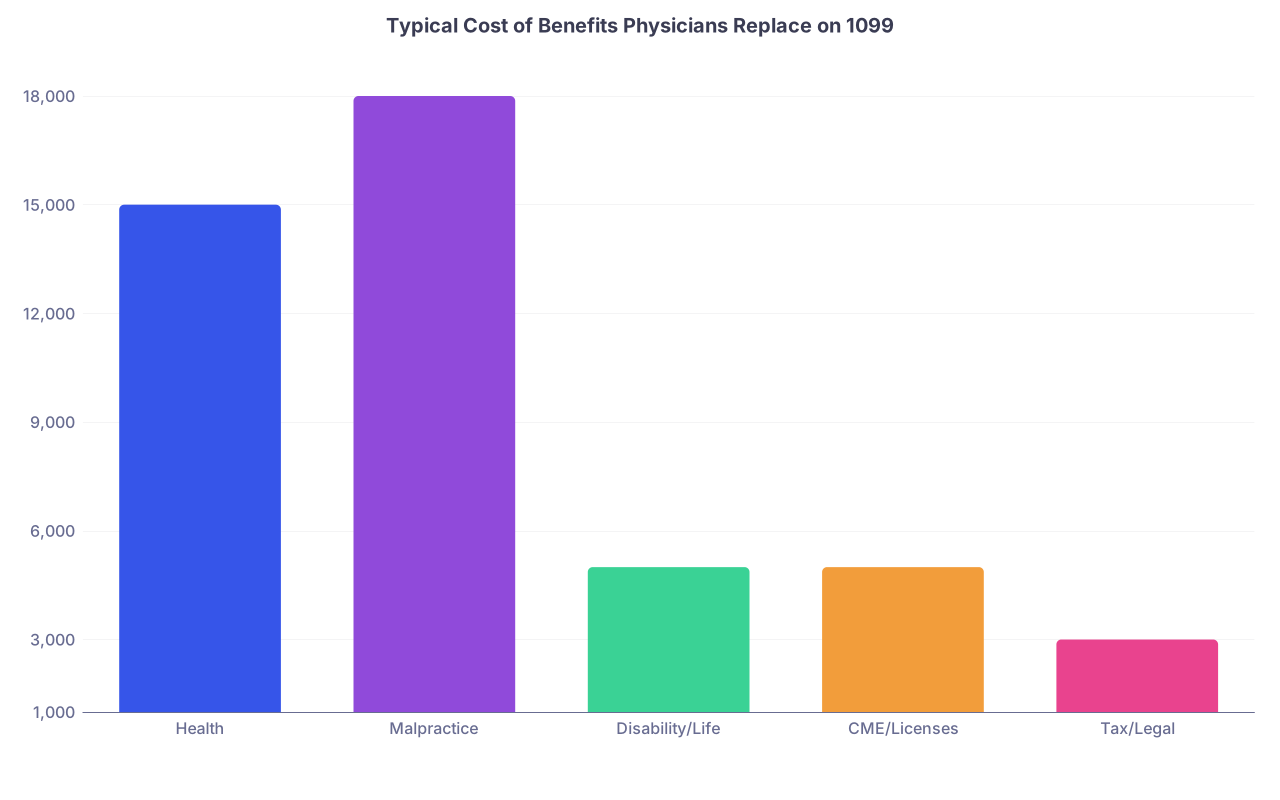
| Category | Value |
|---|---|
| Health | 15000 |
| Malpractice | 18000 |
| Disability/Life | 5000 |
| CME/Licenses | 5000 |
| Tax/Legal | 3000 |
Control, Risk, and Lifestyle: The Non‑Financial Side
Money is only half the story. The other half is how much control and risk you’re willing to carry.
When W‑2 usually makes more sense
You’ll generally be happier as W‑2 if:
- You want predictable income and schedule
- You don’t enjoy tracking expenses and quarterly taxes
- You value employer‑provided health insurance and retirement matching
- You’re early in your career and still building reserves
- You hate dealing with billing, contracts, and business headaches
This is the “I want to practice medicine, not run a business” path. Totally valid.
Emotionally, W‑2 feels safer:
- If census drops, you’re less likely to be instantly cut
- Payroll keeps coming even if collections are terrible
- HR handles a lot of the headaches (sometimes badly, but still)
When 1099 usually fits better
1099 tends to fit physicians who:
- Want maximum hourly rate and are willing to manage the rest
- Do a lot of locums or moonlighting and like flexibility
- Are comfortable with spreadsheets, accountants, and planning
- Want to stack multiple gigs (telemed + ED shifts + consulting, etc.)
- Already have benefits from a spouse/partner or main job
As 1099, you can often:
- Walk away faster from bad situations
- Negotiate higher rates, especially for nights/weekends/undesirable locations
- Deduct a meaningful amount of work‑related expenses
But it’s on you to avoid being under‑insured or under‑saved. No one will fix it for you.
Moonlighting: W‑2 vs 1099 Side Gigs
Most residents and attendings hit this question first with moonlighting. You have a main W‑2 job, and a side gig offers 1099 pay.
What usually makes sense for moonlighting
For side work, 1099 is often fine or even ideal if:
- Your main job already gives you benefits (health, retirement, malpractice for your main practice)
- You’re moonlighting in the same specialty and can add coverage via rider or separate policy as needed
- You’re willing to pay quarterly taxes or adjust withholding at your main job
In that situation, the 1099 moonlighting check is mostly “extra” income. You won’t need to replicate a full benefit package out of it.
You do still have to:
- Clarify malpractice (who’s covering what, including tail)
- Make sure your primary contract doesn’t forbid outside work
- Document your expenses and track hours

| Step | Description |
|---|---|
| Step 1 | Have main W2 job with benefits |
| Step 2 | 1099 often fine for moonlighting |
| Step 3 | Compare W2 moonlighting with benefits vs 1099 rate |
| Step 4 | If 1099 >20 to 30 percent higher and you can cover benefits, consider 1099 |
| Step 5 | Yes |
| Step 6 | No |
If you have no main benefits and you’re relying on moonlighting as a primary income source, then 1099 becomes much more serious. At that point, you’re effectively running a small business, not just “picking up extra shifts.”
Taxes, Entities, and the “Set Up an LLC” Myth
This is where the internet is full of half‑truths.
What actually changes with 1099
As a 1099 physician, you:
- Can deduct legitimate business expenses (CME, licensing, home office portion, etc.)
- Generally should make quarterly estimated tax payments
- May form an LLC or S‑Corp for admin/asset reasons, but that doesn’t magically erase taxes
The biggest tax advantage you get is the ability to control when and how money flows (e.g., via S‑Corp salary vs distributions) and which expenses are safely deductible. That’s it. If someone is promising you 50% tax savings, walk away.
When an LLC or S‑Corp makes sense
Rough guide (not legal advice, talk to a CPA who actually works with physicians):
- Under ~$50k of 1099 income: often fine as a sole proprietor with a d/b/a and solid bookkeeping
- Around $75k–$100k+ of 1099 income: worth seriously evaluating S‑Corp with a CPA
- Over $150k–$200k of 1099 income: most high‑earning contractors should at least run the numbers
The S‑Corp play is mainly about reducing self‑employment tax on the portion you can reasonably classify as distributions vs salary. It’s not free, and you must pay yourself a “reasonable salary” or you’re begging for IRS trouble.
Legal and Liability Differences You Shouldn’t Ignore
Most physicians obsess over pay and forget legal risk. Bad idea.
As W‑2:
- You’re part of the employer’s general structure; they carry the main risk for billing, compliance, HR issues
- You’re still individually liable for malpractice, but coverage is usually arranged and paid for by the employer
- You’re more protected by employment laws (EEOC, etc.)
As 1099:
- You’re closer to the blast radius if the facility is doing shady billing and your NPI is on those claims
- Hospital can cut you fast with minimal process – you’re not “fired,” the contract just isn’t renewed
- You must read the indemnity language very carefully (who eats what liability?)
Bottom line: with 1099, don’t sign contracts you don’t understand. Spend $500–$1500 on a physician‑savvy attorney. The number of times I’ve seen doctors stuck with ugly indemnity clauses or no tail coverage is embarrassing.
How to Decide: A Simple Framework
Here’s a straight decision framework you can walk through.
Step 1: Define your primary goal
Which one is your top priority?
- Maximize cash now
- Maximize stability and benefits
- Maximize control and flexibility
Write down the order. Don’t skip this. It changes the answer.
Step 2: Put numbers on the table
For each offer (or possible setup):
- Take the W‑2 total: base pay + guaranteed bonus + employer retirement match + any known stipends.
- Take the 1099 total: projected hours × rate × realistic fill (you won’t work 100% of “available shifts”).
- Subtract realistic costs you must cover as 1099: health, malpractice, retirement you want to fund, disability, CME, licenses, accountant, lawyer.
Now compare apples to apples: after‑benefit, pre‑tax income.
Step 3: Check your risk tolerance and runway
- Do you have at least 3–6 months of expenses saved? If not, heavy 1099 dependence is riskier.
- Are you okay with income bouncing around month to month?
- If the gig ends suddenly, how fast can you replace it?
If you get anxious just thinking about this, lean W‑2 or at least keep a W‑2 anchor and use 1099 only for side income.
Step 4: Consider phase of career
- Residents/fellows: Moonlighting as 1099 is fine as a side stream, but for full‑time post‑training, I’d start with W‑2 for a couple of years unless you’re unusually business‑savvy.
- Early attendings (0–5 years): Hybrid is powerful – main W‑2 job for stability, selective 1099 to boost income and test the waters.
- Mid/late career: 1099 can be fantastic if you want to ramp down, work seasonal/part‑time, or do a portfolio of clinical + telemed + expert witness + consulting.
Future of Medicine: Why 1099 Is Becoming More Common
You’re not imagining it. More and more:
- Telemedicine platforms
- Hospitalist groups
- ED staffing companies
- Urgent care chains
…are moving physicians to 1099 models. It’s cheaper for them, cleaner on their books, and pushes risk onto you.
That means:
- You need to get comfortable reading contracts and basic tax strategy.
- You can’t assume “W‑2 forever” will always be on the table in your specialty and location.
- Physicians who understand 1099 well will have more options and better negotiating power than those who blindly chase the highest hourly rate.

| Category | Value |
|---|---|
| 2010 | 10 |
| 2015 | 18 |
| 2020 | 26 |
| 2025 (proj) | 35 |
So… Which Structure Actually Fits You?
Here’s my honest answer:
- If you want stability, simplicity, and a safety net → default to W‑2, especially for your main job.
- If you want flexibility, higher ceiling, and you’re willing to run a mini‑business → use 1099 strategically, either as moonlighting or as your primary structure once you know what you’re doing.
- The smartest play for most physicians at some point → W‑2 main job + 1099 side work, at least for a few years. It gives you options without throwing you into the deep end on day one.
You don’t win by picking the “sexier” form. You win by knowing exactly what you’re giving up and what you’re getting — in dollars, risks, and lifestyle.
FAQ (Exactly 5 Questions)
1. Is 1099 always better for taxes than W‑2 for physicians?
No. That’s a myth. 1099 gives you more control over deductions and business structure, but you also pay both sides of payroll taxes and must replace employer benefits. Sometimes, once you factor in lost benefits and extra self‑employment tax, the W‑2 package is actually more valuable even at a lower headline salary. You need to run numbers for your situation, preferably with a CPA who regularly works with physicians.
2. Should residents and fellows take 1099 moonlighting shifts?
Yes, but carefully. If you already have health insurance and basic disability coverage through your program, 1099 moonlighting can be a great way to boost income. The key is to confirm malpractice coverage (including tail) for the moonlighting site and to set aside money for taxes. Often the simplest move is increasing withholding on your residency W‑2 paycheck to cover the extra 1099 taxes instead of messing with quarterly estimates for small amounts.
3. Can I switch from W‑2 to 1099 with the same hospital or group?
Sometimes, but it’s more common with staffing companies and locums than with directly employed hospital positions. Groups may offer a 1099 option if they want more flexibility or less HR overhead. If they do, be suspicious of arrangements where your pay barely increases but you lose all benefits. If they’re not giving at least a 20–30% bump in total comp when they move you to 1099, you’re probably subsidizing their cost savings.
4. Do I really need an LLC or S‑Corp for 1099 physician work?
Not always. For small amounts of 1099 income (say <$50k), you can often function as a sole proprietor with a separate bank account and solid bookkeeping. Once your 1099 income is substantial (e.g., $75k–$100k+), it’s worth talking to a CPA about an S‑Corp. The real value is in potential self‑employment tax savings and better structure, but it comes with more paperwork, costs, and rules. It’s not a “must” on day one for every contractor.
5. How do I compare one W‑2 job to one 1099 job fairly?
Make a simple comparison sheet. For each job, list: base pay, expected bonus, retirement contributions, value of health insurance, malpractice (including tail), CME, PTO, and any stipends. Put a dollar value on benefits as best you can. For 1099, subtract what you’ll have to buy yourself (insurance, retirement savings, professional fees) from the total pay. Then compare the net amounts. Only after that should you layer on lifestyle factors like schedule, flexibility, and job security. The math comes first; the gut feeling refines the final choice.
Key Takeaways:
- W‑2 vs 1099 isn’t just paperwork; it’s a trade‑off between stability, benefits, and control.
- 1099 should usually pay meaningfully more than W‑2 once you price in benefits and self‑employment taxes.
- For most physicians, a W‑2 anchor plus selective 1099 work is the most flexible and safest overall strategy.