
The away rotation did not go how you hoped. That does not mean you are out.
I have watched very average away rotations turn into interview offers and successful matches at brutally competitive programs. I have also seen “rockstar” aways implode because the student handled one bad month poorly. The difference is not the rotation. It is what you do next.
You are in a competitive specialty. Ortho, derm, plastics, ENT, neurosurg, IR, urology, optho, EM at top programs—take your pick. The margin between “we should interview them” and “delete” is thin. A so‑so rotation can absolutely be salvaged into a credible shot. But you need a plan, not vibes.
Here is that plan.
Step 1: Diagnose the Rotation Honestly (Not Emotionally)
The first move is brutally simple: figure out what actually went wrong, and what did not.
Do this before you talk yourself into a story that is either too dramatic (“they all hated me”) or too comforting (“it was fine, I just did not click with them”).
A. Separate signal from noise
Right after the rotation—or tonight, if you are mid‑panic—sit down and write:
- 3 things you did well
- 3 things you clearly did badly or inconsistently
- 3 unknowns (things you are not sure how they saw)
Examples I have seen in real students:
Did well:
- Showed up early, never late, knew patients cold.
- Closed skin competently by week 3 in ortho.
- Took good ownership of consult follow‑ups.
Did badly:
- Quiet on rounds, never offered plans.
- Looked lost on first 2 call nights, waited to be told what to do.
- Documentation always behind.
Unknowns:
- Did the PD even know who I was?
- Did my awkward answer about research hurt me?
- Did that one attending who pimped me hard actually dislike me?
Already you can see something: “so‑so” is usually very specific. Fixable specific.
B. Get actual feedback from humans who watched you
Not a vague “you did great, thanks for rotating.” That is worthless.
Ask 2–3 people who saw you a lot:
- A senior resident who likes teaching
- A fellow or chief resident
- One faculty who worked with you more than once
How to do it without sounding needy:
“I am applying to [specialty], and I want to improve before my next away. Could you give me 2–3 very specific things I could have done better this month? Honest is more helpful than nice.”
If you can do this in person at the end of the rotation, good. If not, send a short, focused email within a week.
You are listening for patterns:
- “Slow to help without being asked”
- “Strong fund of knowledge, but not proactive”
- “Personable, but seemed unsure in the OR/clinic”
Those patterns become your repair checklist.

| Step | Description |
|---|---|
| Step 1 | Rotation Ends |
| Step 2 | Self Assessment |
| Step 3 | Ask 2 to 3 Residents |
| Step 4 | Ask 1 Attending |
| Step 5 | Identify Patterns |
| Step 6 | Immediate Fix |
| Step 7 | Communication Fix |
| Step 8 | Damage Control |
| Step 9 | Real Problem? |
Step 2: Decide Which Scenario You Are In
There are only a few real scenarios. You need to know which one matches your away.
| Scenario | Interview Odds If You Act Smart |
|---|---|
| Quiet but dependable student | Moderate to good |
| One bad day / awkward encounter | Still salvageable |
| Weak effort, visible disengagement | Low unless major repair |
| Clinical concern about safety | Very low at that program |
| Completely invisible to PD | Depends on follow up |
Be honest:
-
- You showed up, did the work, did not stand out.
- Residents probably rated you “middle of the pack.”
- This is very fixable.
One bad day or single bad interaction
- Snapped at on rounds.
- Missed something you “should have caught.”
- Weird answer when PD grilled you.
- Usually fixable if you handle it directly.
Low effort / weak engagement
- Left early when others stayed.
- Phone out a lot.
- Frequently unprepared.
- Harder to fix, but not always impossible, especially if you were just late to wake up and improved over time.
Serious professionalism or safety flag
- Yelled at staff.
- Blatant dishonesty.
- Repeatedly unsafe with patients.
- This is not “spin this away.” This is “repair your reputation over a longer arc,” and you may not get this program back.
Once you know your scenario, you can act surgically instead of flailing.
Step 3: Fix the Things You Can Fix Immediately
Before worrying about the program’s opinion, fix your behavior. You are likely still doing more aways or going back to your home program. You do not want to replicate the same “so‑so” everywhere.
A. Tighten your fundamentals
Competitive specialties are merciless about basics:
Show up earlier than you think makes sense.
If you are arriving when the residents are, you are late. You want:- Notes prepped or at least started
- Imaging reviewed
- Overnight events known
Know your patients cold.
No excuses here. You should know:- Vitals trends
- Labs and imaging
- Consultants’ recommendations
- The plan—and you should have an opinion
Be visibly useful.
Stop standing with your hands in your pockets. Do:- Transport patients when appropriate
- Grab supplies without being asked
- Help with dressing changes, consent, scut that makes the team’s day easier
This is not “be a doormat.” It is “be someone they would want in the trenches at 2 a.m.”
B. Correct the common personality errors
You do not need to be charming. You need to be non‑annoying, coachable, and easy to have around.
Watch for:
Too quiet.
Fix: Once per patient, say one clinical thought: “Given X, I was wondering if we should…” Not constant, just presence.Too talkative / trying too hard.
Fix: Cut your talking by 50%. Answer questions, ask 1–2 good questions per day, then read and work.Defensive with feedback.
If someone corrects you, your immediate script is:
“Got it. Thanks for pointing that out.”
Then you actually adjust.
C. Patch obvious knowledge gaps
If your shelf scores or feedback suggest your fund of knowledge is thin, you cannot repair that with charm. You need a rapid content plan tied to your specialty.
Use a strict, boring protocol:
- Every evening: 20–40 practice questions from a specialty‑relevant bank or key text.
- Every weekend: 2–3 hours of reading about:
- Every case you saw that week
- Every pimp question you missed
You show improvement by week 2–3 on the next rotation. Residents notice when a student suddenly knows what “volar plate” means or can walk through melanoma staging without stumbling.
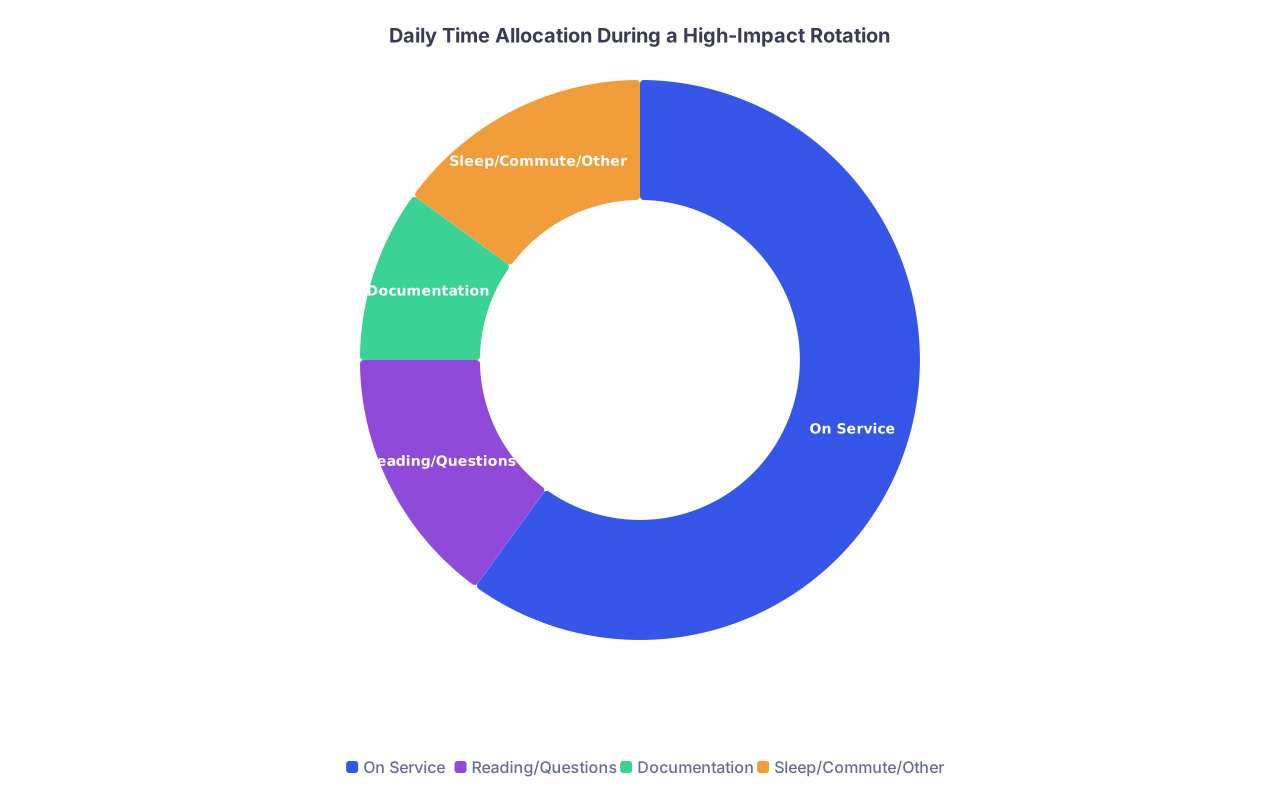
| Category | Value |
|---|---|
| On Service | 60 |
| Reading/Questions | 15 |
| Documentation | 10 |
| Sleep/Commute/Other | 15 |
Step 4: Decide Whether and How to Ask for a Letter
The big anxiety: “Should I even ask this place for a letter after a mediocre month?”
Here is how I approach it.
A. Who counts as a viable letter writer?
You are looking for someone who:
- Worked with you at least 1–2 weeks
- Saw you improve
- Likes teaching and does not hate you
They do not need to think you are the best student they have ever seen. They do need to be comfortable saying, “I would be happy to work with them as a resident.”
If you literally cannot identify anyone who fits that description, do not force it. You are better off with:
- A strong letter from home institution faculty
- A research PI in the specialty
- A faculty from another away where you did very well
B. How to ask when the rotation felt “meh”
You do not ask: “Can you write me a strong letter?” That is a meme and everyone is tired of it.
You say something closer to:
“I appreciated working with you during my rotation in [month]. I am applying in [specialty] and would value your perspective. Would you feel comfortable writing a letter of recommendation on my behalf for residency applications?”
If they hesitate or suggest someone else, do not push. That is your answer.
If you already know feedback was mixed, you can even acknowledge it:
“I know I was slow early in the month and became more comfortable later. I learned a lot from your style of teaching. If you feel you can speak to my growth and work ethic, I would greatly appreciate a letter.”
That shows self‑awareness and maturity, which matters more than pretending everything was stellar.
C. Strategic letter mix
For competitive specialties, you want something like:
| Letter Type | Ideal Count |
|---|---|
| Home program specialty | 1–2 |
| Strong away rotation | 1 |
| Research / PI in specialty | 1 |
| Non‑specialty clinical | Optional |
If your “meh” away is your only away, a decent letter from there is still valuable. If you have a stellar away elsewhere, lean harder on that and let this one recede in importance.
Step 5: Manage the Narrative—Before They Do It For You
Programs do not just look at scores and LORs. They look for patterns across your application:
- This student rotated here.
- We did not hear much about them.
- Their other letters are strong.
- Their personal statement says X.
- What is the story?
You can either let them guess, or you can quietly control the frame.
A. Do not overconfess in your application
You do not write: “I struggled during my away at BigName University because I was anxious and unprepared…” No.
You do:
- Emphasize what you learned from varied environments.
- Use generic language if you must reference growth:
- “Early in fourth year, I realized I needed to be more proactive in communicating my plans. Since then, I have…”
You frame it as growth, not failure.
B. Use your personal statement and experiences to highlight your redeeming traits
If your away was quiet, your application needs to scream:
- Work ethic
- Coachability
- Resilience
- Long‑standing commitment to the field
Use concrete examples:
- The research project you stuck with for 2+ years.
- The time you took over QI work no one wanted.
- The call shifts where you took initiative with consults while others hid.
This makes a “middle of the pack” eval from one program less lethal because you have a strong, consistent story elsewhere.
C. Repair relationships quietly
If there was a specific awkward moment with one faculty or resident, sometimes a short note helps.
For example:
“Thank you again for the opportunity to rotate with your team. I realize that early in the month I struggled with [X—e.g., presenting efficiently on rounds], but your feedback helped me improve. I have been working on this on subsequent rotations and have noticed a big difference. I appreciate your time and teaching.”
You are not begging. You are signaling maturity and closing the loop.
Step 6: Decide Whether to Rank / Revisit That Program
You did a so‑so away. Should you still want to end up there? Maybe. But you need to be realistic.
A. Ask residents quietly how the program views you
If you have a friendly senior or chief, ask off the record:
“Honest question—do you think my rotation here was strong enough that I am likely to be seriously considered for an interview?”
You may hear:
- “Yes, I think people liked you. You were solid.”
- “You were fine, but to be blunt they usually interview the standouts and the home kids first.”
- “You had some rough days, but if your scores are high and letters are good, you still have a shot.”
Translate this:
- “Fine” + strong overall app → still worth applying and ranking if you get an interview.
- Clear message that you triggered concern → do not bank your future on this one place.
B. Recognize that some programs use aways as “auditions,” others as “ties”
In some ultra‑competitive spots, aways are mostly:
- A way to identify true top‑tier candidates
- A way to give home students a structured look
- A filter for red flags
If you did not clearly shine, that program may still interview you, but not rank you high. That does not mean you are doomed elsewhere.
Other programs use aways as:
- A way to increase familiarity
- A way to see who fits culturally
- A tie‑breaker
There, a neutral rotation is less terrible, especially if your rest of application is strong.
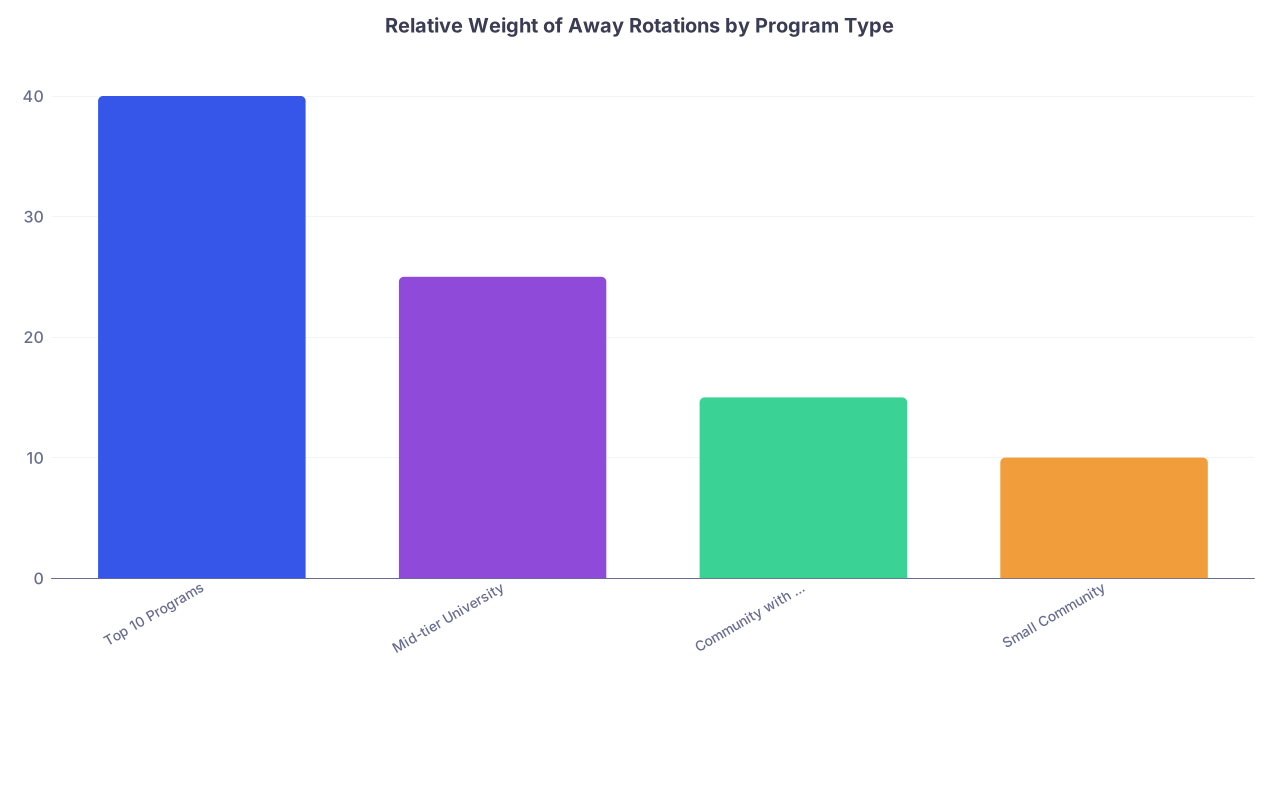
| Category | Value |
|---|---|
| Top 10 Programs | 40 |
| Mid-tier University | 25 |
| Community with Fellowship | 15 |
| Small Community | 10 |
(Values as conceptual “importance out of 100,” not literal percentages.)
C. Use interviews to reframe—without oversharing
If you do get an interview at that program, you will probably be asked:
“You rotated with us. How was that experience for you?”
Your answer needs to:
- Be honest, not groveling
- Highlight growth
- Avoid self‑sabotage
Example script:
“I really appreciated the chance to rotate here. I was pushed clinically more than at my home program, particularly in [OR/clinic/trauma/etc.]. Early in the month I was a bit hesitant to speak up on rounds, but as I understood the expectations better, I became more comfortable offering plans and taking more ownership. The rotation confirmed for me that I like a high‑volume, high‑expectation environment like this.”
Notice the structure:
- Compliment the challenge
- Admit a mild weakness without drama
- End on growth + fit
Step 7: Build a Stronger Overall Application Around That “So‑So”
Your away is one data point. If the rest of your application screams “top candidate,” the rotation becomes just another month.
Focus hard on the parts you still control.
A. Maximize your next rotation (home or away)
Your next rotation must be excellent. Non‑negotiable.
I tell students to run a “reset protocol”:
Before day 1:
- Email the chief or coordinator:
“I am excited to start on [date]. Are there any resources or expectations you recommend I review so I can be as useful as possible from day one?”
- Skim 1–2 core review chapters of your specialty.
- Prepare templates for notes, consults, common presentations.
- Email the chief or coordinator:
First 3 days:
- Learn names of every resident, nurse, coordinator.
- Ask for expectations:
“What makes a great student on this service from your perspective?”
- Check in briefly at the end of the first week:
“Anything I can adjust to be more helpful to the team?”
Week 2 onward:
- Take ownership of some piece of the service (e.g., all dressing changes, all clinic follow‑ups, all imaging pulls).
- Regularly volunteer for call, cases, or late‑day tasks.
Residents and attendings recognize students who changed gears after a lukewarm first away.
B. Tighten your research and CV story
For competitive specialties, borderline clinical performance can be offset somewhat by:
- Strong research with at least one publication or in‑submission manuscript.
- National presentations.
- Specialty‑specific involvement (interest groups, courses, externships).
Do not suddenly chase 10 meaningless abstracts. Pick 1–2 ongoing projects and take them across the finish line.
C. Backstop with a rational application strategy
You are not in a position to “only apply to top 10 places where I rotated.” That is fantasy.
You need a spread:
| Program Tier | Approx. Number to Apply |
|---|---|
| Top 10–15 | 5–8 |
| Other academics | 20–30 |
| Strong community | 10–15 |
| Safety / broad net | 5–10 |
Adjust numbers to your specialty, but the logic holds: cast a wide net, do not anchor emotionally to the place where you felt mediocre.
Step 8: When Things Were Actually Bad—Damage Control
If your away rotation was not just “meh” but actively bad—formal feedback, concern documented, PD had a talk—you are in a different category.
Still not hopeless, but you need a different posture.
A. Own it directly with your home program
You must have a frank conversation with:
- Your home PD or department advisor
- Possibly your dean’s office if an official evaluation is negative
Your script is something like:
“I wanted to discuss my rotation at [program]. I received feedback that [specific issues]. I understand the concerns and have already started working on [concrete changes]. I would value your guidance on how best to strengthen my performance on upcoming rotations and how this might affect my application strategy.”
You are not arguing with their assessment. You are showing that you can absorb a hit and adjust.
B. Document improvement
From that point on, everything you do should leave a paper trail of “they got better”:
- Ask for mid‑rotation feedback and save the emails.
- Request that strong subsequent evaluations specifically mention improvement.
- If you get a chance to rework something (e.g., documentation, handoffs), ask attendings to comment on it.
PDs are more willing to forgive a bad month if they see an upward slope, not a flat line.
C. Consider a targeted 1‑month “repair” away
Sometimes you can deliberately set up one more away later in the year at a different program that:
- Knows your home PD
- Is more teaching‑oriented and less cutthroat
- Is aware, at least in general terms, that you are working on X and Y
This is not a guarantee, but I have seen it rehabilitate applicants who had an early rough rotation.
The Bottom Line
You cannot rewrite the month you just had. You can absolutely control what happens next.
Three key points:
Diagnose and fix, do not catastrophize. Be specific about what was mediocre, correct it on the very next rotation, and get feedback early. Quietly closing the loop beats public self‑flagellation.
Shape the narrative with actions, not excuses. Strong subsequent performance, carefully chosen letters, and a coherent application story will outweigh one so‑so away at most programs.
Play a long, strategic game. Apply broadly, use interviews to show growth, and lean on your strengths—research, work ethic, resilience. A single month, even at a big‑name place, is not the entire story unless you let it be.