
The biggest mistake MS2s aiming for competitive specialties make is thinking they have “plenty of time.” You do not. By the end of second year, you’ve already won or lost key ground for derm, ortho, ENT, plastics, neurosurgery, urology, optho, and the cut‑throat programs in anything else.
Here’s the month‑by‑month reality check and what you should be doing at each point.
Big Picture: MS2 Year at a Glance
Let’s anchor the year first, then we’ll slice it down to months and weeks.
Assume:
- MS2 starts: August
- MS2 classes end: April/May
- Dedicated Step 1 (or Level 1): 6–8 weeks after classes
- Clinical rotations start: June/July of the following year
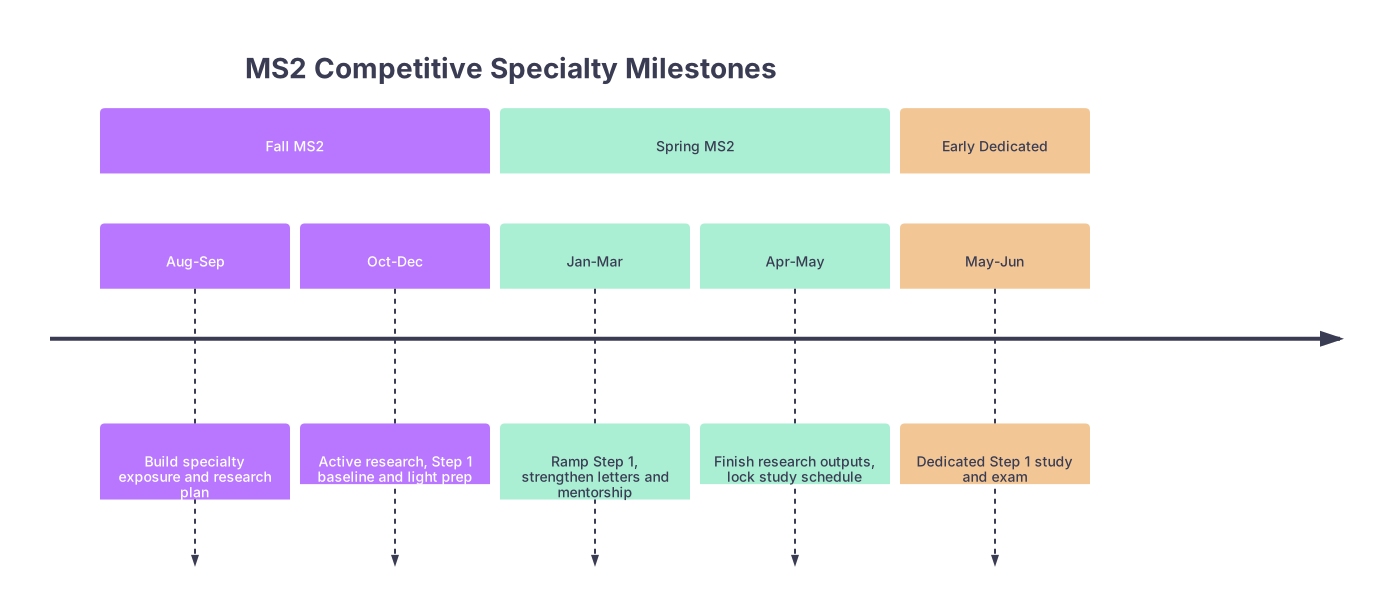
| Period | Event |
|---|---|
| Fall MS2 - Aug-Sep | Build specialty exposure and research plan |
| Fall MS2 - Oct-Dec | Active research, Step 1 baseline and light prep |
| Spring MS2 - Jan-Mar | Ramp Step 1, strengthen letters and mentorship |
| Spring MS2 - Apr-May | Finish research outputs, lock study schedule |
| Early Dedicated - May-Jun | Dedicated Step 1 study and exam |
Your MS2 milestones fall into four buckets:
- Specialty exposure & mentorship – Who knows you and will vouch for you.
- Research & CV building – Are you “serious” enough for the specialty.
- Step 1 performance (even if P/F) – Are you safe to interview at all.
- Reputation & professionalism – Are you someone people want on their team at 2 a.m.
You don’t get to pick only one. Competitive specialties expect all four.
August–September: Lay the Foundation (No, You Can’t “Wait Till MS3”)
At this point you should be making three decisions:
Which competitive lane you’re leaning toward.
Example lanes:- Surgical: ortho, ENT, neurosurgery, plastics, urology
- Procedure-heavy: derm, optho, IR (via DR or IM), gas
- Highly academic: radiation oncology, certain IM subspecialty tracks
Who “your people” are going to be.
Faculty, residents, and research mentors in that lane.How Step 1 will fit into your weekly life from day one.
Not all‑consuming yet, but present and intentional.
Action checklist: August
At this point you should:
Identify your specialty targets (max 2 serious contenders).
Waffling between derm/ENT/ortho/IM/EM/psych is a red flag. Narrow to:- 1 main competitive target
- 1 realistic alternate (IM, anesthesia, gen surg, etc.)
Schedule specialty exposure (shadowing or structured electives). Aim for:
- 1 half‑day every other week in your target specialty
- Attend at least 1 departmental conference or grand rounds
Find a home department. Send 3–5 short, targeted emails:
- To the program director or clerkship director
- To research‑active faculty whose names keep showing up on departmental papers
- To a chief resident or fellow who seems friendly (ask MS3s who’s good)
Your ask is simple:
“I’m an MS2 strongly considering [specialty]. I’d love to (1) attend your conferences regularly and (2) get involved in a project if there’s something appropriate for a 2nd‑year.”
Action checklist: September
At this point you should:
Be attached to at least one project.
Not “emailing about a possible project.” Actually on something:- Chart review
- Case series
- Education project
- Systematic review
Set up a Step 1 structure (light, but real).
Baseline:- 10–15 UWorld questions per week (yes, week, not day…yet)
- 1–2 hours revisiting weak MS1 systems (basic phys, path, pharm)
Pick your core resources.
For competitive specialties, scattered is death. Prefer:- One Qbank (UWorld) – non‑negotiable
- One concise reference (Boards & Beyond, Pathoma, or similar)
- One spaced-repetition system (Anki, pre‑made deck if you must)
October–December: Build Credibility and Traction
By now, you’re not “interested” in the specialty. You’re actually doing things in it.
October: Become a Known Face
At this point you should:
Show up consistently at departmental events.
- Weekly or biweekly conferences
- Resident didactics if allowed
- Morbidity & Mortality (for surgical fields) – goldmine of context and stories
People should start to recognize your face. “Oh yeah, that MS2 is always here.”
Clarify project expectations and timelines.
Push for:- A clear role: data abstraction, literature review, figure drafting, etc.
- A tentative output: poster, abstract, or manuscript submission within 6–12 months
- Authorship: where you realistically fit in the author list
Begin slow Step 1 integration into your weekly routine.
- 10–15 UWorld questions twice per week
- Daily Anki (200–300 new/review cards is common for serious test takers)
- Micro + pharm from MS1 – keep them warm
November: Set Performance Benchmarks
At this point you should start getting hard numbers, not vibes.
Take a low‑stakes Step 1 baseline (NBME or school exam).
- Don’t cram. Just see where you stand.
- Goal is not score; it’s pattern: are you consistently weak in pathophys? Pharm? Biostats?
Compare yourself to typical competitive specialty expectations.
| Specialty | Research Involvement | Step 1 (historically) | Home Dept Importance |
|---|---|---|---|
| Dermatology | Strong, multiple pubs | Very high | Critical |
| Ortho | Strong, ortho-focused | Very high | Very important |
| ENT | Strong, ENT-focused | Very high | Very important |
| Neurosurg | Extensive, often many | Extremely high | Essential |
| Plastics | Strong, plastics-focused | Very high | Essential |
Even with Step 1 now P/F, these expectations didn’t magically disappear. Programs just moved their scrutiny elsewhere—research, letters, school reputation, and Step 2.
- Adjust your weekly schedule.
- 1 half‑day: research work
- 1 half‑day: in‑person specialty exposure
- 3–4 evenings: Step 1‑aligned studying (integrated with classes)
December: Lock in Mentors Before the Holiday Fog
At this point you should:
Secure at least one real mentor in the specialty.
Signs they’re real:- They know your background and goals
- They’ve talked with you more than once
- They offer specific suggestions (“You should join Dr. X’s project” not “Keep working hard”)
Ask explicitly about your competitiveness.
Mid‑December is a good moment to say:- “I’m seriously considering [specialty]. Could you be honest about what I should prioritize in MS2 and early MS3 to be a strong applicant?”
Set a Q1 (Jan–Mar) research deliverable.
Concretely:- “We’ll submit this abstract by March” or
- “We’ll have the first draft of the manuscript by April”
January–March: Turn Up the Heat (Quietly but Aggressively)
This is where serious and not-so-serious applicants separate.
January: Tighten Systems and Study Habits
At this point you should:
Increase Step 1 volume—intentionally. Aim for:
- 10–20 UWorld questions per day (5–6 days a week)
- Keep them tied to current blocks: cardio UWorld during cardio block, etc.
Align class studying with board studying.
Stop double‑studying. Structure:- Use board resources as primary
- Use lecture slides only for what board resources miss (school‑specific details)
Refine project roles.
- If your current project is dying (no movement in 2+ months), quietly start a backup project. Dead projects are common. They don’t go on your CV.
- Push something that can realistically lead to your name on something before ERAS.
February: Test Your Systems Under Real Pressure
At this point you should:
- Do a structured progress check on Step 1.
- NBME or school‑wide practice exam
- Track raw performance by system, not just “overall doing okay”
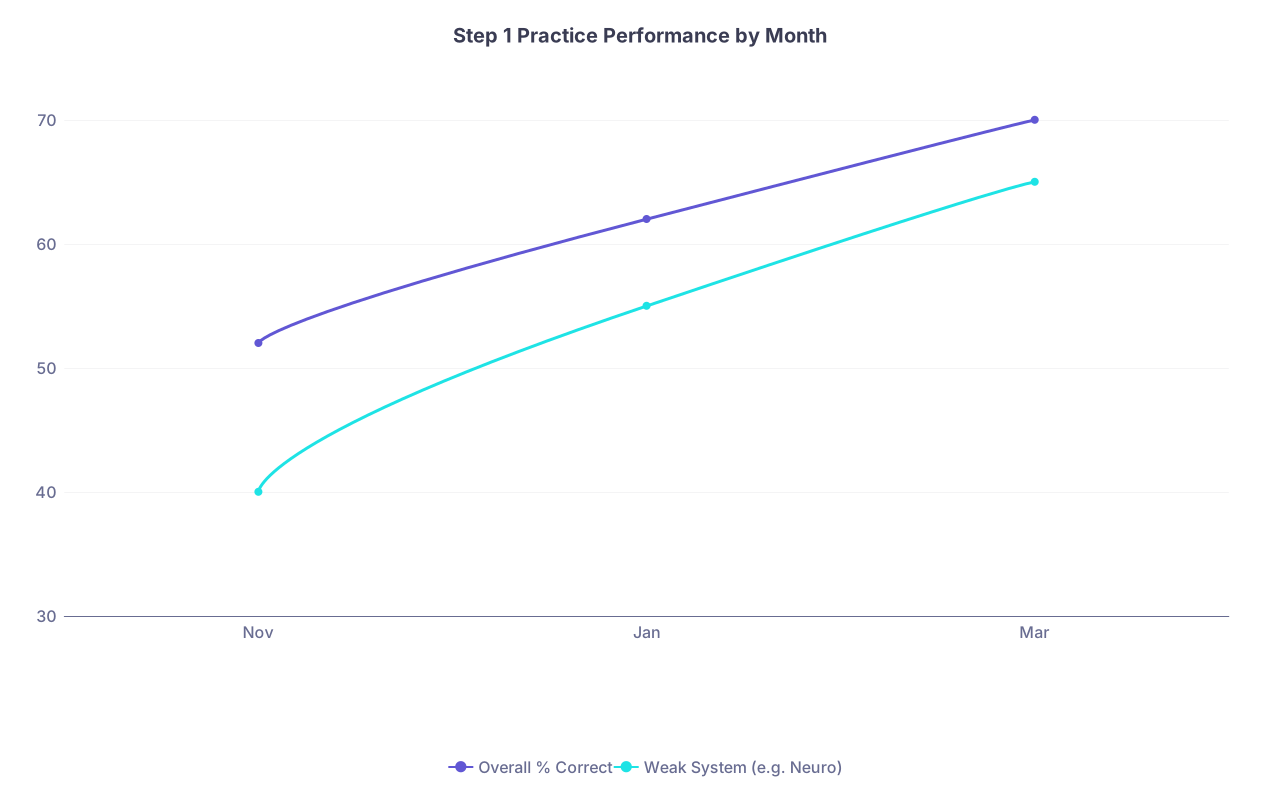
| Category | Overall % Correct | Weak System (e.g. Neuro) |
|---|---|---|
| Nov | 52 | 40 |
| Jan | 62 | 55 |
| Mar | 70 | 65 |
- Get mid‑year feedback from residents and junior faculty.
Ask a PGY‑2 or PGY‑3 you’ve worked with:
- “If I keep doing what I’m doing, do you think I’ll be a reasonable applicant in this specialty from our school? What would you change?”
If two different people hesitate or give vague answers, that’s not random. That’s a signal.
- Start mapping sub‑I and away rotation strategy (yes, this early).
- Popular away months for competitive specialties: June–October of MS4
- Many programs open VSLO applications in February–April
- Talk to your dean’s office now about:
- Home rotation timing
- How many aways are realistic
- Which programs traditionally like your students
March: Lock in Your Narrative and Your Numbers
At this point you should:
Have a clear story. Not “I like procedures.” Everybody does.
Your line needs to sound like:- “I’ve been working with the [ortho trauma group] since MS2 fall on outcomes in open tibia fractures, and I’ve really enjoyed the OR time and the longitudinal follow‑up in clinic.”
Clarify the letter‑writing pipeline.
- One faculty who could realistically write you a strong letter if they had to tomorrow
- One resident or fellow who will back up your work ethic and personality
- Plan to add more during MS3 rotations, but you need the seeds planted now
Start sketching your dedicated Step 1 window. Decide:
- How many weeks of dedicated you’ll target (6–8 is common)
- When exactly your last exam is and how quickly you can transition
- Rough weekly targets: questions/day, NBMEs, review cycles
April–May: Finish MS2 Strong and Set Up Dedicated
By now, Step 1 is no longer “later.” It’s the next big rock.
April: Stop Adding, Start Executing
At this point you should:
Stop taking on new major projects.
If someone offers a shiny new project in April of MS2 with no clear early product, decline politely. You need outputs, not eternal drafts.Push existing projects to visible endpoints. Targets:
- One poster or abstract submitted
- One manuscript in either:
- Data collection nearly complete, or
- Draft in progress with clear timeline
Create your dedicated study calendar (detailed). Down to the week:
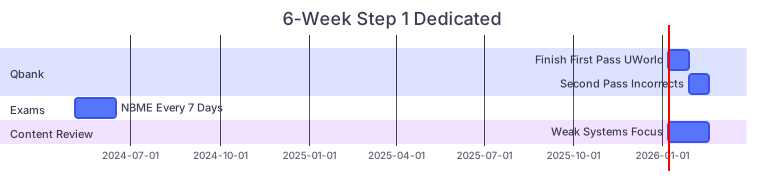
| Task | Details |
|---|---|
| Qbank: Finish First Pass UWorld | a1, 2024-05-01, 3w |
| Qbank: Second Pass Incorrects | a2, after a1, 3w |
| Exams: NBME Every 7 Days | b1, 2024-05-05, 6w |
| Content Review: Weak Systems Focus | c1, 2024-05-01, 6w |
You don’t guess your way through dedicated. You script it.
May: Prepare to Disappear (Temporarily)
At this point you should:
Communicate realistic availability to research mentors. Send a short note:
- “I’ll be starting dedicated Step 1 study on [date] and will be less responsive for about 6–8 weeks. Before that, I’d like to [finish X / hand off Y / clarify next steps].”
People appreciate this. And they remember who’s organized.
Clean up your professional footprint.
- CV: update with ongoing projects, abstracts “submitted” (accurately labeled), teaching, leadership
- Email: filter and folder your research correspondence so you can pick it back up after the exam
- Calendar: block‑off Step 1 period as “not scheduling commitments”
Make a clear mental shift. For most competitive specialties, a bad Step 1 (even if pass/fail) can close doors or force you to over‑perform on Step 2. Treat this exam like the gatekeeper it still is.
Dedicated Period: Execute Like Your Future Depends on It (Because It Does)
You’re technically between MS2 and MS3 now, but this is part of the MS2 arc.
At this point you should:
Run a tight weekly cycle. Example:
- 60–80 UWorld questions/day
- Daily Anki maintenance
- NBME every 7–10 days
- Same‑day review of every practice test
Track performance like an adult, not by vibes.
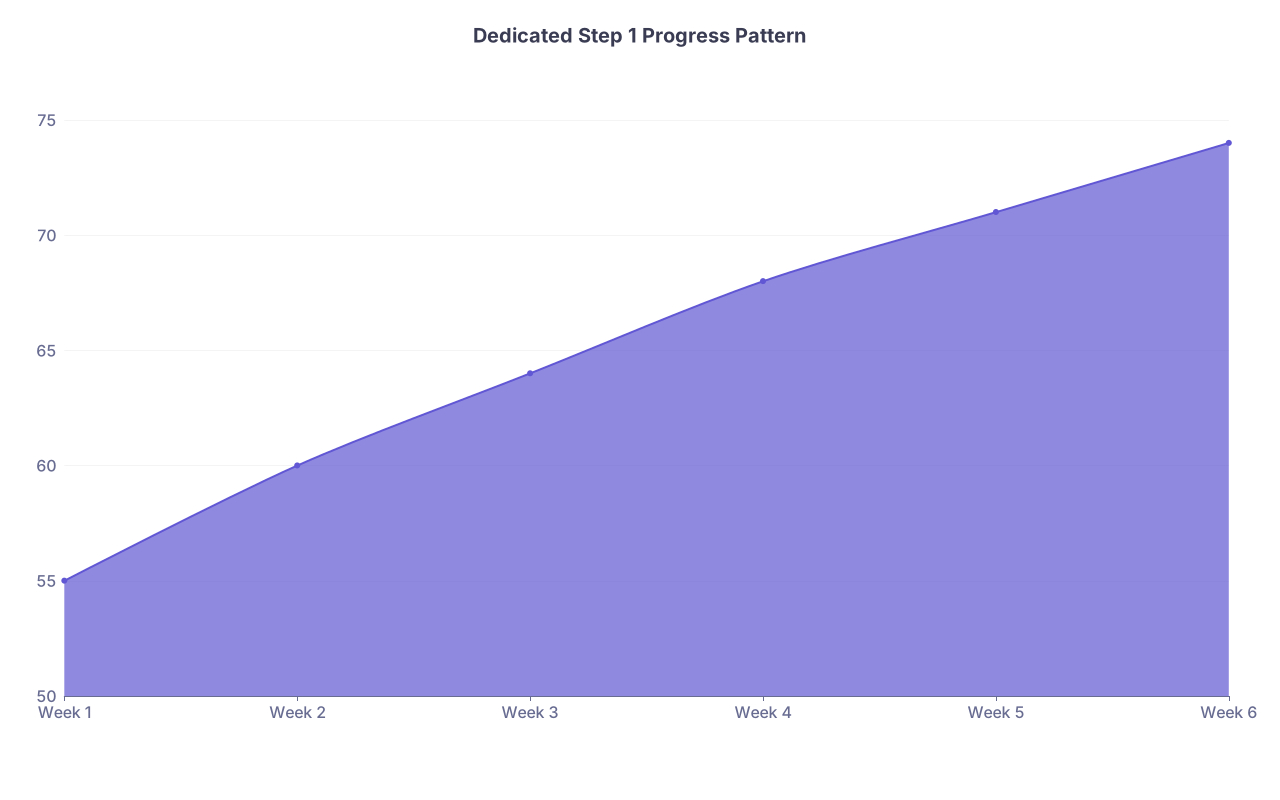
| Category | Value |
|---|---|
| Week 1 | 55 |
| Week 2 | 60 |
| Week 3 | 64 |
| Week 4 | 68 |
| Week 5 | 71 |
| Week 6 | 74 |
If your practice tests are flat or dropping across 2+ NBMEs, something has to change. You don’t just “hope” it works out.
Protect your health just enough to not crash.
- Sleep: non‑negotiable 6–7 hours
- Movement: 20–30 minutes most days
- No new diets, no new workout experiments. Simple and sustainable.
Schedule the exam with intention.
- Not 2 days after a horrible NBME
- Not after a 4‑day “break” where you forgot half of pharm
- Aim for the week after a solid performance plateau
Specialty-Specific Notes You Should Factor In During MS2
I’m not going to list every specialty; I’ll tell you how to think.
Competitive fields broadly care about:
Specialty‑specific research.
Ortho programs do not care about that random pediatrics QI abstract. Derm does not care about your EM ultrasound project. Have at least 1–2 things clearly in the lane you want.Reputation inside your own department.
You want this kind of phrase circulating about you:- “Yeah, that MS2 is always here, shows up on time, asks good questions, and actually finishes tasks.”
Trajectory, not perfection.
I’ve seen people with rough MS1 grades who:- Crushed Step 1
- Stuck with a single department and had 2–3 solid projects
- Got very strong letters
Those people matched into ENT, ortho, derm. Because the trajectory was clearly upward and the story was coherent.
Realistic backup planning.
By late MS2, if multiple mentors are hinting your odds are low in your dream specialty, you need to:- Explore dual‑application strategies (e.g., DR + IR, gen surg + vascular interest, IM + cards track)
- Bring your dean into the conversation early, not in panic during MS4.
Where You Should Be by the End of MS2
If you’re eyeing a competitive specialty, by the day you sit for Step 1, you should honestly be able to say:
“I have a home in [specialty].”
- At least one faculty knows you well enough to describe you without looking at your CV.
- You’ve shown up consistently at conferences or in clinic/OR.
“I am on at least 1–2 projects with real output potential.”
- One abstract/poster submitted or clearly planned.
- One manuscript in draft or late data‑collection stage.
“My board prep is structured, data-driven, and on schedule.”
- Baseline and follow‑up NBME scores tracked.
- Dedicated study plan is written, not in your head.
Hit those, and you walk into MS3 with momentum instead of panic.
Key points to walk away with:
- By mid‑fall of MS2, you should already be attached to a specialty department and at least one project. If you’re not, that’s your top priority.
- MS2 is not “pre‑clinical downtime” if you want derm/ortho/ENT/neurosurg/ plastics/ophtho. It’s when you quietly build the research, relationships, and exam foundation that everyone else will pretend “just happened” later.
- Step 1 being pass/fail didn’t make the year easier; it just shifted scrutiny. Treat MS2 as the year you prove—on paper and in people’s memories—that you belong in a competitive match.