
The mythology around ENT being “competitive but chill” is outdated. Modern otolaryngology is brutally selective, research‑heavy, and politically sensitive.
Let me break this down specifically: if you want ENT, you are competing in three arenas simultaneously—research, away rotations, and signaling. If you are weak in any one of these, you must be disproportionately strong in the others. There is no coasting.
1. How Competitive Is ENT Really Right Now?
Forget the vague “top 5 most competitive” clichés. Look at behavior, not labels.
Programs are acting like a hyper‑selective niche surgical field:
- They expect a credible scholarly footprint.
- They heavily weight performance on sub‑internships.
- They quietly stalk your signals and networking footprint.
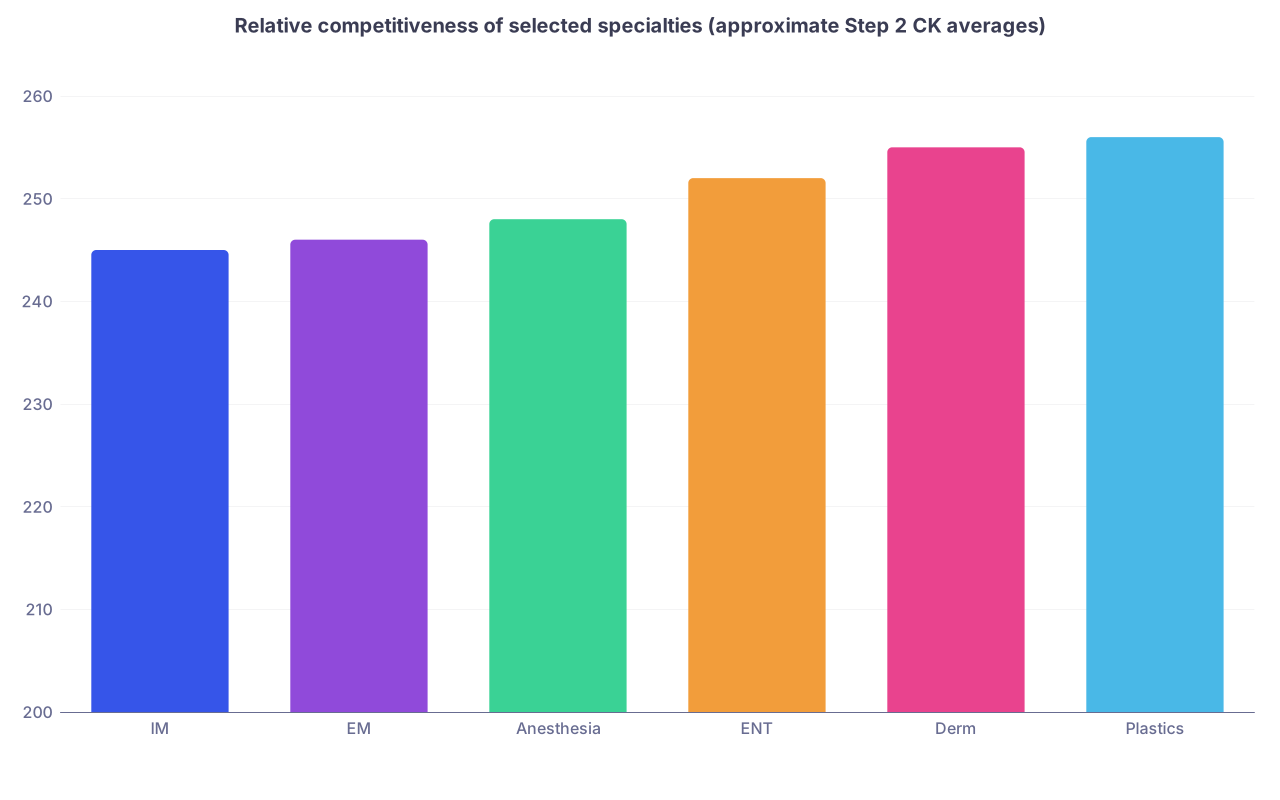
| Category | Value |
|---|---|
| IM | 245 |
| EM | 246 |
| Anesthesia | 248 |
| ENT | 252 |
| Derm | 255 |
| Plastics | 256 |
Do not obsess over the exact number in that chart. Programs know scores are compressed and USMLE Step 1 is pass/fail. They shift weight onto other things that actually differentiate you:
- Research productivity and relevance.
- Letters from known ENT faculty.
- How you functioned on their service as an acting intern.
- How your signals match your story.
I have seen applicants with Step 2 CK 260+ go unmatched in ENT, and I have seen applicants in the mid‑240s match strong university programs because their research and clinical reputation were airtight.
So treat Step 2 as threshold, not destiny:
- 250+ = You are safe on the numbers side, provided the rest of your application is consistent.
- 240s = You must be strong in research and rotations.
- Below ~240 = Not impossible, but you need real strengths somewhere else, and probably a very strategic list plus a realistic backup.
2. Research in ENT: What Actually Matters
“Do I really need ENT research?” Yes. For almost everyone, yes.
Not because everyone loves research. Because ENT is small, academic, and tribal. Research is how faculty know who you are before you ever scrub together.
What type of research counts?
Hierarchy of value, from an ENT residency selection perspective:
ENT‑specific, with ENT faculty, resulting in:
- PubMed‑indexed publication (original research, systematic review, or solid case series).
- National or major regional ENT meeting presentation (AAO‑HNSF, COSM subspecialty societies, Triological, etc.).
ENT‑specific projects “in progress”:
- Submitted manuscripts.
- Abstracts accepted for presentation.
- Retrospective chart reviews with clear ENT relevance (e.g., outcomes of FESS, HPV‑related OPSCC survival, tympanoplasty revisions).
Non‑ENT but surgical / procedural / oncology research:
- Head and neck oncology via radiation oncology, med onc, or radiology.
- Surgical outcomes, quality improvement in surgical care.
Completely unrelated basic science or clinical work:
- Better than nothing, but will not impress as much without a clear narrative why you pivoted to ENT.
If you are still pre‑clinical, get into an ENT lab early. If your school does not have ENT, find:
- A nearby academic center that will take a visiting research student.
- A virtual collaboration (multicenter database, meta‑analysis, systematic review) with ENT folks elsewhere.

How much research is “enough”?
Programs do not have a magic number, but there are recognizable tiers.
| Profile Type | ENT‑Related Outputs | Total Scholarly Items | Competitiveness Snapshot |
|---|---|---|---|
| High‑end | 3–5+ pubs, 2+ ENT | 8–15+ | Competitive anywhere |
| Solid | 1–2 pubs, 1 ENT | 3–7 | Strong for most programs |
| Minimal | 0–1 pubs, ENT‑adj. | 1–3 | Needs strength elsewhere |
| None | 0 | 0 | Very high risk |
What matters more than the raw count:
- At least one thing clearly ENT and clearly yours (your name not buried at position 17 on a 23‑author abstract).
- Evidence of persistence: multiple projects, ongoing work, or progressively more responsibility.
How to salvage a late start
If you are starting in late M3 or early M4 and have little to show:
Immediately connect with ENT faculty and ask for:
- Case reports that are half‑written.
- Retrospective reviews where data are already pulled.
- Help with a systematic review where you can screen abstracts and extract data.
Set realistic publication goals:
- One submitted manuscript (even if acceptance comes later).
- One national or regional abstract.
Make your ENT PI your strongest advocate:
- They can write a powerful letter saying: “She joined late but outperformed our full‑time research students.”
3. ENT Audition Rotations: Where the Match is Won (or Lost)
Acting internships in ENT are not “nice to have.” They are core currency.
I have watched committees explicitly separate applicants into:
- “We know them from our rotation or from a trusted colleague’s rotation.”
- “We do not know them.”
You want to be in the first pile at as many realistic programs as you can manage.
How many away rotations?
Most ENT applicants do:
- Home ENT sub‑I (or equivalent) if available.
- 1–2 away ENT rotations.
- Occasionally a 3rd if:
- No home program.
- Geographic or couples‑match constraints.
- They are trying to flip coasts or land a very specific type of program.
If you have no home ENT program, your away rotations essentially become your home experience. You must treat each one like a month‑long interview.
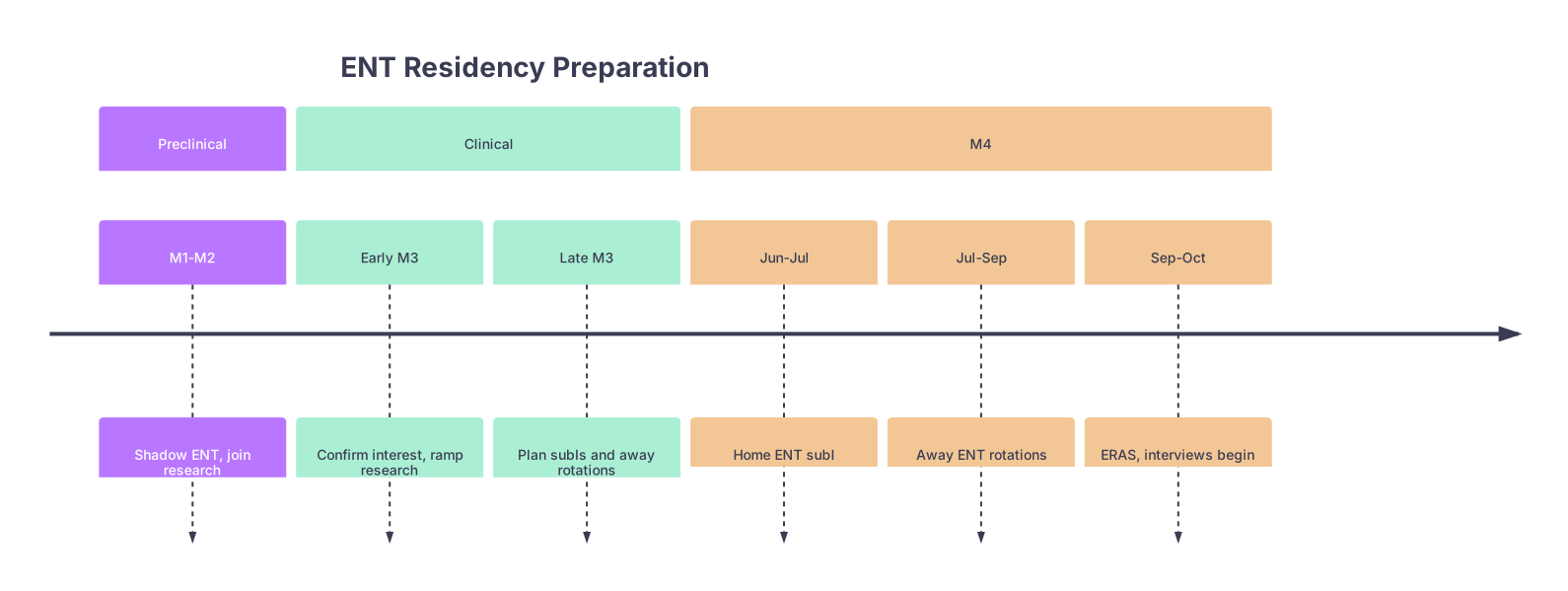
| Period | Event |
|---|---|
| Preclinical - M1-M2 | Shadow ENT, join research |
| Clinical - Early M3 | Confirm interest, ramp research |
| Clinical - Late M3 | Plan subIs and away rotations |
| M4 - Jun-Jul | Home ENT subI |
| M4 - Jul-Sep | Away ENT rotations |
| M4 - Sep-Oct | ERAS, interviews begin |
What programs actually evaluate during a sub‑I
They are not only checking “competency.” They are deciding: would I want this person in my call room for five years?
They look for:
- Work ethic without drama: showing up before residents, staying late when needed, not complaining.
- Initiative with boundaries: you anticipate tasks, but you do not overstep clinically.
- Humility with confidence: you try procedures appropriately, accept feedback, and never argue about petty things.
- Team fit: do the residents like you, or are they relieved when you are on clinic instead of in the OR?
Common ways students unintentionally damage themselves:
- Acting like an eager beaver with attendings but ignoring residents and nurses.
- Being obsessed with “cool cases” and visibly disinterested in clinic or mundane tasks.
- Being entitled about hours, call, or cases (“Do I have to stay for this trach?” said out loud within earshot of the fellow).
How to crush an ENT sub‑I
Concrete behaviors that ENT faculty and residents repeatedly reward:
Pre‑round like a junior resident.
- Have vitals, labs, imaging pulled up.
- Know post‑op day, drains, airway status, diet, and disposition plan.
- Have your own one‑sentence assessment and plan ready if asked.
Own your patients (within your scope).
- Follow them from OR to floor to clinic.
- Look up every one of your cases the night before. Know:
- Indication.
- Key anatomy.
- Basic steps.
- Main complications.
Be OR‑useful.
- Learn how to drape for tonsillectomy, FESS, thyroid, trach.
- Anticipate suture needs, suction positioning, and endoscope handling.
- Never touch the microscope or endoscope without asking. Ever.
Be relentlessly pleasant under stress.
- Call days, 12‑hour OR marathons, and post‑op chaos will happen.
- The resident who is drowning will remember that you quietly handled pages, grabbed consents, and did not make their life harder.

Letters from audition rotations
The best ENT letters:
- Come from someone who saw you in multiple settings (OR, clinic, call).
- Compare you explicitly to other ENT‑bound students.
- Comment on your trajectory: “He progressed to functioning at the level of an intern by the end of the month.”
If you performed very well but the big‑name chair barely worked with you, it is sometimes better to take a letter from the associate PD or senior faculty who actually watched you grind every day.
4. Signaling and “Fit”: The New Gatekeeper
Signaling is ENT’s polite way of asking: “Where do you want us to take you seriously?”
If you treat signals casually, you are volunteering to be screened out.
Think of three categories:
- Must‑have programs (genuine top choices).
- Good‑fit realistic targets.
- Geographic or personal‑reason anchors.
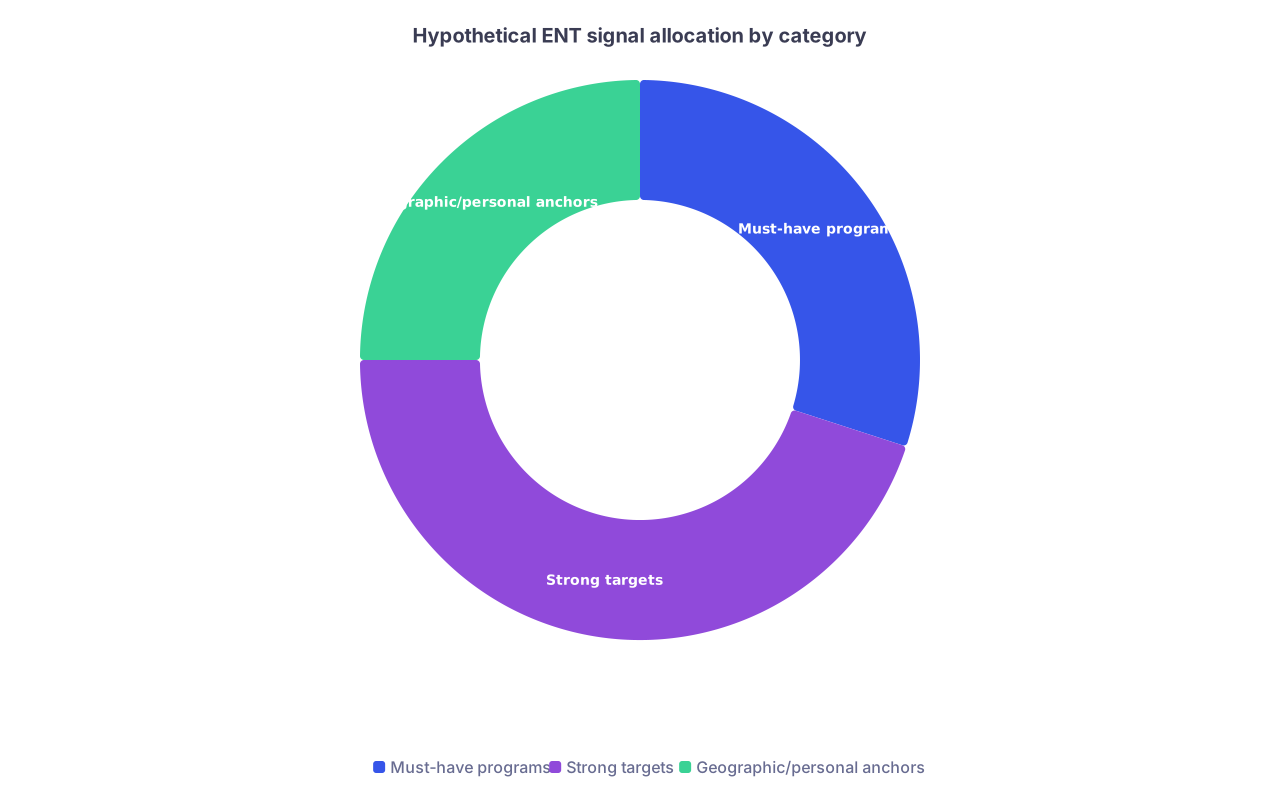
| Category | Value |
|---|---|
| Must-have programs | 30 |
| Strong targets | 45 |
| Geographic/personal anchors | 25 |
The exact number of signals changes as policies evolve, but the logic does not.
How programs use signals
Patterns I have seen watching faculty sort ERAS lists:
- “No signal, no connection, mid‑tier application” → often not reviewed seriously at highly selective programs.
- “Signal + away rotation + regional tie” → pushed into the “discuss” pile, even with modest numbers.
- “Signal but zero plausible reason for interest” → may be interpreted as random spraying.
Signals are not binding. But if you signal a place that:
- Does not match your geographic story.
- Does not align with your stated career goals.
- Has nothing to do with your research footprint.
…you had better be able to articulate why on interview day. Otherwise, you come across as insincere and opportunistic.
Strategy to align research, auditions, and signals
The mature ENT application tells one coherent story.
Example 1: “Academic head and neck oncology focus”
- Research: Outcomes in OPSCC, HPV‑related disease, or reconstructive work.
- Rotations: One home ENT rotation, one away at a strong H&N‑heavy academic center.
- Signals: Academic programs with strong oncology presence, especially where your research would plug in naturally.
Example 2: “Rhinology / skull base with geographic constraint”
- Research: Chronic rhinosinusitis, smell loss, or sinonasal tumors.
- Rotations: Away at a program in your desired city or region with strong rhinology.
- Signals: Focused on your geographic constraint plus a few national‑name places with rhinology strength.
The worst thing you can do is scattershot:
- Random GI research.
- ENT away rotation at a place you do not signal.
- Signals to cities you have never lived in, with no visible ties, while calling yourself “geographically flexible but family oriented.”
That is how you look unfocused.
5. Building and Showing “Fit” in a Small Field
ENT is not internal medicine. Everyone knows everyone. Gossip travels. Personality outliers stand out, for better or worse.
“Fit” is not code for “we only take one type of person.” It means: can you operate within a small, intense, practice‑heavy world without causing drama or burnout for others.
What ENT programs think makes a good resident
A composite sketch from attendings and PDs I have heard over and over:
- Surgically inclined and technically curious.
- Comfortable with airways, bleeding, and head and neck anatomy.
- Reliable under pressure, especially at 2 a.m. with a difficult airway or post‑tonsil bleed.
- Balanced enough to handle a high outpatient load plus OR volume.
Your application should show:
- Comfort with procedural environments (surgery, anesthesia, EM).
- Longitudinal commitment (not a last‑minute pivot).
- Collegiality – strong comments about teamwork in MSPE and letters.

Red flags ENT committees quietly care about
Some of these will not be said out loud, but they matter:
- Repeated professionalism “concerns” in your MSPE, even if “resolved.”
- Multiple specialty pivots late in M3/M4 with no clear explanation.
- Reputation for OR arrogance or dismissiveness toward nurses / anesthesia.
- Evidence that you crumble when not in control (poor feedback from sub‑I, emotional volatility).
Conversely, you get disproportionate credit for:
- Great teamwork comments from surgery, anesthesia, or EM rotations.
- Taking ownership of complex patients.
- Positive feedback from nurses and staff that reaches faculty ears.
6. Targeting Programs: Where Do You Actually Fit?
ENT programs are not all the same animal. You should target ones that match who you are and what you can realistically offer.
| Program Type | Features | Best for Applicants Who… |
|---|---|---|
| Big‑name academic | Heavy research, fellowships | Have strong research / academic goals |
| Mid‑sized university | Balanced clinic + OR | Have solid but not elite metrics |
| Community‑heavy university | High clinical volume | Want operative experience, less research |
| Pure community (few exist) | Focus on general ENT | Want primarily private‑practice pathway |
You should not apply identically to all of them.
If you have:
- 260+ Step 2, strong ENT research, multiple high‑impact letters:
- You are competitive for big‑name academics, but you still must show fit and not just numbers.
If you have:
- 240s Step 2, 1–2 ENT projects, solid but not famous letters:
- Cast a broad net with a mix of mid‑tier university and clinically heavy programs.
- Focus on places where your away rotations and signals give you an edge.
If you have:
- Below 240 Step 2, limited research, or late ENT pivot:
- You should strongly consider a parallel plan (prelim surgery, TY, or another field) rather than pretending you are equally competitive.
7. Putting It All Together: A Sample Strategy
Let me outline two concrete applicant scenarios and the strategy that actually makes sense.
Scenario A: Solid but not superstar, M3 deciding early
Profile:
- Step 1 pass on first attempt.
- M3 clerkships: mostly Honors/High Pass, especially on surgery.
- Step 2 projected low‑250s.
- One ENT case report in progress, one ENT QI project starting.
- Home ENT program.
Strategy:
- M3 second half:
- Deepen engagement in current ENT projects: push the case report to submission, get data for the QI project.
- Early M4:
- Home ENT sub‑I in June or July. Goal: crush it and secure a top‑tier letter.
- Away rotations:
- Two aways at realistic academic programs, one in a region you truly prefer.
- Signals:
- Signal home, both aways, and a handful of academic programs with resident culture and clinical style that match your personality.
- Application narrative:
- Emphasize consistent interest from M3, research that plugs into your academic curiosity, strong team‑based comments from surgery and ENT.
Outcome: This applicant is not “automatic,” but with good interviews and no personality red flags, they can match at a respectable university program.
Scenario B: No home ENT, late interest, M3 spring
Profile:
- No home ENT department.
- Step 1 pass; Step 2 projected 240–245.
- Research: one radiology abstract, nothing ENT‑specific.
- ENT interest crystallized after shadowing during M3 surgery.
Strategy:
- Now:
- Cold‑email regional ENT academic centers about research collaborations.
- Secure at least one project with clear ENT branding (even a small chart review).
- M4:
- Three away ENT rotations (because you have no home program) at:
- One “reach” academic center.
- One realistic mid‑tier.
- One in a region where you have strong ties.
- Three away ENT rotations (because you have no home program) at:
- Signals:
- Prioritize aways and programs where you have a believable geographic or family reason.
- Backup:
- Build a credible parallel application (e.g., general surgery, prelim year) and be honest with mentors; ENT may still work, but it is not guaranteed.
Outcome: This candidate can match ENT, but must absolutely maximize sub‑I performance and relational capital. The backup is not optional.
FAQ (5 Questions)
1. If my school has no ENT department, am I basically doomed?
No, but the bar rises. You must:
- Do more away rotations (usually 2–3).
- Be aggressive about finding ENT research externally.
- Get at least one strong ENT letter from an away site. Programs will cut you slack for having no home department, but they will not excuse a completely empty ENT CV.
2. How critical is it for my research to be first‑author?
First‑author ENT work is ideal, but not mandatory. A mix is fine:
- One or two first‑author (case report, small review, or retrospective).
- Some middle‑author contributions on larger projects. What matters is that your letter writers can credibly describe your intellectual role, not just your name placement on a PubMed list.
3. Is it better to rotate at a “top‑10” program where I am average or a mid‑tier place where I can shine?
For most applicants, it is better to shine at a mid‑tier that might realistically rank you highly than to be anonymous at a prestige program you are unlikely to match. One strategic “reach” away is fine, but do not burn all your sub‑I time on places that will never seriously consider you.
4. Does a single weak clerkship grade (like a Pass in Medicine) kill my ENT chances?
One outlier grade rarely kills an application. Patterns do. If your surgery and ENT‑adjacent rotations (anesthesia, EM) are strong, and your sub‑Is go well, most programs will not fixate on one Pass. You should still be prepared to explain it succinctly if asked: what happened, what changed afterward, and what you learned.
5. How many ENT programs should I apply to?
It depends on your profile, but ENT is not the place to be minimalist. Typical ranges:
- Very strong applicant: 40–50 programs.
- Solid but not elite: 60–80 programs.
- Borderline metrics or late pivot: 80+ and a serious backup plan. Numbers alone are not enough; you still need targeted signals, thoughtful away choices, and a coherent story.
With research, auditions, and signaling aligned, you stop looking like a random name in a crowded ERAS list and start looking like someone specific programs can picture in their call room. Once that happens, the conversation shifts from “Can we justify interviewing this person?” to “Can we afford to let them go somewhere else?” Your next move after that is interview execution and rank strategy—but that is a separate game, and we will tackle that another day.