
The shelf failure is not what kills a competitive application. Doing nothing, hiding it, or reacting badly is what kills it.
You failed a shelf and still want derm, ortho, ENT, plastics, rad onc, neurosurgery, ophtho, urology, EM at a big name place. Everyone around you is suddenly an expert in doom. Half your classmates are quietly relieved it was not them. Your school gives you some generic “this won’t define you” email.
Let’s talk about what actually matters now, and what you need to do in the next 2–12 months to keep competitive options realistically on the table.
Step 1: Stabilize the Situation (Next 48–72 Hours)
You are not making good strategic decisions in the first 24 hours while your brain is screaming.
Here’s the immediate checklist:
Get the exact facts in writing.
Email the clerkship director or coordinator:- What was the passing cutoff?
- Was it the NBME shelf or an in-house exam?
- How does this affect my clerkship grade (pass vs fail, remediation, notation)?
- What will appear on my transcript and MSPE?
Ask specifically about the remediation plan.
There are usually flavors:- Repeat just the shelf
- Repeat part of the rotation and the shelf
- Full repeat of the rotation in a later block
You need dates. When will you retake? Will the original failure appear anywhere official?
Do not start mass-confessing to residents and attendings.
Talk to:- Your academic advisor
- One trusted faculty member in or near your target specialty That’s it for now. Gossip spreads faster than fact. Don’t feed it.
Pause all “I guess I’m not smart enough for derm/ortho/etc.” storylines.
Failing a shelf means one thing: you underperformed on one standardized test.
That’s it. Programs care far more about:- Pattern of performance
- Recovery
- How you explain it when asked
For the next 2–3 days, the mission is simple: stabilize, get the remediation plan, and stop yourself from making impulsive long-term decisions.
Step 2: Determine the Real Damage (Not the Imagined One)
Now we quantify the hit. Not all shelf failures are created equal.
| Situation | Likely Impact |
|---|---|
| Failed early M3 shelf, remediated, later high shelves | Mild |
| Failed core shelf + low Step 2 | Moderate–severe |
| Failed elective shelf (e.g., sub-I) | Moderate |
| Multiple shelf failures | Severe |
You’re asking: “Can I still go for a competitive specialty?” You need to answer three technical questions.
1. Where in the timeline did this happen?
- Early third year (first 1–2 rotations):
Programs are more forgiving. You can frame it as an adjustment to clinical learning or NBME style, especially if every shelf after that is strong. - Mid/late third year:
Harder to spin as “just adjustment.” You’ll need clear improvement afterwards. - Fourth-year sub-I shelf in your target specialty:
This is the worst one to fail. Not fatal, but you have to overcompensate with letters, Step 2, and performance on away rotations (if applicable).
2. What does your record look like around it?
Here’s what you line up in your head (or literally in a spreadsheet):
- Step 1: Pass/Fail (did you barely pass? did you crush it before it went P/F?)
- Step 2 CK (or projected): numeric, critical
- Other shelf scores: approximate percentiles or school honors/high pass/pass
- Preclinical performance: any failures/remediation?
- Any earlier academic issues (leaves, repeats, professionalism flags)?
Patterns matter. One isolated failure with otherwise solid performance = explainable. A pattern of just-barely-passing and then a failure = you need a serious academic turnaround plan, not just PR spin.
3. What does your school actually put on the MSPE?
Do not guess. Ask.
Some schools:
- Show only final clerkship grade (Pass/Honors)
- Explicitly document shelf failures and remediation
- Include percentile distributions for shelves
If the failure is invisible in the final MSPE (for example, you remediated, passed, and the narrative is neutral), the “damage control” is more about your confidence and Step 2 than program perception.
If it’s explicitly mentioned, then it’s part of your story and you need a clean, specific explanation ready.
Step 3: Decide if Competitive Is Still Realistic for YOU
I’m not going to tell everyone “You can still match derm at UCSF, just believe in yourself.” That’s irresponsible.
We’re going to be honest about tiers of competitiveness and where you probably sit now.
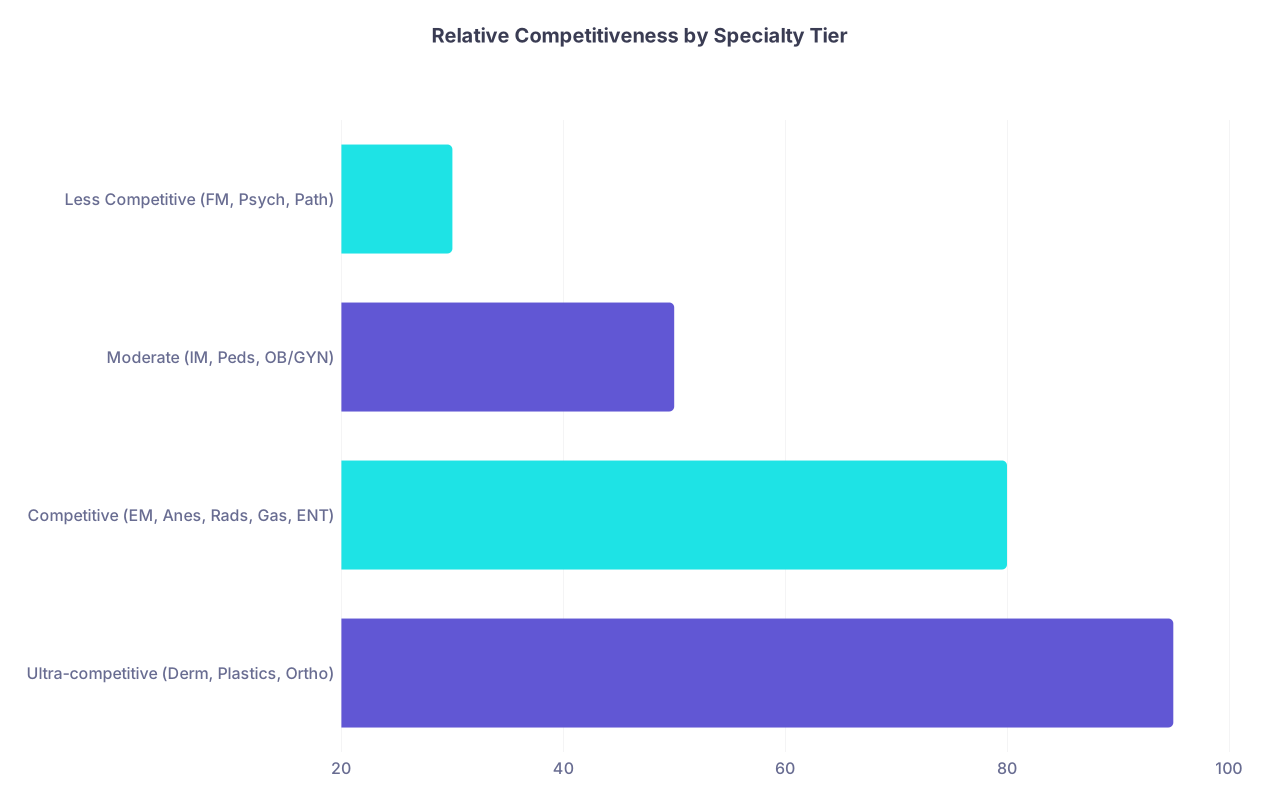
| Category | Value |
|---|---|
| Ultra-competitive (Derm, Plastics, Ortho) | 95 |
| Competitive (EM, Anes, Rads, Gas, ENT) | 80 |
| Moderate (IM, Peds, OB/GYN) | 50 |
| Less Competitive (FM, Psych, Path) | 30 |
Where you stand now depends on three things more than the shelf:
- Step 2 CK (actual or projected)
- Class rank/clinical grades
- Research & letters in your specialty
Here’s the blunt breakdown:
- Single shelf failure, Step 2 projected ≥ 245, mostly honors/high passes:
Still in the game for derm/ortho/ENT/ophtho/urology/etc. You’ll need a tight narrative and strong letters. - Single shelf failure, Step 2 projected 230–240, mostly passes, maybe one more weak spot:
You can still aim competitive, but probably not Top 10 programs. You’ll need a broader list and a backup specialty you’d actually be okay with. - Multiple academic hits (another failed exam, low Step 1, borderline Step 2):
Going all-in on ultra-competitive without a realistic backup is reckless. You can still apply, but you must build a safety net.
If you’re not sure which category you fall into, bring your entire CV + grade summary to a specialty advisor and ask them the question directly:
“If I were applying this year with this record, what range of programs could I realistically target?”
If they dodge with vague encouragement, press:
“I’m fine with hearing that certain places are unrealistic. I need ranges so I can plan.”
Step 4: Use the Remediation Smartly (Not as Punishment Time)
If you have to retake the shelf or repeat the rotation, that block becomes your “pivot zone.” You can either let it confirm everyone’s worst assumptions, or you can turn it into evidence that you respond well to failure.
Here’s how you structure it:
Academically
You treat the shelf like a mini-Step 2 CK.
- Get your original NBME breakdown (subject performance). Identify 2–3 weakest content areas.
- Build a 3–4 week focused plan with:
- UWorld (or AMBOSS) questions specifically tagged for that rotation
- One dedicated shelf review resource (e.g., UWorld + OnlineMedEd + one concise book)
- Do at least 30–40 questions per day in timed, random blocks. Review every question, even the ones you got right. Not negotiable.
You’re not just trying to pass the retake; you’re trying to prove this was a one-time blip.
Clinically
During the remediation or repeated rotation:
- Be early. Seriously early. Residents notice the chronically 2-minutes-late student.
- Volunteer for notes, follow-ups, and presentations. Show you’re not sulking in the corner.
- Ask for feedback mid-rotation using the exact phrase:
“I had a setback with the shelf and I really want to show I can grow from it. Are there 1–2 specific things I can improve this week?”
Residents and attendings are much more willing to write strong comments for someone who falls, owns it, and then visibly levels up.
Step 5: Protect Step 2 CK At All Costs
For competitive specialties in the Step 1 P/F era, Step 2 is king. It is the fastest way to “wash out” the stain of a shelf failure.
Your question is no longer “How do I pass?” It’s “How do I make Step 2 a weapon?”
If you’re within 4–8 months of Step 2:
Have a date on the calendar.
Not “sometime in summer.” An actual scheduled day.Build your rotation + Step 2 plan together.
If you’re stacking brutal rotations with no shelf and no Step 2 prep, that’s how people end up with 225 and tears.Aim for this structure for 6–8 weeks before Step 2:
- Daily:
- 40–80 UWorld questions (timed, random, full-length blocks)
- Review all questions
- Weekly:
- One NBME or UWorld self-assessment every 1–2 weeks
- Track scores. You want your last 2 assessments ≥ your target.
- Daily:
If your predictive scores are mediocre (e.g., 220–230 range) and you’re gunning for ortho/ENT/derm:
You need to delay the exam if at all possible.
Better to take an extra month and walk in ready than to explain a 224 to every PD.
Programs will forgive 1 failed shelf if you come back with a 250+ Step 2 and strong letters. They will not ignore a mediocre Step 2 just because “boards aren’t everything.”
Step 6: Craft the Narrative (So You Don’t Sound Shaky)
At some point, someone will ask: “I see you remediated a shelf. What happened there?”
You need a 30–45 second answer that:
- Takes ownership
- Avoids melodrama
- Shows specific correction
- Ends on growth
Use a structure like this:
- Short description of what happened (no excuses)
- One real contributing factor you actually addressed
- Concrete steps you took to fix it
- Evidence that your approach worked
Example:
“I failed my surgery shelf early in third year. I underestimated how different NBME-style clinical questions would be from preclinical exams and I tried to ‘wing it’ with last-minute studying around call. I met with my advisor, built a specific question-based plan, and treated that retake like a mini-Step 2. Since then I’ve consistently scored above average on every shelf and scored a 247 on Step 2, using that same structured approach.”
Bad answers sound like:
- “The exam was unfair.”
- “I’m just not a good test taker.” (Programs hear: I will fail your boards.)
- “Personal issues came up.” (If you say this, you must be prepared to briefly, concretely explain and show that it’s resolved.)
Write your answer. Say it out loud. Fix the parts where you sound defensive or vague.
Step 7: Maximize Every Strength You Still Control
With a blemish, you don’t get to be average anywhere else. You need clear spikes.
The three biggest levers for competitive specialties now:
-
- You need at least 2 truly strong letters from people in your desired field.
- “Strong” means: they know you well enough to mention specifics (cases, patient interactions, call nights where you shined), not just “pleasant to work with.”
- Use sub-Is and away rotations strategically: be the reliable, low-drama student everyone wants back.
Specialty-specific commitment
PDs are allergic to the “I woke up an M4 and decided I love ortho” applicant.Show:
- Research in the field (even if small projects, case reports, QI)
- Longitudinal interest: shadowing, elective, journal club involvement
- A coherent story: why this specialty, not just “I like procedures” or “I enjoy continuity.”
Application strategy
You’re not in the “apply to 20 programs and be picky” group anymore.For ultra-competitive specialties with a shelf failure on your record, you’re probably looking at:
- Broad application list (60–80+ in some fields)
- Inclusive mix of:
- Academic powerhouses
- Mid-tier academic
- Community/university-affiliated programs
Plus:
- A real parallel plan if your Step 2/letters are not top tier (e.g., IM with plan for competitive fellowship, or a second specialty you’d genuinely be okay with).
Step 8: When You Actually Should Pivot (And How To Do It Intelligently)
Sometimes the right move after a shelf failure is not “double down and charge the same wall.” Sometimes it’s a controlled pivot.
Signs you should at least seriously consider changing target specialty:
- Step 2 CK at or below ~230 and you’re aiming for derm/plastics/ENT/ortho with no other massive strengths
- Multiple shelves at or near pass cutoff, plus one failure
- Advisors in that specialty, who know you and your record, clearly hesitate when you say “I want to match at a top-20 program in this field”
A pivot doesn’t mean “give up your dreams.” It means pick a path where your likelihood of:
- Matching
- Being happy
- Not burning out trying to prove you belong
…is higher.
You can aim for:
- IM with card/onc/GI aspirations
- Peds with PICU/NICU aspirations
- Anesthesia instead of surgery
- Radiology instead of certain surgical fields
- EM instead of some procedure-heavy specialties
Talk to residents who actually live those lives, not just attendings romantically reminiscing about the “good old days.”

| Step | Description |
|---|---|
| Step 1 | Failed Shelf |
| Step 2 | Assess Context and Pattern |
| Step 3 | Stay with competitive specialty |
| Step 4 | Consider pivot or backup |
| Step 5 | Focus on Step 2 and letters |
| Step 6 | Meet advisors in multiple fields |
| Step 7 | Single failure, rest strong |
| Step 8 | Multiple issues or low Step 2 |
Quick Reality Check by Specialty Tier
This is rough, but it gives you a sense of how hard you’ll need to push.
| Profile | Ultra-Competitive (Derm/Plastics/Ortho/ENT) | Competitive (EM/Anes/Rads/Uro/Ophtho) |
|---|---|---|
| Single shelf fail, Step 2 ≥ 245, strong letters | Still viable with broad list | Very viable |
| Single shelf fail, Step 2 230–240 | Reach only, backup essential | Realistic with strong app |
| Multiple issues, Step 2 < 230 | Very unlikely | Difficult; backup needed |
This is not absolute. But I’ve watched versions of this play out over and over.
FAQs
1. Should I disclose the shelf failure in my personal statement?
Usually no, unless:
- It will clearly appear in your MSPE/transcript
- It is part of a bigger, coherent story of growth or overcoming a defined obstacle that is truly central to who you are now
Even then, keep it tight: one paragraph, maximum. The personal statement is not your confessional booth. If you mention it, frame it exactly like the 30–45 second answer we built earlier: brief, specific, focused on what changed.
2. Is it worth doing an extra research year to offset this?
Sometimes. Not automatically.
A research year helps most if:
- You’re targeting a field where research is prized (derm, plastics, ENT, rad onc, some ortho programs)
- You can realistically get:
- Multiple abstracts
- At least one paper or strong poster
- Strong letters from known faculty
It is less useful if:
- Your Step 2 is weak and you’re avoiding fixing your test-taking problem
- You’re doing “busywork” research without meaningful outcomes
- You’re using it just to “hide” for a year without changing your actual study approach
If you do a research year, your narrative becomes: academic interest + upward trajectory, not “I was scared to apply on time.”
3. How many programs should I apply to now that I have this red flag?
More than you originally planned. Exact numbers depend on specialty, but ballpark:
- Ultra-competitive (derm, plastics, ortho, ENT, etc.) with a shelf failure showing in your record:
Think 60–80+ programs, including community and less name-brand places if they exist in that field. - Middle-tier competitive (EM, anesthesia, rads, uro, ophtho):
Often 40–60 if you have one red flag; could be fewer if the rest of your app is very strong. - With multiple red flags:
Go broad in your main specialty and have a serious backup application ready to submit.
Bottom line:
- One failed shelf isn’t your death sentence.
- Step 2 + letters are now your main weapons.
- Your response to this—how you study, how you remediate, how you talk about it—will matter more than the failure itself.