The obsession with AOA for competitive specialties is wildly overstated. The data does not support the panic you hear on Reddit and in hallway gossip.
AOA helps. It’s a meaningful signal. But it is not “essential” for dermatology, plastics, ortho, ENT, neurosurgery, or any other competitive field. Plenty of people match these specialties every year without AOA. And they don’t all have 270s and 30 pubs either.
Let’s walk through what people think AOA does, what the actual numbers show, and when it really matters versus when it’s mostly psychological comfort for anxious applicants and lazy screeners.
What AOA Actually Is (And Why People Misread It)
AOA is an honor society. At most schools it means you’re roughly in the top 10–20% of your class by some opaque mix of:
- Preclinical grades
- Clinical evaluations
- Exam scores (Step 1/2, NBME subject exams)
- Maybe research, leadership, “professionalism”
Programs know this. So in their minds: AOA = “probably top quartile or better” and “faculty at home institution thought highly of this student.”
Here’s the problem: students translate that as:
“No AOA = dead for derm/ortho/ENT/rads/anesthesia/you name it.”
That leap is not supported by match data. At all.
The Data: AOA Is Helpful, Not Mandatory
The best systematic data we have still comes from NRMP’s “Charting Outcomes in the Match” (for MD) and “Charting Outcomes in the Match: Osteopathic” (for DO). A lot has changed with Step 1 going pass/fail, but AOA’s role hasn’t magically become life-or-death.
Let’s look at where AOA actually moves the needle.
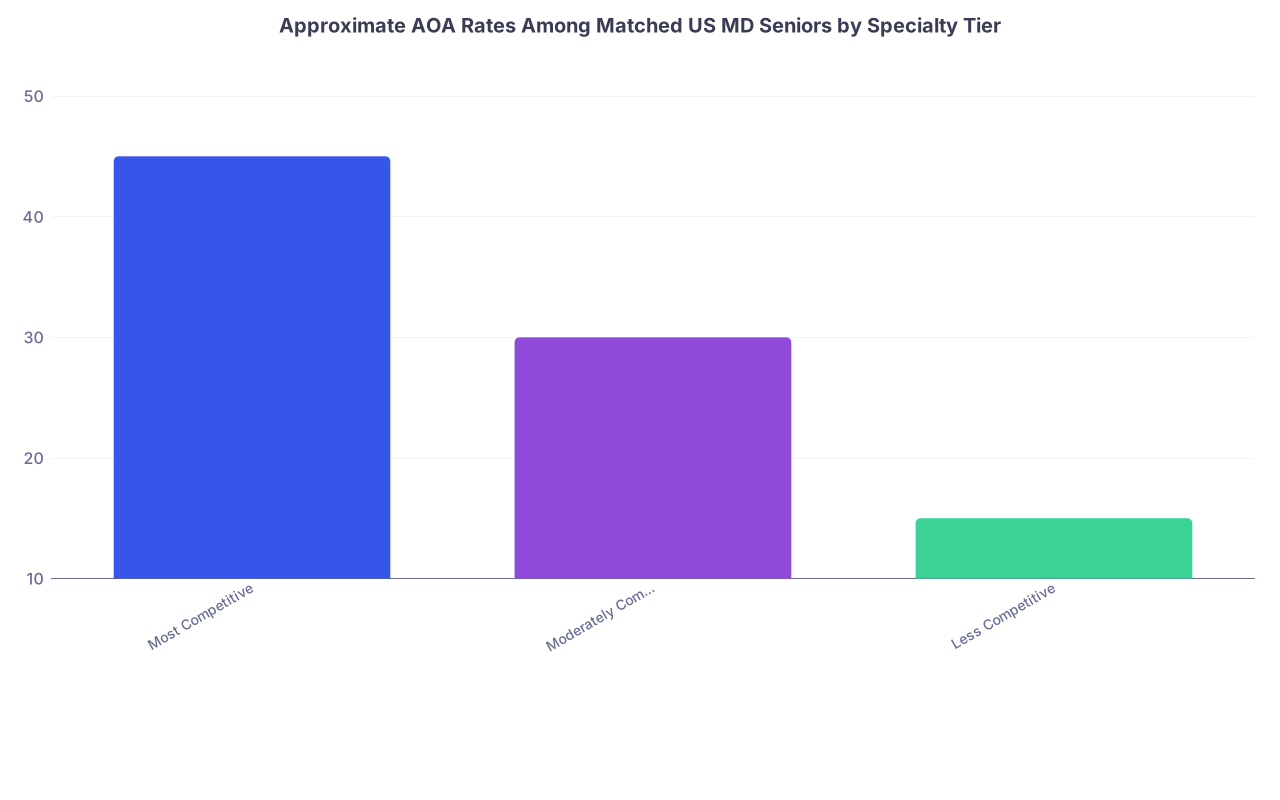
| Category | Value |
|---|---|
| Most Competitive | 45 |
| Moderately Competitive | 30 |
| Less Competitive | 15 |
These are ballpark, but the pattern is consistent: more AOA in hyper-competitive fields, fewer in everything else. That doesn’t mean “no AOA = no match.” It means “top-of-class students tend to cluster in top-competition specialties,” which is obvious.
Concrete patterns from prior Charting Outcomes reports
Across dermatology, plastic surgery (integrated), orthopedics, ENT, neurosurgery, and radiation oncology, the data repeatedly showed three things:
- AOA is more common in matched applicants than unmatched.
- Plenty of matched applicants are not AOA.
- When you control (even informally) for Step 2 CK and research productivity, the “magic” of AOA shrinks.
For example (numbers approximate based on past cycles):
- Dermatology: around half of matched US MD seniors were AOA at many points. Not 100%. Not 90%.
- Integrated plastics: AOA rates high but still left a big non‑AOA chunk matched.
- Ortho, ENT, neurosurg: same pattern—AOA enriches the matched pool, but non‑AOA with strong applications consistently get in.
If AOA were essential, you’d expect something like 80–90%+ of matched MD seniors in those fields to be AOA. That’s just not what the data show.
Why People Think AOA Is Life-or-Death
I’ve heard the same lines in almost every medical school I’ve visited or worked with:
- “Our derm program basically only interviews AOA.”
- “If you want ortho here, you better be AOA or have a famous mentor.”
- “The plastics PD told us: ‘no AOA, no shot.’”
Two problems:
- Students love absolutist rules because they reduce anxiety. “AOA or bust” lets them blame the game instead of the strategy.
- Program directors exaggerate to scare people into working harder. Or they’re describing their ideal pool, not what they actually rank.
Ask PDs off-mic and you’ll get a different story:
- “We look at AOA, but it’s one of many signals.”
- “No AOA is not disqualifying; weak letters are.”
- “Honestly, we barely trust how some schools decide AOA.”
And that last point is key: AOA isn’t standardized. At some schools:
- Only clinical AOA exists, no junior election.
- Preclinical honors matter heavily.
- Research and leadership can nudge a borderline candidate in.
At others, the process is basically grade-based. The result: AOA is a noisy measure of “excellence.” Programs know that. They don’t throw out every non‑AOA applicant on principle.
What Actually Predicts Matching Competitive Specialties
Let’s stop worshiping the wrong idol. Here’s what repeatedly shows real signal for competitive matches.

1. Step 2 CK and other exam performance
Like it or not, Step 2 CK is the only standardized, high-resolution evaluation left.
- For derm/ortho/ENT/plastics, a Step 2 CK in the top quintile of US MD scores puts you in contention without AOA.
- Middle-of-the-road Step 2 with AOA? You’re not suddenly golden. You’re just confusing.
Some PDs have said explicitly in surveys: a strong Step 2 CK can “offset” lack of AOA. There’s no equivalent statement the other way around—AOA rarely “offsets” mediocre board performance in competitive specialties.
2. Specialty-specific performance on rotations
AOA is usually more about overall class ranking. Programs, however, care more about:
- How you performed on their audition rotation (sub-I/away).
- Comments in letters: operative skill, reliability, work ethic, how you function on a team.
I’ve seen applicants with:
- No AOA
- Step 2 CK mid‑250s
- A couple of solid away rotations
match integrated plastics because a big‑name attending wrote “top 1–2 students I’ve worked with in the last five years” and meant it.
You can’t fake that with a line that says “AOA” on ERAS.
3. Letters of recommendation
This is the real gatekeeper. Strong, specific, comparative letters from known faculty carry far more weight than a generic AOA line.
Programs know exactly how to read:
- “Outstanding” with no comparisons → baseline good student.
- “Top 10% of residents or students I’ve worked with” → now we’re paying attention.
- “Top 1–2” with supporting detail → interview almost guaranteed, AOA or not.
I’ve watched PDs glance at AOA, nod, and then spend five minutes dissecting the letters. That’s where decisions are actually made.
4. Meaningful, aligned research
Let’s be blunt: in derm/plastics/rads, having no specialty research and no AOA is rough. But you don’t need both. You need one strong signal of commitment and ability:
- Several first/second‑author papers or strong abstracts in the field
or - Stellar home‑department support (mentorship, letters, rotation performance) with maybe less research.
No one in these specialties is saying, “We only ranked her because she was AOA even though she had no research and weak letters.” That’s not how this works.
Where AOA Does Change the Game
Now the nuance: there are scenarios where AOA is genuinely high-impact. I’m not pretending it’s irrelevant.
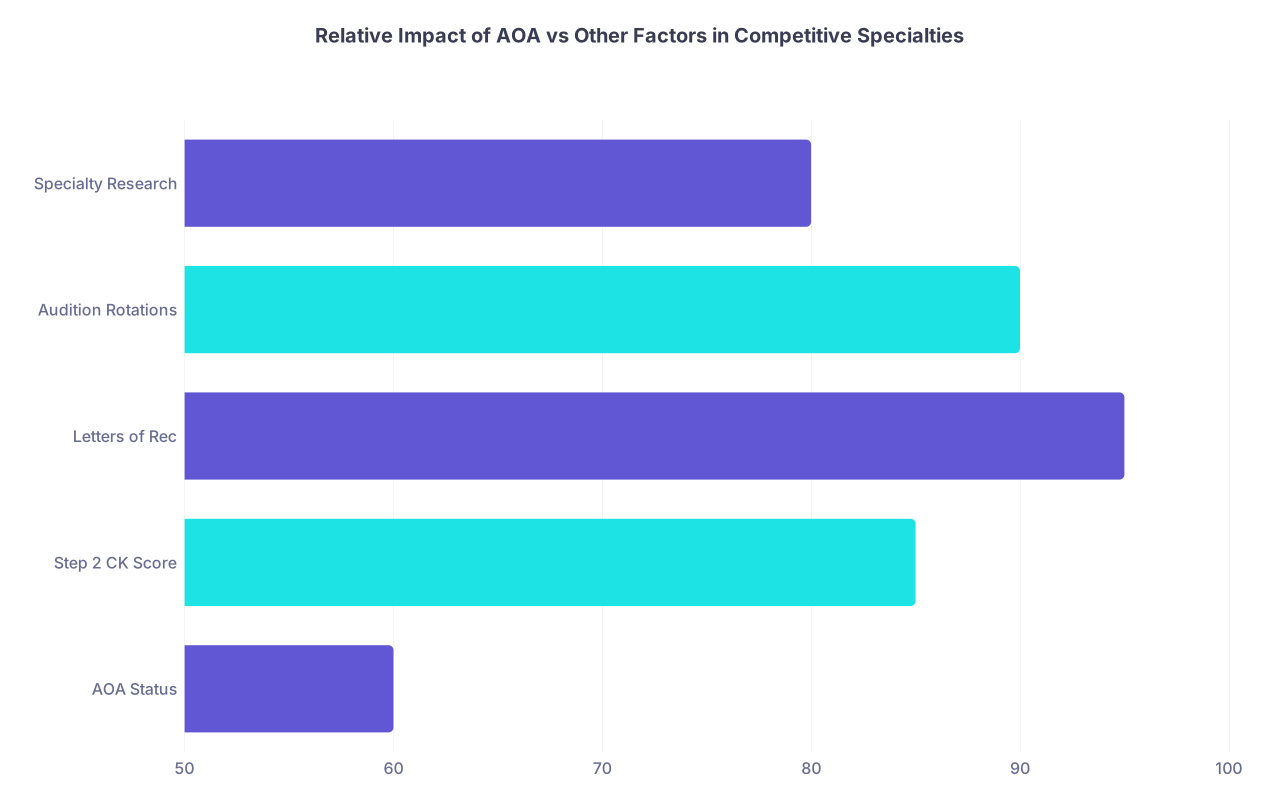
| Category | Value |
|---|---|
| AOA Status | 60 |
| Step 2 CK Score | 85 |
| Letters of Rec | 95 |
| Audition Rotations | 90 |
| Specialty Research | 80 |
(Think of these values as “relative importance” out of 100—rough visual, not exact science.)
1. At top-5 “trophy” programs
At the hyper-elite programs—think UCSF derm, MGH plastics, HSS ortho, etc.—AOA often functions as a lazy screen because they’re inundated.
You’ll see patterns like:
- “Among US MD interviewees, majority were AOA.”
- “Our matched class: all had either AOA or extremely strong alternative markers (e.g., PhD plus 25+ publications).”
In that microscopic slice of the match, no AOA makes life harder. You’re now relying on being exceptional in some other obvious way.
2. At schools where AOA strongly tracks class rank
Some institutions tie AOA pretty tightly to objective metrics—exam scores, clinical evaluations, standardized grading rubrics.
At those places:
- AOA roughly = “most consistent academic excellence.”
- Programs that know the school well treat AOA as high-trust signal.
So if you’re non‑AOA and from a school where the PDs know exactly what that means, you might be starting a little behind classmates who are AOA. Still not dead. Just not auto-boosted.
3. As a tiebreaker among elite applicants
When a committee is ranking:
- Two derm applicants, both with Step 2 260+, strong research, glowing letters.
One is AOA. One is not. Who gets nudged up? Often the AOA. Because when everything else is equal, humans default to easy signals.
But that’s a luxury problem. You have to be in that conversation first.
Where AOA Matters Less Than You’ve Been Told
Here’s where the mythology really falls apart.

1. For DO students and schools without AOA
Osteopathic students and MD schools that don’t participate in AOA exist—and they match into competitive fields every cycle. Programs:
- Know which schools do not have AOA.
- Don’t penalize applicants for lacking an honor that doesn’t exist.
For those applicants, the focus naturally shifts to boards, rotation performance, research, and letters. And—surprise—that still works.
2. At mid‑tier and lower‑tier programs in competitive specialties
Not every derm or ortho program is Harvard. The majority are:
- Regional
- Resident‑driven
- Focused heavily on work ethic, culture fit, and trainability
Those programs are much more likely to take:
- The non‑AOA student with a strong away rotation and great letters
over - The AOA student with mediocre interpersonal skills or weak team feedback.
I’ve seen this repeatedly in ortho and ENT: “We loved working with her. Great resident-in-the-making.” That line crushes AOA on committees every time.
3. In specialties that are “competitive but broad”
Fields like anesthesiology, EM (pre-SLOE-reform chaos aside), radiology, and even some neuro/PM&R niches:
- AOA is a bonus, not an expectation.
- Step 2 CK, SLOEs (for EM), and faculty advocacy dominate.
If you’re non‑AOA and someone tells you you’re “probably dead for anesthesia,” that person either doesn’t know the data or is projecting their own anxiety on you.
How to Compensate If You’re Non‑AOA
This is the part students actually need, but rarely get, because everyone’s too busy catastrophizing.
| Target Field | Without AOA, Emphasize Most |
|---|---|
| Derm / Plastics | Step 2 CK, research, letters |
| Ortho / ENT / Neurosurg | Audition rotations, letters |
| Rad Onc / Rads | Research, Step 2 CK |
| Anesthesia / EM | Step 2 CK, SLOEs/letters, fit |
| Less competitive fields | Solid Step 2, consistent evals |
1. Crush Step 2 CK
You don’t need a 270. You do need a score that makes committees pause and think “okay, this person can handle the cognitive load.”
For many competitive fields:
- ~250+ keeps you in most conversations as a US MD.
- For DO or IMG, generally higher is safer, but still not all‑or‑nothing.
Would they like that score plus AOA? Sure. But if they have to choose, a lot of PDs will pick the 255 non‑AOA over the 238 AOA.
2. Be undeniable on your away and home rotations
On audition and home specialty rotations:
- Show up early. Always prepared.
- Know your patients cold.
- Help the residents first, impress attendings second.
- Never disappear. Never complain on service.
You want residents saying in their debrief: “That student was already functioning like an intern.” Those comments end up in evals and letters. That’s the kind of social proof that blows AOA out of the water.
3. Secure heavy‑hitting letters
Identify 2–3 faculty who:
- See you work hard over time.
- Have a voice in the department.
- Know people at other institutions.
Tell them directly what you’re aiming for. Ask what you need to do on their service to earn a truly strong letter. Then do it.
A short, specific, enthusiastic letter from a known name beats a vague, polite letter from someone who mentions you’re AOA and nothing else.
4. Build a coherent research story (where it matters)
For derm/plastics/rads/rad‑onc:
- Get on a few projects early.
- Aim for at least 2–3 legit contributions with your name in meaningful author position.
- Present at a specialty meeting if you can.
No, you do not need 20+ publications. But in these fields, having nothing in the pipeline and no AOA is a problem. Pick one lane and commit.
The Real Myth: “AOA or No Match”
Let me be blunt.
The students I’ve seen flame out in competitive specialties without AOA usually did not fail because of AOA. They failed because of:
- Mediocre Step 2 CK scores.
- Weak or lukewarm letters.
- No real specialty‑specific track record (research, electives).
- Poor interviewing or fit issues.
AOA was convenient scapegoating after the fact.
Is AOA nice to have? Sure. It compresses risk. It makes some early screens easier. At the very top programs in the most cutthroat specialties, it can be a genuine differentiator.
But “essential”? No.
If you remember only three things:
- AOA is a helpful signal, not a requirement. Plenty of non‑AOA applicants match derm, ortho, ENT, plastics, and the rest every year.
- Step 2 CK, letters, audition rotations, and specialty‑aligned research carry more real-world weight than one honor society line.
- If you’re non‑AOA, stop mourning and start optimizing. Build undeniable strengths in the areas that programs actually use to make decisions.