
The mythology around surgical lifestyles is exaggerated, weaponized, and also…not completely wrong.
You’re not crazy for being scared of it. You’re smart.
Let me say the quiet part out loud: you absolutely can love surgery and still be deeply freaked out by the lifestyle, the competitiveness, the horror stories about malignant attendings and 100‑hour weeks. Those two things are not mutually exclusive. Most surgically‑inclined med students I’ve seen are walking contradictions: obsessed with the OR, terrified of what it might cost them.
So the real question isn’t “Is surgery hard?” You already know the answer to that.
The real question is: Given how scared you are, should you still seriously consider a competitive surgical field? Or should you run now before it eats you alive?
Let’s walk through this like the anxious, worst‑case‑scenario thinkers we are.
What Are You Actually Afraid Of?
You can’t make a good decision if you’re just running from a vague monster.
For most people, “surgical lifestyle” fear actually breaks down into a few specific anxieties:
- Losing all control over your time
- Being constantly exhausted and unsafe
- Training in toxic, malignant environments
- Failing in a super competitive field and destroying your self‑worth
- Never having a family / hobbies / relationships that survive
- Getting trapped in a specialty you end up hating but can’t escape
You probably recognize at least three of those from your 3 a.m. brain spirals.
Let’s be blunt: some of this is real risk. Some of it is med‑school mythmaking. And some of it is your brain turning “hard” into “catastrophic.”
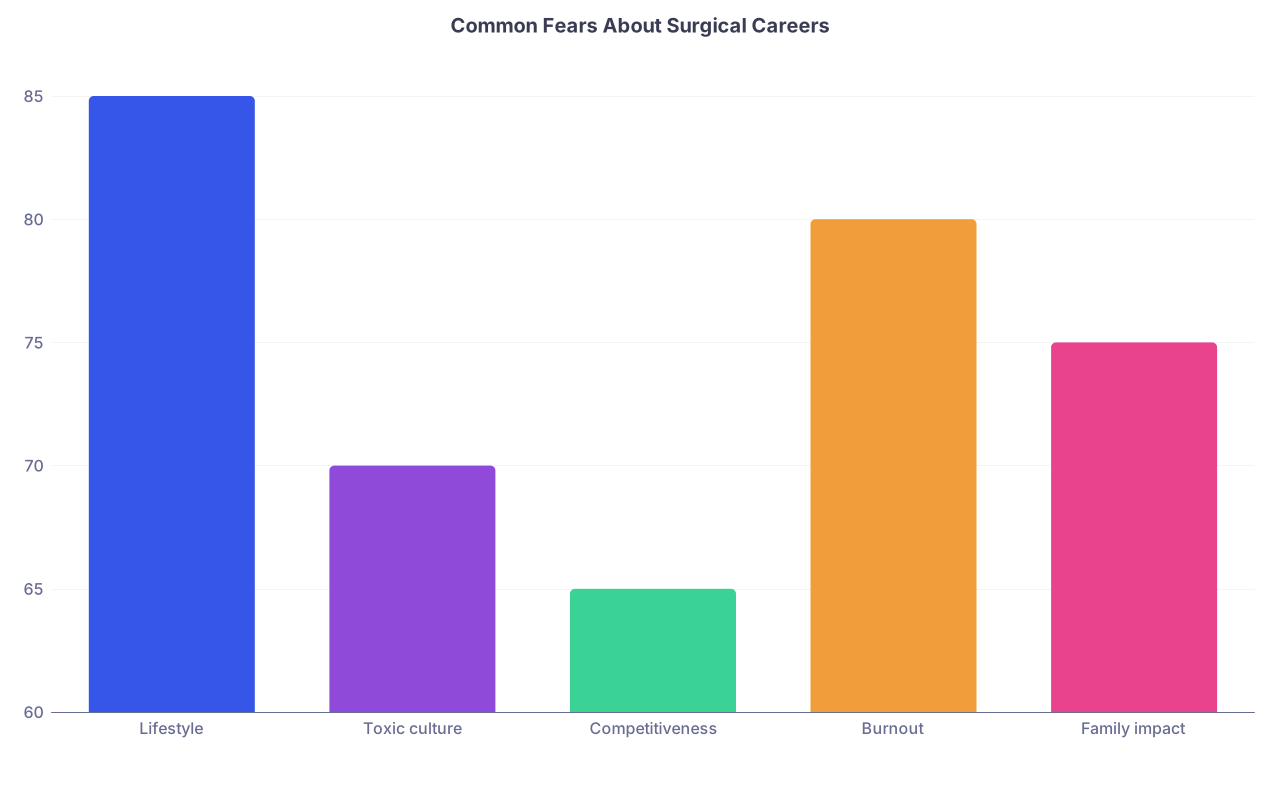
| Category | Value |
|---|---|
| Lifestyle | 85 |
| Toxic culture | 70 |
| Competitiveness | 65 |
| Burnout | 80 |
| Family impact | 75 |
These aren’t rare worries. This is basically the default mental state of any MS3 who enjoyed their surgery rotation but isn’t a robot.
How Bad Is Surgical Lifestyle Actually?
Here’s the annoying truth: it depends. On specialty, program, culture, and what stage you’re in (resident vs attending).
But you want numbers, not vibes. So here’s a rough, honest comparison.
| Stage / Role | Gen Surg Resident | Ortho Resident | ENT Resident | IM Resident | Outpt IM Attending |
|---|---|---|---|---|---|
| PGY1–2 | 70–80 | 70–85 | 65–80 | 60–70 | — |
| PGY3–5 | 65–80 | 70–80 | 60–75 | 55–65 | — |
| Early Attending Years | 55–70 | 55–70 | 50–65 | 45–55 | 35–45 |
Are there programs that routinely break 80 hours? Yes. Do some residents still feel like they’re at 90 even when the official average is 75? Also yes. Does every surgery resident live a permanently miserable existence? No.
Three things people conveniently forget when they tell the war stories:
Residency is not forever.
Those brutal years are a finite phase. Painful, yes. Permanent, no.There’s huge variation by program.
I’ve seen gen surg residents who are constantly dying, and others who are tired but functional humans with hobbies and partners who don’t hate them.Attending life is a completely different animal.
You can structure your life much more once you’re out. Call schedule, practice setting, academic vs private, employed vs partner — these all change the lifestyle dramatically.
But that still leaves the ugly part: training is objectively rougher in surgery than in many non‑procedural fields. You’re not imagining that.
The “Competitive” Part: Are You Setting Yourself Up to Fail?
You’re probably not just scared of the lifestyle. You’re scared of spending years chasing something you’re statistically not going to match into.
Here’s the part people like to sugarcoat. I won’t.
| Specialty | Category | Relative Competitiveness* |
|---|---|---|
| General Surg | Surgical | High |
| Ortho | Surgical | Very High |
| Plastics (int) | Surgical | Extreme |
| ENT | Surgical | Very High |
| Derm | Non-surgical | Extreme |
| IM | Non-surgical | Low–Moderate |
*Relative vs other specialties, not a literal score.
So yeah, if you’re thinking ortho, ENT, plastics, neurosurg — you’re signing up for:
- Higher average Step 2 scores
- Stronger expectation of research
- Smoother letters (ideally from surgeons)
- Needing to look like you “fit” the field
And here’s where your brain jumps straight to: “If I go for this and fail, I’ve wasted everything. I’ll be the cautionary tale.”
But let me say something very direct:
Not matching into a competitive surgical field is not career death. It feels like it from inside med school because no one talks about the “plan B” people without sounding pitying. On the ground, a lot of them end up in solid, meaningful careers — anesthesia, EM, IM subspecialties — and are fine. Some are even relieved.
The real career‑ruining move isn’t trying for surgery.
It’s not having a realistic backup and then emotionally imploding if things don’t go your way.
How Much Fear Is “Normal” vs a Red Flag?
This is the part no one explains clearly.
It’s not: “If you’re scared, surgery isn’t for you.” That’s lazy and wrong.
The more honest breakdown:
You’re in a reasonable fear zone if:
- You loved parts of the OR but felt exhausted on your rotation
- You’re anxious about hours, but you can imagine tolerating 5 hard years for a career you love
- You worry about matching, but you’re willing to work, get honest feedback, and adjust your plans
- You care about your mental health and want to protect it, but you’re not already at a breaking point
You’re in a danger zone if:
- You’re already burned out in med school, barely hanging on emotionally
- The idea of 60+ hour weeks doesn’t just scare you — it makes you physically sick
- You need a lot of structure, predictability, and sleep to stay functional
- Your support system is shaky, or you don’t have one, and you know you spiral badly under stress
- You hated the day‑to‑day of inpatient life but are clinging to the idea of “being a surgeon” as a status or identity thing
You don’t have to decide today. But you do have to be honest with your actual nervous system, not the idealized “future heroic surgeon” version of you.
What You Can Do Now If You’re On the Fence
Here’s the part where your brain usually goes: “I don’t have enough information. I’ll just spin and panic about it for another year.”
Let’s not.
Here’s what I’d actually push you to do over the next 2–4 weeks:
Talk to at least two current residents in the surgical field you’re considering.
Not just the happy Instagram chief. Ask:- “What’s a bad week look like for you?”
- “How many of your co‑residents are actually happy?”
- “If you could go back, would you pick this again?”
- “What do people in your program who struggle usually struggle with?”
Ask someone you trust to honestly assess your competitiveness.
An advisor, PD, or surg faculty who has actually sat in ranking meetings. Not your class group chat. Get specific: “If I wanted ENT / ortho / gen surg, where do you think I stand right now and what would I need to shore up?”Do a brutal self‑audit of your own limits.
Not aspirational. Real. Think back to:- Your busiest clerkship month
- The worst exam + call combo you’ve had
- Times you almost broke in pre‑clinical How did you actually function? Sleeping 4–5 hours for days? Losing it emotionally? Did you recover fast or slow?
Actively taste 1–2 non‑surgical options you’d actually consider as Plan B.
Not as consolation prizes — as real careers. Cards, GI, EM, anesthesia, critical care, rad, etc. You’ll calm down a lot once your brain realizes, “Oh. There are multiple futures I could live with.”
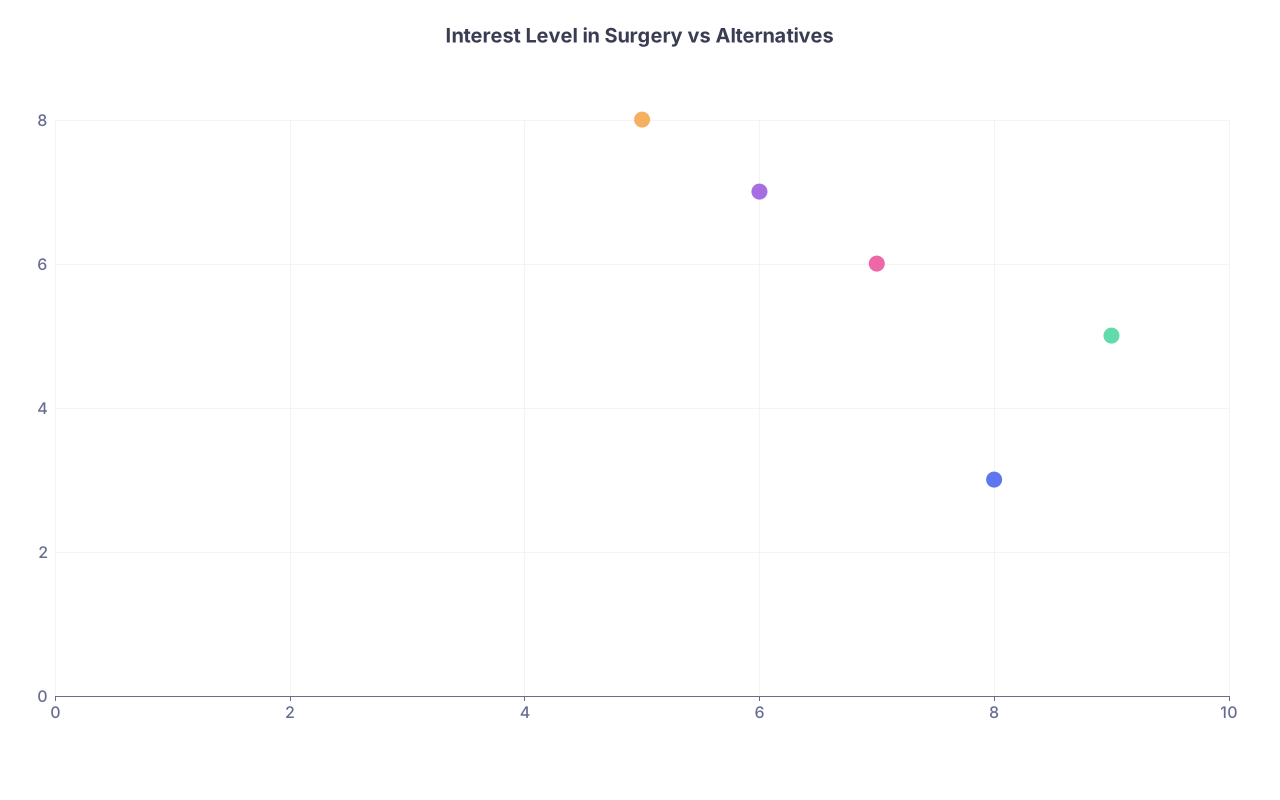
| Category | Value |
|---|---|
| Student A | 8,3 |
| Student B | 6,7 |
| Student C | 9,5 |
| Student D | 5,8 |
| Student E | 7,6 |
(Each point is someone’s interest in surgery vs interest in their favorite non‑surgical option, both 1–10. Most people aren’t at 10/0. They’re somewhere in the messy middle. Like you.)
The Ugly Truth: You Will Sacrifice Something
One of the more toxic myths is: “If you just find the right fit, you can have it all.” No.
You can have a good life in surgery, but it will cost you things. Flexibility. Some evenings. Maybe some hobbies that don’t survive training. A certain kind of spontaneity.
But you also sacrifice things by not doing surgery if it’s what you’re pulled toward. There’s a different kind of quiet, chronic regret that shows up around PGY3–4 for some folks: “Did I dodge a bullet, or did I sell myself short?”
Here’s the question that’s actually worth sitting with:
If both paths are hard — the surgery path and the non‑surgery path — which “hard” are you more willing to live with?
- The hard of long hours, OR days, call, and high expectations
- Or the hard of occasionally wondering “What if I’d tried?” while doing something you maybe like, but don’t love?
There isn’t a universally right answer here. There’s just what you personally can live with at 2 a.m. ten years from now.
A Harsh but Kind Reframe
You’re scared of surgery because you’re imagining it as an all‑or‑nothing bet:
- If you do it and suffer, you’ve ruined your life.
- If you don’t do it, you’ve failed your potential.
Both of those are dramatic, and your anxiety loves them.
Reality is messier and, honestly, kinder:
- People go into surgery, suffer, and adjust: switch programs, switch fields (rare but happens), rearrange values, or learn boundaries as attendings.
- People aim for surgery, don’t match, do a prelim year, pivot to something else and end up fine.
- People walk away from surgery early and end up deeply satisfied in another specialty they didn’t even notice at first.
Medicine is not a one‑shot game unless you decide to treat it that way.
If you’re drawn to a competitive surgical specialty, your fear doesn’t disqualify you. It just means you need to:
- Be honest about your limits
- Be strategic about your application
- Be humble enough to build a real backup
- And be brave enough to accept tradeoffs either way
That’s it. Not magical. Just very emotionally expensive.
FAQ (Exactly 6 Questions)
1. If I’m already anxious and prone to burnout, is surgery automatically a bad idea?
Not automatically, but it’s a serious yellow flag. You need to look at how you function under chronic stress, not short sprints. If your baseline in clerkships was: constant anxiety, insomnia, crying multiple times a week, and needing long recovery after each rotation — I’d be cautious about any high‑intensity inpatient field, especially competitive surgery. Could you still do it? Maybe. But it will be an uphill battle, and you’d need strong support, therapy, boundaries, and a very non‑malignant program. Don’t ignore that data.
2. What if I’m only interested in one specific surgical field (like plastics or ENT)?
That’s high‑risk mentally. The narrower your “acceptable” outcome, the more pressure you put on yourself. For something like plastics (especially integrated), you should assume it’s a lottery even with a strong app. If you’re only willing to be happy in that one field, you’re setting yourself up for catastrophe thinking. Better approach: decide whether you like “being surgical” broadly. If yes, consider whether you’d genuinely be okay with gen surg, ENT, or another related field as an alternative. If the answer is a hard no, you might be more in love with the idea of that specialty than the actual day‑to‑day.
3. Do all surgical residents hate their lives during training?
No. Some are legitimately miserable. Some are tired but content. Some actually love it and thrive. The pattern I’ve seen: people who knew what they were getting into, chose good‑fit programs, and had realistic expectations cope much better. The ones who went in thinking they’d be the exception to all struggle, or who ignored red flags about program culture because of “prestige,” tend to crash harder. You’ll always be tired. You don’t have to always be destroyed.
4. How do I know if I “love surgery enough” to justify the lifestyle?
Watch yourself on service. Compare your energy on surgery days vs other rotations. Do you feel more alive in the OR, even when exhausted? Do you find yourself wanting to scrub back in instead of running out the door at 5 p.m.? Do complications and tough cases scare you and fascinate you? That pull matters. If most of your motivation is external — prestige, money, identity — and not that internal pull toward the work itself, the tradeoff usually doesn’t feel worth it long‑term.
5. What if my scores and CV are “mid” — should I still try for a competitive surgical specialty?
You can, but you need ruthless realism. Talk to advisors and surgeons who will actually tell you the truth. Maybe that means broadening the range of programs and locations you apply to. Maybe it means strengthening research, taking a dedicated research year, or building an ironclad parallel plan (like applying to gen surg and your dream subspecialty, or gen surg vs anesthesia/IM). The disaster scenario isn’t “I tried and didn’t match.” It’s “I tried with no plan B, ignored warning signs, and now I’m emotionally wrecked.”
6. What’s one concrete thing I can do today to get clarity about surgery?
Message one surgical resident — gen surg, ortho, ENT, whatever you’re considering — and ask for 20 minutes to talk specifically about lifestyle and regret. Not “advice,” not “how to match.” Just: “What does a bad week look like?” and “Would you choose this again?” That conversation will do more to ground your decision than another 5 hours of spiraling on Reddit.
Open your calendar right now and block 30 minutes this week to talk to a real surgical resident about their worst weeks and whether they’d do it again — and promise yourself you’ll actually listen to how your body feels hearing their answers.