
What if I told you that plenty of people match into derm, ortho, plastics, ENT, urology, and neurosurgery after deciding late—and that the “you’re already behind” chorus is mostly noise?
Let’s dismantle this.
You’ve heard the script. “If you don’t have a derm mentor by October of MS1, forget it.” “If you’re not scrubbing ortho cases by MS2, you’re done.” “No research by first summer? Say goodbye to ENT.”
Sounds authoritative. Also wrong. Or at least badly oversimplified.
The truth is less sexy: there are windows, not single hard deadlines. And different schools, applicants, and specialties play by slightly different clocks. The problem is people repeat the most extreme timelines as if they’re universal law.
Let me walk you through what the data and real match stories actually show.
The Origin of the “MS2 or Bust” Myth
This myth comes from three places:
Gun gunners with megaphones
The earliest, most organized students talk the loudest. The MS1 who already “knows” they want ortho, joined three research projects before anatomy finished, and has a Step 1 study plan color-coded? They’re not representative. But they’re visible. And they’re loud on Reddit.Advisors using worst‑case benchmarks
Some advisors quietly think: “If I set a ridiculously early timeline, maybe they’ll at least land in a safe middle.” So they say, “You really need to know by MS2.” It’s not a data-based cutoff. It’s paternalistic sandbagging.Programs escalating expectations in aggregate
Over years, competitive specialties have raised bars: more research, more “commitment,” more letters. That gets simplified into “START ASAP OR DIE.” Which is lazy translation of a more nuanced reality: earlier helps, but later is still viable if you compensate.
Here’s the key: most students are not actually “late” when they think they are. They’re just comparing themselves to the no‑life subset who peaked in high school and never stopped.
What the Data Actually Says (Not What Your Class Group Chat Says)
No, there’s no magical NRMP line saying “decide by March of MS2 or perish.” But there are numbers about how late applicants decide and still match.
Let’s break down three big levers that matter for competitive specialties:
- When you start specialty‑specific research
- When you do sub‑Is / away rotations
- When you secure strong letters
And when people actually decide.
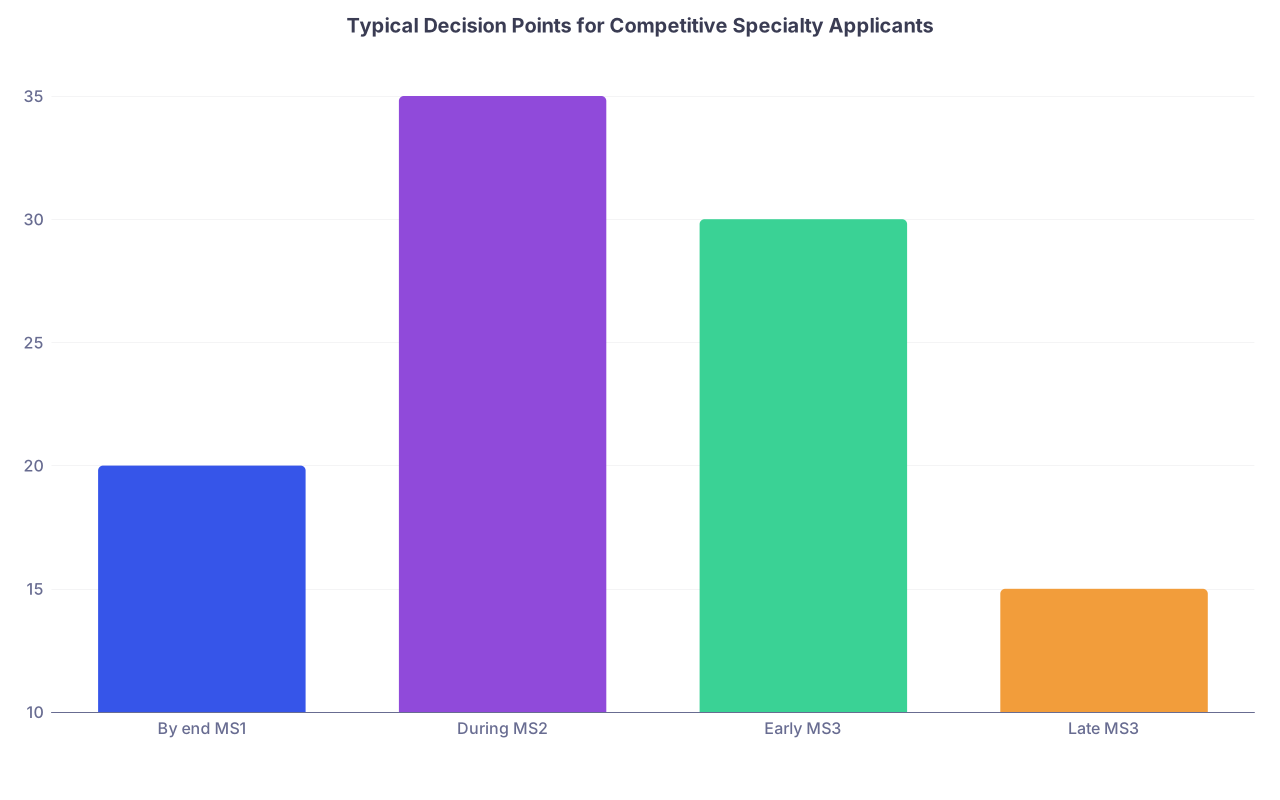
| Category | Value |
|---|---|
| By end MS1 | 20 |
| During MS2 | 35 |
| Early MS3 | 30 |
| Late MS3 | 15 |
That’s a rough, realistic distribution I’ve seen reviewing applicant pools and talking to PDs: a solid chunk decide during MS2, plenty during early MS3, and a non-trivial number even later. The MS1 deciders are the minority, not the standard.
Specialty by Specialty: How Late Is Actually Too Late?
Let’s go through the “scary” fields and be explicit.

Dermatology
Myth: If you’re not in derm research by MS1 summer, forget it.
Reality:
Derm is research-heavy, yes. But I’ve seen people decide derm mid‑MS3, pivot, hustle into 1–2 decent projects, take a research year if needed, and match into solid programs.
The tougher truth is this: derm rarely forgives weak Step 2 + no research + late decision. But late decision plus strong Step 2, good home letters, and 6–18 months of research? Very doable.
Late-ish but realistic derm path:
- Decide: late MS2 or early MS3
- Start / intensify derm research: immediately
- If needed, plan a dedicated research year between MS3 and MS4
- Do a home derm rotation + 1–2 aways during 4th year
Orthopedic Surgery
Myth: If you’re not in the ortho interest group by October MS1, you’re out.
Reality:
What ortho programs care about:
- Step 2 (or now strong clinical performance + shelf scores)
- Satisfied PD that “this person loves ortho and can tolerate misery”
- Some research, but orthopedic-flavored research is a bonus, not an absolute must
You can realistically decide during MS3 after your surgery clerkship and still make a credible ortho application, if you:
- Find an ortho mentor quickly
- Get on a project or two (even case series / retrospective chart reviews)
- Do a strong home ortho sub‑I
- Add 1–2 aways where you can shine
Where you really get in danger is deciding after away season (like September of 4th year). At that point, you’ve missed the main display window.
ENT (Otolaryngology)
ENT has been getting more competitive, so the myth machine is louder.
Reality:
- ENT is definitely not “decide February of 4th year” friendly.
- But “must decide by MS2” is false. Early MS3 is still realistically in the game.
You’ll need:
- At least 1–2 ENT‑related projects
- A couple of strong ENT letters (home + away)
- Good showing on relevant rotations (surgery, ENT elective/sub‑I)
So if you fall in love with ENT during your surgery rotation (typical), you’re not automatically doomed. You just need to move with urgency, not panic.
Plastic Surgery (Integrated)
This one is brutal. Let’s be honest.
Myth: If you didn’t choose plastics before you picked your college major, it’s over.
Reality:
You can come in later than the gunners, but integrated plastics is one of the few fields where an earlier decision genuinely helps a lot.
Realistic late-ish scenarios:
- Decide: late MS2
Still very workable if your school has plastics faculty. You line up a mentor, start research, and target a sub‑I + away(s). - Decide: mid MS3
Now you’re often in “need a research year” territory unless you already have a strong research foundation in a related area (surgery, hand, wound healing).
Here, the “MS2” thing is closer to a soft truth: not because programs wrote a rule, but because you need time for production—papers, presentations, letters from people who know you.
Neurosurgery
Very similar to plastics but with a slightly wider window.
Real stories I’ve seen:
- Student decides neurosurgery after loving their neuro rotation during MS3.
- They already have a strong academic background and maybe some basic science research.
- They grab a neurosurgery mentor quickly and stack clinical and QI projects.
- They sometimes take a research year, sometimes not, and match fine.
Again, late MS2 or early MS3 is not “too late.” But if you wake up in Q4 of MS3 and decide neurosurg with zero related work? You’re probably looking at a research year if you’re serious.
Urology
Urology has moved toward preference signaling and earlier application cycles in some years. That’s what scares people.
Still:
- Deciding during MS2? You’re fine.
- Deciding early MS3? Still absolutely viable.
You need:
- A urology mentor
- Some exposure (elective, sub‑I)
- Good letters
- Ideally a project or two (not always mandatory at community-heavy programs)
What kills you is not “deciding in MS3,” it’s “deciding in MS3 and then doing nothing substantial about it.”
The Real Deadlines That Actually Matter
Let’s separate noise from actual constraints.
| Specialty | Safest Latest Decision Point | Often Needs Research Year if Later |
|---|---|---|
| Dermatology | Early MS3 | Yes |
| Ortho | Mid MS3 | Sometimes |
| ENT | Early MS3 | Sometimes |
| Plastics (Integrated) | Late MS2 | Frequently |
| Neurosurgery | Early MS3 | Sometimes |
These are not commandments. They’re “If you decide by this point, you still have a clear path without needing extra years” estimates based on what I’ve seen and what PDs tell applicants privately.
Here are the actual hard-ish constraints you run into:
Letter-writing window
Faculty need time to see you, work with you, then write letters. If you decide after most senior rotations are scheduled, you may not have a clean way to get 3–4 relevant letters.Away rotation calendars
VSLO slots fill up. If you decide in, say, July of MS4 that you now love ENT, many aways are already spoken for. You might get one spot if you’re lucky.Application opening / ERAS deadlines
You want some specialty-specific work completed before you submit, not in progress with nothing tangible.Research is slow
Clinical research can be measured in months from idea to submission. Basic science, much longer. If you have zero previous research, a late decision means you’ll probably have “submitted” or “in preparation” more than “accepted.” That’s not fatal, but it’s a limitation.
Those are the constraints. Not a cosmic MS2 cliff.
Late Decision ≠ Dead; It Just Changes Your Strategy
The real question is never “Am I too late?” It’s “Given when I decided, what levers can I still realistically pull?”
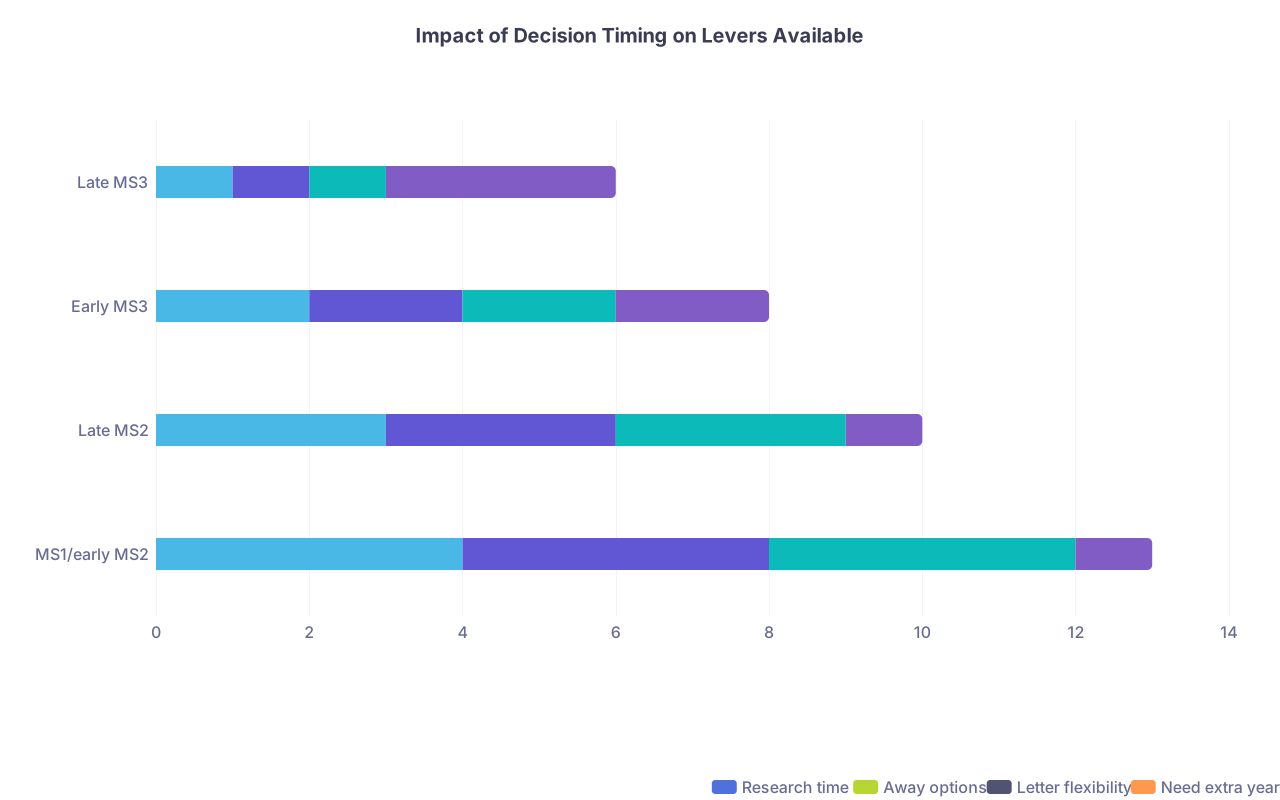
| Category | Research time | Away options | Letter flexibility | Need extra year |
|---|---|---|---|---|
| MS1/early MS2 | 4 | 4 | 4 | 1 |
| Late MS2 | 3 | 3 | 3 | 1 |
| Early MS3 | 2 | 2 | 2 | 2 |
| Late MS3 | 1 | 1 | 1 | 3 |
Scoring is conceptual, but the pattern is real: earlier = more optionality, not binary yes/no.
If you’re “late” by Reddit standards:
- Maximize clinical performance: Honors on core rotations, strong comments. PDs still care a lot about “would I trust this person at 2 a.m.”
- Make every rotation audition-like once you decide. People underestimate how much a glowing letter from a home attending can compensate for fewer publications.
- Choose fewer, deeper projects over a flurry of shallow nonsense. One completed, presented project with you as first or second author beats five vaporware “I helped” lines.
- Use a research year strategically if needed. It’s not failure. For plastics/derm/neurosurg, it is often simply the actual standard, not the exception.
The Hidden Risk of “Decide by MS2”: Lock-in and Regret
Nobody talks enough about the cost of locking yourself into a specialty at 23 based on what you saw on Instagram, then spending five years trying to love a career that objectively does not fit you.
The push to decide by MS2 has side effects:
- Students latch onto a “competitive” label for ego reasons, not fit.
- They ignore red flags during rotations (“I hated that week in clinic”).
- They burn time and sanity on research that doesn’t serve them because they’re chasing prestige, not their own career.
I have seen:
- An “ortho or die” MS1 who finally did psych in MS3, lit up like a different human being, dumped ortho, matched psych, and is now actually happy.
- A derm‑bound student who realized during medicine that they loved sick inpatients and procedures and switched to cards / interventional.
- A would-be neurosurgeon who discovered they liked neurology plus a life, went into neuro with plans for neurocritical care.
You know what they all had in common? They decided later than MS2. And thank God.
The real tragedy is not “I decided at the start of MS3.” The real tragedy is I never allowed myself to change my mind once I’d built an identity around a specialty I barely understood.
How to Sanely Approach Competitive Specialties Without the Fake Deadlines
If you want a simple frame, use this:
- MS1: Explore. Shadow a bit. Join an interest group if you like. But your main job is to pass and learn how to learn. If research falls in your lap, great. If not, no one cares yet.
- MS2: Start narrowing what truly repels you vs. what you might enjoy. If you’re leaning competitive, sure, start dipping into research. But you’re not behind if you don’t have a 10‑paper PubMed page.
- Early MS3: Now your experiences carry weight. How do you feel about surgery hours, clinic flow, inpatient chaos? This is your best time to choose. If you lean competitive now, this is when urgency is justified.
- Late MS3: Here, timing strategy matters. You may need:
- A research year in the most crowded fields (plastics, derm)
- Very targeted letters and aways
- Or to honestly decide that a “second‑tier competitive” or less brutal specialty better matches your timeline and sanity
For the chronically anxious: “But what if I’m already behind?”
Then you focus on what is still under your control and stop looking sideways. All comparison will do now is paralyze you.
FAQs
1. I’m late MS2 and just decided on a competitive specialty. Am I screwed?
No. You’re in the “need to be intentional” zone, not the doomed zone. Get a mentor in that specialty this month, ask what’s realistic for timelines at your school, and prioritize: clinical excellence, one or two meaningful projects, and a clear plan for sub‑Is/aways. For derm/plastics, start mentally preparing that a research year might be your best strategic move, not a shameful delay.
2. Do I absolutely need a research year for derm/plastics/neurosurgery if I decide after MS2?
Not automatically. If you’re at a research-heavy institution, have prior work (even in another field), and move aggressively, you may assemble a competitive portfolio without a full extra year. But if you’re at a smaller place with limited specialty faculty, or your CV is thin, a research year becomes the most efficient way to close the gap. Think of it as buying time and legitimacy in a crowded market.
3. I didn’t do any research in MS1/MS2. Can I still match a competitive specialty?
Yes, especially in ortho, ENT, urology, and sometimes neurosurgery. You’ll need to compress research into MS3/MS4 or a research year, and you can lean harder on strong clinical evaluations and letters. Plenty of matched residents had zero MS1 research because they were focused on passing and adjusting to med school. What matters is what you do from the moment you decide onward.
4. How many specialty-specific publications do I “need” to be competitive?
There is no magic number, and anyone who tells you “you need 5” is making it up. PDs look at trajectory and role: Did you take initiative? Did you see projects through? One first‑author paper or major poster where you clearly led can impress more than five meaningless middle‑author entries from data‑drone work. The hyper‑stacked CVs you see online are often from people at powerhouse institutions with built‑in pipelines. That’s not the standard everywhere.
5. Is it better to aim lower (less competitive specialty) than risk not matching my dream field?
This is a values question, not just a data question. If you’re willing to take a research year, apply broadly, and have a hard‑headed backup plan, going for the dream is reasonable. If the thought of not matching at all terrifies you more than the idea of doing a non‑dream but still decent specialty, then be strategic: maybe target a related but less cutthroat field. What’s misguided is making this choice purely out of fear stoked by fake MS2 deadlines, without an honest look at your actual scores, work ethic, and tolerance for uncertainty.
Key points:
- “You must decide by MS2” is a myth. Earlier gives you more options, not a binary pass/fail outcome.
- The real constraints are letters, aways, research runway, and ERAS timing—not some mystical second‑year cutoff.
- A later, well‑considered decision with focused action beats an early, ego-driven commitment that you’re too afraid to question.